Results by title
808 books match the query 'Drama' and 20 start with g

Gavin Bolton's Contextual Drama
The Road Less TravelledMargaret R. Burke
Intellect Books, 2013
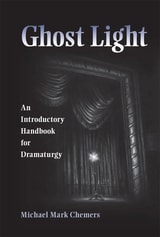
Ghost Light
An Introductory Handbook for DramaturgyMichael Mark Chemers
Southern Illinois University Press, 2010
Ghost Light: An Introductory Handbook for Dramaturgy offers useful and entertaining answers to the confounding questions: “What, exactly, is dramaturgy, and what does a dramaturg do?” According to Michael Mark Chemers, dramaturgs are the scientists of the theater world—their primary responsibility is to query the creative possibilities in every step of the production process, from play selection to costume design, and then research the various options and find ways to transform that knowledge into useful ideas. To say that dramaturgs are well-rounded is an understatement: those who choose this profession must possess an acute aesthetic sensibility in combination with an extensive knowledge of theater history and practice, world history, and critical theory, and they must be able to collaborate with every member of the creative team and theater administration.
Ghost Light is divided into three sections. Part 1, “Philosophy,” describes what dramturgs do, presents a detailed history of dramaturgy, and summarizes many of the critical theories needed to analyze and understand dramatic texts. “Analysis” teaches the two essential skills of a dramaturg: reading and writing. It includes a “12-step program for script analysis” along with suggestions about how to approach various genres and play structures. “Practice,” the third part, delves into the relationships that dramaturgs forge and offers useful advice about collaborating with other artists. It also includes ideas for audience outreach initiatives such as marketing and publicity plans, educational programs, talkbacks, blogs, and program notes and lobby displays, all of which are often the responsibility of the dramaturg.
Ghost Light was written with undergraduate students in mind and is perfectly suited for the classroom (each chapter concludes with a series of practical exercises that can be used as course assignments). However, dramaturgy is a skill that is essential to all theater practitioners, not just professional or aspiring dramaturgs, making Ghost Light a valuable addition to all theater libraries.
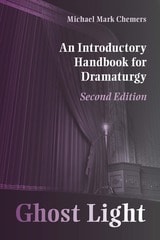
Ghost Light
An Introductory Handbook for DramaturgyMichael Mark Chemers, with a foreword by Faedra Chatard Carpenter
Southern Illinois University Press, 2023
Since its release in 2010, Ghost Light: An Introductory Handbook for Dramaturgy has become the international standard for dramaturgy training and practice. The first textbook introduced students to the “ghost light” model of dramaturgy—a creatively engaged, artistically vibrant approach that draws on extensive knowledge of theatre history, practice, and theory—and this second edition brings the conversation up to the present.
Over three parts, author and theory creator Michael Mark Chemers helps students explore the world of the dramaturg. Part 1 describes what dramaturgs do, presents a detailed history of dramaturgy, and summarizes many of the critical theories needed to analyze and understand dramatic texts. Part 2 teaches students to read, write, and analyze scripts through a twelve-step program with suggestions about how to approach various genres and play structures. The final part delves into the relationships dramaturgs forge and offers useful advice about collaborating with other artists. It also includes ideas for audience outreach initiatives such as marketing and publicity plans, educational programs, program notes and lobby displays, and more.
Perfectly suited for the undergraduate theatre classroom, this holistic guide includes chapter exercises for students to practice the skills as they learn. The new edition also incorporates recent theory and new resources on multimedia performance and dramaturgy in the digital age. As the field of dramaturgy continues to shift and change, this new edition of Ghost Light: An Introductory Handbook for Dramaturgy prepares theatre students and practitioners to create powerful, relevant performances of all types.
Ghosts
Death’S Double And The Phenomena Of TheatreAlice Rayner
University of Minnesota Press, 2006
In Ghosts, Alice Rayner examines theatre as a memorial practice that is haunted by the presence of loss, looking at how aspects of stagecraft turn familiar elements into something uncanny. Citing examples from the works of Shakespeare, Beckett, and Suzan-Lori Parks as well as the films Vertigo, Gaslight, and The Sixth Sense, she begins by describing time as it is employed by theatre with multiple aspects of presence, duration, and passage. Suggesting that objects connect past to present through the sense of touch, she explores how props are suspended backstage between motion and meaning. Her final chapters consider the curtain as theatre’s means for attempting to divide real and imaginary worlds.
If ghosts hover where secrets—secrets of the past, secrets from oneself, secrets of life and death—are kept, then, according to Rayner, “theatre is where ghosts best make their appearances and let communities and individuals know that we live amid secrets hiding in plain sight.”
Alice Rayner is associate professor of drama at Stanford University and author of, most recently, To Act, To Do, To Perform: Drama and the Phenomenology of Action.
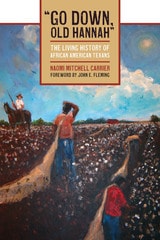
Go Down, Old Hannah
The Living History of African American TexansBy Naomi Mitchell Carrier
University of Texas Press, 2010
Living history is a style of instructive and entertaining performance that seeks to bring history to life with the use of costumes, tools, and reenactments appropriate to a specific time period. Done well, living history performances illuminate human experience in powerful, unforgettable ways.
The fifteen living history plays in this collection were commissioned by museums and historic sites in Texas to show the interdependence of African American experiences and contributions to the living history of Texas. The plays cover subject matter ranging from slave celebrations, family breakups, and running away, to the Civil War, emancipation, and Reconstruction. Each play is research based and performed by Talking Back Living History Theatre as a festival production. These scripts are easily performed, and author Naomi Mitchell Carrier has included production notes in the overviews that precede each play. Lesson plans are also included, which add to the collection's appeal as a classroom tool.
Carrier's talent for bringing historical figures to life is exceptional. The names of most primary characters in these plays are real. By giving them faces, feelings, intelligence, and dignity, Carrier aims to give them new life.
Gogol
Plays and Selected WritingsNikolai Gogol
Northwestern University Press, 1994

Good Woman Of Setzuan
Bertolt Brecht
University of Minnesota Press, 1999

Grace
A PlayCraig Wright
Northwestern University Press, 2012
The difference between belief and knowledge and the consequences of mistaking one for the other are at the heart of Craig Wright’s play Grace. An evangelical Christian couple, Sara and Steve, leave a dreary life in Minnesota for sunny Florida and the hope of fast money from turning abandoned hotels into a chain of gospel-themed inns. Their new neighbor, Sam, is struggling to emerge from the trauma of a car accident that killed his fiancée and left him badly maimed. And the building’s pest exterminator, Karl, is still tormented by a dark childhood episode. As their stories converge, Wright’s characters find themselves face-to-face with the most eternally vexing questions—the nature of faith, the meaning of suffering, and the possibility of redemption. Acidly funny and relentlessly searching, Grace is a trenchant work from an immensely gifted playwright.
Grand Concourse
A PlayHeidi Schreck
Northwestern University Press, 2015
Great Lengths
Seven Works of Marathon TheaterJonathan Kalb
University of Michigan Press, 2013
"Reading this book is certainly a vigorous experience. Kalb's sense of nuance, unpredictability, and the complexity of perception brings these productions to life. He is our surrogate, our scapegoat even, enduring the length of these productions so that he can convey the essence of their power."
---Stanton B. Garner, Jr., University of Tennessee
"Jonathan Kalb takes us on a tour of monumental theater events, which flaunt the rules of economy, Aristotelian and otherwise. Kalb captures these unwieldy marathon productions by skillfully mixing personal experience and scholarly analysis. I read this engaging book in a single sitting---and came away ready to join the first theater marathon I could find."
---Martin Puchner, Harvard University
"Jonathan Kalb's Great Lengths leaps to the head of any class in theatre history. Rich with critical perspective of 'marathon' works by Peter Brook, Tony Kushner, Robert Wilson, and others, and written with panache and lucidity, Kalb's book is filled with suspense as he describes and demystifies more than the post-modern and post-dramatic haunting recent theatre. This is history as present event, embracing the Greeks, Shakespeare, and even Charles Dickens."
---Gordon Rogoff, Yale University
We know that size matters in many areas of human endeavor, but what about works of the imagination? Why do some dramatic creations extend to five hours or more, and how does their extreme length help them accomplish extraordinarily ambitious aims? In Great Lengths, theater critic and scholar Jonathan Kalb addresses these and other questions through a close look at seven internationally prominent theater productions, including Tony Kushner's Angels in America, Robert Wilson's Einstein on the Beach, and the Royal Shakespeare Company's Nicholas Nickleby. This is a book about extreme length, monumental scope, and intensive immersion in the theater in general, written by a passionate spectator reflecting on selected pinnacles of his theatergoing over thirty years.
The book's examples, deliberately chosen for their diversity, range from adapted novels and epics, to dramatic chronicles with macrohistorical and macropolitical implications, to stagings of super-size classic plays, to "postdramatic" works that negotiate the border between life and art. Kalb reconstructs each of the works, re-creating the experience of seeing it while at the same time explaining how it maintained attention and interest over so many hours, and then expanding the scope to embrace a wider view and ask broader questions. The discussion of Nicholas Nickleby, for example, considers melodrama as a basic tool of theatrical communication, and the section on Peter Brook's The Mahabharata explores the ethical problems surrounding theatrical exoticism. The chapter on Einstein on the Beach grows into a reflection on the media-age status of the much-debated Gesamtkunstwerk (or "total artwork") and a reassessment of the long avant-gardist tradition of challenging the primacy of rational language in theater. The essay on Peter Stein's Faust I + II becomes a reflection on the interpretive role of theater directors and the theatrical viability of antitheatrical closet drama. Great Lengths thus offers a remarkable panorama of the surprisingly broad field of contemporary marathon theater---an art form that diverse audiences of savvy, screen-weaned spectators continue to seek out, for the increasingly rare experiences of awe, transcendence, and sustained immersion that it provides.
Great Lengths will appeal to general readers as well as theater specialists. It situates the chosen productions in various historical and critical contexts and engages with the many lively scholarly debates that have swirled around them. At the same time, it uses the productions as springboards for wide-ranging reflections on the basic purpose and enduring power of theater in an attention-challenged, media-saturated era.
Greek Tragedies 1
Aeschylus: Agamemnon, Prometheus Bound; Sophocles: Oedipus the King, Antigone; Euripides: HippolytusEdited by Mark Griffith, Glenn W. Most, David Grene, and Richmond Lattimore
University of Chicago Press, 2013
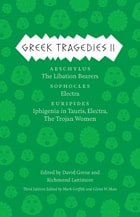
Greek Tragedies 2
Aeschylus: The Libation Bearers; Sophocles: Electra; Euripides: Iphigenia among the Taurians, Electra, The Trojan WomenEdited by Mark Griffith, Glenn W. Most, David Grene, and Richmond Lattimore
University of Chicago Press, 2013
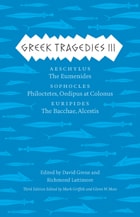
Greek Tragedies 3
Aeschylus: The Eumenides; Sophocles: Philoctetes, Oedipus at Colonus; Euripides: The Bacchae, AlcestisEdited by Mark Griffith, Glenn W. Most, David Grene, and Richmond Lattimore
University of Chicago Press, 2013
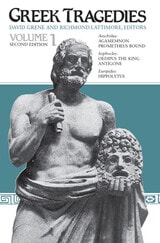
Greek Tragedies, Volume 1
Edited by David Grene and Richmond Lattimore
University of Chicago Press, 1991
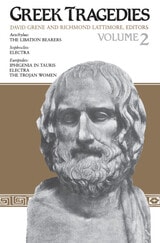
Greek Tragedies, Volume 2
Edited by David Grene and Richmond Lattimore
University of Chicago Press, 1960
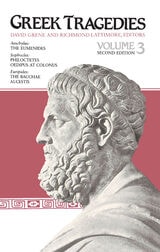
Greek Tragedies, Volume 3
Edited by David Grene and Richmond Lattimore
University of Chicago Press, 1991
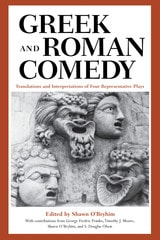
Greek and Roman Comedy
Translations and Interpretations of Four Representative PlaysEdited by Shawn O'Bryhim
University of Texas Press, 2001
Much of what we know of Greco-Roman comedy comes from the surviving works of just four playwrights—the Greeks Aristophanes and Menander and the Romans Plautus and Terence. To introduce these authors and their work to students and general readers, this book offers a new, accessible translation of a representative play by each playwright, accompanied by a general introduction to the author's life and times, a scholarly article on a prominent theme in the play, and a bibliography of selected readings about the play and playwright.
This range of material, rare in a single volume, provides several reading and teaching options, from the study of a single author to an overview of the entire Classical comedic tradition. The plays have been translated for readability and fidelity to the original text by established Classics scholars. Douglas Olson provides the translation and commentary for Aristophanes' Acharnians, Shawn O'Bryhim for Menander's Dyskolos, George Fredric Franco for Plautus' Casina, and Timothy J. Moore for Terence's Phormio.
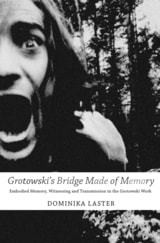
Grotowski's Bridge Made of Memory
Embodied Memory, Witnessing and Transmission in the Grotowski WorkDominika Laster
Seagull Books, 2016
Considered one of the most influential theatre practitioners of the 20th century, Polish director Jerzy Grotowski revolutionized contemporary theatre in multiple ways. Perhaps best known for his notion of ‘poor theatre,’ Grotowski went beyond the confines of conventional theatre to systematically explore the possibilities of the human being in a performative context. In Grotowski’s Bridge Made of Memory, Dominika Laster analyzes core aspects of Grotowski’s work such as body-memory, vigilance, witnessing, verticality, and transmission, arguing that these performance praxes involve a deliberate blurring of the boundaries of the self and other.
This comprehensive study traces key thematic threads across Grotowski’s research, examining lesser-known aspects of his work such as performance compositions structured around African and Afro-Caribbean traditional songs and ritual movement as well as textual material from the Christian Gnostic tradition. As an active process of research and questioning conducted through the “body-being” of the performer, Grotowski’s work represents a practical realization of the often highly theoretical and abstract discussions of one of the field’s main preoccupations: embodied practice as a way of knowing.

Guillaume Tell
Opera in Four Acts by Etienne de Jouy and Hippolyte BisGioachino Rossini
University of Chicago Press, 1992
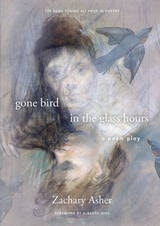
gone bird in the glass hours
a poem playZachary Asher
University of Utah Press, 2020
Winner of the 2019 Agha Shahid Ali Prize in Poetry
Zachary Asher’s second collection, gone bird in the glass hours, is a play in verse, featuring seven voices. It begins with a rabbi, bewildered and bent by personal grief, guided and beguiled by elusive Blue Postman into the world of “the glass hours” and its inhabitants.
Rooted in magical realism, gone bird in the glass hours experiments with multiple forms from epistles to centos, from fractals to prayers. These poems are brave in their excavations of grief and solace, wonder and rage, collective trauma and, ultimately, transcendence.