Results by title
6 books match the query 'Responding'
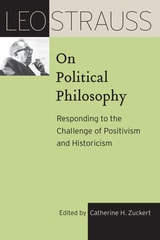
Leo Strauss on Political Philosophy
Responding to the Challenge of Positivism and HistoricismLeo Strauss
University of Chicago Press, 2018
Leo Strauss on Political Philosophy brings together the lectures that comprise Strauss’s “Introduction to Political Philosophy.” Strauss begins by emphasizing the importance of political philosophy in determining the common good of society and critically examining the two most powerful contemporary challenges to the possibility of using political theory to learn about and develop the best political order: positivism and historicism. In seeking the common good, classical political philosophers like Plato and Aristotle did not distinguish between political philosophy and political science. Today, however, political philosophy must contend with the contemporary belief that it is impossible to know what the good society really is. Strauss emphasizes the need to study the history of political philosophy to see whether the changes in the understanding of nature and conceptions of justice that gradually led people to believe that it is not possible to determine what the best political society is are either necessary or valid. In doing so, he ranges across the entire history of political philosophy, providing a valuable, thematically coherent foundation, including explications of many canonical thinkers, such as Auguste Comte and Immanuel Kant, about whom Strauss did not write extensively in his published writings.

Renaissance Postscripts
Responding to Ovid's Heroides in Sixteenth-Century FrancePaul White
The Ohio State University Press, 2009
Responding to Crisis in Contemporary Mexico
The Political Writings of Paz, Fuentes, Monsiváis, and PoniatowskaClaire Brewster
University of Arizona Press, 2005
Claire Brewster has mined direct quotations from a host of publications to illustrate the techniques that they used in combating government and editorial restraints. Brewster first addresses the Student Movement of 1968—the violent suppression of which was a watershed in the relationship between the Mexican government and people—and illustrates the ways in which the student crisis affected the writers’ relationships with presidents Luis Echeverría Alvarez and José López Portillo. She next considers the profound social and political repercussions of the 1985 earthquake as described by Poniatowska and Monsiváis and the consequent emergence of Mexican civil society. She then outlines Paz’s and Monsiváis’s vociferous responses to the 1988 presidential election campaigns and their highly contentious result, and lastly she examines the Chiapas rebellion from January to July 1994.
The eloquent Zapatista spokesman, Subcomandante Marcos, challenged Mexican writers to a duel of words, and Brewster analyzes the ways in which the four writers took up the gauntlet—and in so doing reveals the development of their political thoughts and their relationships with the Mexican people and the federal government. The work of these four authors charts an important historical era, and a close examination of their essays reveals their maturation as writers and provides an understanding of the development of Mexican society. By bringing their opinions and attitudes to light, Brewster unearths a rich lode of insight into the inner workings of Mexican intellectuals and invites observers of contemporary Mexico to reconsider their role in reflecting social change.
Responding to Rapid Change in Libraries
A User Experience ApproachLauren Stara and Callan Bignoli
American Library Association, 2020
In the face of rapid change and an ever-widening constellation of challenges, it’s crucial for library leaders to pull back to the question of “why?” Plotting a sustainable way forward depends upon recommitting ourselves to our underlying values, such as customer service and community-building, while fostering the improvements that change makes possible. With passion, patience, and fortitude, libraries can stride confidently into the future. In this book, noted speakers and consultants Bignoli and Stara speak directly to library directors, managers, administrators, and technology staff, offering concrete guidance on setting or resetting strategic priorities. Taking an interconnected and specific approach to planning for and strengthening the library environment as a whole, their book
- discusses why libraries should embrace change as a fundamental part of library life;
- explores how to harness rapid change to provide more responsive, user-centered library service;
- addresses the ways in which libraries straddle the physical and the digital, in areas such as service provision and collections, illuminating how they overlap and can be improved using similar philosophies;
- presents both a comprehensive overview of library technologies as well as related team and change management advice, all grounded in user experience principles;
- shows how the concepts of sustainability and flexibility apply to physical space planning and design, from furniture selection and arrangement to infrastructure; and
- provides sound guidance on project management, problem solving, preparing for future challenges, personal reflection and self-care, and other leadership topics.

Responding to Writing
A Practical Sourcebook for InstructorsDana R. Ferris, Grant Eckstein, and Betsy Gilliland
University of Michigan Press, 2027
Responding to Writing brings together practical, cutting-edge ideas from teachers who spend their days working with student writers and trying to make feedback genuinely useful. The book shares classroom approaches that have been tested in real courses, from high school settings to college and graduate programs. It shows how teachers, peers, and students themselves can make feedback a more collaborative and manageable part of writing instruction.
Each chapter presents a student‑centered approach that helps writers feel supported and more in control of their own writing and revision process. In addition to a summary of the approach with light background and context, readers will find straightforward examples, tools, and routines they can adapt to their own classrooms, including ways to use technology, build reflection into assignments, and support writers with varied backgrounds and needs. This book offers working instructors a set of dependable methods for helping students improve as writers while keeping feedback purposeful and humane.

Shared Mobility and Automated Vehicles
Responding to socio-technical changes and pandemicsAta M. Khan
The Institution of Engineering and Technology, 2022