Results by title
218 books match the query 'Education, Higher' and 3 start with g
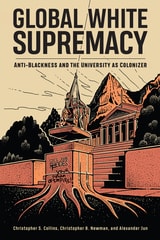
Global White Supremacy
Anti-Blackness and the University as ColonizerChristopher S. Collins
Rutgers University Press, 2023
Going Public
Civic and Community EngagementHiram E. Fitzgerald
Michigan State University Press, 2013
The terms “civic engagement” and “community engagement” have various definitions, but they are united by the sense that individuals who are civically engaged not only are concerned about the quality of life in their communities but also take action to improve conditions for the common good. In the United States, to be civically engaged means to actively participate in a civil democratic society. Going Public examines programs related to civic engagement and the ways in which faculty and students participate in communities in order to improve them. Engagement scholarship is a scholarship of action, a scholarship of practice that takes place both in and with the community. Within the framework of this new scholarship, the mission of the academy does not begin and end with intellectual discovery and fact-finding. Rather, the academy joins forces with the community, and together they use their knowledge and resources to address pressing social, civic, economic, and moral problems. Each chapter in this book tells a unique story of community engagement and the scholarship of practice in a diverse range of settings, documenting successes and failures, the unintended consequences, and the questions yet to be answered.
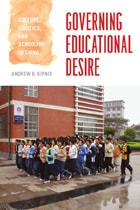
Governing Educational Desire
Culture, Politics, and Schooling in ChinaAndrew B. Kipnis
University of Chicago Press, 2011
Parents in China greatly value higher education for their children, but the intensity and effects of their desire to achieve this goal have largely gone unexamined—until now. Governing Educational Desire explores the cultural, political, and economic origins of Chinese desire for a college education as well as its vast consequences, which include household and national economic priorities, birthrates, ethnic relations, and patterns of governance.
Where does this desire come from? Andrew B. Kipnis approaches this question in four different ways. First, he investigates the role of local context by focusing on family and community dynamics in one Chinese county, Zouping. Then, he widens his scope to examine the provincial and national governmental policies that affect educational desire. Next, he explores how contemporary governing practices were shaped by the Confucian examination system, uncovering the historical forces at work in the present. Finally, he looks for the universal in the local, considering the ways aspects of educational desire in Zouping spread throughout China and beyond. In doing so, Kipnis provides not only an illuminating analysis of education in China but also a thought-provoking reflection on what educational desire can tell us about the relationship between culture and government.