Results by title
108 books match the query 'Effect of human beings on' and 3 start with g

Gardeners of Eden
Rediscovering Our Importance to NatureDan Dagget
University of Nevada Press, 2005
Dan Dagget believes that humanity can have a positive effect on the land. He demonstrates case after case of positive human engagement in the environment and of managed ecosystems and restored areas that are richer, more diverse, and healthier than unmanaged ones. Much of pre-Columbian America, he contends, was not a pristine wilderness but an ancient garden managed over millennia by native peoples who shaped the plant and animal communities around them to the mutual benefit of all.
Dagget recommends a new kind of environmentalism based on management, science, evolution, and holism, and served by humans who enrich the environment even as they benefit from it. His new environmentalism offers hopeful solutions to the current ecological crisis and a new purpose for our human energies and ideals. This book is essential reading for anyone concerned with the earth and anyone seeking a viable way for our burgeoning human population to continue to live upon it.
Dagget recommends a new kind of environmentalism based on management, science, evolution, and holism, and served by humans who enrich the environment even as they benefit from it. His new environmentalism offers hopeful solutions to the current ecological crisis and a new purpose for our human energies and ideals. This book is essential reading for anyone concerned with the earth and anyone seeking a viable way for our burgeoning human population to continue to live upon it.
[more]

Global Environmental History
I. G. Simmons
University of Chicago Press, 2008
The global environment has been in a state of change since the height of the last glacial maximum of the Pleistocene. Examining this state of flux of both the natural environment and the living organisms that inhabit it, I. G. Simmons’s Global Environmental History ranges from 10,000 BCE to the modern day to present an incredibly rich and deep time overview of how we have come to our current state of ecological crisis.
A far-reaching approach that considers the truly global picture and recognizes the contributions of many disciplines—including the natural sciences, the social sciences, and increasingly, the humanities—Global Environmental History focuses not only on the material world but also on humans’ ideas about the planet and their place on it. Taking as his starting point the major phases of human technological evolution of the last 12,000 years, Simmons considers how these changes have affected the natural world and goes on to assess the response to conditions such as climate change. By putting today’s environmental preoccupations into a long-term perspective, Simmons reveals the history of some current anxieties.
A timely examination of the interrelation of history and nature, Simmons’s book will be welcomed by any concerned reader interested in the origins of the modern environmental crisis.
[more]
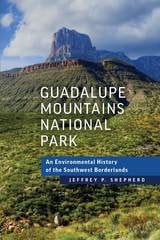
Guadalupe Mountains National Park
An Environmental History of the Southwest BorderlandsJeffrey P. Shepherd
University of Massachusetts Press, 2019
The Guadalupe Mountains stand nearly 9,000 feet tall, spanning the far western fringe of Texas, the border of New Mexico, and the meeting point of the Southern Plains and Chihuahuan Desert. Long an iconic landmark of the Trans-Pecos region, the Guadalupe Mountains have played a critical role for the people in this beautiful corner of the Southwest borderlands. In the late 1960s, the area was finally designated a national park.
Drawing upon published sources, oral histories, and previously unused archival documents, Jeffrey P. Shepherd situates the Guadalupe Mountains and the national park in the context of epic tales of Spanish exploration, westward expansion, Native survival, immigrant settlement, the conservation movement, early tourism, and regional economic development. As Americans cope with climate change, polarized political rhetoric, and suburban sprawl, public spaces such as Guadalupe Mountains National Park remind us about our ties to nature and our historical relationships with the environment.
Drawing upon published sources, oral histories, and previously unused archival documents, Jeffrey P. Shepherd situates the Guadalupe Mountains and the national park in the context of epic tales of Spanish exploration, westward expansion, Native survival, immigrant settlement, the conservation movement, early tourism, and regional economic development. As Americans cope with climate change, polarized political rhetoric, and suburban sprawl, public spaces such as Guadalupe Mountains National Park remind us about our ties to nature and our historical relationships with the environment.
[more]