Results by title
118 books match the query 'Epistemology' and 3 start with g

Gendered Agents
Women and Institutional KnowledgeSilvestra Mariniello and Paul A. Bové, eds.
Duke University Press, 1998
Gendered Agents, edited by Silvestra Mariniello andPaul A. Bové, presents essays by influential feminist theorists who challenge traditional Western epistemology and suggest new directions for feminism. By examining both literary and historical discourses, such critics as Gayatri Spivak, Hortense Spillers, and Lauren Berlant assess questions of sexuality, ethics, race, psychoanalysis, subjectivity, and identity.
Gathered from various issues of the journal boundary 2, the essays in Gendered Agents seek to transform the model of Western academic knowledge by restructuring its priorities and values. In the introduction, Mariniello urges feminists to begin anew but take as their starting place the achievements of feminism and feminist theory: an understanding of language that considers the implications of silence, the motivation to decompartmentalize experience, and the acknowledgement that everything is political. Challenging both a canonical organization of knowledge and the persistently self-referential "ghettoization" of feminism, contributors subsequently tackle subjects as diverse as pre-Marxist France, the American fetus, black intellectuals, queer nationality, and the art of literary interpretation.
Gathered from various issues of the journal boundary 2, the essays in Gendered Agents seek to transform the model of Western academic knowledge by restructuring its priorities and values. In the introduction, Mariniello urges feminists to begin anew but take as their starting place the achievements of feminism and feminist theory: an understanding of language that considers the implications of silence, the motivation to decompartmentalize experience, and the acknowledgement that everything is political. Challenging both a canonical organization of knowledge and the persistently self-referential "ghettoization" of feminism, contributors subsequently tackle subjects as diverse as pre-Marxist France, the American fetus, black intellectuals, queer nationality, and the art of literary interpretation.
Contributors. Lauren Berlant, Karen Brennan, Margaret Cohen, Nancy Fraser, Elizabeth Freeman, Carol Jacobs, Silvestra Mariniello, Larysa Mykyta, Laura Rice, Ivy Schweitzer, Doris Sommer, Hortense J. Spillers, Gayatri Chakravorty Spivak, Judith Wilt
[more]
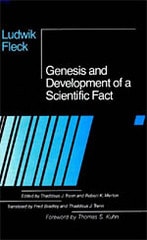
Genesis and Development of a Scientific Fact
Ludwik Fleck
University of Chicago Press, 1981
Originally published in German in 1935, this monograph anticipated solutions to problems of scientific progress, the truth of scientific fact and the role of error in science now associated with the work of Thomas Kuhn and others. Arguing that every scientific concept and theory—including his own—is culturally conditioned, Fleck was appreciably ahead of his time. And as Kuhn observes in his foreword, "Though much has occurred since its publication, it remains a brilliant and largely unexploited resource."
"To many scientists just as to many historians and philosophers of science facts are things that simply are the case: they are discovered through properly passive observation of natural reality. To such views Fleck replies that facts are invented, not discovered. Moreover, the appearance of scientific facts as discovered things is itself a social construction, a made thing. A work of transparent brilliance, one of the most significant contributions toward a thoroughly sociological account of scientific knowledge."—Steven Shapin, Science
"To many scientists just as to many historians and philosophers of science facts are things that simply are the case: they are discovered through properly passive observation of natural reality. To such views Fleck replies that facts are invented, not discovered. Moreover, the appearance of scientific facts as discovered things is itself a social construction, a made thing. A work of transparent brilliance, one of the most significant contributions toward a thoroughly sociological account of scientific knowledge."—Steven Shapin, Science
[more]
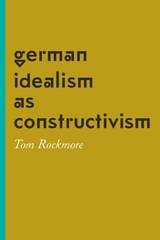
German Idealism as Constructivism
Tom Rockmore
University of Chicago Press, 2016
German Idealism as Constructivism is the culmination of many years of research by distinguished philosopher Tom Rockmore—it is his definitive statement on the debate about German idealism between proponents of representationalism and those of constructivism that still plagues our grasp of the history of German idealism and the whole epistemological project today. Rockmore argues that German idealism—which includes iconic thinkers such as Kant, Fichte, Schelling, and Hegel—can best be understood as a constructivist project, one that asserts that we cannot know the mind-independent world as it is but only our own mental construction of it.
Since ancient Greece philosophers have tried to know the world in itself, an effort that Kant believed had failed. His alternative strategy—which came to be known as the Copernican revolution—was that the world as we experience and know it depends on the mind. Rockmore shows that this project was central to Kant’s critical philosophy and the later German idealists who would follow him. He traces the different ways philosophers like Fichte, Schelling, and Hegel formulated their own versions of constructivism. Offering a sweeping but deeply attuned analysis of a crucial part of the legacy of German idealism, Rockmore reinvigorates this school of philosophy and opens up promising new avenues for its study.
Since ancient Greece philosophers have tried to know the world in itself, an effort that Kant believed had failed. His alternative strategy—which came to be known as the Copernican revolution—was that the world as we experience and know it depends on the mind. Rockmore shows that this project was central to Kant’s critical philosophy and the later German idealists who would follow him. He traces the different ways philosophers like Fichte, Schelling, and Hegel formulated their own versions of constructivism. Offering a sweeping but deeply attuned analysis of a crucial part of the legacy of German idealism, Rockmore reinvigorates this school of philosophy and opens up promising new avenues for its study.
[more]