Results by title
177 books match the query 'Equality' and 3 start with g
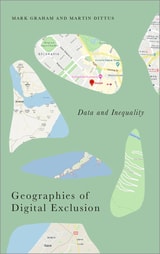
Geographies of Digital Exclusion
Data and InequalityMark Graham
Pluto Press, 2021
Today's urban environments are layered with data and algorithms that fundamentally shape how we perceive and move through space. But are our digitally dense environments continuing to amplify inequalities rather than alleviate them? This book looks at the key contours of information inequality, and who, what and where gets left out.
Platforms like Google Maps and Wikipedia have become important gateways to understanding the world, and yet they are characterized by significant gaps and biases, often driven by processes of exclusion. As a result, their digital augmentations tend to be refractions rather than reflections: they highlight only some facets of the world at the expense of others.
This doesn't mean that more equitable futures aren't possible. By outlining the mechanisms through which our digital and material worlds intersect, the authors conclude with a roadmap for what alternative digital geographies might look like.
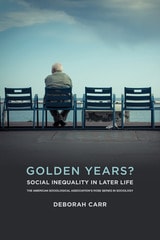
Golden Years?
Social Inequality in Later LifeDeborah Carr
Russell Sage Foundation, 2019
Carr connects research in sociology, psychology, epidemiology, gerontology, and other fields to explore the well-being of older adults. On many indicators of physical health, such as propensity for heart disease or cancer, black seniors fare worse than whites due to lifetimes of exposure to stressors such as economic hardships and racial discrimination and diminished access to health care. In terms of mental health, Carr finds that older women are at higher risk of depression and anxiety than men, yet older men are especially vulnerable to suicide, a result of complex factors including the rigid masculinity expectations placed on this generation of men. Carr finds that older adults’ physical and mental health are also closely associated with their social networks and the neighborhoods in which they live. Even though strong relationships with spouses, families, and friends can moderate some of the health declines associated with aging, women—and especially women of color—are more likely than men to live alone and often cannot afford home health care services, a combination that can be isolating and even fatal. Finally, social inequalities affect the process of dying itself, with white and affluent seniors in a better position to convey their end-of-life preferences and use hospice or palliative care than their disadvantaged peers.
Carr cautions that rising economic inequality, the lingering impact of the Great Recession, and escalating rates of obesity and opioid addiction, among other factors, may contribute to even greater disparities between the haves and the have-nots in future cohorts of older adults. She concludes that policies, such as income supplements for the poorest older adults, expanded paid family leave, and universal health care could ameliorate or even reverse some disparities.
A comprehensive analysis of the causes and consequences of later-life inequalities, Golden Years? demonstrates the importance of increased awareness, strong public initiatives, and creative community-based programs in ensuring that all Americans have an opportunity to age well.
Growth, Equality, and the Mexican Experience
By Morris Singer
University of Texas Press, 1969
Central to the research that went into the preparation of this monograph is the relationship between economic development and equality. To determine and characterize that relationship Morris Singer focuses on the various components of equality at different stages of development. The author particularly explores the behavior of income distribution, together with its bearing on the components of aggregate demand.
Mexico provided an excellent case to examine in depth because of its impressive growth and the fact that it experienced Latin America’s first successful twentieth-century revolution.
Although the Revolution of 1910 hastened social equality and introduced other changes that stimulated Mexico’s economic growth, it could not prevent a serious increase in the inequality of income distribution. By the early 1960s the government found it necessary to rectify this increasing imbalance through a program of expenditures designed to counteract widespread poverty and weak aggregate demand. To ward off inflation, this program in turn could be implemented only by tax reform.
In discussing the relationship between development and equality in its various dimensions, noneconomic as well as economic, this monograph points out that, at the time of this study, government policies in Mexico were dictated by an elite concerned primarily with the country’s economic advancement. Singer concludes that if programs of government expenditure and tax reform succeed in remedying the inequalities of income distribution, this could gradually make possible the development of a more genuine political as well as economic democracy.
This book reflects Singer’s interest in the relationship between equality and development. It is the result of five months of intensive in-residence study in Mexico, financed in part by a grant from the Social Science Research Council.