Results by title
338 books match the query 'Ethnology' and 8 start with g
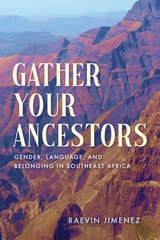
Gather Your Ancestors
Gender, Language, and Belonging in Southeast AfricaRaevin Jimenez
University of Wisconsin Press, 2026
Historically, southeasternmost Africa has been home to a large variety of speech communities, including Nguni, East Bantu, Khoi, and San—the legacy of a long and complicated history of migration, interaction, assimilation, and disaggregation between many peoples. With detailed, careful analysis, Raevin Jimenez guides readers through a thousand years of human movement, cultural contact, and social development in this region. Taking a historical linguistics approach, she sheds new light on this history by focusing on Nguni speakers’ use of gendered practices—including initiation, marriage, and avoidant speech known as hlónipha—to blend multilingual and diverse communities.
Use of gendered institutions inaugurated variable social spaces that could either elide or accommodate difference and thus enabled a multiplicity of community types. Contrary to previous assumptions about the roles of men and women in precolonial southeasternmost Africa, Jimenez shows that gender impacted life and social interactions across a large variety of important domains and became a way of forming, negotiating, and maintaining community. These developments shaped and remain visible in southeastern African speech communities today, and understanding them is vital to understanding the region’s long history and current linguistic society.
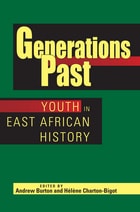
Generations Past
Youth in East African HistoryAndrew Burton
Ohio University Press, 2010
Contemporary Africa is demographically characterized above all else by its youthfulness. In East Africa the median age of the population is now a striking 17.5 years, and more than 65 percent of the population is age 24 or under. This situation has attracted growing scholarly attention, resulting in an important and rapidly expanding literature on the position of youth in African societies.
While the scholarship examining the contemporary role of youth in African societies is rich and growing, the historical dimension has been largely neglected in the literature thus far. Generations Past seeks to address this gap through a wide-ranging selection of essays that covers an array of youth-related themes in historical perspective. Thirteen chapters explore the historical dimensions of youth in nineteenth-, twentieth-, and twenty-first–century Ugandan, Tanzanian, and Kenyan societies. Key themes running through the book include the analytical utility of youth as a social category; intergenerational relations and the passage of time; youth as a social and political problem; sex and gender roles among East African youth; and youth as historical agents of change. The strong list of contributors includes prominent scholars of the region, and the collection encompasses a good geographical spread of all three East African countries.

Genetic Afterlives
Black Jewish Indigeneity in South AfricaNoah Tamarkin
Duke University Press, 2020

Genomics with Care
Minding the Double Binds of ScienceMike Fortun
Duke University Press, 2023

Geontologies
A Requiem to Late LiberalismElizabeth A. Povinelli
Duke University Press, 2016

Global Health for All
Knowledge, Politics, and PracticesJean-Paul Gaudillière
Rutgers University Press, 2022

Gods and Vampires
Return to ChipayaNathan Wachtel
University of Chicago Press, 1994
Wachtel discovered that a series of recent deaths and misfortunes in Chipaya had been attributed to the evil powers of the Urus, a group usually regarded with suspicion by the other ethnic groups. Those incarcerated were believed to be the chief sorcerers and vampires whose paganistic practices had brought death to Chipaya by upsetting the social order. Wachtel's investigation, told in Gods and Vampires: Back to Chipaya, reveals much about relations between the Urus and the region's dominant ethnic groups and confronts some of the most trenchant issues in contemporary anthropology. His analysis shows that the Urus had become victims of the same set of ideals the Spanish had used, centuries before, to establish their hegemony in the region.
Presented as a personal detective story, Gods and Vampires is Wachtel's latest work in a series studying the ongoing impact of the Spanish conquest on the Andean consciousness and social system. Its insight into Bolivian society and the legacy of hegemony confronts some of the most trenchant issues in contemporary anthropologyand will be of great interest to scholars of anthropology, Latin American studies, and Native American studies.
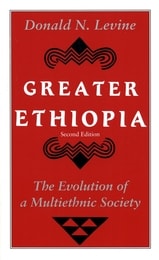
Greater Ethiopia
The Evolution of a Multiethnic SocietyDonald N. Levine
University of Chicago Press, 2000
Donald Levine's interdisciplinary study makes a substantial contribution both to Ethiopian interpretive history and to sociological analysis. In his new preface, Levine examines Ethiopia since the overthrow of the monarchy in the 1970s.
"Ethiopian scholarship is in Professor Levine's debt. . . . He has performed an important task with panache, urbanity, and learning."—Edward Ullendorff, Times Literary Supplement
"Upon rereading this book, it strikes the reader how broad in scope, how innovative in approach, and how stimulating in arguments this book was when it came out. . . . In the past twenty years it has inspired anthropological and historical research, stimulated theoretical debate about Ethiopia's cultural and historical development, and given the impetus to modern political thinking about the complexities and challenges of Ethiopia as a country. The text thus easily remains an absolute must for any Ethiopianist scholar to read and digest."-J. Abbink, Journal of Modern African Studies