Results by title
60 books match the query 'Evangelicalism' and 4 start with g
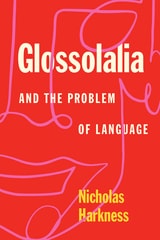
Glossolalia and the Problem of Language
Nicholas Harkness
University of Chicago Press, 2021
Speaking in tongues, also known as glossolalia, has long been a subject of curiosity as well as vigorous theological debate. A worldwide phenomenon that spans multiple Christian traditions, glossolalia is both celebrated as a supernatural gift and condemned as semiotic alchemy. For some it is mystical speech that exceeds what words can do, and for others it is mere gibberish, empty of meaning. At the heart of these differences is glossolalia’s puzzling relationship to language.
Glossolalia and the Problem of Language investigates speaking in tongues in South Korea, where it is practiced widely across denominations and congregations. Nicholas Harkness shows how the popularity of glossolalia in Korea lies at the intersection of numerous, often competing social forces, interwoven religious legacies, and spiritual desires that have been amplified by Christianity’s massive institutionalization. As evangelicalism continues to spread worldwide, Glossolalia and the Problem of Language analyzes one of its most enigmatic practices while marking a major advancement in our understanding of the power of language and its limits.
Glossolalia and the Problem of Language investigates speaking in tongues in South Korea, where it is practiced widely across denominations and congregations. Nicholas Harkness shows how the popularity of glossolalia in Korea lies at the intersection of numerous, often competing social forces, interwoven religious legacies, and spiritual desires that have been amplified by Christianity’s massive institutionalization. As evangelicalism continues to spread worldwide, Glossolalia and the Problem of Language analyzes one of its most enigmatic practices while marking a major advancement in our understanding of the power of language and its limits.
[more]
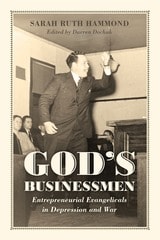
God's Businessmen
Entrepreneurial Evangelicals in Depression and WarSarah Ruth Hammond
University of Chicago Press, 2017
How evangelical businessmen in the 1930s and 1940s joined their religious and business lives.
The evangelical embrace of conservatism is a familiar feature of the contemporary political landscape. What’s less well-known, however, is that the connection predates the Reagan revolution, going all the way back to the Depression and World War II. Evangelical businessmen at the time were quite active in opposing the New Deal—on both theological and economic grounds—and in doing so claimed a place alongside other conservatives in the public sphere. Like previous generations of devout laymen, they self-consciously merged their religious and business lives, financing and organizing evangelical causes with the kind of visionary pragmatism that they practiced in the boardroom.
In God’s Businessmen, Sarah Ruth Hammond explores not only these men’s personal trajectories but also those of the service clubs and other institutions that, like them, believed that businessmen were God’s instrument for the Christianization of the world. Hammond presents a capacious portrait of the relationship between the evangelical business community and the New Deal—and in doing so makes important contributions to American religious history, business history, and the history of the American state.
[more]
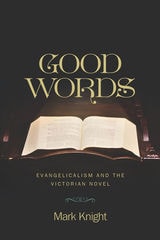
Good Words
Evangelicalism and the Victorian NovelMark Knight
The Ohio State University Press, 2019
This new study explores how evangelicalism played a vital role in the development of the Victorian novel. In contrast to those who see the evangelical movement as trivial to our histories of the novel and part of the losing side in religion’s battle with secularity, Good Words: Evangelicalism and the Victorian Novel examines fiction by major writers of the nineteenth century—Thackeray, Dickens, Wood, MacDonald, Collins, and Butler—and reveals the extent to which the novel was shaped by evangelical thought and practice.
Rather than getting lost in historical and theological rabbit holes, Good Words invites readers to think about why evangelicalism still matters for the stories we tell about fiction in the Victorian period. The result has major implications for our understanding of the Victorian novel, our conception of the relationship between nineteenth-century literature and religion, the way in which we think about evangelical culture in the modern world, and our ideas about the practices and protocols of scholarly reading.
Rather than getting lost in historical and theological rabbit holes, Good Words invites readers to think about why evangelicalism still matters for the stories we tell about fiction in the Victorian period. The result has major implications for our understanding of the Victorian novel, our conception of the relationship between nineteenth-century literature and religion, the way in which we think about evangelical culture in the modern world, and our ideas about the practices and protocols of scholarly reading.
[more]

Goodbye, My Tribe
An Evangelical ExodusVic Sizemore
University of Alabama Press, 2020
Goodbye, My Tribe: An Evangelical Exodus is Vic Sizemore’s collection of personal essays chronicling two simultaneous transformations. One is the gathering of unconnected—and nonpolitical—evangelical congregations across the nation into the political juggernaut called the Religious Right; the other is the author’s own coming to terms with the emotional and spiritual trauma of his life deep inside fundamentalist Christianity, and his struggle to free himself from its grasp. Sizemore, whose father was a preacher and professor at a small West Virginia Bible college, attended Liberty University in Lynchburg, Virginia, arguably the crucible of American evangelical Christianity.
Sizemore began writing these essays with the aim of exploring and understanding what happened when the mythology of his “tribe” crumbled from beneath his feet. He draws heavily on his upbringing and his family history as a framework for how his “tribe” of white evangelicals have found ways to reconcile Christianity with what the author finds to be troubling stances on many social issues, among them race, gender, sexuality, materialism, anti-intellectualism, and white supremacy.
In a clear-eyed and eloquent voice, Sizemore grapples movingly with his own bewilderment and chagrin as he struggles to reconcile the essential philosophical and moral decay that he believes many evangelicals have come to embrace. His insights, arranged topically and thematically and told through graceful and accessible prose, toggle between memoir and literary journalism, along a spectrum that touches on history, philosophy, theology, and personal reflections.
.
[more]