153 books match the query 'Genres' and 6 start with g
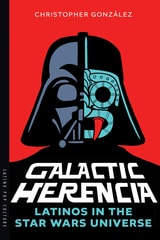
cover of Galactic Herencia: Latinos in the Star Wars Universe

Galactic Herencia

Latinos in the Star Wars Universe

Christopher González

University of Arizona Press, 2027

In 1977, George Lucas created a galaxy far, far away that somehow contained no Latinos. Forty-seven years later, Diego Luna’s Cassian Andor speaks unapologetically accented English as he leads a rebel cell against the Empire, Pedro Pascal’s Din Djarin anchors Disney’s flagship series, and Oscar Isaac’s Poe Dameron commands X-wing squadrons with a confidence that refuses to apologize for difference. The transformation didn’t happen by accident—it was fought for character by character, film by film, against resistance both corporate and cultural.

In Galactic Herencia, Christopher González uses personal, historical, and critical reflection to trace this long arc from erasure to visibility, examining how Latinx actors bring cultural resonance to roles in a fictional universe that never explicitly acknowledges their heritage—and what it means when so few performers must carry the hopes of so many. The book moves from the painful absences of the original trilogy through the breakthrough moments of Rogue One and The Mandalorian, to the current struggles over authentic representation in an era of franchise expansion and toxic fandom. By centering Latinx perspectives on a globally dominant franchise, Galactic Herencia makes visible the cultural work that representation does—demonstrating that genuine inclusion isn’t about quotas but about empowering stories that affirm our full humanity.

[more]
cover of Genres of Listening: An Ethnography of Psychoanalysis in Buenos Aires

Genres of Listening

An Ethnography of Psychoanalysis in Buenos Aires

Xochitl Marsilli-Vargas

Duke University Press, 2022
In Genres of Listening Xochitl Marsilli-Vargas explores a unique culture of listening and communicating in Buenos Aires. She traces how psychoanalytic listening circulates beyond the clinical setting to become a central element of social interaction and cultural production in the city that has the highest number of practicing psychologists and psychoanalysts in the world. Marsilli-Vargas develops the concept of genres of listening to demonstrate that hearers listen differently, depending on where, how, and to whom they are listening. In particular, she focuses on psychoanalytic listening as a specific genre. Porteños (citizens of Buenos Aires) have developed a “psychoanalytic ear” that emerges during conversational encounters in everyday interactions in which participants offer different interpretations of the hidden meaning the words carry. Marsilli-Vargas does not analyze these interpretations as impositions or interruptions but as productive exchanges. By outlining how psychoanalytic listening operates as a genre, Marsilli-Vargas opens up ways to imagine other modes of listening and forms of social interaction.
[more]
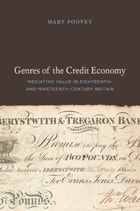
cover of Genres of the Credit Economy: Mediating Value in Eighteenth- and Nineteenth-Century Britain

Genres of the Credit Economy

Mediating Value in Eighteenth- and Nineteenth-Century Britain

Mary Poovey

University of Chicago Press, 2008

How did banking, borrowing, investing, and even losing money—in other words, participating in the modern financial system—come to seem likeroutine activities of everydaylife? Genres of the Credit Economy addressesthis question by examining the history of financial instruments and representations of finance in eighteenth- and nineteenth-century Britain.
Chronicling the process by which some of our most important conceptual categories were naturalized, Mary Poovey explores complex relationships among forms of writing that are not usually viewed together, from bills of exchange and bank checks, to realist novels and Romantic poems, to economic theory and financial journalism. Taking up all early forms of financial and monetarywriting, Poovey argues that these genres mediated for early modern Britons the operations of a market system organized around credit and debt. By arguing that genre is a critical tool for historical and theoretical analysis and an agent in the events that formed the modern world, Poovey offers a new way to appreciate the character of the credit economy and demonstrates the contribution historians and literary scholars can make to understanding its operations.
Much more than an exploration of writing on and around money, Genres of the Credit Economy offers startling insights about the evolution of disciplines and the separation of factual and fictional genres.

[more]
cover of German Ways of War: The Affective Geographies and Generic Transformations of German War Films

German Ways of War

The Affective Geographies and Generic Transformations of German War Films

Jaimey Fisher

Rutgers University Press, 2022

German Ways of War deploys theories of space, mobility, and affect to investigate how war films realize their political projects. Analyzing films across the decades, from the 1910s to 2000s, German Ways of War addresses an important lacuna in media studies: while scholars have tended to focus on the similarities between cinematic looking and weaponized targeting -- between shooting a camera and discharging a gun – this book argues that war films negotiate spaces throughout that frame their violence in ways more revealing than their battle scenes. Beyond that well-known intersection of visuality and violence, German Ways of War explores how the genre frames violence within spatio-affective operations. The production of novel spaces and evocation of new affects transform war films, including the genre’s manipulation of mobility, landscape, territory, scales, and topological networks. Such effects amount to what author Jaimey Fisher terms the films’ “affective geographies” that interweave narrative-generated affects, spatial depictions, and political processes.
 
[more]
cover of Get Real: Crafting Race in the Reality Television Industry

Get Real

Crafting Race in the Reality Television Industry

Eva Hageman

Duke University Press, 2027
In Get Real, Eva Hageman examines how race is constructed in reality television from pre-production to broadcast. Hageman foregrounds an ethnography of production practices to analyze how and why difference is developed, narrated, and cast in the modern entertainment and economic landscape. Drawing on interviews with industry professionals, cast members, and fans, Hageman teases out themes of quality, relatability, participation, and lifestyle that function as racializing mechanisms within the reality TV marketplace. Hageman also places reality television in a lineage, from cinema verité to public access television, to consider the shifting structures of media participation in an evolving economy. In doing so, reality TV becomes an important site for investigating how race and gender emerge and intersect within neoliberalism at a supposedly post-racial cultural moment.
[more]
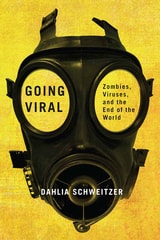
cover of Going Viral: Zombies, Viruses, and the End of the World

Going Viral

Zombies, Viruses, and the End of the World

Schweitzer, Dahlia

Rutgers University Press, 2018

Outbreak narratives have proliferated for the past quarter century, and now they have reached epidemic proportions. From 28 Days Later to 24 to The Walking Dead, movies, TV shows, and books are filled with zombie viruses, bioengineered plagues, and disease-ravaged bands of survivors. Even news reports indulge in thrilling scenarios about potential global pandemics like SARS and Ebola. Why have outbreak narratives infected our public discourse, and how have they affected the way Americans view the world?

In Going Viral, Dahlia Schweitzer probes outbreak narratives in film, television, and a variety of other media, putting them in conversation with rhetoric from government authorities and news organizations that have capitalized on public fears about our changing world. She identifies three distinct types of outbreak narrative, each corresponding to a specific contemporary anxiety: globalization, terrorism, and the end of civilization. Schweitzer considers how these fears, stoked by both fictional outbreak narratives and official sources, have influenced the ways Americans relate to their neighbors, perceive foreigners, and regard social institutions. 

Looking at everything from I Am Legend to The X Files to World War Z, this book examines how outbreak narratives both excite and horrify us, conjuring our nightmares while letting us indulge in fantasies about fighting infected Others. Going Viral thus raises provocative questions about the cost of public paranoia and the power brokers who profit from it.  

Supplemental Study Materials for "Going Viral": 
https://www.rutgersuniversitypress.org/going-viral-dahlia-schweitzer
Dahlia Schweitzer- Going Viral: https://www.youtube.com/watch?v=5xF0V7WL9ow
[more]