Results by title
383 books match the query 'Globalization' and 45 start with g

Games of Empire
Global Capitalism and Video GamesNick Dyer-Witheford
University of Minnesota Press, 2009
In the first decade of the twenty-first century, video games are an integral part of global media culture, rivaling Hollywood in revenue and influence. No longer confined to a subculture of adolescent males, video games today are played by adults around the world. At the same time, video games have become major sites of corporate exploitation and military recruitment.
In Games of Empire, Nick Dyer-Witheford and Greig de Peuter offer a radical political critique of such video games and virtual environments as Second Life, World of Warcraft, and Grand Theft Auto, analyzing them as the exemplary media of Empire, the twenty-first-century hypercapitalist complex theorized by Michael Hardt and Antonio Negri. The authors trace the ascent of virtual gaming, assess its impact on creators and players alike, and delineate the relationships between games and reality, body and avatar, screen and street.
Games of Empire forcefully connects video games to real-world concerns about globalization, militarism, and exploitation, from the horrors of African mines and Indian e-waste sites that underlie the entire industry, the role of labor in commercial game development, and the synergy between military simulation software and the battlefields of Iraq and Afghanistan exemplified by Full Spectrum Warrior to the substantial virtual economies surrounding World of Warcraft, the urban neoliberalism made playable in Grand Theft Auto, and the emergence of an alternative game culture through activist games and open-source game development.
Rejecting both moral panic and glib enthusiasm, Games of Empire demonstrates how virtual games crystallize the cultural, political, and economic forces of global capital, while also providing a means of resisting them.
Gandhi Meets Primetime
Globalization and Nationalism in Indian TelevisionShanti Kumar
University of Illinois Press, 2005
Kumar argues that India's hybrid national identity is manifested in the discourses found in this variety of empirical sources. He deconstructs representations of Mahatma Gandhi as the Father of the Nation on the state-sponsored network Doordarshan and those found on Rupert Murdoch's STAR TV network. The book closely analyzes print advertisements to trace the changing status of the television set as a cultural commodity in postcolonial India and examines publicity brochures, promotional materials and programming schedules of Indian-language networks to outline the role of vernacular media in the discourse of electronic capitalism. The empirical evidence is illuminated by theoretical analyses that combine diverse approaches such as cultural studies, poststructuralism and postcolonial criticism.
Geographies of the Ear
The Cultural Politics of Sound in Contemporary BarcelonaTania Gentic
Duke University Press, 2025

Geopolitical Economy
After US Hegemony, Globalization and EmpireRadhika Desai
Pluto Press, 2013
Geopolitical Economy radically reinterprets the historical evolution of the world order, as a multi-polar world emerges from the dust of the financial and economic crisis.
Radhika Desai offers a radical critique of the theories of US hegemony, globalisation and empire which dominate academic international political economy and international relations, revealing their ideological origins in successive failed US attempts at world dominance through the dollar.
Desai revitalizes revolutionary intellectual traditions which combine class and national perspectives on ‘the relations of producing nations’. At a time of global upheavals and profound shifts in the distribution of world power, Geopolitical Economy forges a vivid and compelling account of the historical processes which are shaping the contemporary international order.
Global Common Good
Intercultural Perspectives on a Just and Ecological TransformationEdited by Michael Reder, Verena Risse, Katharina Hirschbrunn, and Georg Stoll
Campus Verlag, 2015
Global Currents
Media and Technology NowOren, Tasha G
Rutgers University Press, 2004
Rhetoric about media technology tends to fall into two extreme categories: unequivocal celebration or blanket condemnation. This is particularly true in debate over the clash of values when first world media infiltrate third world audiences.
Bringing together the best new work on contemporary media practices, technologies, and policies, the essayists in Global Currents argue that neither of these extreme views accurately represents the role of media technology today. New ways of thinking about film, television, music, and the internet demonstrate that it is not only media technologies that affect the cultures into which they are introduced—it is just as likely that the receiving culture will change the media.
Topics covered in the volume include copyright law and surveillance technology, cyber activism in the African Diaspora, transnational monopolies and local television industries, the marketing and consumption of “global music,” “click politics” and the war on Afghanistan, the techno-politics of distance education, artificial intelligence and global legal institutions, and traveling and “squatting” in digital space. Balanced between major theoretical positions and original field research, the selections address the political and cultural meanings that surround and configure new technologies.
Global Decisions, Local Collisions
Urban Life In The New World OrderDavid Ranney
Temple University Press, 2002
Global Governance in Question
Empire, Class and the New Common Sense in Managing North-South RelationsSusanne Soederberg
Pluto Press, 2006
William I. Robinson, University of California-Santa Barbara
"[An] acute and revealing examination of the economic difficulties facing the American empire."
Ronnie D. Lipschutz, Professor of Politics, University of California, Santa Cruz
"Indispensable for students of international polical economy and a must for political activists." Professor Elmar Altvater, Department of Political Science, Free University, Berlin
Like many buzzwords, 'global governance' is as poorly understood as it is popular. In contrast to most mainstream accounts, this book examines global economic governance as an integral moment of contemporary capitalism -- presenting a critical insight into its real nature and the interests that it serves.
This book begins by asking what has not been discussed in the mainstream debates and why. Drawing on a Marxist perspective, Soederberg explores neglected issues including transnational debt and the increasingly coercive nature of US aid to so-called Œfailed states'. Soederberg argues that mainstream understandings fail to engage with the wider contradictions that characterise global capitalism. In consequence, there is no explanation of the changing nature of American empire and capitalist power in the world. Furthermore, Soederberg argues that global governance acts to normalise and legitimise increasingly austere forms of capitalist expansion, which may be regarded as a deepening and broadening of neoliberalism.
Susanne Soederberg is a Canada Research Chair in Global Political Economy and Associate Professor in International Development Studies at Queen's University, Kingston, Canada. She is author of The Politics of the New International Financial Architecture: Reimposing Neoliberal Domination in the Global South (Zed, 2005).
Global Health for All
Knowledge, Politics, and PracticesJean-Paul Gaudillière
Rutgers University Press, 2022
Global Hermeneutics. Reflections and Consequences
Knut Holter
SBL Press, 2010
A collection of essays from the International Cooperation Initiative of the Society of Biblical Literature
This first volume in the International Voices in Biblical Studies series stimulates and facilitates a global hermeneutic in which centers and margins fade. The collection explores the global context within which biblical studies and interpretation take place, includes three case studies from different regions, and reflections on the consequences of global hermeneutics on biblical interpretation and on translation.Features
Global Memoryscapes
Contesting Remembrance in a Transnational AgeEdited by Kendall R. Phillips and G. Mitchell Reyes
University of Alabama Press, 2011
The essays contained within the volume--by scholars from a wide range of disciplines including American studies, art history, political science, psychology, and sociology--each engage a particular instance of the practices of memory as they are complicated by globalization.
Subjects include the place of nostalgia in post-Yugoslavia Serbian national memory, Russian identity after the collapse of the Soviet Union, political remembrance in South Africa’s Truth and Reconciliation Commissions, the role of Chilean mass media in forging national identity following the arrest of Augusto Pinochet, American debates over memorializing Japanese internment camps, and how the debate over the Iraq war is framed by memories of opposition to the Vietnam War.
Global Prescriptions
The Production, Exportation, and Importation of a New Legal OrthodoxyYves Dezalay and Bryant G. Garth, Editors
University of Michigan Press, 2002
Comprised of two sections, the volume first develops theoretical perspectives key to an understanding of the production and impact of new "global legal prescriptions." The second part shifts attention to the national importation of these legal orthodoxies. The scholars provide a diverse set of sophisticated approaches, both to the circumstances promoting the production of these prescriptions and to the limitations of the prescriptions in the different national settings. Thus, Global Prescriptions provides a unique treatment for readers interested in globalization generally or the potential spread of the "rule of law" in particular.
This volume will intrigue scholars and students interested in a political science, economics, history, anthropology, law, and sociology.
Contributors are Jeremy Adelman, Robert Boyer, Elizabeth Heger Boyle, Miguel Angel Centeno, Heinz Klug, Larissa Adler Lomnitz, John W. Meyer, Setsuo Miyazawa, Hiroshi Otsuka, Rodrigo Salazar, Kathryn Sikkink, Anne-Marie Slaughter, and Catalina Smulovitz.
Yves Dezalay is Director of Research, National Center for Scientific Research, Paris. Bryant G. Garth is Director of the American Bar Foundation.
Global Rivalries From the Cold War to Iraq
Kees van der Pijl
Pluto Press, 2006
Tracing the liberal state structure back to the closing stages of the English Civil War and settlement in North America, it argues that the rise of the English-speaking West has created rivalries between contender states that are never entirely put to rest. With each round of Western expansion, new rivalries are created.
Offering a truly global analysis that covers every area of the world - from Europe and America to China, the Middle East, Latin America and Russia -- he analyses the development of international relations post WWII, and questions whether the neoliberal project and its human rights ideology have collapsed back into authoritarianism under the guise of the 'war on terror'.

Global Rivalries
Standards Wars and the Transnational Cotton TradeAmy A. Quark
University of Chicago Press, 2013
Nowhere is the conflict over rule setting more evident than in the simmering “standards wars” over the rules that define quality and enable the adjudication of disputes. In Global Rivalries, Amy A. Quark explores the questions of how rules are made, who makes them, and how they are enforced, using the lens of cotton—a simple commodity that has become a poignant symbol of both the crisis of Western rule making power and the potential for powerful new rivals to supplant it. Quark traces the strategies for influencing rule making processes employed not only by national governments but also by transnational corporations, fiber scientists, and trade associations from around the globe. Quark analyzes the efficacy of their approaches and the implications for more marginal actors in the cotton trade, including producers in West Africa.

Global Sex
Dennis Altman
University of Chicago Press, 2001

Global Shadows
Africa in the Neoliberal World OrderJames Ferguson
Duke University Press, 2006
In Global Shadows the renowned anthropologist James Ferguson moves beyond the traditional anthropological focus on local communities to explore more general questions about Africa and its place in the contemporary world. Ferguson develops his argument through a series of provocative essays which open—as he shows they must—into interrogations of globalization, modernity, worldwide inequality, and social justice. He maintains that Africans in a variety of social and geographical locations increasingly seek to make claims of membership within a global community, claims that contest the marginalization that has so far been the principal fruit of “globalization” for Africa. Ferguson contends that such claims demand new understandings of the global, centered less on transnational flows and images of unfettered connection than on the social relations that selectively constitute global society and on the rights and obligations that characterize it.
Ferguson points out that anthropologists and others who have refused the category of Africa as empirically problematic have, in their devotion to particularity, allowed themselves to remain bystanders in the broader conversations about Africa. In Global Shadows, he urges fellow scholars into the arena, encouraging them to find a way to speak beyond the academy about Africa’s position within an egregiously imbalanced world order.
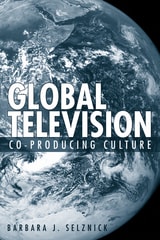
Global Television
Co-Producing CultureBarbara J. Selznick
Temple University Press, 2008
The face of U.S. television broadcasting is changing in ways that are both profound and subtle. Global Television uncovers the particular processes by which the international circulation of culture takes place, while addressing larger cultural issues such as identity formation.
Focusing on how the process of internationally made programming such as Highlander: The Series and The Odyssey—amusingly dubbed “Europudding” and “commercial white bread”—are changing television into a transnational commodity, Barbara Selznick considers how this mode of production—as a means by which transnational television is created—has both economic rewards and cultural benefits as well as drawbacks.
Global Television explores the ways these international co-productions create a “global” culture as well as help form a national identity. From British “brand” programming (e.g, Cracker) that airs on A&E in the U.S. to children’s television programs such as Plaza Sesamo, and documentaries, Selznick indicates that while the style, narrative, themes and ideologies may be interesting, corporate capitalism ultimately affects and impacts these programs in significant ways.
Global Trends and Global Governance
Edited by Paul Kennedy, Dirk Messner, and Franz Nuscheler
Pluto Press, 2001

Globalisation and Industrial Relations
The Pharmaceutical Industry in Germany and the United KingdomLuitpold Rampeltshammer
Campus Verlag, 2008
Globalisation
Studies in AnthropologyEdited by Thomas Hylland Eriksen
Pluto Press, 2003

Globalization
Arjun Appadurai, ed.
Duke University Press, 2001
Seeking an alternative to the dead-end debate between those who see globalization as a phenomenon wholly without precedent and those who see it simply as modernization, imperialism, or global capitalism with a new face, the contributors seek to illuminate how space and time are transforming each other in special ways in the present era. They examine how this complex transformation involves changes in the situation of the nation, the state, and the city. While exploring distinct regions—China, Africa, South America, Europe—and representing different disciplines and genres—anthropology, literature, political science, sociology, music, cinema, photography—the contributors are concerned with both the political economy of location and the locations in which political economies are produced and transformed. A special strength of the collection is its concern with emergent styles of subjectivity, citizenship, and mobilization and with the transformations of state power through which market rationalities are distributed and embodied locally.
Contributors. Arjun Appadurai, Jean François Bayart, Jérôme Bindé, Néstor García Canclini, Leo Ching, Steven Feld, Ralf D. Hotchkiss, Wu Hung, Andreas Huyssen, Boubacar Touré Mandémory, Achille Mbembe, Philipe Rekacewicz, Saskia Sassen, Fatu Kande Senghor, Seteney Shami, Anna Tsing, Zhang Zhen

Globalization From Below
Transnational Activists And Protest NetworksDonatella della Porta Della Porta
University of Minnesota Press, 2006
Presenting the first systematic empirical research on the global justice movement, Globalization from Below analyzes a movement from the viewpoints of the activists, organizers, and demonstrators themselves. The authors traveled to Genoa with anti-G8 protesters and collected data from more than 800 participants. A year later, they surveyed 2,400 activists at the European Social Forum in Florence. To understand how this cycle of global protest emerged, they examine the interactions between challengers and elites, and discuss how these new models of activism fit into current social movement work.
Globalization from Below places the protests within larger debates, revealing and investigating the forces that led to a clash between demonstrators and the Italian government, which responded with violence.
Donatella della Porta is professor of political science; Massimiliano Andretta is a researcher in political science and sociology; Lorenzo Mosca is a researcher in information and communication technologies; Herbert Reiter is a researcher in history, all at the European University Institute.
Globalization Under Construction
Govermentality, Law, and IdentityRichard Warren Perry
University of Minnesota Press, 2003
A kaleidoscopic look at the intersections of globalization and governance
The future outlines of the new global order are the constant object of speculation—economic, political, and metaphysical. From the sunny new world proclaimed by global free marketers to the rebellion against globalization unleashed in the streets of Seattle and Genoa, to the doomsdays envisioned by transnational terrorists and counterterrorists alike, this emerging global-millennial epoch is foretold alternately as redemption or apocalypse. The authors consider these sweeping descriptions of humankind’s future, as well as the discourses of globalization that filter and frame them, from perspectives in anthropology, geography, law, sociology, and cultural studies. Their goal is not to resolve the ultimate semantic or philosophical question of what “globalization” really is; instead, their essays explore the forms, practices, and effects of governmentality integral to global modernity’s architecture.
In Globalization under Construction, the authors ask: What are the rationalities of government implicit in global modernity’s project of mobilizing space, time, and difference? And what difference does it make to the globalization debates to put those rationalities in the foreground of critical analysis? Altogether, their work attempts to discern in the disparateness of contemporary events an emerging pattern of governmentality, techniques of governance and assemblages of intersecting arguments about the history of the present and the nature of the future that our present portends.Contributors: Kitty Calavita, U of California, Irvine; Rosemary J. Coombe, York U; Susan Bibler Coutin, U of California, Irvine; Karen Leonard, U of California, Irvine; Sally Engle Merry, Wellesley College; Aihwa Ong, U of California, Berkeley; Susan Roberts, U of Kentucky; Lisa Sanchez, U of California, San Diego; Liliana Suárez-Navaz, Autónoma U, Madrid.
Globalization and Culture
John Tomlinson
University of Chicago Press, 1999
Tomlinson begins this ambitious project by studying the relationship between globalization and contemporary culture, explaining the importance of time and space concerns, cultural imperialism, "deterritorialization," the impact of the media and communication technologies, and the possible growth of more cosmopolitan culture. We come to understand how someone may face unemployment as a result of downsizing decisions made at a company's head office on another continent, or how the food we find in our grocery stores is radically different today from twenty years ago. He discusses the uneven nature of the experience of global modernity in relation to first and third world countries, and concludes that a genuinely cosmopolitan culture is unlikely to emerge unless we respect cultural differences and share a common sense of commitment about the world.
Globalization and Its Discontents
The Rise of Postmodern SocialismsEdited by Roger Burbach, Boris Kagarlitsky, and Orlando Nunez
Pluto Press, 1997

Globalization and Nationalism
The Cases of Georgia and the Basque CountryNatalie Sabanadze
Central European University Press, 2010
This book argues for an original, unorthodox conception about the relationship between globalization and contemporary nationalism. While the prevailing view holds that nationalism and globalization are forces of clashing opposition, Sabanadze establishes that these tend to become allied forces. It acknowledges that nationalism does react against the rising globalization and represents a form of resistance against globalizing influences, but the Basque and Georgian cases prove that globalization and nationalism can be complementary rather than contradictory tendencies.
Nationalists have often served as promoters of globalization, seeking out globalizing influences and engaging with global actors out of their very nationalist interests. In the case of both Georgia and the Basque Country, there is little evidence suggesting the existence of strong, politically organized nationalist opposition to globalization.
Globalization and Nationalism discusses why, on a broader scale, different forms of nationalism develop differing attitudes towards globalization and engage in different relationships.

Globalization and New Geographies of Conservation
Edited by Karl S. Zimmerer
University of Chicago Press, 2006
Globalization and New Geographies of Conservation makes four important arguments about the recent coupling of conservation and globalization that is reshaping the place of nature in human-environmental change. First, it has led to an unprecedented number of spatial arrangements whose environmental management goals and prescribed activities vary along a spectrum from strict biodiversity protection to sustainable utilization involving agriculture, food production, and extractive activities. Conservation and globalization are also leading, by necessity, to new scales of management in these activities that rely on environmental science, thus shifting the spatial patterning of humans and the environment. This interaction results, as well, in the unprecedented importance of boundaries and borders; transnational border issues pose both opportunities and threats to global conservation proposed by organizations and institutions that are themselves international. Lastly, Globalization and New Geographies of Conservation argues that the local level has been integral to globalization, while the regional level is often eclipsed at the peril of the successful implementation of conservation and management programs.
Bridging the gap between geography and life science, Globalization and New Geographies of Conservation will appeal to a broad range of students of the environment, conservation planning; biodiversity management, and development and globalization studies.
Globalization and Poverty
Edited by Ann Harrison
University of Chicago Press, 2007
Over the past two decades, the percentage of the world’s population living on less than a dollar a day has been cut in half. How much of that improvement is because of—or in spite of—globalization? While anti-globalization activists mount loud critiques and the media report breathlessly on globalization’s perils and promises, economists have largely remained silent, in part because of an entrenched institutional divide between those who study poverty and those who study trade and finance.
Globalization and Poverty bridges that gap, bringing together experts on both international trade and poverty to provide a detailed view of the effects of globalization on the poor in developing nations, answering such questions as: Do lower import tariffs improve the lives of the poor? Has increased financial integration led to more or less poverty? How have the poor fared during various currency crises? Does food aid hurt or help the poor?
Poverty, the contributors show here, has been used as a popular and convenient catchphrase by parties on both sides of the globalization debate to further their respective arguments. Globalization and Poverty provides the more nuanced understanding necessary to move that debate beyond the slogans.

Globalization and Race
Transformations in the Cultural Production of BlacknessKamari Maxine Clarke and Deborah A. Thomas, eds.
Duke University Press, 2006
A number of the essays bring to light the formative but not unproblematic influence of African American identity on other populations within the black diaspora. Among these are an examination of the impact of “black America” on racial identity and politics in mid-twentieth-century Liverpool and an inquiry into the distinctive experiences of blacks in Canada. Contributors investigate concepts of race and space in early-twenty-first century Harlem, the experiences of trafficked Nigerian sex workers in Italy, and the persistence of race in the purportedly non-racial language of the “New South Africa.” They highlight how blackness is consumed and expressed in Cuban timba music, in West Indian adolescent girls’ fascination with Buffy the Vampire Slayer, and in the incorporation of American rap music into black London culture. Connecting race to ethnicity, gender, sexuality, nationality, and religion, these essays reveal how new class economies, ideologies of belonging, and constructions of social difference are emerging from ongoing global transformations.
Contributors. Robert L. Adams, Lee D. Baker, Jacqueline Nassy Brown, Tina M. Campt, Kamari Maxine Clarke, Raymond Codrington, Grant Farred, Kesha Fikes, Isar Godreau, Ariana Hernandez-Reguant, Jayne O. Ifekwunigwe, John L. Jackson Jr., Oneka LaBennett, Naomi Pabst, Lena Sawyer, Deborah A. Thomas
Globalization and the Circumpolar North
Edited by Lassi Heininen and Chris Southcott
University of Alaska Press, 2010

Globalization and the Post-Creole Imagination
Notes on Fleeing the PlantationMichaeline A. Crichlow
Duke University Press, 2009
Engaging with the thought of Michel Foucault, Michel Rolph-Trouillot, Achille Mbembe, Henri Lefebvre, Margaret Archer, Saskia Sassen, Pierre Bourdieu, and others, Crichlow argues for understanding creolization as a continual creative remaking of past and present moments to shape the future. She draws on sociology, philosophy, postcolonial studies, and cultural studies to illustrate how national histories are lived personally and how transnational experiences reshape individual lives and collective spaces. Critically extending Bourdieu’s idea of habitus, she describes how contemporary Caribbean subjects remake themselves in and beyond the Caribbean region, challenging, appropriating, and subverting older, localized forms of creolization. In this book, Crichlow offers a nuanced understanding of how Creole citizens of the Caribbean have negotiated modern economies of power.
Globalization in Historical Perspective
Edited by Michael D. Bordo, Alan M. Taylor, and Jeffrey G. Williamson
University of Chicago Press, 2003
This volume collects eleven papers doing exactly that and more. The first group of essays explores how the process of globalization can be measured in terms of the long-term integration of different markets-from the markets for goods and commodities to those for labor and capital, and from the sixteenth century to the present. The second set of contributions places this knowledge in a wider context, examining some of the trends and questions that have emerged as markets converge and diverge: the roles of technology and geography are both considered, along with the controversial issues of globalization's effects on inequality and social justice and the roles of political institutions in responding to them. The final group of essays addresses the international financial systems that play such a large part in guiding the process of globalization, considering the influence of exchange rate regimes, financial development, financial crises, and the architecture of the international financial system itself.
This volume reveals a much larger picture of the process of globalization, one that stretches from the establishment of a global economic system during the nineteenth century through the disruptions of two world wars and the Great Depression into the present day. The keen analysis, insight, and wisdom in this volume will have something to offer a wide range of readers interested in this important issue.
Globalization in Rural Mexico
Three Decades of ChangeBy Frances Abrahamer Rothstein
University of Texas Press, 2007
Winner, Society of the Anthropology of Work Book Prize, 2010
When the ever-intensifying global marketplace "modernizes" rural communities, who stands to gain? Can local residents most impacted by changes to their social fabric ever recover or even identify what has been lost?
Frances Abrahamer Rothstein uses thirty years of sustained anthropological fieldwork in the rural Mexican community of San Cosme Mazatecochco to showcase globalization's complexities and contradictions.
Rothstein's lucid work chronicles the changes in production, consumption, and social relations during three distinct periods: the Mexican "miracle," when economic development fueled mobility for a large segment of the population, including San Cosme's worker-peasants; the lost decade of the 1980s, when much of what had been gained was lost; and the recent period of trade liberalization and globalization, considered by many in Mexico and beyond as a panacea and a disaster at the same time.
After Mexico's textile industry decline in the late 1980s, some families of former textile workers in San Cosme opened home workshops—talleres—and a small-scale, textile-based economy took root. These families, who managed to prosper through their own trade and industry, demonstrate that those who rely on consumer demand for their livelihood need not always follow the dictate of the marketplace, but rather can position themselves assertively to influence alternative economic possibilities held close to their culture.
Employing rich ethnography and broad analysis, Rothstein focuses on how everyday life has been transformed by these processes, but shows also how important continuities with the past persist. She strikes a delicate balance between firmly grounded scientific study and a deep compassion for the subjects of her work, while challenging contemporary views of globalization and consumption.
Globalization in an Age of Crisis
Multilateral Economic Cooperation in the Twenty-First CenturyEdited by Robert C. Feenstra and Alan M. Taylor
University of Chicago Press, 2013
Prompted by these questions, Robert C. Feenstra and Alan M. Taylor have brought together top researchers with policy makers and practitioners whose contributions consider the ways in which the global economic order might address the challenges of globalization that have arisen over the last two decades and that have been intensified by the recent crisis. Chapters in this volume consider the critical linkages between issues, including exchange rates, global imbalances, and financial regulation, and plumb the political and economic outcomes of past policies for what they might tell us about the future of the global economic cooperation.

Globalization, Nationalism, and Imperialism
A New History of Eastern EuropeJames W. Peterson
Central European University Press, 2023
The authors of this book retell the political and economic history of East-Central Europe, the post-communist Balkans, and the Baltic states and speculate about their future from the vantage point of three competing forces operating in the region: territorial imperialism, globalization, and nationalism.
Exposed to imperial aspirations, the geographic area from the Baltic Sea to the Black Sea has in the past 150 years been subject to alternating waves of globalization and nationalism. The nineteenth century Eastern European empires were open to forces of economic globalization, but all collapsed at the end of World War One. Emerging nation-states embraced the logic of Western-led globalization but were subjugated by Nazi and Soviet empires, which pursued policies of economic autarchy. The demise of the Soviet empire marked the revival of pre-1939 nation-states and the re-entry of forces of liberalism and globalization into the region, with multiple crises of economic transition, ethnic militancy, new forms of authoritarianism, and external security threats. By 2010 negative, nationalist-populist reactions against crises that globalization brought to Eastern Europe became the dominant political trend. The analysis involves the consideration about the very contemporary factors of Brexit and COVID, as well as Russia’s and China’s influences, and their effects on Eastern Europe.

Globalization
Millennial Quartet II, Volume 12Arjun Appadurai, ed.
Duke University Press, 0
Seeking an alternative to the dead-end debate between those who see globalization as a phenomenon wholly without precedent and those who see it simply as modernization, imperialism, or global capitalism with a new face, the contributors seek to illuminate how space and time are transforming each other in special ways in the present era. They examine how this complex transformation involves changes in the situation of the nation, the state, and the city. While exploring distinct regions—China, Africa, South America, Europe—and representing different disciplines and genres—anthropology, literature, political science, sociology, music, cinema, photography—the contributors are concerned with both the political economy of location and the locations in which political economies are produced and transformed. A special strength of the collection is its concern with emergent styles of subjectivity, citizenship, and mobilization and with the transformations of state power through which market rationalities are distributed and embodied locally.
Contributors. Arjun Appadurai, Jérome Bindé, Néstor García Canclini, Leo Ching, Steven Feld, Ralf D. Hotchkiss, Wu Hung, Andreas Huyssen, Boubacar Touré Mandémory, Achille Mbembe, Saskia Sassen, Fatu Kande Senghor, Seteney Shami, Anna Tsing, Zhang Zhen
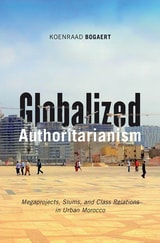
Globalized Authoritarianism
Megaprojects, Slums, and Class Relations in Urban MoroccoKoenraad Bogaert
University of Minnesota Press, 2018
A rich investigation into Morocco’s urban politics
Over the past thirty years, Morocco’s cities have transformed dramatically. To take just one example, Casablanca’s medina is now obscured behind skyscrapers that are funded by global capital and encouraged by Morocco’s monarchy, which hopes to transform this city into a regional leader of finance and commerce. Such changes have occurred throughout Morocco. Megaprojects are redesigning the cityscapes of Rabat, Tangiers, and Casablanca, turning the nation’s urban centers into laboratories of capital accumulation, political dominance, and social control.
In Globalized Authoritarianism, Koenraad Bogaert links more abstract questions of government, globalization, and neoliberalism with concrete changes in the city. Bogaert goes deep beneath the surface of Morocco’s urban prosperity to reveal how neoliberal government and the increased connectivity engendered by global capitalism transformed Morocco’s leading urban spaces, opening up new sites for capital accumulation, creating enormous class divisions, and enabling new innovations in state authoritarianism. Analyzing these transformations, he argues that economic globalization does not necessarily lead to increased democratization but to authoritarianism with a different face, to a form of authoritarian government that becomes more and more a globalized affair.
Showing how Morocco’s experiences have helped produce new forms of globalization, Bogaert offers a bridge between in-depth issues of Middle Eastern studies and broader questions of power, class, and capital as they continue to evolve in the twenty-first century.
Globalizing Afghanistan
Terrorism, War, and the Rhetoric of Nation BuildingZubeda Jalalzai and David Jefferess, eds.
Duke University Press, 2011
Contributors. Gwen Bergner, Maliha Chishti, Cheshmak Farhoumand-Sims, Nigel C. Gibson, Zubeda Jalalzai, David Jefferess, Altaf Ullah Khan, Kamran Rastegar, Rodney J. Steward, Imre Szeman
Globalizing the Caribbean
Political Economy, Social Change, and the Transnational Capitalist ClassJeb Sprague
Temple University Press, 2019
The beautiful Caribbean basin is fertile ground for a study of capitalism past and present. Transnational corporations move money and labor around the region, as national regulations are reworked to promote conditions benefiting private capital. Globalizing the Caribbean offers a probing account of the region’s experience of economic globalization while considering gendered and racialized social relations and the frequent exploitation of workers.
Jeb Sprague focuses on the social and material nature of this new era in the history of world capitalism. He combines an historical overview of capitalism in the region with theoretical analysis backed by case studies. Sprague elaborates upon the role of class formation and the restructuring of local states. He considers both U.S. hegemony, and how various upsurges from below and crises occur. He examines the globalization of the cruise ship and mining businesses, looks at the growth of migrant labor and reverse flow of remittances, and describes the evolving role of export processing and supranational associations. In doing so, Sprague shows how transnationally oriented elites have come to rule the Caribbean, and how capitalist globalization in the region occurs alongside shifting political, institutional, and organizational dynamics.

Globalizing the Lower Rio Grande
European Entrepreneurs in the Borderlands, 1749-1881Kyle Carpenter
University of North Texas Press, 2024

Globalizing the Sacred
Religion Across the AmericasVásquez, Manuel A
Rutgers University Press, 2003
French and German tourists join Mexican migrant workers to venerate the image of the Virgin Mary at a strip mall in Florida; Latino gang members, deported from the United States to home countries they barely know, find Jesus in transnational churches; U.S. evangelicals use electronic media to preach a “neo liberal” gospel of wealth and health to landless peasants in remote indigenous villages in Guatemala. These are just some examples of how religion in the Americas today intersects in complex ways with the economic, political, and cultural dimensions of globalization.
Drawing on case studies in the United States and Latin America, Manuel A. Vásquez and Marie Friedmann Marquardt explore the evolving roles of religion in the Americas in the face of globalization, transnational migration, the rapid growth of culture industries, the rise of computer mediated technologies, and the crisis of modernity. Combining ethnographic research in local congregations, studies of material culture and sacred space, textual analyses, and approaches to mass and electronic media, the authors challenge dominant paradigms in sociology of religion, such as the secularization and rational choice models. Further, the book offers alternative theoretical and methodological tools to understand the increasing complexity of religious life in the Americas.
By illustratingthe challenges that scholars and students must confront in order to understand the complexity of today’s religious landscape, Globalizing the Sacred makes both important theoretical and methodological contributions to the study of religion’s role in social change.
Governing the End
The Making of Climate Change Loss and DamageLisa Vanhala
University of Chicago Press, 2025
A searing account of how the international community is trying—and failing—to address the worst effects of climate change and the differential burdens borne by rich and poor countries.
Climate change is increasingly accepted as a global emergency creating irrevocable losses for the planet. Yet, each country experiences these losses differently, and reaching even inadequate political agreements is fraught with contestation. Governing the End untangles the complex relationship between deteriorating environmental conditions, high politics, and everyday diplomatic practices, focusing on the United Nations’ agreement to address “loss and damage” and subsequent battles over implementation.
Lisa Vanhala looks at the differing assumptions and strategic framings that poor and rich countries bring to bear and asks why some norms emerge and diffuse while others fail to do so. Governing the End is based on ethnographic observation of eight years of UN meetings and negotiations and more than one hundred and fifty interviews with diplomats, policymakers, UN secretariat staff, experts, and activists. It explores explicit political contestation, as well as the more clandestine politics that have stymied implementation and substantially reduced the scope of compensation to poor countries. In doing so, Governing the End elucidates the successes and failures of international climate governance, revealing the importance of how ideas are constructed and then institutionally embodied.
Governing the Global Polity
Practice, Mentality, RationalityIver B. Neumann and Ole Jacob Sending
University of Michigan Press, 2010
"There have been many attempts to adapt Foucault's arguments to the study of international relations, but this powerful and provocative book is the most sustained, and arguably the most successful in showing how the governmentality approach can be adapted to the analysis of global politics."
---Barry Hindess, Research School of Social Sciences, The Australian National University
A highly welcome and original contribution to contemporary debates on the shape and future of the international system and on the possibility of reconfiguring IR theory as social theory."
---Mathias Albert, Bielefeld University, Germany
"Iver Neumann and Ole Jacob Sending have put meat on the bones of Michel Foucault's notion of governmentality, fulfilling the hopes of long-famished students and scholars of global governance. Through their focus on specific case studies, the authors have provided a much-needed contribution to the international relations literature, one that is sure to become a staple of courses and seminars throughout the world."
---Ronnie D. Lipschutz, University of California, Santa Cruz
What does globalization mean for the principle of state sovereignty and for the power and functioning of states? Whereas realists assert the continued importance of states, constructivists contend that various political entities as well as the logic of globalization itself undermine state sovereignty.
Drawing on the state formation literature and on social theory, particularly the works of Weber and Foucault, Iver B. Neumann and Ole Jacob Sending question the terms of the realist-constructionist debate. Through detailed case studies, they demonstrate that states use nongovernmental organizations and international organizations indirectly to enforce social order and, ultimately, to increase their own power. At the same time, global politics is dominated by a liberal political rationality that states ignore at their peril. While states remain as strong as ever, they operate within a global polity of new hierarchies among states and between states and other actors.
Iver B. Neumann is Director of Research at the Norwegian Institute of International Affairs and Professor of Russian Studies at the University of Oslo.
Ole Jacob Sending is Senior Researcher at the Norwegian Institute of International Affairs, where he heads the Research Programme on Global Governance and International Organizations.
Cover art credit: © iStockphoto.com/Will Evans
Also available as an e-book.

Grassroots Struggles for Sustainability in Central America
Lynn R. Horton
University Press of Colorado, 2007
With a comparative, empirical approach, Horton also analyzes dominant practices linked to sustainable development - neoliberal reforms, project interventions, and environmental protection. She reveals how these practices support or undermine economic, cultural, and political opportunities for the rural and indigenous poor and impact these communities' advancement of their own visions of sustainability. Finally, the author explores processes of empowerment that enable communities to articulate and put into practice local visions of sustainability, which contribute toward broader social and structural transformations.
Grassroots Struggles for Sustainability in Central America will interest sociologists, anthropologists, and others who study the theory and practice of sustainable development.
Growing Up Global
Economic Restructuring and Children’s Everyday LivesCindi Katz
University of Minnesota Press, 2004
Growing Up Global examines the processes of development and global change through the perspective of children’s lives in two seemingly disparate places: New York City and a village in northern Sudan. At the book’s core is a longitudinal ethnographic study of children growing up in a Sudanese village that was included in a large state-sponsored agricultural program in the year they were born. It follows a small number of children intermittently from ten years of age to early adulthood, concentrating particularly on their work and play, which together trained the children for an agrarian life centered around the family, a life that was quickly becoming obsolete.
Shifting her focus to largely working-class families in New York City in the 1980s and 1990s, Katz is able to expose unsuspected connections with the Sudanese experience in the effects on children of a constantly changing, capitalist environment—the decline of manufacturing jobs and the increase in knowledge-based jobs—in which young people with few skills and stunted educations face bleak employment prospects. In teasing out how “development” transforms the grounds on which these young people come of age, Cindi Katz provides a textured analysis of the importance of knowledge in the ability of people, families, and communities to reproduce themselves and their material social practices over time.