Results by title
66 books match the query 'Government & Business' and 3 start with g

Going Private
Outsourcing the Administrative StateRachel Augustine Potter
University of Chicago Press, 2027
Shows how the proliferation of contractors within the federal agencies is fundamentally reshaping American governance.
Much of what the federal government does today is carried out by people the public rarely sees. While debates focus on bureaucrats and political appointees, agencies increasingly rely on a vast contractor workforce to perform functions ranging from tech support to policy analysis to regulatory drafting services. This quiet transformation has altered how the government functions while simultaneously preserving the public-facing image of a bureaucracy run by civil servants. The federal government does not keep reliable data on how many contractors it employs, but many estimates suggest that contractors outnumber career bureaucrats.
In Going Private, Rachel Augustine Potter explains how this shift reshapes the everyday operation of the administrative state and coalesces power within the presidency. Easily hired and easily fired, contractors have strong incentives to please their clients, making them malleable to the president’s will. Presidents from both parties have leveraged these features and learned to rely on contractors to advance political priorities, bypass uncooperative bureaucrats, and gain increased control over agency work.
Drawing on new data and interviews, Going Private argues that outsourcing is not merely an administrative convenience. Rather, it is a defining feature of contemporary governance—one that complicates accountability, blurs the boundaries of the administrative state, and alters the exercise of presidential power.
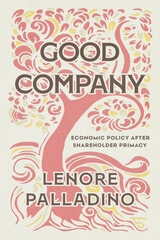
Good Company
Economic Policy after Shareholder PrimacyLenore Palladino
University of Chicago Press, 2024
On the faulty intellectual origins of shareholder primacy—and how policy can win back what’s been lost.
In an era of shareholder primacy, share price is king. Businesses operate with short-term goals to deliver profits to shareholders, enjoying stability (and bonuses) in the process. While the public bemoans the doctrine for its insularity and wealth-consolidating effects, its influence over corporate governance persists. Good Company offers an exacting argument for why shareholder primacy was never the right model to follow for truly understanding how corporations operate.
Lenore Palladino shows that corporations draw power from public charters—agreements that allow corporations to enjoy all manner of operational benefits. In return, companies are meant to innovate for the betterment of the societies that support them. However, that debt—increasingly wielded for stock buybacks and shareholder bonuses—is not being repaid. Palladino theorizes a modern corporation that plays its intended role while delivering social and economic good in the process and offers tangible policy solutions to make this a reality. Good Company is both an expert introduction to the political economy of the firm—as it was, as it is, as it can be—and a calibrating examination of how public policy can shape companies, and societies, for the better.
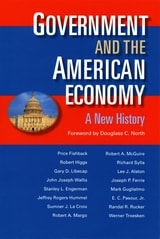
Government and the American Economy
A New HistoryPrice V. Fishback et al.
University of Chicago Press, 2007
The American economy has provided a level of well-being that has consistently ranked at or near the top of the international ladder. A key source of this success has been widespread participation in political and economic processes. In The Government and the American Economy, leading economic historians chronicle the significance of America’s open-access society and the roles played by government in its unrivaled success story.
America’s democratic experiment, the authors show, allowed individuals and interest groups to shape the structure and policies of government, which, in turn, have fostered economic success and innovation by emphasizing private property rights, the rule of law, and protections of individual freedom. In response to new demands for infrastructure, America’s federal structure hastened development by promoting the primacy of states, cities, and national governments. More recently, the economic reach of American government expanded dramatically as the populace accepted stronger limits on its economic freedoms in exchange for the increased security provided by regulation, an expanded welfare state, and a stronger national defense.