Results by title
100 books match the query 'Grammar & Punctuation' and 7 start with g
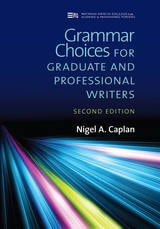
Grammar Choices for Graduate and Professional Writers, Second Edition
Nigel A. Caplan
University of Michigan Press, 2019
Each of the eight units in Grammar Choices contains: an overview of the grammar topic; a preview test that allows students to assess their control of the target grammar and teachers to diagnose areas of difficulty; an authentic example of graduate-student writing showing the unit grammar in use; clear descriptions of essential grammar structures using the framework of functional grammar, cutting-edge research in applied linguistics, and corpus studies; vocabulary relevant to the grammar point is introduced—for example, common verbs in the passive voice, summary nouns used with this/these, and irregular plural nouns; authentic examples for every grammar point from corpora and published texts; exercises for every grammar point that help writers develop grammatical awareness and use, including completing sentences, writing, revising, paraphrasing, and editing; and a section inviting writers to investigate discipline-specific language use and apply it to an academic genre.
Among the changes in the Second Edition are:
- new sections on parallel form (Unit 2) and possessives (Unit 5)
- revised and expanded explanations, but particularly regarding verb complementation, complement noun clauses, passive voice, and stance/engagement
- a restructured Unit 2 and significantly revised/updated Unit 7
- new Grammar Awareness tasks in Units 3, 5, and 6
- new exercises plus revision/updating of many others
- self-editing checklists in the Grammar in Your Discipline sections at the end of each unit
- representation of additional academic disciplines (e.g., engineering, management) in example sentences and texts and in exercises.

Grammar and Discourse Principles
Functional Syntax and GB TheorySusumu Kuno and Ken-ichi Takami
University of Chicago Press, 1993
Kuno and Takami begin by looking at extraction phenomena, including extraction from complement clauses, the overt subject requirement, and subjacency, and provide functional accounts that improve on the Barriers analysis. Next, they discuss multiple wh questions in English and Japanese, with special reference to why and naze. The authors also examine and ultimately reject the major arguments in support of Larson's "light predicate raising" analysis. Finally, Kuno and Takami discuss coreferentiality of picture noun reflexives and the relation of quantifier scope interpretations, particularly those in sentences involving psychological verbs such as bother, worry, and please.
In this subtly argued book, the authors raise questions of critical importance for theoretical linguists of all persuasions.
Grammatical Competence and Parsing Performance
Bradley L. Pritchett
University of Chicago Press, 1992
Pritchett critiques the major performance-based parsing models to argue that the principles of grammar drive the parser; the parser, furthermore, is the apparatus that tries to enforce the conditions of the grammar at every point in the processing of a sentence. In comparing garden path phenomena, those instances when the parser fails on the first reading of a sentence and must reanalyze it, with occasions when the parser successfully functions the first time around, Pritchett makes a convincing case for a grammar-derived parsing theory.
Grammatical Framework
Programming with Multilingual GrammarsAarne Ranta
CSLI, 2011
Grammatical Framework is a programming language designed for writing grammars, which has the capability of addressing several languages in parallel. This thorough introduction demonstrates how to write grammars in Grammatical Framework and use them in applications such as tourist phrasebooks, spoken dialogue systems, and natural language interfaces. The examples and exercises presented here address several languages, and the readers are shown how to look at their own languages from the computational perspective.
Grammatical Interfaces in HPSG
Edited by Ronnie Cann, Claire Grover, and Philip H. Miller
CSLI, 2001
Grammatical Theory
Its Limits and Its PossibilitiesFrederick J. Newmeyer
University of Chicago Press, 1983
Newmeyer's formidable scholarship raises the level of debate on transformational generative grammar. He stresses the central importance of an autonomous formal grammar, discusses the limitations of "discourse-based" approaches to syntax, cites support for generativist theory in recent research, and clarifies misunderstood concepts associated with generative grammar.
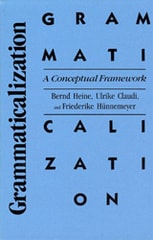
Grammaticalization
A Conceptual FrameworkBernd Heine, Ulrike Claudi, and Friederike Hünnemeyer
University of Chicago Press, 1991
This volume challenges theories which describe language as a static system, as well as those which assume that linguistic categorization is based on discrete morpheme types, word classes, or sentence constituents. In contrast, the book's central argument is that both language structure and language use are dynamic phenomena and that linguistic behavior is essentially a creative activity. That creativity manifests itself, for example, in conceptual transfer leading to the encoding of more abstract concepts and of grammatical categories. Another key element of this theory is captured in the term "grammaticalization chain," which refers to a specific kind of linguistic category which cuts across morpheme types and word classes and has both a synchronic and diachronic dimension.