Results by title
54 books match the query 'Grief' and 5 start with g
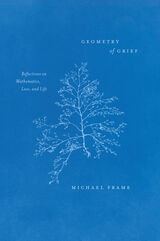
Geometry of Grief
Reflections on Mathematics, Loss, and LifeMichael Frame
University of Chicago Press, 2021
We all know the euphoria of intellectual epiphany—the thrill of sudden understanding. But coupled with that excitement is a sense of loss: a moment of epiphany can never be repeated. In Geometry of Grief, mathematician Michael Frame draws on a career’s worth of insight—including his work with a pioneer of fractal geometry Benoit Mandelbrot—and a gift for rendering the complex accessible as he delves into this twinning of understanding and loss. Grief, Frame reveals, can be a moment of possibility.
Frame investigates grief as a response to an irrevocable change in circumstance. This reframing allows us to see parallels between the loss of a loved one or a career and the loss of the elation of first understanding a tricky concept. From this foundation, Frame builds a geometric model of mental states. An object that is fractal, for example, has symmetry of magnification: magnify a picture of a mountain or a fern leaf—both fractal—and we see echoes of the original shape. Similarly, nested inside great loss are smaller losses. By manipulating this geometry, Frame shows us, we may be able to redirect our thinking in ways that help reduce our pain. Small‐scale losses, in essence, provide laboratories to learn how to meet large-scale losses.
Interweaving original illustrations, clear introductions to advanced topics in geometry, and wisdom gleaned from his own experience with illness and others’ remarkable responses to devastating loss, Frame’s poetic book is a journey through the beautiful complexities of mathematics and life. With both human sympathy and geometrical elegance, it helps us to see how a geometry of grief can open a pathway for bold action.
Gone Gone
Todd Meyers
Duke University Press, 2025
Grief and the Hero
The Futility of Longing in the IliadEmily P. Austin
University of Michigan Press, 2021
Grief and the Hero examines Achilles’ experience of the futility of grief in the context of the Iliad’s study of anger. No action can undo his friend Patroklos’ death, but the experience of death drives him to behave as though he can achieve something restorative. Rather than assuming that grief gives rise to anger, as most scholars have done, Grief and the Hero pays close attention to the poem’s representation of the origin of these emotions. In the Iliad, only Achilles’ grief for Patroklos is joined with the word pothê, “longing”; no other grief in the poem is described with this term. The Iliad depicts Achilles’ grief as the rupture of shared life—an insight that generates a new way of reading the epic. Achilles’ anguish drives him to extremes, oscillating between self-isolation and seeking communal expressions of grief; between weeping abundantly and relentlessly pursuing battle; between varied threats of mutilation, deeds of vengeance, and other vows. Yet his yearning for life shared with Patroklos is the common denominator. Here lies the profound insight of the Iliad. All of Achilles’ grief-driven deeds arise from his longing for life with Patroklos, and thus all of these deeds are, in a deep sense, futile. He yearns for something unattainable—undoing the reality of death. Grief and the Hero will appeal not only to scholars and students of Homer but to all humanists. Loss, longing, and even revenge touch many human lives, and the insights of the Iliad have broad resonance.
Grief for the Green That Was
Jacob Shores-Argüello
University of Arizona Press, 2026
Moving tenderly across memory, continents, and literary forms, Jacob Shores-Argüello’s tightly woven cross-genre collection evolves a private family bereavement into an exploration of collective ecological grief. Following the death of his mother, the speaker navigates between his Costa Rican heritage and his Oklahoma upbringing, eventually arriving at something like healing on the banks of New Zealand’s Whanganui River—the first river in the world granted legal personhood.
Structured around a Spanish nursery rhyme, Grief for the Green That Was finds solace in the prospect of citizenship for a more-than-human world, a possibility it approaches through perspectival shifts and innovative forms—including footnoted poems, hybrid fiction, and an experimental choose-your-own-adventure sequence—that overturn lyric and storytelling conventions.
A book about what we inherit and what we leave behind, both in families and in landscapes, Grief for the Green That Was examines how climate change affects not just the physical world but also our emotional and spiritual relationships to place. Here Shores-Argüello creates a new language for twenty-first-century grief that refuses to separate the personal from the planetary.

Grief is a Sneaky Bitch
An Uncensored Guide to Navigating LossLisa Keefauver
University of Texas Press, 2024
A comprehensive and compassionate guide to navigating loss.
When social worker Lisa Keefauver became a widow in 2011, she was alarmed to discover that even though 100 percent of us experience loss, we’re living in a grief illiterate world. In her work as a therapist, and in her search for help in the wake of her own loss, Keefauver began to see how the misguided stories we consume about grief lead to unnecessary suffering. Responding to the problematic narratives that grief is something to move on from after completing the five stages like some sort of to-do list, Keefauver became a grief activist. Through this book and her hit podcast of the same title, she creates a safe place to be inside the messiness of it all, to discover the full spectrum of grief, and to find the tools that help grievers move forward, not on. Grief is a Sneaky Bitch is a comprehensive guide—both a manual full of insights and skills and, even more importantly, a thoughtful companion that helps readers feel seen and held.
Keefauver shares her personal and professional wisdom alongside the lessons she’s learned from clinicians, authors, poets, and friends. In place of rigid instructions and must-do checklists, Grief is a Sneaky Bitch invites reflection, encourages self-compassion, and explores the therapeutic power of humor with, yes, a bit of profanity.