Results by title
679 books match the query 'Historiography' and 15 start with g
Galbert of Bruges and the Historiography of Medieval Flanders
Jeff Rider
Catholic University of America Press, 2009

Gender and Historiography
Studies in the earlier middle ages in honour of Pauline StaffordJanet L. Nelson, Susan Reynolds, and Susan M. Johns
University of London Press, 2012

Gendering Historiography
Beyond National CanonsEdited by Angelika Epple and Angelika Schaser
Campus Verlag, 2009
Comparing various European and American historiographies from the past two hundred years, Gendering Historiography provides insights into the establishment and cultivation of gendered power relations in different societies and outlines the devastating effects that exclusionary practices can have on each national canon. This detailed and revealing book will change the face of history writing, bringing overlooked and previously excluded histories back into modern historiography.
Generations and Collective Memory
Amy Corning and Howard Schuman
University of Chicago Press, 2015
Their key finding—built on historical research and interviews in the United States and seven other countries (including China, Japan, Germany, Lithuania, Russia, Israel, and Ukraine)—is that our most powerful generational memories are of shared experiences in adolescence and early adulthood, like the 1963 Kennedy assassination for those born in the 1950s or the fall of the Berlin Wall for young people in 1989. But there are exceptions to that rule, and they're significant: Corning and Schuman find that epochal events in a country, like revolutions, override the expected effects of age, affecting citizens of all ages with a similar power and lasting intensity.
The picture Corning and Schuman paint of collective memory and its formation is fascinating on its face, but it also offers intriguing new ways to think about the rise and fall of historical reputations and attitudes toward political issues.
Genre of Autobiography in Victorian Literature
Clinton Machann
University of Michigan Press, 1995
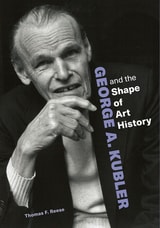
George A. Kubler and the Shape of Art History
Thomas F. Reese
J. Paul Getty Trust, The, 0
Art historian George A. Kubler (1912–1996) was a foundational scholar of ancient American art and archaeology as well as Spanish and Portuguese architecture. During over five decades at Yale University, he published seventeen books that included innovative monographs, major works of synthesis, and an influential theoretical treatise. In this biography, Thomas F. Reese analyzes the early formation, broad career, and writings of Kubler, casting nuanced light on the origins and development of his thinking.
Notable in Reese’s discussion and contextualization of Kubler’s writings is a revealing history and analysis of his Shape of Time—a book so influential to students, scholars, artists, and curious readers in multiple disciplines that it has been continuously in print since 1962. Reese reveals how pivotal its ideas were in Kubler’s own thinking: rather than focusing on problems of form as an ordering principle, he increasingly came to sequence works by how they communicate meaning. The author demonstrates how Kubler, who professed to have little interest in theory, devoted himself to the craft of art history, discovering and charting the rules that guided the propagation of structure and significance through time.
German Colonialism in a Global Age
Bradley Naranch and Geoff Eley, eds.
Duke University Press, 2015
Contributors. Dirk Bönker, Jeff Bowersox, David Ciarlo, Sebastian Conrad, Christian S. Davis, Geoff Eley, Jennifer Jenkins, Birthe Kundus, Klaus Mühlhahn, Bradley Naranch, Deborah Neill, Heike Schmidt, J. P. Short, George Steinmetz, Dennis Sweeney, Brett M. Van Hoesen, Andrew Zimmerman
German Memorials, Motifs, and Meanings
A Cultural History in Bronze, Wood, and StoneJennifer Hansen-Glucklich
University of Massachusetts Press, 2025
German Memorials, Motifs, and Meanings offers a unique cultural history of German memorialization. The book focuses not on a single, isolated era, but rather on enduring memorial motifs—enchanted stones, magical trees, raised fists, stone circles, and similar evocative symbols derived from myth, folklore, Christianity, national iconography, and post-Holocaust imagery. It thus takes a long-duration perspective, sweeping across the centuries to explore abiding themes such as death, rebirth, and redemption; violence and reconciliation; and sacrifice, identity, and community. Along with a consideration of the historical and social circumstances of each memorial and its motifs, author Jennifer Hansen-Glucklich answers the questions of why and how these cultural markers survive the passage of time and how they endure amidst cultural, social, and political upheavals that include the rise and fall of empires, catastrophes of war and occupation, and genesis of new national identities. She uniquely focuses on lesser-known or unknown memorials found either in smaller German cities or tucked away in villages and hamlets.
These memorials tell colorful, often ambiguous and problematic stories in contrast to the vaunted monuments of Germany’s post-WWII era, such as Berlin’s Memorial to the Murdered Jews of Europe. Through vivid descriptions and deep analysis of the narratives and aesthetics of key monuments and motifs, Hansen-Glucklich details the remarkable story of German memorial culture from medieval times to the present day.
Gesta Hungarorum
The Deeds of the HungariansSimon Kézai
Central European University Press, 1999
Ghosts Of Slavery
A Literary Archaeology of Black Women’s LivesJenny Sharpe
University of Minnesota Press, 2002
Questions traditional assumptions about power and agency in slave women’s everyday lives.
Through their open defiance, women like Harriet Tubman and Sojourner Truth had a significant impact on the institution of slavery. But what of the countless other women who did not commit public or even private acts of resistance? Are their stories worthy of our attention? While some scholars imply that only the struggle for freedom was legitimate, Jenny Sharpe complicates the linear narrative-from slavery to freedom and literacy-that emerged from the privileging of autobiographical accounts like that of Frederick Douglass. She challenges a paradigm that equates agency with resistance and self-determination, and introduces new ways to examine negotiations for power within the constraints of slavery.
In Ghosts of Slavery, Sharpe introduces a wider range of everyday practices by examining the lives of three distinctive Caribbean women: a maroon leader, a mulatto concubine, and a fugitive slave. Through them she explains how the diasporic experience of slavery enabled black women to claim an authority that they didn’t possess in Africa, how concubines empowered themselves through their mimicry of white women, and how less-privileged slave women manipulated situations that they were powerless to change. Finding the highly mediated portrayal of slave women in the historical records limited and sometimes misleading, Sharpe turns to unconventional sources for investigating these women’s lives. In this fascinating and historically rich account, she calls for new strategies of reading that question traditional narratives of history, and she finds alternative ways to integrate oral storytelling, slave songs, travel writing, court documents, proslavery literature, and contemporary literature into black history. Ultimately, this layered approach not only produces a more complex picture of the slave women’s agency than conventional readings, it encourages a more nuanced understanding of the roles of slaves in the history of slavery.
Given World and Time
Temporalities in ContextTyrus Miller
Central European University Press, 2008
Glamorous Sorcery
Magic and Literacy in the High Middle AgesDavid Rollo
University of Minnesota Press, 2000
God's Scribe
The Historiographical Art of Galbert of BrugesJeff Rider
Catholic University of America Press, 2001
Growing in the Shadow of Antifascism
Remembering the Holocaust in State-Socialist Eastern EuropeKata Bohus
Central European University Press, 2022
Reined into the service of the Cold War confrontation, antifascist ideology overshadowed the narrative about the Holocaust in the communist states of Eastern Europe. This led to the Western notion that in the Soviet Bloc there was a systematic suppression of the memory of the mass murder of European Jews. Going beyond disputing the mistaken opposition between “communist falsification” of history and the “repressed authentic” interpretation of the Jewish catastrophe, this work presents and analyzes the ways as the Holocaust was conceptualized in the Soviet-ruled parts of Europe.
The authors provide various interpretations of the relationship between antifascism and Holocaust memory in the communist countries, arguing that the predominance of an antifascist agenda and the acknowledgment of the Jewish catastrophe were far from mutually exclusive. The interactions included acts of negotiation, cross-referencing, and borrowing. Detailed case studies describe how both individuals and institutions were able to use anti-fascism as a framework to test and widen the boundaries for discussion of the Nazi genocide. The studies build on the new historiography of communism, focusing on everyday life and individual agency, revealing the formation of a great variety of concrete, local memory practices.
Guaman Poma
Writing and Resistance in Colonial PeruBy Rolena Adorno
University of Texas Press, 2000
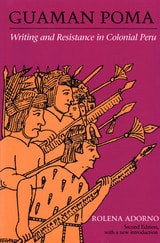
In the midst of native people's discontent following Spanish conquest, a native Andean born after the fall of the Incas took up the pen to protest Spanish rule. Felipe Guaman Poma de Ayala wrote his Nueva corónica y buen gobierno to inform Philip III of Spain about the evils of colonialism and the need for governmental and societal reform. By examining Guaman Poma's verbal and visual engagement with the institutions of Western art and culture, Rolena Adorno shows how he performed a comprehensive critique of the colonialist discourse of religion, political theory, and history. She argues that Guaman Poma's work chronicles the emergence of a uniquely Latin American voice, characterized by the articulation of literary art and politics.
Following the initial appearance of Guaman Poma: Writing and Resistance in Colonial Peru, the 1990s witnessed the creation of a range of new studies that underscore the key role of the Nueva corónica y buen gobierno in facilitating our understanding of the Andean and Spanish colonial pasts. At the same time, the documentary record testifying to Guaman Poma's life and work has expanded dramatically, thanks to the publication of long-known but previously inaccessible drawings and documents. In a new, lengthy introduction to this second edition, Adorno shows how recent scholarship from a variety of disciplinary perspectives sheds new light on Guaman Poma and his work, and she offers an important new assessment of his biography in relation to the creation of the Nueva corónica y buen gobierno.