Results by title
148 books match the query 'History, Military' and 3 start with g
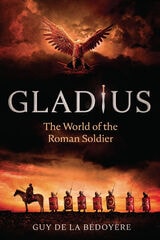
Gladius
The World of the Roman SoldierGuy de la Bédoyère
University of Chicago Press, 2020
Empire.
The Roman army was the greatest fighting machine in the ancient world. More than that, it was the single largest organization in Western antiquity, taking in members from all classes, from senators to freed slaves. The Roman Empire depended on its army not just to win its wars, defend its frontiers, and control the seas, but to act as the very engine of the state.
In Gladius, Guy de la Bédoyère takes us straight to the heart of what it meant to be a part of the Roman army. Rather than a history of the army itself, or a guide to military organization and fighting methods, this book is a ground-level recreation of what it was like to be a soldier in the army that made the empire. Surveying numerous aspects of life in the Roman army between 264 BCE and 337 CE, Gladius—the Latin word for sword—draws not only on the words of famed Roman historians, but also those of the soldiers themselves, as recorded in their religious dedications, tombstones, and even private letters and graffiti. Gladius reveals the everyday life of these soldiers and their families, whether stationed in a bleak frontier garrison in Britain or North Africa, tasked with guarding the emperor in Rome, fighting on foreign battlefields, mutinying over pay, marching in triumph, throwing their weight around on city streets, or enjoying esteem in honorable retirement.
By illuminating the history of one organization that reflected all corners of the Roman world, Gladius gives us a portrait of an ancient society that is unprecedented in both its broad sweep and gritty intimacy.
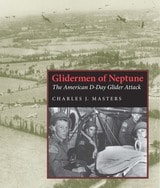
Glidermen of Neptune
The American D-Day Glider AttackCharles J. Masters
Southern Illinois University Press, 1995
Although the word gliderman does not appear in the dictionary, a brave group of World War II soldiers known as glidermen flew into combat inside unarmed and unarmored canvas-covered gliders known as "flying coffins."
Charles J. Masters points out that because World War II was the first truly mechanized and armored global conflict, the role of the glidermen and their combat gliders was at best anachronistic. Fighter planes exceeded speeds of 400 miles per hour and were heavily armed with multiple machine guns. Dogfights had taken on new dimensions, eclipsing the tactics, speed, and firepower first evidenced by the fragile biplanes of World War I. Tanks achieved a lethal efficiency barely dreamed of even five years before the war. An array of weaponry never seen in any previous military engagement confronted the combat soldier during World War II.And yet there were gliders. And glidermen.
Masters tells of these men and of their fragile aircraft in a war of mechanized chaos. In copious detail, he describes the gliders and the Americans who boarded them during the American D-Day glider attack, a mission that was part of the overall cross-channel plan code-named "Operation Neptune." The son of a gliderman with the 82nd Airborne Division, Masters had unique access to the surviving glidermen and comrades of his father. During the course of his research, he located and interviewed 106 of the men who had flown the D-Day mission in gliders. As an insider—in a sense almost a member of the family and fraternity of glider-men—Masters was cordially received by the members of the American airborne divisions that participated in D-Day, many of whom told him stories they had seldom told their own friends and families. Often harrowing and always riveting, the stories these men told an eager listener and researcher are very much a part of this narrative.
Masters has also assembled the finest existing collection of photographs of the American D-Day glider attack. These photographs—many of which have never before been published—provide a spectacular photographic record of a little-known aspect of this war. In fact, because of the short military history of the American combat glider, most readers, including veterans of World War II, will not have seen one of these "flying coffins," even at a distance. These photographs afford the opportunity to actually examine the inside of the combat gliders used on D-Day, to observe the glidermen in action, and to witness the often tragic consequences of the glider attack.
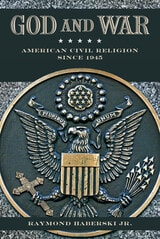
God and War
American Civil Religion since 1945Haberski, Jr., Raymond
Rutgers University Press, 2012
Americans have long considered their country to be good—a nation "under God" with a profound role to play in the world. Yet nothing tests that proposition like war. Raymond Haberski argues that since 1945 the common moral assumptions expressed in an American civil religion have become increasingly defined by the nation's experience with war.
God and War traces how three great postwar “trials”—the Cold War, the Vietnam War, and the War on Terror—have revealed the promise and perils of an American civil religion. Throughout the Cold War, Americans combined faith in God and faith in the nation to struggle against not only communism but their own internal demons. The Vietnam War tested whether America remained a nation "under God," inspiring, somewhat ironically, an awakening among a group of religious, intellectual and political leaders to save the nation's soul. With the tenth anniversary of 9/11 behind us and the subsequent wars in Iraq and Afghanistan winding down, Americans might now explore whether civil religion can exist apart from the power of war to affirm the value of the nation to its people and the world.