Results by title
219 books match the query 'Holocaust, Jewish (1939-1945)' and 3 start with g
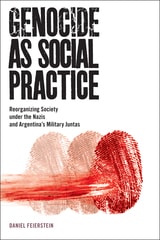
Genocide as Social Practice
Reorganizing Society under the Nazis and Argentina's Military Juntasby Daniel Feierstein, Translated by Douglas Andrew Town
Rutgers University Press, 2014
The Nazis resorted to ruthless methods in part to stifle dissent but even more importantly to reorganize German society into a Volksgemeinschaft, or people’s community, in which racial solidarity would supposedly replace class struggle. The situation in Argentina echoes this. After seizing power in 1976, the Argentine military described its own program of forced disappearances, torture, and murder as a “process of national reorganization” aimed at remodeling society on “Western and Christian” lines.
For Feierstein, genocide can be considered a technology of power—a form of social engineering—that creates, destroys, or reorganizes relationships within a given society. It influences the ways in which different social groups construct their identity and the identity of others, thus shaping the way that groups interrelate. Feierstein establishes continuity between the “reorganizing genocide” first practiced by the Nazis in concentration camps and the more complex version—complex in terms of the symbolic and material closure of social relationships —later applied in Argentina. In conclusion, he speculates on how to construct a political culture capable of confronting and resisting these trends.
First published in Argentina, in Spanish, Genocide as Social Practice has since been translated into many languages, now including this English edition. The book provides a distinctive and valuable look at genocide through the lens of Latin America as well as Europe.
Download open access ebook here.

Ghetto Kingdom
Tales of the Lodz GhettoIsaiah Spiegel
Northwestern University Press, 1998
The stories examine the relationship between inmates and their families, their friends, their Christian former neighbors, the German soldiers, and, ultimately, the world of hopelessness and desperation that surrounded them. In using his creative powers to transform the suffering and death of his people into stories that preserve their memory, Spiegel succeeds in affirming the humanity and dignity the Germans were so intent on destroying.
Originally published as Malchut geto (Malkhes geto) in Yiddish.
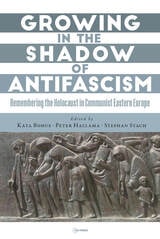
Growing in the Shadow of Antifascism
Remembering the Holocaust in State-Socialist Eastern EuropeKata Bohus
Central European University Press, 2022
Reined into the service of the Cold War confrontation, antifascist ideology overshadowed the narrative about the Holocaust in the communist states of Eastern Europe. This led to the Western notion that in the Soviet Bloc there was a systematic suppression of the memory of the mass murder of European Jews. Going beyond disputing the mistaken opposition between “communist falsification” of history and the “repressed authentic” interpretation of the Jewish catastrophe, this work presents and analyzes the ways as the Holocaust was conceptualized in the Soviet-ruled parts of Europe.
The authors provide various interpretations of the relationship between antifascism and Holocaust memory in the communist countries, arguing that the predominance of an antifascist agenda and the acknowledgment of the Jewish catastrophe were far from mutually exclusive. The interactions included acts of negotiation, cross-referencing, and borrowing. Detailed case studies describe how both individuals and institutions were able to use anti-fascism as a framework to test and widen the boundaries for discussion of the Nazi genocide. The studies build on the new historiography of communism, focusing on everyday life and individual agency, revealing the formation of a great variety of concrete, local memory practices.