Results by title
405 books match the query 'Human Geography' and 17 start with g
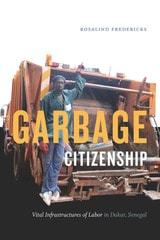
Garbage Citizenship
Vital Infrastructures of Labor in Dakar, SenegalRosalind Fredericks
Duke University Press, 2018
Gender, Identity, and Place
Understanding Feminist GeographiesLinda Mcdowell
University of Minnesota Press, 1999
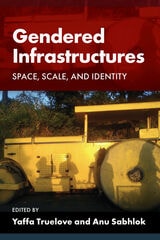
Gendered Infrastructures
Space, Scale, and IdentityYaffa Truelove
West Virginia University Press, 2024
The first book to take a feminist geographical approach to infrastructure, Gendered Infrastructures delves into the complex relationships between identity, social relations, and infrastructure. By drawing on feminist scholarship to enable new frameworks for critical study, this edited volume explores the gendered nature of infrastructures as diverse as Senegal’s waste disposal, Vietnam’s cement industry, and Lilongwe’s water kiosks. The chapters consider how infrastructural assemblages rework and shape gendered relations, identities, and meanings across space, while tracing the intersectionality of relations and uneven geographies that surround infrastructure. Ultimately, the contributors show how gender is always present in the quotidian building blocks that organize the socio-material world and daily life.
Edited by Yaffa Truelove and Anu Sabhlok, and the third book in Amy Trauger and Jennifer Fluri’s Gender, Feminism, and Geography series, the original essays in Gendered Infrastructures respond to and build upon a “new infrastructural turn in critical scholarship”—one that has helped enliven studies of identity across scale. The volume is relevant to geographers, anthropologists, architects, sociologists, urban researchers, and other interdisciplinary scholars interested in the gendered and social dimensions of infrastructure.
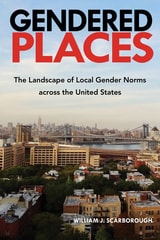
Gendered Places
The Landscape of Local Gender Norms across the United StatesWilliam J. Scarborough
Temple University Press, 2023
Every place has its quirky attributes, cultural reputation, and distinctive flair. But when we travel across America, do we also experience distinct gender norms and expectations? In his groundbreaking Gendered Places, William Scarborough examines metropolitan commuting zones to see how each region’s local culture reflects gender roles and gender equity. He uses surveys and social media data to measure multiple dimensions of gender norms, including expectations toward women in leadership, attitudes toward working mothers, as well as the division of household labor.
Gendered Places reveals that different locations, even within the same region of the country, such as Milwaukee and Madison Wisconsin, have distinct gender norms and highly influential cultural environments. Scarboroughshows how these local norms shape the attitudes and behaviors of residents with implications on patterns of inequality such as the gender wage gap. His findings offer valuable insight for community leaders and organizers making efforts to promote equality in their region.
Scarboroughrecognizes local culture as not value-neutral, but highly crucial to the gender structure that perpetuates, or challenges, gender inequality. Gendered Places questions how these gender norms are sustained and their social consequences.
Geographic Citizen Science Design
No One Left BehindEdited by Artemis Skarlatidou and Muki Haklay
University College London, 2020
Unbeknownst to them as they made their scientific discoveries, Isaac Newton, Charles Darwin, and other “gentlemen scientists” would later inspire a field of scientific practice and innovation known as citizen science. Today, the growth and availability of citizen science projects have been substantial, as anyone can now contribute to a scientific discipline without professional qualifications. As a subset of this movement, geographic citizen science presents a unique approach towards supporting the participation of everyday citizens in the collection, analysis, and dissemination of scientific data. This book presents a selection of wide-ranging case studies that provide insights into the design, interaction barriers, and lessons learned from a diverse set of participants. The volume captures the current status of research and development of geographic citizen science, providing critical insight to inform technological innovation and future research in this area.
Geographical Identities Of Ethnic America
Race, Space, And PlaceKate A. Berry
University of Nevada Press, 2001
Geographies of Digital Exclusion
Data and InequalityMark Graham
Pluto Press, 2021
Today's urban environments are layered with data and algorithms that fundamentally shape how we perceive and move through space. But are our digitally dense environments continuing to amplify inequalities rather than alleviate them? This book looks at the key contours of information inequality, and who, what and where gets left out.
Platforms like Google Maps and Wikipedia have become important gateways to understanding the world, and yet they are characterized by significant gaps and biases, often driven by processes of exclusion. As a result, their digital augmentations tend to be refractions rather than reflections: they highlight only some facets of the world at the expense of others.
This doesn't mean that more equitable futures aren't possible. By outlining the mechanisms through which our digital and material worlds intersect, the authors conclude with a roadmap for what alternative digital geographies might look like.
Geographies of Writing
Inhabiting Places and Encountering DifferenceNedra Reynolds
Southern Illinois University Press, 2004
Twenty-first-century technological innovations have revolutionized the way we experience space, causing an increased sense of fragmentation, danger, and placelessness. In Geographies of Writing: Inhabiting Places and Encountering Difference, Nedra Reynolds addresses these problems in the context of higher education, arguing that theories of writing and rhetoric must engage the metaphorical implications of place without ignoring materiality.
Geographies of Writing makes three closely related contributions: one theoretical, to reimagine composing as spatial, material, and visual; one political, to understand the sociospatial construction of difference; and one pedagogical, to teach writing as a set of spatial practices. Aided by seven maps and illustrations that reinforce the book’s visual rhetoric, Geographies of Writing shows how composition tasks and electronic space function as conduits for navigating reality.
Geography, Resources and Environment, Volume 2
Themes from the Work of Gilbert F. WhiteEdited by Robert W. Kates and Ian Burton
University of Chicago Press, 1986
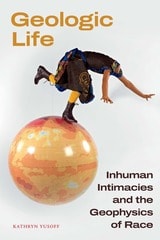
Geologic Life
Inhuman Intimacies and the Geophysics of RaceKathryn Yusoff
Duke University Press, 2024

Get Yo' Life
Black Queer PlacemakingR. J. Millhouse
The Ohio State University Press, 2025
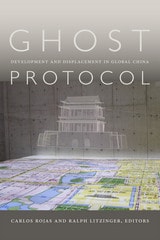
Ghost Protocol
Development and Displacement in Global ChinaCarlos Rojas and Ralph A. Litzinger, editors
Duke University Press, 2016
Contributors. Yomi Braester, Alexander Des Forges, Kabzung, Rachel Leng, Ralph A. Litzinger, Lisa Rofel, Carlos Rojas, Bryan Tilt, Robin Visser, Biao Xiang, Emily T. Yeh
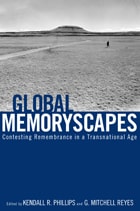
Global Memoryscapes
Contesting Remembrance in a Transnational AgeEdited by Kendall R. Phillips and G. Mitchell Reyes
University of Alabama Press, 2011
The essays contained within the volume--by scholars from a wide range of disciplines including American studies, art history, political science, psychology, and sociology--each engage a particular instance of the practices of memory as they are complicated by globalization.
Subjects include the place of nostalgia in post-Yugoslavia Serbian national memory, Russian identity after the collapse of the Soviet Union, political remembrance in South Africa’s Truth and Reconciliation Commissions, the role of Chilean mass media in forging national identity following the arrest of Augusto Pinochet, American debates over memorializing Japanese internment camps, and how the debate over the Iraq war is framed by memories of opposition to the Vietnam War.

Globalization
Millennial Quartet II, Volume 12Arjun Appadurai, ed.
Duke University Press, 0
Seeking an alternative to the dead-end debate between those who see globalization as a phenomenon wholly without precedent and those who see it simply as modernization, imperialism, or global capitalism with a new face, the contributors seek to illuminate how space and time are transforming each other in special ways in the present era. They examine how this complex transformation involves changes in the situation of the nation, the state, and the city. While exploring distinct regions—China, Africa, South America, Europe—and representing different disciplines and genres—anthropology, literature, political science, sociology, music, cinema, photography—the contributors are concerned with both the political economy of location and the locations in which political economies are produced and transformed. A special strength of the collection is its concern with emergent styles of subjectivity, citizenship, and mobilization and with the transformations of state power through which market rationalities are distributed and embodied locally.
Contributors. Arjun Appadurai, Jérome Bindé, Néstor García Canclini, Leo Ching, Steven Feld, Ralf D. Hotchkiss, Wu Hung, Andreas Huyssen, Boubacar Touré Mandémory, Achille Mbembe, Saskia Sassen, Fatu Kande Senghor, Seteney Shami, Anna Tsing, Zhang Zhen
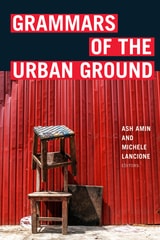
Grammars of the Urban Ground
Ash Amin and Michele Lancione, editors
Duke University Press, 2022
Contributors. Ash Amin, Teresa Caldeira, Filip De Boeck, Suzanne Hall, Caroline Knowles, Michele Lancione, Colin McFarlane, Natalie Oswin, Edgar Pieterse, Ananya Roy, AbdouMaliq Simone, Tatiana Thieme, Nigel Thrift, Mariana Valverde
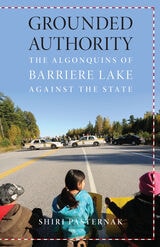
Grounded Authority
The Algonquins of Barriere Lake against the StateShiri Pasternak
University of Minnesota Press, 2017
Western Political Science Association's Clay Morgan Award for Best Book in Environmental Political Theory
Canadian Studies Network Prize for the Best Book in Canadian Studies
Nominated for Best First Book Award at NAISA
Honorable Mention: Association for Political and Legal Anthropology Book Prize
Since Justin Trudeau’s election in 2015, Canada has been hailed internationally as embarking on a truly progressive, post-postcolonial era—including an improved relationship between the state and its Indigenous peoples. Shiri Pasternak corrects this misconception, showing that colonialism is very much alive in Canada. From the perspective of Indigenous law and jurisdiction, she tells the story of the Algonquins of Barriere Lake, in western Quebec, and their tireless resistance to federal land claims policy.
Grounded Authority chronicles the band’s ongoing attempts to restore full governance over its lands and natural resources through an agreement signed by settler governments almost three decades ago—an agreement the state refuses to fully implement. Pasternak argues that the state’s aversion to recognizing Algonquin jurisdiction stems from its goal of perfecting its sovereignty by replacing the inherent jurisdiction of Indigenous peoples with its own, delegated authority. From police brutality and fabricated sexual abuse cases to an intervention into and overthrow of a customary government, Pasternak provides a compelling, richly detailed account of rarely documented coercive mechanisms employed to force Indigenous communities into compliance with federal policy.
A rigorous account of the incredible struggle fought by the Algonquins to maintain responsibility over their territory, Grounded Authority provides a powerful alternative model to one nation’s land claims policy and a vital contribution to current debates in the study of colonialism and Indigenous peoples in North America and globally.
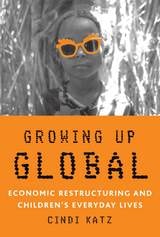
Growing Up Global
Economic Restructuring and Children’s Everyday LivesCindi Katz
University of Minnesota Press, 2004
Growing Up Global examines the processes of development and global change through the perspective of children’s lives in two seemingly disparate places: New York City and a village in northern Sudan. At the book’s core is a longitudinal ethnographic study of children growing up in a Sudanese village that was included in a large state-sponsored agricultural program in the year they were born. It follows a small number of children intermittently from ten years of age to early adulthood, concentrating particularly on their work and play, which together trained the children for an agrarian life centered around the family, a life that was quickly becoming obsolete.
Shifting her focus to largely working-class families in New York City in the 1980s and 1990s, Katz is able to expose unsuspected connections with the Sudanese experience in the effects on children of a constantly changing, capitalist environment—the decline of manufacturing jobs and the increase in knowledge-based jobs—in which young people with few skills and stunted educations face bleak employment prospects. In teasing out how “development” transforms the grounds on which these young people come of age, Cindi Katz provides a textured analysis of the importance of knowledge in the ability of people, families, and communities to reproduce themselves and their material social practices over time.