Results by title
95 books match the query 'Ideology' and 3 start with g

Genesis of The Brothers Karamazov
The Aesthetics, Ideology, and Psychology of Making a TextRobert L. Belknap
Northwestern University Press, 1990
Robert L. Belknap is the author of The Structure of "The Brothers Karamazov," which is generally regarded as one of the best studies on Dostoevsky produced by the present generation of scholars. The Genesis of "The Brothers Karamazov" continues and complements Belknap's earlier work, tracing Dostoevsky's last, great novel to its sources and exploring the works Dostoevsky read and consciously employed in constructing it.
[more]

German Ideology
From France to Germany and BackLouis Dumont
University of Chicago Press, 1995
In this comparative anthropological analysis, Louis Dumont illuminates German and French ideology, European culture, and cultural interaction. His analysis of texts by Troeltsch, Thomas Mann, Goethe, and others, against the background of previously gathered evidence and of French common notions, specify the differences—otherwise frequently but vaguely alluded to—between French and German cultures.
Anyone interested in the fate of national ideology and the concept of the individual will benefit from this radical reinterpretation of modern values and the place of modernity in history.
"What François Furet did for French history, Dumont did for anthropology, turning it away from engaged politics and towards the sober study of the modern age." —Mark Lilla, London Review of Books
"There are many fine things in Dumont's study. Beyond any doubt, his cultural anthropology of the modern spirit highlights some of the key energies of the of the last two centuries. . . . [An] impressive . . . detailed analysis." —Martin Swales, Times Higher Education Supplement
"[An] unsettling, rich, demanding, profound study." —Publishers Weekly
[more]
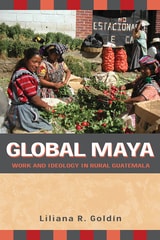
Global Maya
Work and Ideology in Rural GuatemalaLiliana R. Goldín
University of Arizona Press, 2009
In the central highland Maya communities of Guatemala, the demands of the global economy have become a way of life. This book explores how rural peoples experience economic and cultural change as their country joins the global market, focusing on their thoughts about work and sustenance as a way of learning about Guatemala’s changing economy.
For more than a decade, Liliana Goldín observed in highland towns both the intensification of various forms of production and their growing links to wider markets. In this first book to compare economic ideology across a range of production systems, she examines how people make a living and how they think about their options, practices, and constraints. Drawing on interviews and surveys—even retellings of traditional narratives—she reveals how contemporary Maya respond to the increasingly globalized yet locally circumscribed conditions in which they work.
Goldín presents four case studies: cottage industries devoted to garment production, vegetable growing for internal and border markets reached through direct commerce, crops grown for export, and wage labor in garment assembly factories. By comparing generational and gendered differences among workers, she reveals not only complexities of change but also how these complexities arereflected in changing attitudes, understandings, and aspirations that characterize people’s economic ideology. Further, she shows that as rural people take on diverse economic activities, they also reinterpret their views on such matters as accumulation, cooperation, competition, division of labor, and community solidarity.
Global Maya explores global processes in local terms, revealing the interplay of traditional values, household economics, and the inescapable conditions of demographic growth, a shrinking land base, and a global economy always looking for cheap labor. It offers a wealth of new insights not only for Maya scholars but also for anyone concerned with the effects of globalization on the Third World.
[more]