Results by title
593 books match the query 'Jews' and 13 start with g
Gender, Religion, and Family Law
Theorizing Conflicts between Women’s Rights and Cultural TraditionsEdited by Lisa Fishbayn Joffe and Sylvia Neil
Brandeis University Press, 2012
Genetic Afterlives
Black Jewish Indigeneity in South AfricaNoah Tamarkin
Duke University Press, 2020
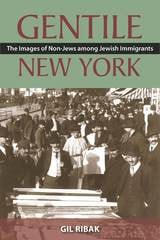
Gentile New York
The Images of Non-Jews among Jewish ImmigrantsRibak, Gil
Rutgers University Press, 2012
The very question of “what do Jews think about the goyim” has fascinated Jews and Gentiles, anti-Semites and philo-Semites alike. Much has been written about immigrant Jews in nineteenth- and twentieth-century New York City, but Gil Ribak’s critical look at the origins of Jewish liberalism in America provides a more complicated and nuanced picture of the Americanization process.
Gentile New York examines these newcomers’ evolving feelings toward non-Jews through four critical decades in the American Jewish experience. Ribak considers how they perceived Gentiles in general as well as such different groups as “Yankees” (a common term for WASPs in many Yiddish sources), Germans, Irish, Italians, Poles, and African Americans. As they discovered the complexity of America’s racial relations, the immigrants found themselves at odds with “white” American values or behavior and were drawn instead into cooperative relationships with other minorities. Sparked with many previously unknown anecdotes, quotations, and events, Ribak’s research relies on an impressive number of memoirs, autobiographies, novels, newspapers, and journals culled from both sides of the Atlantic.
German City, Jewish Memory
The Story of WormsNils Roemer
Brandeis University Press, 2010
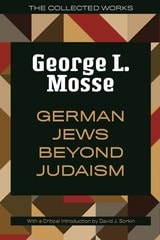
German Jews Beyond Judaism
George L. Mosse, With a critical introduction by David J. Sorkin
University of Wisconsin Press, 2025
German Jews Beyond Judaism was, in Mosse’s own estimation, his “most personal book, almost a confession of faith.” David J. Sorkin’s new critical introduction illustrates how Mosse’s life and values both shaped and exemplified his historical analysis and offers potential meanings of his intellectual legacy for the present day.
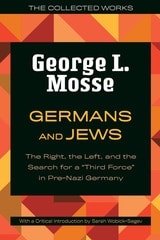
Germans and Jews
The Right, the Left, and the Search for a "Third Force" in Pre-Nazi GermanyGeorge L. Mosse
University of Wisconsin Press, 2023
This innovative perspective has implications for understanding not only the rise of fascism and Nazism in Germany but also the rise and fall of the New Left in the United States and Europe, which was occurring at the time of Mosse’s writing. A new critical introduction by Sarah Wobick-Segev, research associate at the University of Hamburg, places Mosse’s work in its historical and intellectual contexts and draws lessons for students and scholars today.
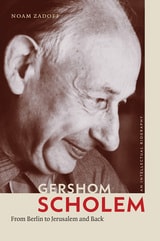
Gershom Scholem
From Berlin to Jerusalem and BackNoam Zadoff
Brandeis University Press, 2017
Ghetto Kingdom
Tales of the Lodz GhettoIsaiah Spiegel
Northwestern University Press, 1998
The stories examine the relationship between inmates and their families, their friends, their Christian former neighbors, the German soldiers, and, ultimately, the world of hopelessness and desperation that surrounded them. In using his creative powers to transform the suffering and death of his people into stories that preserve their memory, Spiegel succeeds in affirming the humanity and dignity the Germans were so intent on destroying.
Originally published as Malchut geto (Malkhes geto) in Yiddish.
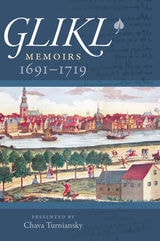
Glikl
Memoirs 1691-1719Annotated by and with an Introduction by Chava Turniansky
Brandeis University Press, 2019
These words from the memoirs Glikl bas Leib wrote in Yiddish between 1691 and 1719 shed light on the life of a devout and worldly woman. Writing initially to seek solace in the long nights of her widowhood, Glikl continued to record the joys and tribulations of her family and community in an account unique for its impressive literary talents and strong invocation of self. Through intensely personal recollections, Glikl weaves stories and traditional tales that express her thoughts and beliefs. While influenced by popular Yiddish moral literature, Glikl’s frequent use of first person and the significance she assigns her own life experience set the work apart. Informed by fidelity to the original Yiddish text, this authoritative new translation is fully annotated to explicate Glikl’s life and times, offering readers a rich context for appreciating this classic work.
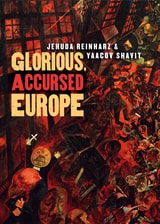
Glorious, Accursed Europe
Jehuda Reinharz and Yaacov Shavit
Brandeis University Press, 2010

Good for the Jews
Debra Spark
University of Michigan Press, 2009
Good for the Jews is a smart, funny, sexy novel set in Madison, Wisconsin, during the Bush administration. Part mystery and part stranger-comes-to town story, Good for the Jews is loosely based on the biblical book of Esther. Like Esther, Debra Spark's characters deal with anti-Semitism and the way that powerful men—and the women who love them—negotiate bureaucracies.
At the core of the story of right and wrong are young, attractive Ellen Hirschorn and her older cousin Mose, a high school teacher who thinks he knows, in fact, what is "good for the Jews"—and for Ellen, too. Their stories intertwine with those of the school superintendent, his ex-wife and son, and a new principal. Workplace treachery, the bonds of family, coming of age, and romantic relationships all take center stage as the characters negotiate the fallout from a puzzling fire.
Spark's evocative writing style and sharp, understanding treatment of her diverse characters draw the reader into this surprising page-turner, a finalist for the 2009 Foreword Magazine Book of the Year Award.
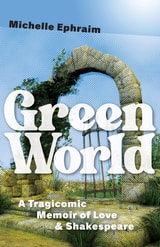
Green World
A Tragicomic Memoir of Love & ShakespeareMichelle Ephraim
University of Massachusetts Press, 2024
Shortlisted for the 2026William Saroyan International Prize for Writing • Shortlisted for the Story Circle Network Gilda Prize • Winner of the Wisconsin Library Association's Literary Award for Nonfiction • Shortlisted for the Rubery Book Award • A 2025 IPPY Awards Silver Medal Winner in Autobiography/Memoir • Winner of the 2025 Friends of American Writers Adult Literature Award • A 2024 Foreword INDIES Finalist • A 2025 Sophie Brody Medal Notable Book • A Jewish Women's Archive Summer Book Club Pick
At twenty-three, Michelle Ephraim was failing at everything. The only child of reclusive Holocaust-survivor parents who were dismayed by her literary studies, she found herself dumped by her boyfriend and bombing out of graduate school. Then, one night, she crashed a Shakespeare recitation party. Loopy from vodka and never having read a single line of Shakespeare, she was transfixed. Shakespeare, she decided, was the lifeline she needed.
Green World is the hilarious and heartbreaking story of Ephraim’s quest to become a Shakespeare scholar and to find community and home. As she studies Shakespeare, Ephraim’s world uncannily begins to mirror the story of the Jewish daughter in The Merchant of Venice, and she finds herself in a Green World, an idyllic place where Shakespeare’s heroines escape their family trauma. Green World reckons with global, historical, and personal tragedy and shows how literature—comic and tragic—can help us brave every kind of anguish.
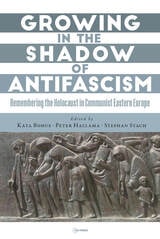
Growing in the Shadow of Antifascism
Remembering the Holocaust in State-Socialist Eastern EuropeKata Bohus
Central European University Press, 2022
Reined into the service of the Cold War confrontation, antifascist ideology overshadowed the narrative about the Holocaust in the communist states of Eastern Europe. This led to the Western notion that in the Soviet Bloc there was a systematic suppression of the memory of the mass murder of European Jews. Going beyond disputing the mistaken opposition between “communist falsification” of history and the “repressed authentic” interpretation of the Jewish catastrophe, this work presents and analyzes the ways as the Holocaust was conceptualized in the Soviet-ruled parts of Europe.
The authors provide various interpretations of the relationship between antifascism and Holocaust memory in the communist countries, arguing that the predominance of an antifascist agenda and the acknowledgment of the Jewish catastrophe were far from mutually exclusive. The interactions included acts of negotiation, cross-referencing, and borrowing. Detailed case studies describe how both individuals and institutions were able to use anti-fascism as a framework to test and widen the boundaries for discussion of the Nazi genocide. The studies build on the new historiography of communism, focusing on everyday life and individual agency, revealing the formation of a great variety of concrete, local memory practices.