Results by title
403 books match the query 'Journalism' and 8 start with g

Gender Violence and the Press
The St. Kizito StoryH. Leslie Steeves
Ohio University Press, 1997
On the night of Saturday, July 13, 1991, a mob of male students at the St. Kizito Mixed Secondary School in Meru, Kenya, attacked their female classmates in a dormitory. Nineteen schoolgirls were killed in the melee and more than 70 were raped or gang raped. The explanations in the press for the attack included a rebellion by male students over administrative mismanagement, academic stress, cultural norms for the Meru ethnic group, and victim characteristics (as assumed in rape myths). Rape had been tolerated at the school, according to press accounts. Dr. Steeves studied all stories published in three Nairobi daily newspapers and a weekly Kenyan newsmagazine for the year following the crime. She also examined a sampling of international reports. Her qualitative analysis sought to identify “framing patterns” supportive of patriarchal or of feminist ideologies of rape, and the ways in which those patterns have been affected by news values and traditions. Gender Violence and the Press shows how media discourse may allow space for feminist interests within the dominant patriarchal ideology. In this instance, the appearance of resistant views was significant in making alternative meanings available and in supporting women’s growing anti-violence activism.
[more]
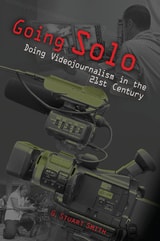
Going Solo
Doing Videojournalism in the 21st CenturyG. Stuart Smith
University of Missouri Press, 2011
The traditional model of video news reporting has always had two separate roles: reporting and videography. For years, however, small-market news outlets have relied on “one-man bands”—individual reporters who shoot and edit their own video—for stories and footage. Lately, as the journalism landscape has evolved, this controversial practice has grown more and more popular. With the use of video constantly expanding, many large-market TV stations, networks, and newspaper Web sites are relying on one person to carry out a job formerly executed by two. News outlets now call these contributors VJs, digital journalists, backpack journalists, or mobile journalists. But no matter what they are called, there’s no denying the growing significance of solo videojournalists to the media landscape.
Going Solo: Doing Videojournalism in the 21st Century details the controversy, history, and rise of this news genre, but its main objective is to show aspiring videojournalists how to learn the craft. While other textbooks depict the conventional reporter-and-videographer model, Going Solo innovates by teaching readers how to successfully juggle the skills traditionally required of two different people.
Award-winning journalist G. Stuart Smith begins by describing how and why the media’s use of solo videojournalists is growing, then delves into the controversy over whether one person can cover a story as well as two. He illuminates how, together, the downsizing of the media, downturn in the economy, and growth of video on the Web have led to the rise of the solo videojournalist model. Going Solo profiles TV stations and newspaper Web operations across the country that are using the model and offers helpful advice from VJs in the field. The book presents useful guidelines on how to multitask as a reporter-videographer: conducting interviews, shooting cover video, and writing and editing a good video story. Readers will also learn how to produce non-narrated stories and market themselves in a competitive field.
Smith, who started his career as a “one-man band,” insightfully covers an area of journalism that, despite its growing market demand, has received little academic attention. Going Solo: Doing Videojournalism in the 21st Century is useful for students learning the basics and those already in the field who need to upgrade their skills. By presenting industry know-how and valuable tips, this unique guidebook can help any enterprising videojournalist create a niche for him- or herself in the increasingly fragmented news media market.
[more]
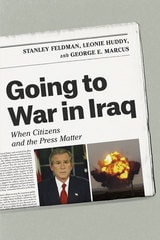
Going to War in Iraq
When Citizens and the Press MatterStanley Feldman, Leonie Huddy, and George E. Marcus
University of Chicago Press, 2015
Conventional wisdom holds that the Bush administration was able to convince the American public to support a war in Iraq on the basis of specious claims and a shifting rationale because Democratic politicians decided not to voice opposition and the press simply failed to do its job.
Drawing on the most comprehensive survey of public reactions to the war, Stanley Feldman, Leonie Huddy, and George E. Marcus revisit this critical period and come back with a very different story. Polling data from that critical period shows that the Bush administration’s carefully orchestrated campaign not only failed to raise Republican support for the war but, surprisingly, led Democrats and political independents to increasingly oppose the war at odds with most prominent Democratic leaders. More importantly, the research shows that what constitutes the news matters. People who read the newspaper were more likely to reject the claims coming out of Washington because they were exposed to the sort of high-quality investigative journalism still being written at traditional newspapers. That was not the case for those who got their news from television. Making a case for the crucial role of a press that lives up to the best norms and practices of print journalism, the book lays bare what is at stake for the functioning of democracy—especially in times of crisis—as newspapers increasingly become an endangered species.
Drawing on the most comprehensive survey of public reactions to the war, Stanley Feldman, Leonie Huddy, and George E. Marcus revisit this critical period and come back with a very different story. Polling data from that critical period shows that the Bush administration’s carefully orchestrated campaign not only failed to raise Republican support for the war but, surprisingly, led Democrats and political independents to increasingly oppose the war at odds with most prominent Democratic leaders. More importantly, the research shows that what constitutes the news matters. People who read the newspaper were more likely to reject the claims coming out of Washington because they were exposed to the sort of high-quality investigative journalism still being written at traditional newspapers. That was not the case for those who got their news from television. Making a case for the crucial role of a press that lives up to the best norms and practices of print journalism, the book lays bare what is at stake for the functioning of democracy—especially in times of crisis—as newspapers increasingly become an endangered species.
[more]
Governing With the News, Second Edition
The News Media as a Political InstitutionTimothy E. Cook
University of Chicago Press, 2005
The ideal of a neutral, objective press has proven in recent years to be just that—an ideal. In Governing with the News, Timothy E. Cook goes far beyond the single claim that the press is not impartial to argue that the news media are in fact a political institution integral to the day-to-day operations of our government. This updated edition includes a new afterword by the author, which pays close attention to two key developments in the twenty-first century: the accelerating fragmentation of the mass media and the continuing decline of Americans' confidence in the press.
"Provocative and often wise. . . . Cook, who has a complex understanding of the relationship between governing and the news, provides a fascinating account of the origins of this complicity."—James Bennet, Washington Monthly
"[Governing with the News] addresses central issues of media impact and power in fresh, illuminating ways. . . . Cook mines a wealth of historical and organizational literature to assert that the news media are a distinct political institution in our democratic system."—Robert Schmuhl, Commonweal
[more]

Governing with the News
The News Media as a Political InstitutionTimothy E. Cook
University of Chicago Press, 1998
The ideal of a neutral, objective press has proven in recent years to be just that—an ideal. But while everyone talks about the political biases and influences of the news, no one has figured out whether and how the news media exert power. In Governing with the News, Timothy E. Cook goes far beyond the single claim that the press is not impartial to argue that the news media are in fact a political institution integral to the day-to-day operations of the three branches of our government.
The formation of the press as a political institution began in the early days of the republic when newspapers were sponsored by political parties; the relationship is now so central that press offices are found wherever one turns. Cook demonstrates not only how the media are structured as an institution that exercises collective power but also how the role of the media has become institutionalized within the political process, affecting policy and instigating, rather than merely reflecting, political actions. Cook's analysis is a powerful and fascinating guide to our age when newsmaking and governing are inseparable.
"This is a wonderful analysis of a highly important topic. Tim Cook is resoundingly right that we need to look at the media as political institutions and their operatives as political actors."—David R. Mayhew, author of Divided We Govern
"This meticulously researched and well reasoned work proposes to take seriously a thesis which flies in the face of both journalistic lore and political myth. Governing with the News is an innovative contribution to our understanding of media."—W. Lance Bennett, author of News: The Politics of Illusion
"This book should be read by journalists . . . by mass communication faculty teaching courses in media structure or effects and journalism faculty as a supplemental text to courses in media history and media management."—Benjamin J. Burns, Journalism & Mass Communication Quarterly
[more]
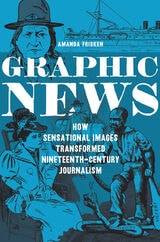
Graphic News
How Sensational Images Transformed Nineteenth-Century JournalismAmanda Frisken
University of Illinois Press, 2020
”You furnish the pictures and I’ll furnish the war.” This famous but apocryphal quote, long attributed to newspaper magnate William Randolph Hearst, encapsulates fears of the lengths to which news companies would go to exploit visual journalism in the late nineteenth century. From 1870 to 1900, newspapers disrupted conventional reporting methods with sensationalized line drawings. A fierce hunger for profits motivated the shift to emotion-driven, visual content. But the new approach, while popular, often targeted, and further marginalized, vulnerable groups. Amanda Frisken examines the ways sensational images of pivotal cultural events—obscenity litigation, anti-Chinese bloodshed, the Ghost Dance, lynching, and domestic violence—changed the public's consumption of the news. Using intersectional analysis, Frisken explores how these newfound visualizations of events during episodes of social and political controversy enabled newspapers and social activists alike to communicate—or challenge—prevailing understandings of racial, class, and gender identities and cultural power.
[more]

Grit and Ink
An Oregon Family’s Adventures in Newspapering, 1908–2018William F. Willingham
Oregon State University Press, 2018
Beneath the 24/7 national news cycle and argument over “fake news,” there is a layer of journalism that communities absolutely depend upon. Grit and Ink offers a rare look inside the financial struggles and family dynamic that has kept a Pacific Northwest publishing group alive for more than a century. The newspapers of the Aldrich-Forrester-Bedford-Brown family depict the histories of towns like Pendleton, Astoria, John Day, Enterprise, and Long Beach, Washington. Written by noted historian William Willingham, Grit and Ink describes threats presented by the Ku Klux Klan, the Great Astoria Fire of 1923, the Great Depression, the Aryan Nation, the Malheur National Wildlife Refuge occupation, the Digital Revolution, and more.
[more]

Guardians of Power
The Myth of the Liberal MediaDavid Edwards and David Cromwell, Foreword by John Pilger
Pluto Press, 2005
"Guardians of Power ought to be required reading in every media college. It is the most important book about journalism I can remember."
- John Pilger
"Regular critical analysis of the media, filling crucial gaps and correcting the distortions of ideological prisms, has never been more important. Media Lens has performed a major public service by carrying out this task with energy, insight, and care."
- Noam Chomsky
"Media Lens is doing an outstanding job of pressing the mainstream media to at least follow their own stated principles and meet their public service obligations. [This is] fun as well as enlightening."
- Edward S. Herman
Can a corporate media system be expected to tell the truth about a world dominated by corporations?
Can newspapers, including the 'liberal' Guardian and the Independent, tell the truth about catastrophic climate change -- about its roots in mass consumerism and corporate obstructionism -- when they are themselves profit-oriented businesses dependent on advertisers for 75% of their revenues?
Can the BBC tell the truth about UK government crimes in Iraq when its senior managers are appointed by the government? Has anything fundamentally changed since BBC founder Lord Reith wrote of the establishment: "They know they can trust us not to be really impartial"?
Why did the British and American mass media fail to challenge even the most obvious government lies on Iraqi weapons of mass destruction before the invasion in March 2003? Why did the media ignore the claims of UN weapons inspectors that Iraq had been 90-95% "fundamentally disarmed" as early as 1998?
This book answers these questions, and more.
Since July 2001, Media Lens has encouraged thousands of readers to email senior editors and journalists, challenging them to account for their distorted reporting on Iraq, Afghanistan, Kosovo, Haiti, East Timor, climate change, Western crimes in Central America, and much more. The responses -- often surprising, sometimes outrageous -- reveal the arrogance, unaccountability and servility to power of even our most respected media.
[more]