Results by title
135 books match the query 'Landscape' and 7 start with g
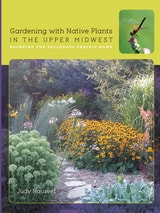
Gardening with Native Plants in the Upper Midwest
Bringing the Tallgrass Prairie HomeJudy Nauseef
University of Iowa Press, 2016
Nauseef emphasizes the need for careful planning and design to create comfortable, low-maintenance spaces that bring homeowners outside. Her designs solve problems such as a lack of privacy, shade, or sun; plan for water use; replace troublesome nonnative plants with native plants that attract pollinators; and enable homeowners to enjoy living sustainably on their land. Colorful photographs of projects around the Midwest show the wide range of possibilities, from newly created gardens using only native plants to traditional gardens that mix nonnative with native species. Whether you have a city yard, a suburban lot, or a rural acreage, there are ideas here for you, along with examples of well-designed landscapes in which native plants enhance paths, patios, pergolas, and steps.
Providing information on planting and maintaining native plants and prairies as well as seed and plant sources, organizations, and public arboretum and prairie sites, this book enables every gardener to master a new palette of plants and landforms. However small our personal landscapes, together they can slow the loss of many species of plants and wildlife and bring native flowers and grasses back where they belong. Ecologists, landscape architects and designers, master gardeners, landscape contractors, teachers, and home gardeners—everyone dedicated to conserving and improving our environment—will benefit from Nauseef’s approach.
Gendered Places
The Landscape of Local Gender Norms across the United StatesWilliam J. Scarborough
Temple University Press, 2023
Every place has its quirky attributes, cultural reputation, and distinctive flair. But when we travel across America, do we also experience distinct gender norms and expectations? In his groundbreaking Gendered Places, William Scarborough examines metropolitan commuting zones to see how each region’s local culture reflects gender roles and gender equity. He uses surveys and social media data to measure multiple dimensions of gender norms, including expectations toward women in leadership, attitudes toward working mothers, as well as the division of household labor.
Gendered Places reveals that different locations, even within the same region of the country, such as Milwaukee and Madison Wisconsin, have distinct gender norms and highly influential cultural environments. Scarboroughshows how these local norms shape the attitudes and behaviors of residents with implications on patterns of inequality such as the gender wage gap. His findings offer valuable insight for community leaders and organizers making efforts to promote equality in their region.
Scarboroughrecognizes local culture as not value-neutral, but highly crucial to the gender structure that perpetuates, or challenges, gender inequality. Gendered Places questions how these gender norms are sustained and their social consequences.
Geography of the Gaze
Urban and Rural Vision in Early Modern EuropeRenzo Dubbini
University of Chicago Press, 2002
He begins with the idea of the "view," explaining its role in the invention of landscape painting and in the definition of landscape as a cultural space. Among other topics, Dubbini explores how the descriptive and pictorial techniques used in mariners' charts, view-oriented atlases, military cartography, and garden design were linked to the proliferation of highly realistic paintings of landscapes and city scenes; how the "picturesque" system for defining and composing landscapes affected not just art but also archaeology and engineering; and how the ever-changing modern cityscapes inspired new ways of seeing and representing the urban scene in Impressionist painting, photography, and stereoscopy. A marvelous history of viewing, Geography of the Gaze will interest everyone from scientists to artists.
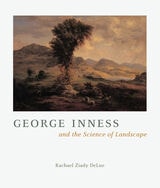
George Inness and the Science of Landscape
Rachael Ziady DeLue
University of Chicago Press, 2005
Throughout his career, Inness struggled to make visible what was invisible to the human eye by combining a deep interest in nineteenth-century scientific inquiry—including optics, psychology, physiology, and mathematics—with an idiosyncratic brand of mysticism. Rachael Ziady DeLue's George Inness and the Science of Landscape—the first in-depth examination of Inness's career to appear in several decades—demonstrates how the artistic, spiritual, and scientific aspects of Inness's art found expression in his masterful landscapes. In fact, Inness's practice was not merely shaped by his preoccupation with the nature and limits of human perception; he conceived of his labor as a science in its own right.
This lavishly illustrated work reveals Inness as profoundly invested in the science and philosophy of his time and illuminates the complex manner in which the fields of art and science intersected in nineteenth-century America. Long-awaited, this reevaluation of one of the major figures of nineteenth-century American art will prove to be a seminal text in the fields of art history and American studies.
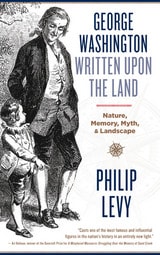
George Washington Written Upon the Land
Nature, Memory, Myth, and LandscapePhilip Levy
West Virginia University Press, 2015
George Washington’s childhood is famously the most elusive part of his life story. For centuries biographers have struggled with a lack of period documentation and an absence of late-in-life reflection in trying to imagine Washington’s formative years.
In George Washington Written upon the Land, Philip Levy explores this most famous of American childhoods through its relationship to the Virginia farm where much of it took place. Using approaches from biography, archaeology, folklore, and studies of landscape and material culture, Levy focuses on how different ideas about Washington’s childhood functioned—what sorts of lessons they sought to teach and how different epochs and writers understood the man and the past itself.
In a suggestive and far-reaching final chapter, Levy argues that Washington was present at the onset of the Anthropocene—the geologic era when human activity began to have a significant impact on world ecosystems. Interpreting Washington’s childhood farm through the lens of “big” history, he encourages scholars to break down boundaries between science and social science and between human and nonhuman.
Grammars of Approach
Landscape, Narrative, and the Linguistic PicturesqueCynthia Wall
University of Chicago Press, 2019
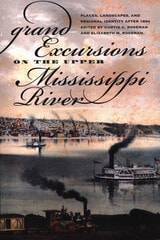
Grand Excursions on the Upper Mississippi River
Places, Landscapes, and Regional Identity after 1854Curtis C. & Elizabeth M. Roseman & Roseman
University of Iowa Press, 2004
One hundred and fifty years later, the thirteen essays in this volume examine the activities and environments of the 1854 Grand Excursion and place them in the context of an evolving regional identity for the Upper Mississippi River Valley based on the economy, culture, geography, and history of the area. In a series of “excursions,” the contributors explore the building of the Chicago and Rock Island Railroad, eastern newspaper accounts of the 1854 excursion, steamboating, the area’s pictorial landscape, passenger trains along the scenic river, the genesis and features of river towns, the control of the river for navigation, the development of preserves, parks, and recreation areas, the lumber industry, and commercial fishing. The book concludes by examining the resurgence of river-oriented development, as river towns are once again embracing the Mississippi.
Generously illustrated with maps, engravings, ephemera, and historic and present-day photographs, Grand Excursions on the Upper Mississippi River will be of interest to tourists and residents of the area, river aficionados, railroad and steamboat history buffs, as well as academics interested in the history, geography, and regional development of the area.