Results by title
97 books match the query 'Lesbians' and 4 start with g
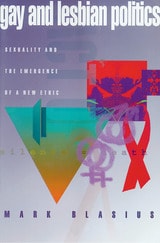
Gay & Lesbian Politics
Sexuality and the Emergence of a New EthicMark Blasius
Temple University Press, 1994
"This important study is both an analysis of and a call to an involved politics. It opens the door to a far-reaching dialogue."
--Martin Duberman, Center for Lesbian and Gay Studies, The City University of New York
An active participant in and theorist of the gay and lesbian movement, Mark Blasius contends that being gay or lesbian is by definition political. By extension, the phenomenon of a movement founded on collective identity is a quintessential part of American politics. The continually rising public consciousness of the needs and interest of gays and lesbians provides Blasius with a vehicle for showing how a particular aspect of human life comes to assume political dimensions. Upon this premise, he analyzes the process of how power is exercised through sexuality and traces the historical conditions that have made possible a gay and lesbian politics
Drawing on works of political philosophy, social science, including Foucault, and gay and lesbian studies, Blasius explores the invention of a gay and lesbian ethos, through which participation, even for apolitical gays and lesbians, goes beyond a shared culture and perspective. It is a way of life more encompassing than either sexual orientation or lifestyle alone. Though he acknowledges and reflects upon the divergent range of gay and lesbian experiences, Blasius provides a framework based on theories of power, sexuality, and ethics that elaborates the significance of the movement as a whole within contemporary society.
"It is in the process of coming out...Blasius argues, that lesbians and gay men create themselves--as new subjects, as the producers of new truth, and as agents of social change. Blasius gives a coherent account that ties together all these processes--from coming out to the emergence of lesbian and gay studies-and goes on to show the 'ethical' contribution that lesbians and gay men make to contemporary American society."
--Harvard Gay & Lesbian Review
"An engaging book that intelligently explores a range of possibilities in human relations."
--George Kateb, Department of Politics, Princeton University
[more]

Genealogy Of Queer Theory
William Turner
Temple University Press, 2000
Who are queers and what do they want? Could it be that we are all queers? Beginning with such questions, William B. Turner's lucid and engaging book traces the roots of queer theory to the growing awareness that few of us precisely fit standard categories for sexual and gender identity.
Turner shows how Michal Foucault's work contributed to feminists' investigations into the ways that power relates to identity. In the last decades of the twentieth century, feminists were the first to challenge the assumption that a claim to universal identity -- the white male citizen -- should serve as the foundation of political thought and action. Difference matters. Race, ethnicity, class, gender, and sexuality interact, producing a wide array of identities that resist rigid definition and are mutable. By understanding the notion of transhistorical categories -- woman, man, homosexual, and so forth -- feminist and gay male scholars launched queer theoretical work as a new way to think about the politics of gender and sexuality.
A Geneology of Queer Theory probes the fierce debates among scholars and activists, weighing the charges that queer readings of texts and identity politics do not constitute and might inhibit radical social change. Written by a historian, it considers the implications of queer theory for historical inquiry and the distinction between philosophy and history. As such, the book will interest readers of gay/lesbian/bisexual/transgender studies, intellectual history, political theory, and the history of gender/sexuality.
[more]
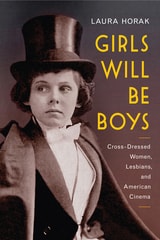
Girls Will Be Boys
Cross-Dressed Women, Lesbians, and American Cinema, 1908-1934Horak, Laura
Rutgers University Press, 2016
2016 Choice Outstanding Academic Title
Finalist for 2016 Richard Wall Memorial Award from the Theatre Library Association
Long-listed for the 2017 Best Photography Book Award from the Kraszna-Krausz Foundation
Marlene Dietrich, Greta Garbo, and Katharine Hepburn all made lasting impressions with the cinematic cross-dressing they performed onscreen. What few modern viewers realize, however, is that these seemingly daring performances of the 1930s actually came at the tail end of a long wave of gender-bending films that included more than 400 movies featuring women dressed as men.
Laura Horak spent a decade scouring film archives worldwide, looking at American films made between 1908 and 1934, and what she discovered could revolutionize our understanding of gender roles in the early twentieth century. Questioning the assumption that cross-dressing women were automatically viewed as transgressive, she finds that these figures were popularly regarded as wholesome and regularly appeared onscreen in the 1910s, thus lending greater respectability to the fledgling film industry. Horak also explores how and why this perception of cross-dressed women began to change in the 1920s and early 1930s, examining how cinema played a pivotal part in the representation of lesbian identity.
Girls Will Be Boys excavates a rich history of gender-bending film roles, enabling readers to appreciate the wide array of masculinities that these actresses performed—from sentimental boyhood to rugged virility to gentlemanly refinement. Taking us on a guided tour through a treasure-trove of vintage images, Girls Will Be Boys helps us view the histories of gender, sexuality, and film through fresh eyes.
[more]
Global Emergence Of Gay & Lesbian Pol
edited by Barry D Adam, Jan Willem Duyvendak and André Krouwel
Temple University Press, 1998
Since the Stonewall rebellion in 1969, gay and lesbian movements have grown from small outposts in a few major cities to a worldwide mobilization. This book brings together stories of the emergence and growth of movements in more than a dozen nations on five continents, with a comparative look that offers insights for both activists and those who study social movements.
Lesbian and gay groups have existed for more than a century, often struggling against enormous odds. In the middle of the twentieth century, movement organizations were suppressed or swept away by fascism, Stalinism, and McCarthyism. Refounded by a few pioneers in the postwar period, movements have risen again as more and more people have stood up for their right to love and live with persons of their choice.
This book addresses both the mature movements of the European Union, North America, and Australia and the newer movements emerging in Latin America, Eastern Europe, and parts of Asia and Africa, examining the social and political conditions that shape movement opportunities and trajectories. It is rich in the details of gay and lesbian cultural and political life in different countries.
[more]