Results by title
8113 books match the query 'Literary Criticism' and 159 start with g
Gabriel Garcia Marquez and the Powers of Fiction
By Julio Ortega
University of Texas Press, 1988
Together with the late Jorge Luis Borges, Gabriel García Márquez, the 1982 Nobel laureate, stands at the pinnacle of Latin American literature. His work, in the words of Julio Ortega, "contains its own 'deconstructive' force—a literary power capable of reshaping natural order and rhetorical tradition in order to 'carnivalize' the Borges' library and allow us to hear the voices—and the laughter—of a culture, that of Latin America." This reshaping force invites us to read the works of García Márquez in a new way, one that bypasses the traditional, inadequate approaches through Latin American politics, history, and "magical realism."
In Gabriel García Márquez and the Powers of Fiction, noted scholars Julio Ortega, Ricardo Gutiérrez Mouat, Michael Palencia-Roth, Aníbal González, and Gonzalo Díaz-Migoyo offer English-speaking readers a new approach to García Márquez's work. Their poststructuralist readings focus on the peculiar sign-system, formal configuration, intradiscursivity, and unfolding representation in the novels One Hundred Years of Solitude, No One Writes to the Colonel, In Evil Hour, The Autumn of the Patriarch, and Chronicle of a Death Foretold and in several of the author's short stories. Also included as an appendix is a translation of García Márquez's Nobel Prize acceptance speech, "The Solitude of Latin America."
Gaelic Scotland in the Colonial Imagination
Anglophone Writing from 1600 to 1900Silke Stroh
Northwestern University Press, 2017
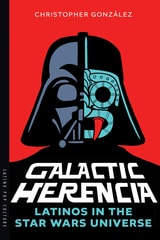
Galactic Herencia
Latinos in the Star Wars UniverseChristopher González
University of Arizona Press, 2027
In 1977, George Lucas created a galaxy far, far away that somehow contained no Latinos. Forty-seven years later, Diego Luna’s Cassian Andor speaks unapologetically accented English as he leads a rebel cell against the Empire, Pedro Pascal’s Din Djarin anchors Disney’s flagship series, and Oscar Isaac’s Poe Dameron commands X-wing squadrons with a confidence that refuses to apologize for difference. The transformation didn’t happen by accident—it was fought for character by character, film by film, against resistance both corporate and cultural.
In Galactic Herencia, Christopher González uses personal, historical, and critical reflection to trace this long arc from erasure to visibility, examining how Latinx actors bring cultural resonance to roles in a fictional universe that never explicitly acknowledges their heritage—and what it means when so few performers must carry the hopes of so many. The book moves from the painful absences of the original trilogy through the breakthrough moments of Rogue One and The Mandalorian, to the current struggles over authentic representation in an era of franchise expansion and toxic fandom. By centering Latinx perspectives on a globally dominant franchise, Galactic Herencia makes visible the cultural work that representation does—demonstrating that genuine inclusion isn’t about quotas but about empowering stories that affirm our full humanity.

Galileo, Science and the Church
Jerome J. Langford
University of Michigan Press, 1992
Jerome J. Langford's Galileo, Science, and the Church is widely recognized as a classic, balanced account of Galileo Galilei’s legendary 1633 confrontation with the Roman Catholic Inquisition. Moving past the overly polarized arguments of traditional polemicists and apologists, Langford contextualizes the "Galileo Affair" within its proper 17th-century historical, theological, and philosophical milieu. The book meticulously explores how the clash was less a fundamental war between science and faith, and more a complex dispute over scriptural interpretation, ecclesiastical authority, and the academic rigidities of Aristotelian philosophy. Through objective research, Langford demonstrates that this momentous historical drama still serves as a timeless case study on the enduring friction between institutional authority and the freedom of individual thought and expression.
Game Poems
Videogame Design as Lyric PracticeJordan Magnuson
Amherst College Press, 2023
Scholars, critics, and creators describe certain videogames as being “poetic,” yet what that means or why it matters is rarely discussed. In Game Poems: Videogame Design as Lyric Practice, independent game designer Jordan Magnuson explores the convergences between game making and lyric poetry and makes the surprising proposition that videogames can operate as a kind of poetry apart from any reliance on linguistic signs or symbols.
This rigorous and accessible short book first examines characteristics of lyric poetry and explores how certain videogames can be appreciated more fully when read in light of the lyric tradition—that is, when read as “game poems.” Magnuson then lays groundwork for those wishing to make game poems in practice, providing practical tips and pointers along with tools and resources. Rather than propose a monolithic framework or draw a sharp line between videogame poems and poets and their nonpoetic counterparts, Game Poems brings to light new insights for videogames and for poetry by promoting creative dialogue between disparate fields. The result is a lively account of poetic game-making praxis.
“Everyone who loves the true power of games will benefit from the treasure trove of insights in Game Poems.” — Jesse Schell, author of The Art of Game Design
“Magnuson shines a sensitive and incisive light on small, often moving, videogames.” — D. Fox Harrell, Ph.D., Professor of Digital Media, Computing, and Artificial Intelligence, MIT
“[Game Poems] tells a new story about games— that games can be lyrical, beautiful, emotionally challenging—to inspire creators and critics alike.” —Noah Wardrip-Fruin, author of How Pac-Man Eats
“Even as the news swells with impending doom for creativity, writing, and text itself, this literate and crafty book pursues poetry not through implacable algorithms but in concrete and personal play. It should be an indispensable guide for anyone who aims to maintain the true, human promise of technical poetics.”—Stuart Moulthrop, coauthor of Twining: Critical and Creative Approaches to Hypertext Narratives
“For far too long videogames have flourished – and commanded both capital and attention – in a kind of counterculture that they seem to have created as if ex nihilo for themselves and their players. But we are these players, and their culture has always been integrated with all of our own. In this evenhanded artist-scholar’s ars poetica Jordan Magnuson respects the material cultural specificity of videogames while regarding them through the ‘lens of poetry’ in order to discover – and help create – a practice and an art of Game Poems within the wider field. Magnuson formally, int(erv)entionally embraces this art as lyrically poetic.”—John Cayley, Brown University
“In Game Poems, Magnuson listens carefully to videogames, and hears them speak to questions of art, language, and meaning that connect our written past to our software future. Read this book and you will hear it too.”—Frank Lantz, Director, NYU Game Center
“Jordan Magnuson has created a work that ties together the worlds of poetry and videogames in a deep and enlightening way. For those of us who care about the potential of poetic games, Jordan greatly improves the language of how we talk about them and expands our ability to see what this unique form can become. This is one of my favorite books on game design and I apologize in advance to those whom I will end up cornering and not being able to stop talking to about it.”—Benjamin Ellinger, Game Design Program Director, DigiPen Institute of Technology
“A groundbreaking and accessible book that helps us think about games as poems. With patient tenacity, Magnuson teases out what he felt for years as he engaged in his own practice of making videogames. His mission to help us apply a ‘lyric reading’ to games so that our engagement with, and appreciation of, games can be enhanced feels deeply personal. Drawing from a wide range of games and computational media scholars, poetry scholars, game creators, and poets, Magnuson provides a rigorous, balanced, and unique interdisciplinary contribution. A must-read for videogame scholars, practicing game makers, and anyone interested in the potential of ‘game poems.’”—Susana Ruiz, University of California, Santa Cruz
“This book tenaciously wrenches videogame hermeneutics from the insatiable maws of rhetoric and narratology—to the cheers of poets everywhere. In elucidating the lyric characteristics of the "game poem," Magnuson demonstrates not just that poetry is a useful lens for understanding videogames, but also that videogames can be a useful lens for understanding poetry. A rewarding text for scholars, game designers, poets, and anyone in between.”—Allison Parrish, Interactive Telecommunications Program and Interactive Media Arts, NYU
“A concise, passionate articulation - and defense! - of an artistic space between poems and videogames. If game scholars wish to prove that they are not engaged merely in an apologetics for violent pornography, they need only to teach this book.”—Chris Bateman, author of Imaginary Games and 21st Century Game Design
“I feel I've found a kindred spirit in Jordan Magnuson and his practical recommendations for creating distilled, compelling, personal videogames – throw out the conventions of game design one at a time? Yes, please! The revelation for me in this book, however, is the heat and power of the language of poets and poetry brought close to videogame design. There's much in here worth pursuing to kindle the fires of new and exciting videogame poems, and Jordan is a capable and delightfully humble guide.”—Pippin Barr, author of How to Play a Video Game and The Stuff Games Are Made Of
“With Game Poems, Jordan Magnuson lays to rest any last vestige of the notion that the implicit limits of games are as ‘entertainment products’. By taking games seriously as successors of the lyric poetry tradition, he opens up new avenues for how game designers can think about what they do, how critical game theorists can approach their many-faceted object of study, and how players can more fully engage with videogames.”—Soraya Murray, author of On Video Games
“Game Poems shines an important light on a neglected area of videogame theory and provides unique guidance for those interested in exploring the poetic potential of videogames.”—Jenova Chen, designer of Flow, Flower, Journey, and Sky: Children of the Light
“Popular frameworks for video game scholarship consistently fail to account for the most avant-garde and affective works of interactive art. With Game Poems, Jordan Magnuson provides not only a lens to understand these diverse and important titles but also a guide to constructing the next generation of personal and incisive games. With numerous examples from decades of experimental games, including Magnuson's own minimalist and insightful work, this book is an excellent introduction to the form for neophytes as well as finally providing words to describe a movement that many experienced game poets previously understood only intuitively.”—Gregory Avery-Weir, creator of The Majesty of Colors and Looming
“Jordan Magnuson is one of a surprisingly small group of artists who see in the technology of videogames a versatile medium capable of expressing much more than conventional games.”—Michaël Samyn, co-founder, Tale of Tales; co-creator of Sunset, The Graveyard, and The Path
“So much has been written about what games are, and yet there’s always a new way of thinking about them. In Jordan Magnuson’s Game Poems we discover that games are also a lyrical form of art; that games can be understood as poetry, and that the making games as poetry creates new modes of artistic expression. Jordan Magnuson’s book is a fascinating exploration of games as poetry, and the poetry of play.”—Miguel Sicart, author of Play Matters, Beyond Choices: The Design of Ethical Gameplay, and Playing Software
“In Game Poems, I found a new perspective on the kind of videogames that are dearest to me: short, personal, poetic games. By looking at games through the lens of lyric poetry, Jordan Magnuson puts into focus the workings of that mysterious hodgepodge of audio, visuals, and interactivity: the language of videogames. Both experienced and novice game makers will find approachable, practical advice on the craft of videogames. And anyone who plays short games will find new ways of appreciating and talking about them. I know I will be returning to it for inspiration when making my own small games!”—Adam Le Doux, creator of Bitsy
“As a creator and researcher, Jordan Magnuson has been able to demonstrate through the utmost visual simplicity, by enhancing basic geometric forms, the empathetic capacity of the videogame medium. Game Poems explores this idea and the reconfiguration of the videogame beyond its ludic component, highlighting the artistic and poetic potential of games.”—Antonio César Moreno Cantano, University Complutense of Madrid
“Poems ask us to slow down, pay attention, and take the time to appreciate our experiences. Emerging from Magnuson's need to find ways to talk about his own creative practice, this book is all about discovering ways to do this with videogames. Magnuson explores what it means to view videogames as poetry, and provides insight, as a practitioner, on how to make game poems that enable and encourage this type of reflection. Drawing on a wide range of sources, from literature and philosophy to game studies and game design, this book covers a lot of material, but always remains grounded in concrete examples and solid theory. The book ends with a call to “go make some game poems!” After reading the book, I was keen to do exactly that. I urge you to do the same!”—Alex Mitchell, National University of Singapore
“To many, poetry is a dying – or dead – art form. Few people sit down at night to open their favorite poet’s chapbook with the latest streaming service at hand or their favorite videogame console sitting nearby. Spectacle seems to be the cultural norm, and this can be no more evident than in videogames: when the latest and greatest offers 60+ hours of spine-tingling excitement, why would someone want to launch a smaller-form game about expressions such as love, death, loneliness, or even God? But, as Jordan Magnuson, in his new book Games Poems, shows, poems have always been an integral piece of forming human culture. Poems have the ability to get right to the heart of the matter and, in fact, pierce the heart of the reader. Poems can be a form of cultural resistance, and even launch revolutions. Magnuson’s book highlights what it means to use the medium of game design as poetry. Magnuson presents several examples of the intricacies of poetry in general, as well as work that fuses the ideals of poetry with game design. Magnuson succinctly examines how the imagination, rhythm, intensity, style – and brevity – of poetry can enlighten the game design process in order to form possibility spaces within videogames that are pointed and powerful.”—Tim Samoff, Games and Interactive Media Program Director, Azusa Pacific University
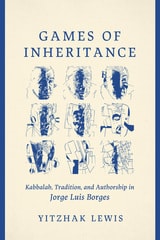
Games of Inheritance
Kabbalah, Tradition, and Authorship in Jorge Luis BorgesYitzhak Lewis
Rutgers University Press, 2025
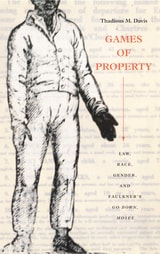
Games of Property
Law, Race, Gender, and Faulkner's Go Down, MosesThadious M. Davis
Duke University Press, 2003
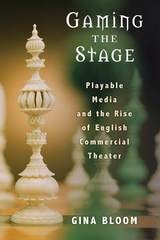
Gaming the Stage
Playable Media and the Rise of English Commercial TheaterGina Bloom
University of Michigan Press, 2018
Gaming the Stage also introduces a new archive for game studies: scenes of onstage gaming, which appear at climactic moments in dramatic literature. Bloom reveals plays to be systems of information for theater spectators: games of withholding, divulging, speculating, and wagering on knowledge. Her book breaks new ground through examinations of plays such as The Tempest, Arden of Faversham, A Woman Killed with Kindness, and A Game at Chess; the histories of familiar games such as cards, backgammon, and chess; less familiar ones, like Game of the Goose; and even a mixed-reality theater videogame.
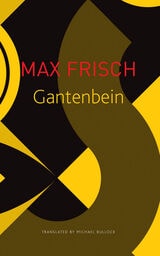
Gantenbein
Max Frisch
Seagull Books, 1965
A man walks out of a bar and is later found dead at the wheel of his car. On the basis of a few overheard remarks and his own observations, the narrator of this novel imagines the story of this stranger, or rather two alternative stories based on two identities the narrator has invented for him, one under the name of Enderlin, the other under the name Gantenbein.
Gardens
An Essay on the Human ConditionRobert Pogue Harrison
University of Chicago Press, 2008
Humans have long turned to gardens—both real and imaginary—for sanctuary from the frenzy and tumult that surrounds them. Those gardens may be as far away from everyday reality as Gilgamesh’s garden of the gods or as near as our own backyard, but in their very conception and the marks they bear of human care and cultivation, gardens stand as restorative, nourishing, necessary havens.
With Gardens, Robert Pogue Harrison graces readers with a thoughtful, wide-ranging examination of the many ways gardens evoke the human condition. Moving from from the gardens of ancient philosophers to the gardens of homeless people in contemporary New York, he shows how, again and again, the garden has served as a check against the destruction and losses of history. The ancients, explains Harrison, viewed gardens as both a model and a location for the laborious self-cultivation and self-improvement that are essential to serenity and enlightenment, an association that has continued throughout the ages. The Bible and Qur’an; Plato’s Academy and Epicurus’s Garden School; Zen rock and Islamic carpet gardens; Boccaccio, Rihaku, Capek, Cao Xueqin, Italo Calvino, Ariosto, Michel Tournier, and Hannah Arendt—all come into play as this work explores the ways in which the concept and reality of the garden has informed human thinking about mortality, order, and power.
Alive with the echoes and arguments of Western thought, Gardens is a fitting continuation of the intellectual journeys of Harrison’s earlier classics, Forests and The Dominion of the Dead. Voltaire famously urged us to cultivate our gardens; with this compelling volume, Robert Pogue Harrison reminds us of the nature of that responsibility—and its enduring importance to humanity.
"I find myself completely besotted by a new book titled Gardens: An Essay on the Human Condition, by Robert Pogue Harrison. The author . . . is one of the very best cultural critics at work today. He is a man of deep learning, immense generosity of spirit, passionate curiosity and manifold rhetorical gifts."—Julia Keller, Chicago Tribune
"This book is about gardens as a metaphor for the human condition. . . . Harrison draws freely and with brilliance from 5,000 years of Western literature and criticism, including works on philosophy and garden history. . . . He is a careful as well as an inspiring scholar."—Tom Turner, Times Higher Education
"When I was a student, my Cambridge supervisor said, in the Olympian tone characteristic of his kind, that the only living literary critics for whom he would sell his shirt were William Empson and G. Wilson Knight. Having spent the subsequent 30 years in the febrile world of academic Lit. Crit. . . . I’m not sure that I’d sell my shirt for any living critic. But if there had to be one, it would unquestionably be Robert Pogue Harrison, whose study Forests: The Shadow of Civilization, published in 1992, has the true quality of literature, not of criticism—it stays with you, like an amiable ghost, long after you read it.
“Though more modest in scope, this new book is similarly destined to become a classic. It has two principal heroes: the ancient philosopher Epicurus . . . and the wonderfully witty Czech writer Karel Capek, apropos of whom it is remarked that, whereas most people believe gardening to be a subset of life, ‘gardeners, including Capek, understand that life is a subset of gardening.’”—Jonathan Bate, The Spectator
Gardens
An Essay on the Human ConditionRobert Pogue Harrison
University of Chicago Press, 2008
Humans have long turned to gardens—both real and imaginary—for sanctuary from the frenzy and tumult that surrounds them. Those gardens may be as far away from everyday reality as Gilgamesh’s garden of the gods or as near as our own backyard, but in their very conception and the marks they bear of human care and cultivation, gardens stand as restorative, nourishing, necessary havens.
With Gardens, Robert Pogue Harrison graces readers with a thoughtful, wide-ranging examination of the many ways gardens evoke the human condition. Moving from from the gardens of ancient philosophers to the gardens of homeless people in contemporary New York, he shows how, again and again, the garden has served as a check against the destruction and losses of history. The ancients, explains Harrison, viewed gardens as both a model and a location for the laborious self-cultivation and self-improvement that are essential to serenity and enlightenment, an association that has continued throughout the ages. The Bible and Qur’an; Plato’s Academy and Epicurus’s Garden School; Zen rock and Islamic carpet gardens; Boccaccio, Rihaku, Capek, Cao Xueqin, Italo Calvino, Ariosto, Michel Tournier, and Hannah Arendt—all come into play as this work explores the ways in which the concept and reality of the garden has informed human thinking about mortality, order, and power.
Alive with the echoes and arguments of Western thought, Gardens is a fitting continuation of the intellectual journeys of Harrison’s earlier classics, Forests and The Dominion of the Dead. Voltaire famously urged us to cultivate our gardens; with this compelling volume, Robert Pogue Harrison reminds us of the nature of that responsibility—and its enduring importance to humanity.
"I find myself completely besotted by a new book titled Gardens: An Essay on the Human Condition, by Robert Pogue Harrison. The author . . . is one of the very best cultural critics at work today. He is a man of deep learning, immense generosity of spirit, passionate curiosity and manifold rhetorical gifts."—Julia Keller, Chicago Tribune
"This book is about gardens as a metaphor for the human condition. . . . Harrison draws freely and with brilliance from 5,000 years of Western literature and criticism, including works on philosophy and garden history. . . . He is a careful as well as an inspiring scholar."—Tom Turner, Times Higher Education
"When I was a student, my Cambridge supervisor said, in the Olympian tone characteristic of his kind, that the only living literary critics for whom he would sell his shirt were William Empson and G. Wilson Knight. Having spent the subsequent 30 years in the febrile world of academic Lit. Crit. . . . I’m not sure that I’d sell my shirt for any living critic. But if there had to be one, it would unquestionably be Robert Pogue Harrison, whose study Forests: The Shadow of Civilization, published in 1992, has the true quality of literature, not of criticism—it stays with you, like an amiable ghost, long after you read it.
“Though more modest in scope, this new book is similarly destined to become a classic. It has two principal heroes: the ancient philosopher Epicurus . . . and the wonderfully witty Czech writer Karel Capek, apropos of whom it is remarked that, whereas most people believe gardening to be a subset of life, ‘gardeners, including Capek, understand that life is a subset of gardening.’”—Jonathan Bate, The Spectator
Garland in His Own Time
A Biographical Chronicle of His Life, Drawn from Recollections, Interviews, and Memoirs by Family, Friends, and AssociatesKeith Newlin
University of Iowa Press, 2013
Gary Snyder and the Pacific Rim
Creating Countercultural CommunityTimothy Gray
University of Iowa Press, 2006
Gray’s introduction tracks the increased use of “Pacific Rim discourse” by politicians and business leaders following World War II. Ensuing chapters analyze Snyder’s countercultural invocation of this regional idea, concentrating on the poet’s migratory or “creaturely” sensibility, his gift for literary translation, his physical embodiment of trans-Pacific ideals, his role as tribal spokesperson for Haight-Ashbury hippies, and his burgeoning interest in environmental issues. Throughout, Gray’s citations of such writers as Allen Ginsberg, Philip Whalen, and Joanne Kyger shed light on Snyder’s communal role, providing an amazingly intimate portrait of the west coast counterculture. An interdisciplinary project that utilizes models of ecology, sociology, and comparative religion to supplement traditional methods of literary biography, Gary Snyder and the Pacific Rim offers a unique perspective on Snyder’s life and work.
This book will fascinate literary and Asian studies scholars as well as the general reader interested in the Beat movement and multicultural influences on poetry.
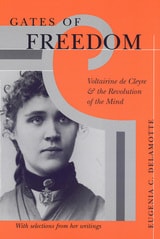
Gates of Freedom
Voltairine de Cleyre and the Revolution of the MindEugenia C. DeLamotte
University of Michigan Press, 2004
---Cary Nelson, University of Illinois
"The question of souls is old; we demand our bodies, now." These words are not from a feminist manifesto of the late twentieth century, but from a fiery speech given a hundred years earlier by Voltairine de Cleyre, a leading anarchist and radical thinker. A contemporary of Emma Goldman---who called her "the most gifted and brilliant anarchist woman America ever produced"---de Cleyre was a significant force in a major social movement that sought to transform American society and culture at its root. But she belongs to a group of late-nineteenth-century freethinkers, anarchists, and sex-radicals whose writing continues to be excluded from the U.S. literary and historical canon.
Gates of Freedom considers de Cleyre's speeches, letters, and essays, including her most well known essay, "Sex Slavery." Part I brings current critical concerns to bear on de Cleyre's writings, exploring her contributions to the anarchist movement, her analyses of justice and violence, and her views on women, sexuality, and the body. Eugenia DeLamotte demonstrates both de Cleyre's literary significance and the importance of her work to feminist theory, women's studies, literary and cultural studies, U.S. history, and contemporary social and cultural analysis. Part II presents a thematically organized selection of de Cleyre's stirring writings, making Gates of Freedom appealing to scholars, students, and anyone interested in Voltairine de Cleyre's fascinating life and rousing work.
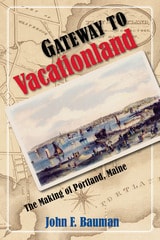
Gateway to Vacationland
The Making of Portland, MaineJohn F. Bauman
University of Massachusetts Press, 2012
Situated on a peninsula jutting into picturesque Casco Bay, Portland has long been admired for its geographical setting—the “beautiful city by the sea,” as native son Henry Wadsworth Longfellow called it. At the same time, Portland's deep, ice-free port has made it an ideal site for the development of coastal commerce and industry. Much of the city's history, John F. Bauman shows, has been defined by the effort to reconcile the competing interests generated by these attributes—to balance the imperatives of economic growth with a desire to preserve Portland's natural beauty.
Caught in the crossfire of British and French imperial ambitions throughout the colonial era, Portland emerged as a prosperous shipbuilding center and locus of trade in the decades following the American Revolution. During the nineteenth century it became a busy railroad hub and winter port for Canadian grain until a devastating fire in 1866 reduced much of the city to ruins. Civic leaders responded by reinventing Portland as a tourist destination, building new hotels, parks, and promenades, and proclaiming it the “Gateway to Vacationland.”
After losing its grain trade in the 1920s and suffering through the Great Depression, Portland withered in the years following World War II as it wrestled with the problems of deindustrialization, suburbanization, and an aging downtown. Efforts at urban renewal met with limited success until the 1980s, when a concerted plan of historic preservation and the restoration of the Old Port not only revived the tourist trade but eventually established Portland as one of America's “most livable cities.”
Gathering Ground
A Reader Celebrating Cave Canem's First DecadeToi Derricotte and Cornelius Eady, Editors
University of Michigan Press, 2006
To mark the first decade of this pathbreaking project, Gathering Ground presents more than one hundred poems by Cave Canem participants and faculty. It embraces an impressive and eclectic gathering of forms, including sonnets, a bop (a new form created by a Cave Canem faculty member), blues, sestinas, prose poems, centos, free verse, and more. The roster of distinguished contributors includes Lucille Clifton, Yusef Komunyakaa, Marilyn Nelson, Sonya Sanchez, Al Young, and many others.
For newcomers and aficionados alike, Gathering Ground assembles in one place the most innovative voices in contemporary African American poetry and boldly attests to the important position it holds in verse-making today.
Toi Derricotte is author of the memoir The Black Notebooks and of four books of poetry: Tender, Captivity, Natural Birth, and The Empress of the Death House. She is Professor of English at the University of Pittsburgh. Cornelius Eady is the author of Brutal Imagination, Autobiography of a Jukebox, You Don't Miss Your Water, The Gathering of My Name, and Victims of the Latest Dance Craze. He is Associate Professor of English at the University of Notre Dame.
Gay Cuban Nation
Emilio Bejel
University of Chicago Press, 2001

Gay Lives
Homosexual Autobiography from John Addington Symonds to Paul MonettePaul Robinson
University of Chicago Press, 1999
Paul Robinson reads the memoirs of French, British, and American gay authors—André Gide, Quentin Crisp, and Martin Duberman, among others—through the prism of sexual identity, asking fascinating questions about homosexuality and its relation to literary form. How did these authors discover their sexual identity? Did they embrace it or reject it? How did they express often conflicted desires in their words, which ranged from defiant and brutally frank to ambiguous and abstract? Robinson considers the choices each made—as a man and an author—to accommodate himself to society's homophobia or live in protest against his oppression.
Despite the threads that connect these stories, Gay Lives refutes the notion that there is a typical homosexual "career" by showing that gay men have led wildly dissimilar lives—from the exuberant to the miserable—and that they have found no less dissimilar meanings in those lives.
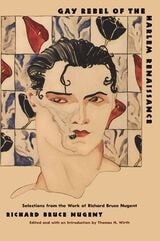
Gay Rebel of the Harlem Renaissance
Selections from the Work of Richard Bruce NugentRichard Bruce Nugent
Duke University Press, 2002
Thomas H. Wirth, a close friend of Nugent’s during the last years of the artist’s life, has assembled a selection of Nugent’s most important writings, paintings, and drawings—works mostly unpublished or scattered in rare and obscure publications and collected here for the first time. Wirth has written an introduction providing biographical information about Nugent’s life and situating his art in relation to the visual and literary currents which influenced him. A foreword by Henry Louis Gates Jr. emphasizes the importance of Nugent for African American history and culture.
Gay and Lesbian Themes in Latin American Writing
By David William Foster
University of Texas Press, 1991
A taboo subject in many cultures, homosexuality has been traditionally repressed in Latin America, both as a way of life and as a subject for literature. Yet numerous writers have attempted to break the cultural silence surrounding homosexuality, using various strategies to overtly or covertly discuss lesbian and gay themes. In this study, David William Foster examines more than two dozen texts that deal with gay and lesbian topics, drawing from them significant insights into the relationship between homosexuality and society in different Latin American countries and time periods.
Foster's study includes works both sympathetic and antagonistic to homosexuality, showing the range of opinion on this topic. The preponderance of his examples come from Argentina, Brazil, and Mexico, countries with historically active gay communities, although he also includes material on other countries. Noteworthy among the authors covered are Reinaldo Arenas, Adolfo Caminha, Isaac Chocrón, José Donoso, Sylvia Molloy, Alejandra Pizarnik, and Luis Zapata.
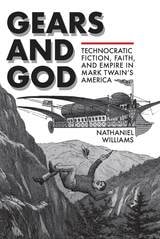
Gears and God
Technocratic Fiction, Faith, and Empire in Mark Twain's AmericaNathaniel Williams
University of Alabama Press, 2018
In Gears and God: Technocratic Fiction, Faith, and Empire in Mark Twain’s America, Nathaniel Williams analyzes the genre of technology-themed exploration novels—dime novel adventure stories featuring steam-powered and electrified robots, airships, and submersibles. This genre proliferated during the same cultural moment when evolutionary science was dismantling Americans’ prevailing, biblically based understanding of human history.
While their heyday occurred in the late 1800s, technocratic adventure novels like Twain’s A Connecticut Yankee in King Arthur’s Court inspired later fiction about science and technology. Similar to the science fiction plotlines of writers like Jules Verne and H. Rider Haggard, and anticipating the adventures of Tom Swift some decades later, these novels feature Americans using technology to visit and seize control of remote locales, a trait that has led many scholars to view them primarily as protoimperialist narratives. Their legacy, however, is more complicated. As they grew in popularity, such works became as concerned with the preservation of a fraught Anglo-Protestant American identity as they were with spreading that identity across the globe.
Many of these novels frequently assert the Bible’s authority as a historical source. Collectively, such stories popularized the notion that technology and travel might essentially “prove” the Bible’s veracity—a message that continues to be deployed in contemporary debates over intelligent design, the teaching of evolution in public schools, and in reality TV shows that seek historical evidence for biblical events. Williams argues that these fictions performed significant cultural work, and he consolidates evidence from the novels themselves, as well as news articles, sermons, and other sources of the era, outlining and mapping the development of technocratic fiction.
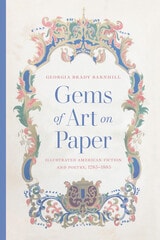
Gems of Art on Paper
Illustrated American Fiction and Poetry, 1785–1885Georgia Brady Barnhill
University of Massachusetts Press, 2021
In the immediate aftermath of the Revolutionary War, only the wealthiest Americans could afford to enjoy illustrated books and prints. But, by the end of the next century, it was commonplace for publishers to load their books with reproductions of fine art and beautiful new commissions from amateur and professional artists.
Georgia Brady Barnhill, an expert on the visual culture of this period, explains the costs and risks that publishers faced as they brought about the transition from a sparse visual culture to a rich one. Establishing new practices and investing in new technologies to enhance works of fiction and poetry, bookmakers worked closely with skilled draftsmen, engravers, and printers to reach an increasingly literate and discriminating American middle class. Barnhill argues that while scholars have largely overlooked the efforts of early American illustrators, the works of art that they produced impacted readers' understandings of the texts they encountered, and greatly enriched the nation's cultural life.
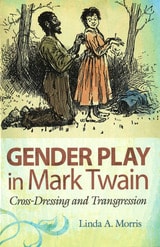
Gender Play in Mark Twain
Cross-Dressing and TransgressionLinda A. Morris
University of Missouri Press, 2007
Huckleberry Finn dressing as a girl is a famously comic scene in Mark Twain’s novel but hardly out of character—for the author, that is. Twain “troubled gender” in much of his otherwise traditional fiction, depicting children whose sexual identities are switched at birth, tomboys, same-sex married couples, and even a male French painter who impersonates his own fictive sister and becomes engaged to another man.
This book explores Mark Twain’s extensive use of cross-dressing across his career by exposing the substantial cast of characters who masqueraded as members of the opposite sex or who otherwise defied gender expectations. Linda Morris grounds her study in an understanding of the era’s theatrical cross-dressing and changing mores and even events in the Clemens household. She examines and interprets Twain’s exploration of characters who transgress gendered conventions while tracing the degree to which themes of gender disruption interact with other themes, such as his critique of race, his concern with death in his classic “boys’ books,” and his career-long preoccupation with twins and twinning.
Approaching familiar texts in surprising new ways, Morris reexamines the relationship between Huck and Jim; discusses racial and gender crossing in Pudd’nhead Wilson; and sheds new light on Twain’s difficulty in depicting the most famous cross-dresser in history, Joan of Arc. She also considers a number of his later “transvestite tales” that feature transgressive figures such as Hellfire Hotchkiss, who is hampered by her “misplaced sex.”
Morris challenges views of Twain that see his work as reinforcing traditional notions of gender along sharply divided lines. She shows that Twain depicts cross-dressing sometimes as comic or absurd, other times as darkly tragic—but that even at his most playful, he contests traditional Victorian notions about the fixity of gender roles.
Analyzing such characteristics of Twain’s fiction as his fascination with details of clothing and the ever-present element of play, Morris shows us his understanding that gender, like race, is a social construction—and above all a performance. Gender Play in Mark Twain: Cross-Dressing and Transgression broadens our understanding of the writer as it lends rich insight into his works.
Gender Politics in Modern China
Writing and FeminismTani E. Barlow, ed.
Duke University Press, 1993
Ranging from interviews with contemporary writers, to historical accounts of gendered writing in Taiwan and semi-colonial China, to close feminist readings of individual authors, these essays confront the degree to which textual stategies construct notions of gender. Among the specific themes discussed are: how femininity is produced in texts by allocating women to domestic space; the extent to which textual production lies at the base of a changing, historically specific code of the feminine; the extent to which women in modern Chinese societies are products of literary canons; the ways in which the historical processes of gendering have operated in Chinese modernity vis à vis modernity in the West; the representation of feminists as avengers and as westernized women; and the meager recognition of feminism as a serious intellectual current and a large body of theory.
Originally published as a special issue of Modern Chinese Literature (Spring & Fall 1988), this expanded book represents some of the most compelling new work in post-Mao feminist scholarship and will appeal to all those concerned with understanding a revitalized feminism in the Chinese context.
Contributors. Carolyn Brown, Ching-kiu Stephen Chan, Sung-sheng Yvonne Chang, Yu-shih Chen, Rey Chow, Randy Kaplan, Richard King, Wolfgang Kubin, Wendy Larson, Lydia Liu, Seung-Yeun Daisy Ng, Jon Solomon, Meng Yue, Wang Zheng
Gender Roles and Faculty Lives in Rhetoric and Composition
Theresa Enos
Southern Illinois University Press, 1997
Combining anecdotal evidence (the personal stories of rhetoric and composition teachers) with hard data, Theresa Enos offers documentation for what many have long suspected to be true: lower-division writing courses in colleges and universities are staffed primarily by women who receive minimal pay, little prestige, and lessened job security in comparison to their male counterparts. Male writing faculty, however, also are affected by factors such as low salaries because of the undervaluation of a field considered feminized. As Enos notes in her preface: "The rhetoric of our institutional lives is connected especially to the negotiations of gender roles in rhetoric and composition."
Enos describes and classifies narratives gathered from surveys, interviews, and campus visits and interweaves these narratives with statistical data gathered from national surveys that show gendered experiences in the profession. Enos discusses the ways in which these experiences affect the working conditions of writing teachers and administrators in various programs at different types of institutions.
Enos points out that fields in which women excel—and are acknowledged—receive less prestige than other fields. On the university level, those genres in which women have demonstrated competence are not taken as seriously as those dominated by men. In practical terms, academia affords more glory for teaching literature than for teaching rhetoric and composition.
Within the field of rhetoric and composition, however, Enos finds it difficult to determine why the accomplishments of women receive less credit than those of men. She speculates as to whether it is part of the larger pattern in society—and in academia—to value men more than women or something in the field itself that keeps women from real power, even though women make up the majority of composition and rhetoric teachers.
Enos provides fascinating personal histories of composition and rhetoric teachers whose work has been largely disregarded. She also provides information about writing programs, teaching, administrative responsibilities, ranks among teachers, ages, salary, tenure status, distribution of research, service responsibilities, records of publication, and promotion and tenure guidelines.
Gender Violence and the Transnational Politics of the Honor Crime
Dana M. Olwan
The Ohio State University Press, 2021
More specifically, Olwan traces the term’s appearance in public and popular works that allow for its continued mass acceptance and circulation—from media depictions in Canada and beyond, to how it is taken up in national registers about migration and belonging in the US, to activism in Palestine that reveal the fault lines between activist and academic critiques of the honor crime, and finally to feminist efforts in Jordan and the wider Middle East to confront legal codes used to sanction gender-related violence. Through these cases, Olwan demonstrates how the honor crime functions as a signifier that governs and manages populations and how its meanings travel and circulate across and between separate and interconnected circuits of power and knowledge.
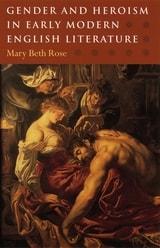
Gender and Heroism in Early Modern English Literature
Mary Beth Rose
University of Chicago Press, 2001
Interweaving discourses of gender, Rose explores ways in which this heroics of endurance became the dominant model. She examines the glamorous, failed destinies of heroes in plays by Shakespeare, Jonson, and Marlowe; Elizabeth I's creation of a heroic identity in her public speeches; the autobiographies of four ordinary women thrust into the public sphere by civil war; and the seduction of heroes into slavery in works by Milton, Aphra Behn, and Mary Astell. Ultimately, her study demonstrates the importance of the female in the creation of modern heroism, while offering a critique of both idealized action and suffering.
Gender and Nation in the Spanish Modernist Novel
Roberta Johnson
Vanderbilt University Press, 2003
The book begins by tracing the history of public discourse on gender from the 1890s through the 1930s, a discourse that included the rise of feminism. Each chapter then analyzes works by female and male novelists that address key issues related to gender and nationalism: the concept of intrahistoria, or an essential Spanish soul; modernist uses of figures from the Spanish literary tradition, notably Don Quixote and Don Juan; biological theories of gender prevalent in the 1920s and 1930s; and the growth of an organized feminist movement that coincided with the burgeoning Republican movement.
This is the first book dealing with this period of Spanish literature to consider women novelists, such as Maria Martinez Sierra, Carmen de Burgos, and Concha Espina, alongside canonical male novelists, including Miguel de Unamuno, Ramon del Valle-Inclan, and Pio Baroja. With its contrasting conceptions of modernism, Johnson's work provides a compelling new model for bridging the gender divide in the study of Spanish fiction.
Gender and National Literature
Heian Texts in the Constructions of Japanese ModernityTomiko Yoda
Duke University Press, 2004
Moving back and forth between a critique of modern discourses on Heian literature and close analyses of the Heian texts themselves, Yoda sheds light on some of the most persistent interpretive models underwriting Japanese literary studies, particularly the modern paradigm of a masculine national subject. She proposes new directions for disciplinary critique and suggests that historicized understandings of premodern texts offer significant insights into contemporary feminist theories of subjectivity and agency.
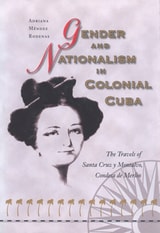
Gender and Nationalism in Colonial Cuba
The Travels of Santa Cruz y Montalvo, Condesa de MerlinAdriana Mendez Rodenas
Vanderbilt University Press, 1998
Born in colonial Havana to an aristocratic Creole family, the future countess of Merlin left Cuba for Spain at an early age. Later, her marriage to the French count Antoine Christophe Merlin and the invasion of French Napoleonic troops precipitated another move to France, where she became one of the belle dames of Paris and began her literary career. She returned only once to Cuba after the death of her husband in 1840, a journey that produced Viaje a la Habana. Upon her return to Paris, Merlin expanded this into La Havane, an ambitious three-volume account of the political, social, and economic organization of the island.
From the viewpoint of feminist and psychoanalytical theory, Gender and Nationalism in Colonial Cuba brilliantly explores the many ways in which issues of gender have contributed to Merlin's virtual absence from the canons of literature and from the discourses on Cuban national identity. Merlin's double identity as both Cuban and French is symbolic of the Cuban exiled condition, a fact taken up by contemporary exiled Cuban writers who see the countess as an alter-ego.
Mendez Rodenas seeks to restore Merlin as the first woman writer in Cuban literary history to articulate a sense of national identity, as well as being Cuba's first female historian. She focuses on Merlin's travel writings because they examine such issues as slavery, independence, nationhood, the role of women, education, and local literature. Together her writings construct an alternative, gendered history of nineteenth-century Cuba that must be acknowledged as both functional and authentic.
By situating Merlin at the intersection of the discourses of gender and nationalism, Mendez Rodenas reveals not only her pioneering role but also the need to expand current critical categories to account for the specificity of the Latin American literary tradition. In the process of restoring Merlin to her appropriate place in the canon of Latin American literature, she broadens our understanding of colonial Cuban history and expands our knowledge of the ways in which travel writing can influence a country's national literature .

Gender and Sexuality in Modern Ireland
Anthony Bradley
University of Massachusetts Press, 1997
Gender and the Gothic in the Fiction of Edith Wharton
Kathy A. Fedorko
University of Alabama Press, 1995
Revealing the Gothic foundations of Edith Wharton's vision of gender and identity.
Gender and the Gothic in the Fiction of Edith Wharton is an innovative study that provides fresh insights into Wharton’s male characters while at the same time showing how Wharton’s imagining of a fe/male self evolves throughout her career. Using feminist archetypal theory and theory of the female Gothic, Kathy A. Fedorko shows how Wharton, in sixteen short stories and six major novels written during four distinct periods of her life, adopts and adapts Gothic elements to explore the nature of feminine and masculine ways of knowing and being and to dramatize the tension between them.
Edith Wharton’s contradictory views of women and men—her attitudes toward the feminine and the masculine—reflect a complicated interweaving of family and social environment, historical time, and individual psychology. Studies of Wharton have exhibited this same kind of contradiction, with some seeing her as disparaging men and the masculine and others depicting her as disparaging women and the feminine. The use of Gothic elements in her fiction provided Wharton, who was often considered the consummate realist, with a way to dramatize the conflict between feminine and masculine selves as she experienced them and to evolve an alternative to the dualism.
Fedorko’s work is unique in its careful consideration of Wharton’s sixteen Gothic works, which are seldom discussed. Further, the revelation of how these Gothic stories are reflected in her major realistic novels. In the novels with Gothic texts, Wharton draws multiple parallels between male and female protagonists, indicating the commonalities between women and men and the potential for a female self. Eventually, in her last completed novel and her last short story, Wharton imagines human beings who are comfortable with both gender selves.
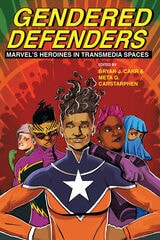
Gendered Defenders
Marvel's Heroines in Transmedia SpacesEdited by Bryan J. Carr and Meta G. Carstarphen
The Ohio State University Press, 2022
Gendered Defenders: Marvel’s Heroines in Transmedia Spaces delivers dynamic and original analyses of how women perform in super heroic spaces. Contributors from a range of disciplinary perspectives—communications, international relations, cultural and media studies, English, history, and public policy—take on Marvel’s representations of women and gender to examine how relations of power are (re)produced, understood, and challenged. Through vivid retellings of character-based scenarios, these essays examine Carol Danvers, Jessica Jones, Ms. Marvel, Shuri, Pepper Potts, Black Widow, and Squirrel Girl across media forms to characterize and critique contemporary understandings of identity, feminism, power, and gender. Collectively, Gendered Defenders challenges notions about female identity while illuminating the multidimensional portrayals that are enabled by the form of speculative fiction. Making explicit the connections between women’s lived experiences and the imagined exploits of superheroines, contributors explore how these pop culture narratives can help us understand real-world gender dynamics and prepare pedagogical, political, and social strategies for dealing with them. Contributors: Bryan J. Carr, Meta G. Carstarphen, Julie A. Davis, Rachel Grant, Annika Hagley, Amanda K. Kerhberg, Gregory P. Perreault, Mildred F. Perreault, CarrieLynn D. Reinhard, Maryanne A. Rhett, Stephanie L. Sanders, J. Richard Stevens, Anna C. Turner, Kathleen M. Turner-Ledgerwood, Robert Westerfelhaus
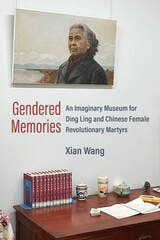
Gendered Memories
An Imaginary Museum for Ding Ling and Chinese Female Revolutionary MartyrsXian Wang
University of Michigan Press, 2025
Gendered Power
Educated Women of the Meiji Empress' CourtMamiko C. Suzuki
University of Michigan Press, 2019
Gendering the Renaissance
Text and Context in Early Modern ItalyMeredith K. Ray
University of Delaware Press, 2023
Genealogies of Joy
The Pleasure of Latinx LiteratureEdited by Leigh Johnson and Erin Murrah-Mandril; Foreword by Melina Vizcaíno-Alemán
University of Arizona Press, 2027
What does it mean to center joy in a world that insists on Latinx suffering? Genealogies of Joy: The Pleasure of Latinx Literature argues that joy is not a luxury or distraction but a radical, sustaining force woven through Latinx literature and culture. From humor and food to protest, friendship, sexuality, and aging, the essays gathered here reveal joy as an embodied, communal practice—one that refuses racialized shame and imagines liberatory futures.
Organized into three sections—Memory, Method, and Maps—the volume traces a genealogy of joy across time and space. Contributors explore how writers such as Gloria Anzaldúa, Julia de Burgos, Erika Sánchez, Javier Zamora, Myriam Gurba, Aidan Thomas, and Sandra Cisneros transform grief into resilience, invert dominant narratives, and reclaim pleasure as political praxis. Whether through irreverent laughter, queer desire, culinary memory, or vulnerable resistance, Latinx authors insist that pleasure and politics are bound together.
Engaging affect theory, Black joy scholarship, borderlands studies, and archival studies, this collection asserts that Latinx joy resists the quantification and commodification of late-stage capitalism. At once rigorous and celebratory, Genealogies of Joy invites readers to recognize joy as a human right and a vital source of connection, creativity, and collective flourishing.
Contributors
Soffía Blystra
Norma Cantú
Margaret Cantú-Sánchez
Karina Diaz
Stephanie Fetta
Elena Foulis
Eva Maria Geicht
Leigh Johnson
Mark J. Mascia
Regina Marie Mills
Erin Murrah-Mandril
Jeannine Ortega
Nancy Ríos
Rey M. Rodríguez
Rosarito Rodríguez-González
Alexandra Rodríguez Sabogal
Karen Roybal
Bianca S. Rubalcava
Suzanne Uzzilia
Natalia Villanueva-Nieves
Melina Vizcaíno-Alemán

Genealogy and Literature
Lee Quinby, Editor
University of Minnesota Press, 1995
Genealogy and Literature was first published in 1995. Minnesota Archive Editions uses digital technology to make long-unavailable books once again accessible, and are published unaltered from the original University of Minnesota Press editions.
Traditionalists insist that literature transcends culture. Others counter that it is subversive by nature. By challenging both claims, Genealogy and Literature reveals the importance of literature for understanding dominant and often violent power/knowledge relations within a given society.
The authors explore the ways in which literature functions as a cultural practice, the links between death and literature as a field of discourse, and the possibilities of dismantling modes of bodily regulation. Through wide-ranging investigations of writing from England, France, Nigeria, Peru, Japan, and the United States, they reinvigorate the study of literature as a means of understanding the complexities of everyday experience.
Contributors: Claudette Kemper Columbus, Lennard J. Davis, Simon During, Michel Foucault, Ellen J. Goldner, Tom Hayes, Kate Mehuron, Donald Mengay, Imafedia Okhamafe, Lee Quinby, José David Saldivar, Malini Johar Schueller.
Lee Quinby is professor of English and American studies at Hobart and William Smith Colleges. She is the author of Anti-Apocalypse: Exercises in Genealogical Criticism (Minnesota, 1994).
Generation X Rocks
Contemporary Peninsular Fiction, Film, and Rock CultureChristine Henseler
Vanderbilt University Press, 2007
Generation and Degeneration
Tropes of Reproduction in Literature and History from Antiquity through Early Modern EuropeValeria Finucci and Kevin Brownlee, eds.
Duke University Press, 2001
The discourses on reproduction, biology, degeneration, legacy, and lineage that this book broaches not only bring to the forefront concepts of sexual identity and gender politics but also show how they were culturally constructed and reconstructed through the centuries by medicine, philosophy, the visual arts, law, religion, and literature. The contributors reflect on a wide range of topics—from what makes men “manly” to the identity of Christ’s father, from what kinds of erotic practices went on among women in sixteenth-century seraglios to how men’s hemorrhoids can be variously labeled. Essays scrutinize stories of menstruating males and early writings on the presumed inferiority of female bodily functions. Others investigate a psychomorphology of the clitoris that challenges Freud’s account of lesbianism as an infantile stage of sexual development and such topics as the geographical origins of medicine and the materialization of genealogy in the presence of Renaissance theatrical ghosts.
This collection will engage those in English, comparative, Italian, Spanish, and French studies, as well as in history, history of medicine, and ancient and early modern religious studies.
Contributors. Kevin Brownlee, Marina Scordilis Brownlee, Elizabeth Clark, Valeria Finucci, Dale Martin, Gianna Pomata, Maureen Quilligan, Nancy Siraisi, Peter Stallybrass,Valerie Traub
Genesis
Michel Serres
University of Michigan Press, 1997
Serres draws on a vast knowledge of such diverse disciplines as anthropology, classical history, music, theology, art history, information theory, physics, biology, dance and athletics, and Western metaphysics, and a range of cultural material that includes the writings of Plato, Kant, August Comte, Balzac, and Shakespeare, to name a few. He argues that although philosophy has been instrumental in the past in establishing laws of logic and rationality that have been crucial to our understanding of ourselves and our universe, one of the most pressing tasks of thought today is to recognize that such pockets of unity are islands of order in a sea of multiplicity--a sea which cannot really be conceived, but which perhaps can still be sensed, felt, and heard raging in chaos beneath the momentary crests of order imposed by human civilization.
Philosophy of science or prose poetry, a classical meditation on metaphysics or a stream-of-consciousness polemic and veiled invective, Serres mounts a quirky, at times rhapsodical, but above all a "noisy" critique of traditional and current models in social theory, historiography, and aesthetics. The result is a work that is at once provocative, poetic, deeply personal, and ultimately religious--an apocalyptic call for the rebirth of philosophy as the art of thinking the unthinkable.
About the Book:
"An intensely beautiful and rigourous meditation on the birth of forms amid chaos and multiplicity from a major philosopher who is also an exquisite craftsman of the written word." --William Paulson, University of Michigan
"Serres exhibits a rare, raw tendentiousness refreshing in its vitriol . . . it's the sort of light-hearted, perverse, and basically liberal tirade one hears too infrequently of late." --Word
Genesis of The Brothers Karamazov
The Aesthetics, Ideology, and Psychology of Making a TextRobert L. Belknap
Northwestern University Press, 1990
Genesis, Structure, and Meaning in Gary Snyder's Mountains and Rivers Without End
Anthony Hunt
University of Nevada Press, 2016
Genre Fission
A New Discourse Practice for Culture StudiesMarleen S. Barr
University of Iowa Press, 2000
Barr expands postmodern assumptions about cultural studies by suggesting that "genre fission" is occurring among discrete literary and cultural "types" of events--mainstream novels, science fiction, historical narratives, film, paintings, and museum displays. For her literary insights, Barr turns her attention to such mainstream authors as Saul Bellow, John Updike, Marge Piercy, and John Barth as well as science fiction writers Ursula Le Guin and Octavia Butler and Hispanic American writers Julia Alvarez, Ana Castillo, and Cristina García, among others.
Barr moves from literary to culture studies by addressing such phenomena from contemporary mass culture as the urban landscapes of New York and Los Angeles, Jackie Kennedy, the Star Trek industry, Lynn Redgrave, Amsterdam's red light district, Lorena Bobbitt, and the Apollo astronauts--to provide only a few of the relevant examples. Thus Genre Fission attains what Barr herself designates (in describing the art of Judy Chicago and Lee Bontecou) as "utopian interweavings of difference," crossing numerous boundaries in order to frame a larger territory for exploration.

Genre Matters
Essays in Theory and CriticismEdited by Garin Dowd, Lesley Stevenson, and Jeremy Strong
Intellect Books, 2006
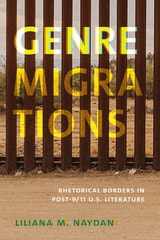
Genre Migrations
Rhetorical Borders in Post-9/11 U.S. LiteratureLiliana M. Naydan
University of Iowa Press, 2026
Genre Migrations argues that authors Jhumpa Lahiri, Valeria Luiselli, Ling Ma, Claudia Rankine, and Gary Shteyngart address immigration in both their content and innovative literary form. These authors highlight the relationship between immigrant identities and others, exposing borders—and genres—as porous and malleable constructs. Through their revisionist aesthetics and rhetorical engagements, these writers challenge the logic of globalization and xenophobia and condemn blind adherence to the limiting conventions of genres and life.
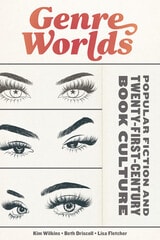
Genre Worlds
Popular Fiction and Twenty-First-Century Book CultureKim Wilkins, Beth Driscoll, and Lisa Fletcher
University of Massachusetts Press, 2022
Works of genre fiction are a source of enjoyment, read during cherished leisure time and in incidental moments of relaxation. This original book takes readers inside popular genres of fiction, including crime, fantasy, and romance, to reveal how personal tastes, social connections, and industry knowledge shape genre worlds. Attuned to both the pleasure and the profession of producing genre fiction, the authors investigate contemporary developments in the field—the rise of Amazon, self-publishing platforms, transmedia storytelling, and growing global publishing conglomerates—and show how these interact with older practices, from fan conventions to writers’ groups.
Sitting at the intersection of literary studies, genre studies, fan studies, and studies of the book and publishing cultures, Genre Worlds considers how contemporary genre fiction is produced and circulated on a global scale. Its authors propose an innovative theoretical framework that unfolds genre fiction’s most compelling characteristics: its connected social, industrial, and textual practices. As they demonstrate, genre fiction books are not merely texts; they are also nodes of social and industrial activity involving the production, dissemination, and reception of the texts.
Genre of Autobiography in Victorian Literature
Clinton Machann
University of Michigan Press, 1994
Genre of Autobiography in Victorian Literature
Clinton Machann
University of Michigan Press, 1995
Genre, Race, and the Production of Subjectivity in German Romanticism
Stephanie Galasso
Northwestern University Press, 2024
Late Enlightenment philosophers and writers like Herder, Goethe, and Schiller broke with conventions of form and genre to prioritize an idealized, and racially coded, universality. Newly translated literatures from colonial contexts served as the basis for their evaluations of how to contribute to a distinctly “German” national literary tradition, one that valorized modernity and freedom and thus fortified crucial determinants of modern concepts of whiteness. Through close readings of both canonical and less-studied Romantic texts, Stephanie Galasso examines the intimately entwined histories of racialized subjectivity and aesthetic theory and shows how literary genre is both symptomatic and generative of the cultural violence that underpinned the colonial project.
Poetic expression and its generic conventions continue to exert pressure on the framing and reception of the stories that can be told about interpersonal and structural experiences of oppression. Genre, Race, and the Production of Subjectivity in German Romanticism explores how white subjectivity is guarded by symbolic and material forms of violence.