Results by title
209 books match the query 'Mathematics' and 11 start with g

Genetic Algorithms in Engineering Systems
A.M.S. Zalzala
The Institution of Engineering and Technology, 1997
Geometrical Vectors
Gabriel Weinreich
University of Chicago Press, 1998
Geometrical Vectors introduces a more sophisticated approach, which not only brings together many loose ends of the traditional treatment, but also leads directly into the practical use of vectors in general curvilinear coordinates by carefully separating those relationships which are topologically invariant from those which are not. Based on the essentially geometric nature of the subject, this approach builds consistently on students' prior knowledge and geometrical intuition.
Written in an informal and personal style, Geometrical Vectors provides a handy guide for any student of vector analysis. Clear, carefully constructed line drawings illustrate key points in the text, and problem sets as well as physical examples are provided.
Geometry and Meaning
Dominic Widdows
CSLI, 2004

Geometry of Grief
Reflections on Mathematics, Loss, and LifeMichael Frame
University of Chicago Press, 2021
We all know the euphoria of intellectual epiphany—the thrill of sudden understanding. But coupled with that excitement is a sense of loss: a moment of epiphany can never be repeated. In Geometry of Grief, mathematician Michael Frame draws on a career’s worth of insight—including his work with a pioneer of fractal geometry Benoit Mandelbrot—and a gift for rendering the complex accessible as he delves into this twinning of understanding and loss. Grief, Frame reveals, can be a moment of possibility.
Frame investigates grief as a response to an irrevocable change in circumstance. This reframing allows us to see parallels between the loss of a loved one or a career and the loss of the elation of first understanding a tricky concept. From this foundation, Frame builds a geometric model of mental states. An object that is fractal, for example, has symmetry of magnification: magnify a picture of a mountain or a fern leaf—both fractal—and we see echoes of the original shape. Similarly, nested inside great loss are smaller losses. By manipulating this geometry, Frame shows us, we may be able to redirect our thinking in ways that help reduce our pain. Small‐scale losses, in essence, provide laboratories to learn how to meet large-scale losses.
Interweaving original illustrations, clear introductions to advanced topics in geometry, and wisdom gleaned from his own experience with illness and others’ remarkable responses to devastating loss, Frame’s poetic book is a journey through the beautiful complexities of mathematics and life. With both human sympathy and geometrical elegance, it helps us to see how a geometry of grief can open a pathway for bold action.
Geometry of Nonpositively Curved Manifolds
Patrick B. Eberlein
University of Chicago Press, 1997
self-contained treatment of differentiable spaces of nonpositive
curvature, focusing on the symmetric spaces in which every geodesic lies
in a flat Euclidean space of dimension at least two. The book builds to
a discussion of the Mostow Rigidity Theorem and its generalizations, and
concludes by exploring the relationship in nonpositively curved spaces
between geometric and algebraic properties of the fundamental group.
This introduction to the geometry of symmetric spaces of non-compact
type will serve as an excellent guide for graduate students new to the
material, and will also be a useful reference text for mathematicians
already familiar with the subject.
Geometry, Rigidity, and Group Actions
Edited by Benson Farb and David Fisher
University of Chicago Press, 2011
The study of group actions is more than a hundred years old but remains to this day a vibrant and widely studied topic in a variety of mathematic fields. A central development in the last fifty years is the phenomenon of rigidity, whereby one can classify actions of certain groups, such as lattices in semi-simple Lie groups. This provides a way to classify all possible symmetries of important spaces and all spaces admitting given symmetries. Paradigmatic results can be found in the seminal work of George Mostow, Gergory Margulis, and Robert J. Zimmer, among others.
The papers in Geometry, Rigidity, and Group Actions explore the role of group actions and rigidity in several areas of mathematics, including ergodic theory, dynamics, geometry, topology, and the algebraic properties of representation varieties. In some cases, the dynamics of the possible group actions are the principal focus of inquiry. In other cases, the dynamics of group actions are a tool for proving theorems about algebra, geometry, or topology. This volume contains surveys of some of the main directions in the field, as well as research articles on topics of current interest.
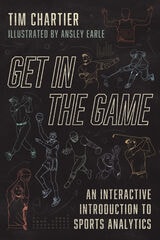
Get in the Game
An Interactive Introduction to Sports AnalyticsTim Chartier
University of Chicago Press, 2022
In 2013, NBA point guard Steph Curry wowed crowds when he sunk 11 out of 13 three-pointers for a game total of 54 points—only seven other players, including Michael Jordan and Kobe Bryant, had scored more in a game at Madison Square Garden. Four years later, the University of Connecticut women’s basketball team won its hundredth straight game, defeating South Carolina 66–55. And in 2010, one forecaster—an octopus named Paul—correctly predicted the outcome of all of Germany’s matches in the FIFA World Cup. These are surprising events—but are they truly improbable?
In Get in the Game, mathematician and sports analytics expert Tim Chartier helps us answer that question—condensing complex mathematics down to coin tosses and dice throws to give readers both an introduction to statistics and a new way to enjoy sporting events. With these accessible tools, Chartier leads us through modeling experiments that develop our intuitive sense of the improbable. For example, to see how likely you are to beat Curry’s three-pointer feat, consider his 45.3 percent three-point shooting average in 2012–13. Take a coin and assume heads is making the shot (slightly better than Curry at a fifty percent chance). Can you imagine getting heads eleven out of thirteen times? With engaging exercises and fun, comic book–style illustrations by Ansley Earle, Chartier’s book encourages all readers—including those who have never encountered formal statistics or data simulations, or even heard of sports analytics, but who enjoy watching sports—to get in the game.
Good Thinking
The Foundations of Probability and Its ApplicationsI.J. Good
University of Minnesota Press, 1983
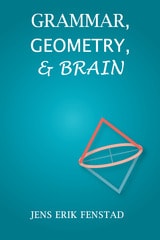
Grammar, Geometry, and Brain
Jens Erik Fenstad
CSLI, 2010
This original study considers the effects of language and meaning on the brain. Jens Erik Fenstad—an expert in the fields of recursion theory, nonstandard analysis, and natural language semantics—combines current formal semantics with a geometric structure in order to trace how common nouns, properties, natural kinds, and attractors link with brain dynamics.
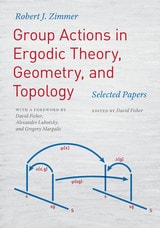
Group Actions in Ergodic Theory, Geometry, and Topology
Selected PapersRobert J. Zimmer
University of Chicago Press, 2019
In addition to the selected papers themselves, this volume opens with a foreword by David Fisher, Alexander Lubotzky, and Gregory Margulis, as well as a substantial introductory essay by Zimmer recounting the course of his career in mathematics. The volume closes with an afterword by Fisher on the most recent developments around the Zimmer program.
Groups of Circle Diffeomorphisms
Andrés Navas
University of Chicago Press, 2011
In recent years scholars from a variety of branches of mathematics have made several significant developments in the theory of group actions. Groups of Circle Diffeomorphisms systematically explores group actions on the simplest closed manifold, the circle. As the group of circle diffeomorphisms is an important subject in modern mathematics, this book will be of interest to those doing research in group theory, dynamical systems, low dimensional geometry and topology, and foliation theory. The book is mostly self-contained and also includes numerous complementary exercises, making it an excellent textbook for undergraduate and graduate students.