Results by title
9 books match the query 'Parodies'
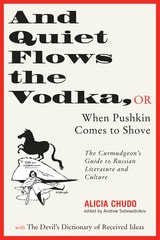
And Quiet Flows the Vodka
or When Pushkin Comes to Shove: The Curmudgeon's Guide to Russian Literature with the Devil's Dictionary of Received IdeasAlicia Chudo
Northwestern University Press, 2000
Written in the tradition of 1066 and All That, The Pooh Perplex, and The Classics Redefined, And Quiet Flows the Vodka will, with any luck, be the final word on the ghastly first two millennia of Russian literature, history, and culture.

Of Huck and Alice
Humorous Writing in American LiteratureNeil Schmitz
University of Minnesota Press, 1983
Of Huck and Alice was first published in 1983. Minnesota Archive Editions uses digital technology to make long-unavailable books once again accessible, and are published unaltered from the original University of Minnesota Press editions.
Huck Finn and Alice B. Toklas allow Mark Twain and Gertrude Stein to slip away from the cramped and smothery intentions of proper writing. Like Krazy Kat, who transforms the hurt of Ignatz Mouse's brick into humorous bliss, Huck and Alice brilliantly misrepresent painful authority. As exemplars of humorous skepticism, Mark Twain and Gertrude Stein are at the center of this far-ranging book that begins with an examination of Jacksonian dialect humor, ends with an account of the humorous style in post-modern American fiction, and considers along the way the sweet parlance of Krazy Kat, the meaning of Harpo Marx's silence, and the iconicity of Woody Allen's face. Schmitz's analysis of the humorous style explores the texture of its language, discusses its preferred forms, and shows how the humorist frames his or her question within the text.
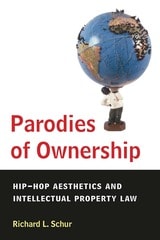
Parodies of Ownership
Hip-Hop Aesthetics and Intellectual Property LawRichard L. Schur
University of Michigan Press, 2009
"Richard Schur offers a provocative view of contemporary African American cultural politics and the relationship between African American cultural production and intellectual property law."
---Mark Anthony Neal, Duke University
"Whites used to own blacks. Now, they accomplish much the same thing by insisting that they 'own' ownership. Blacks shouldn't let them. A culture that makes all artists play by its rules will end up controlling new ideas and stifling change. Richard Schur's fine book explains why."
---Richard Delgado, Seattle University
What is the relationship between hip-hop and African American culture in the post--Civil Rights era? Does hip-hop share a criticism of American culture or stand as an isolated and unique phenomenon? How have African American texts responded to the increasing role intellectual property law plays in regulating images, sounds, words, and logos? Parodies of Ownership examines how contemporary African American writers, artists, and musicians have developed an artistic form that Schur terms "hip-hop aesthetics." This book offers an in-depth examination of a wide range of contemporary African American painters and writers, including Anna Deavere Smith, Toni Morrison, Adrian Piper, Colson Whitehead, Michael Ray Charles, Alice Randall, and Fred Wilson. Their absence from conversations about African American culture has caused a misunderstanding about the nature of contemporary cultural issues and resulted in neglect of their innovative responses to the post--Civil Rights era. By considering their work as a cross-disciplinary and specifically African American cultural movement, Schur shows how a new paradigm for artistic creation has developed.
Parodies of Ownership offers a broad analysis of post--Civil Rights era culture and provides the necessary context for understanding contemporary debates within American studies, African American studies, intellectual property law, African American literature, art history, and hip-hop studies. Weaving together law, literature, art, and music, Schur deftly clarifies the conceptual issues that unify contemporary African American culture, empowering this generation of artists, writers, and musicians to criticize how racism continues to affect our country.
Richard L. Schur is Director, Interdisciplinary Studies Center, and Associate Professor of Interdisciplinary Studies at Drury University. Visit the author's website: http://www2.drury.edu/rschur/index.htm.
Postmodern Pooh
Frederick Crews
Northwestern University Press, 2006
Seeing MAD
Essays on MAD Magazine's Humor and LegacyJudith Yaross Lee
University of Missouri Press, 2021
Mad magazine stands near the heart of post-WWII American humor, but at the periphery in scholarly recognition from American cultural historians, including humor specialists. This book fills that gap, with perceptive, informed, engaging, but also funny essays by a variety of scholars. The chapters, written by experts on humor, comics, and popular culture, cover the genesis of Mad; its editors and prominent contributors; its regular features and departments and standout examples of their contents; perspectives on its cultural and political significance; and its enduring legacy in American culture.
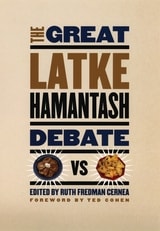
The Great Latke-Hamantash Debate
Edited by Ruth Fredman Cernea
University of Chicago Press, 2005
What began as an informal gathering is now an institution that has been replicated on campuses nationwide. Highly absurd yet deeply serious, the annual debate is an
opportunity for both ethnic celebration and academic farce. In poetry, essays, jokes, and revisionist histories, members of elite American academies attack the latke-versus-hamantash question with intellectual panache and an unerring sense of humor, if not chutzpah. The Great Latke-Hamantash Debate is the first collection of the best of these performances, from Martha Nussbaum's paean to both foods—in the style of Hecuba's Lament—to Nobel laureate Leon Lederman's proclamation on the union of the celebrated dyad. The latke and the hamantash are here revealed as playing a critical role in everything from Chinese history to the Renaissance, the works of Jane Austen to constitutional law.
Philosopher and humorist Ted Cohen supplies a wry foreword, while anthropologist Ruth Fredman Cernea provides historical and social context as well as an overview of the Jewish holidays, latke and hamantash recipes, and a glossary of Yiddish and Hebrew terms, making the book accessible even to the uninitiated. The University of Chicago may have split the atom in 1942, but it's still working on the equally significant issue of the latke versus the hamantash.
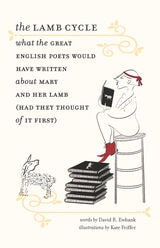
The Lamb Cycle
What the Great English Poets Would Have Written About Mary and Her Lamb (Had They Thought of It First)David R. Ewbank
Brandeis University Press, 2023
In The Lamb Cycle, David R. Ewbank achieves the unthinkable—he writes so convincingly in the style of the great English poets that one could be lulled into thinking that Shakespeare himself was inspired to muse upon the subject of “Mary Had a Little Lamb.” Ewbank captures not only the style of each of the poets he chooses, but also their preoccupations and subject matter. So D.H. Lawrence’s Mary longs for her lamb as any woman longing for her lover, whilst T.S. Eliot’s Mary is recollected by an old man looking back on his life. Alexander Pope writes an “An Essay on Lambs,” and Tennyson’s lotus eaters become “The Clover Eater.” Brilliantly written, sophisticated, and laugh-out-loud funny, these poems, enhanced by Kate Feiffer’s charming illustrations, will enchant anyone who has ever read an English poem.
The Snobs of England and Punch's Prize Novelists
William Makepeace Thackeray
University of Michigan Press, 2005
This volume of The Snobs of England and Punch's Prize Novelists is an addition to The Thackeray Edition collection, the first full-scale scholarly edition of William Makepeace Thackeray's works to appear in over seventy years, and the only one ever to be based on an examination of manuscripts and relevant printed texts. It is also a concrete attempt to put into practice a theory of scholarly editing that gives new insight into Thackeray's own compositional process. In The Snobs of England, a series of amusing satirical sketches, Thackeray provides a panoramic awareness of the many varieties of human folly, identifying snobbery not as a social attitude but as the unworthy admiration of foolish things. Punch's Prize Novelists presents a series of illustrated burlesque parodies of Thackeray's contemporary writers, including Edward Bulwer, Benjamin Disraeli, Mrs. Catherine Gore, G.P.R. James, Charles Lever, and James Fenimore Cooper. The works are edited here from a comparative study of all relevant documents: from the first published appearances to the last editions touched by the author.
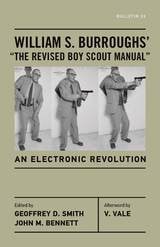
William S. Burroughs' "The Revised Boy Scout Manual"
An Electronic RevolutionEdited by Geoffrey D. Smith & John M. Bennett with an afterword by V. Vale
The Ohio State University Press, 2018
The Revised Boy Scout Manual was a work Burroughs revisited many times, but which has never before been published in its complete form. Based primarily on recordings of a performance of the complete piece found in the archives at the OSU libraries, as well as various incomplete versions of the typescript found at Arizona State University and the New York Public Library archives, this lost masterpiece of satiric subversion is finally available in its entirety.