914 books match the query 'Medieval' and 20 start with g
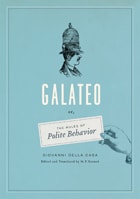
cover of Galateo: Or, The Rules of Polite Behavior

Galateo

Or, The Rules of Polite Behavior

Giovanni Della Casa

University of Chicago Press, 2013

“Since it is the case that you are now just beginning that journey that I have for the most part as you see completed, that is, the one through mortal life, and loving you so very much as I do, I have proposed to myself—as one who has been many places—to show you those places in life where, walking through them, I fear you could easily either fall or take the wrong direction.”

So begins Galateo, a treatise on polite behavior written by Giovanni Della Casa (1503–56) for the benefit of his nephew, a young Florentine destined for greatness.

           
In the voice of a cranky yet genial old uncle, Della Casa offers the distillation of what he has learned over a lifetime of public service as diplomat and papal nuncio. As relevant today as it was in Renaissance Italy, Galateo deals with subjects as varied as dress codes, charming conversation and off-color jokes, eating habits and hairstyles, and literary language. In its time, Galateo circulated as widely as Machiavelli’s Prince and Castiglione’s Book of the Courtier. Mirroring what Machiavelli did for promoting political behavior, and what Castiglione did for behavior at court, Della Casa here creates a picture of the refined man caught in a world in which embarrassment and vulgarity prevail. Less a treatise promoting courtly values or a manual of savoir faire, it is rather a meditation on conformity and the law, on perfection and rules, but also an exasperated—often theatrical—reaction to the diverse ways in which people make fools of themselves in everyday social situations.
           
With renewed interest in etiquette and polite behavior growing both inside and outside the academy, the time is right for a new, definitive edition of this book. More than a mere etiquette book, this restored edition will be entertaining (and even useful) for anyone making their way in modern civilized and polite society, and a subtle gift for the rude neighbor, the thoughtless dinner guest, or the friend or relative in need of a refresher on proper behavior.
[more]
cover of Gender and Historiography: Studies in the earlier middle ages in honour of Pauline Stafford

Gender and Historiography

Studies in the earlier middle ages in honour of Pauline Stafford

Janet L. Nelson, Susan Reynolds, and Susan M. Johns

University of London Press, 2012
The chapters in this volume celebrate the work of Pauline Stafford, highlighting the ways in which it has advanced research in the fields of both Anglo-Saxon history and the history of medieval women and gender. Ranging across the period, and over much of the old Carolingian world as well as Anglo-Saxon England, they deal with such questions as the nature of kingship and queenship, fatherhood, elite gender relations, the transmission of property, the participation of women in lordship, slavery and warfare, and the nature of assemblies. Gender and historiography presents the fruits of groundbreaking research, inspired by Pauline Stafford’s own interests over a long and influential career.
[more]
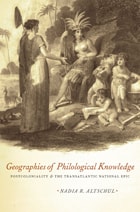
cover of Geographies of Philological Knowledge: Postcoloniality and the Transatlantic National Epic

Geographies of Philological Knowledge

Postcoloniality and the Transatlantic National Epic

Nadia R. Altschul

University of Chicago Press, 2012

Geographies of Philological Knowledge examines the relationship between medievalism and colonialism in the nineteenth-century Hispanic American context through the striking case of the Creole Andrés Bello (1781–1865), a Venezuelan grammarian, editor, legal scholar, and politician, and his lifelong philological work on the medieval heroic narrative that would later become Spain’s national epic, the Poem of the Cid. Nadia R. Altschul combs Bello’s study of the poem and finds throughout it evidence of a “coloniality of knowledge.”
 
Altschul  reveals how, during the nineteenth century, the framework for philological scholarship established in and for core European nations—France, England, and especially Germany—was exported to Spain and Hispanic America as the proper way of doing medieval studies. She argues that the global designs of European philological scholarship are conspicuous in the domain of disciplinary historiography, especially when examining the local history of a Creole Hispanic American like Bello, who is neither fully European nor fully alien to European culture. Altschul likewise highlights Hispanic America’s intellectual internalization of coloniality and its understanding of itself as an extension of Europe.  
 
A timely example of interdisciplinary history, interconnected history, and transnational study, Geographies of Philological Knowledge breaks with previous nationalist and colonialist histories and thus forges a new path for the future of medieval studies.
[more]
cover of Gesta Hungarorum: The Deeds of the Hungarians

Gesta Hungarorum

The Deeds of the Hungarians

Simon Kézai

Central European University Press, 1999
Simon of Kéza was a court cleric of the Hungarian King, Ladislas IV (1272-1290). He travelled extensively in Italy, France and Germany and culled the epic and poetic material from a broad range of readings.Written between 1282-1285, the Gesta Hungarorum is an ingenious and imaginative historical fiction of prehistory, medieval history and contemporary social history. The author divides Hungarian history into two periods: Hunnish-Hungarian prehistory and Hungarian history, giving a division which persisted in Hungary up to the beginnings of modern historiography. Simon of Kéza provides a vivid retelling of the well known Attila stories, using such lively prose as - ".the battle lasted for 15 days on end, Csaba's army received such a crushing defeat that very few of the Huns or the sons of Attila survived, the river Danube from Sicambria as far as the city of Potentia was swollen with blood and for several days neither men nor animals could drink the water." The book is also significant because of the author's legal-theoretical framework of corporate self government and constitutional law, inspired by French and Italian sources and practice, which made this chronicle become an integral part of Hungarian historiography.
[more]
cover of Gesta principum Polonorum: The Deeds of the Princes of the Poles

Gesta principum Polonorum

The Deeds of the Princes of the Poles

János M. Bak

Central European University Press, 2003
Written around 1112-1116, The Deeds of the Princes of the Poles is the oldest narrative source from Poland, formerly attributed to 'Gallus,' a French monk. The anonymous author tells the ancient history of Poland down to the reign of Boleslaw III. The chronicle contains valuable information on Poland's relations to her neighbors as well as the political ideas of his time.
[more]
cover of Gesta, volume 60 number 2 (Fall 2021)

Gesta, volume 60 number 2 (Fall 2021)

The University of Chicago Press

University of Chicago Press Journals, 2021
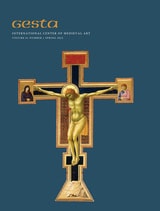
This is volume 60 issue 2 of Gesta. Gesta publishes original research on medieval art and architecture. The journal embraces all facets of artistic production from ca. 300 to ca. 1500 C.E. in every corner of the medieval world.
[more]
cover of Gesta, volume 61 number 1 (Spring 2022)

Gesta, volume 61 number 1 (Spring 2022)

The University of Chicago Press

University of Chicago Press Journals, 2022
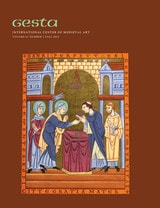
This is volume 61 issue 1 of Gesta. Gesta publishes original research on medieval art and architecture. The journal embraces all facets of artistic production from ca. 300 to ca. 1500 C.E. in every corner of the medieval world.
[more]
cover of Gesta, volume 61 number 2 (Fall 2022)

Gesta, volume 61 number 2 (Fall 2022)

The University of Chicago Press

University of Chicago Press Journals, 2022
This is volume 61 issue 2 of Gesta. Gesta publishes original research on medieval art and architecture. The journal embraces all facets of artistic production from ca. 300 to ca. 1500 C.E. in every corner of the medieval world.
[more]
cover of Gesta, volume 62 number 1 (Spring 2023)

Gesta, volume 62 number 1 (Spring 2023)

The University of Chicago Press

University of Chicago Press Journals, 2023
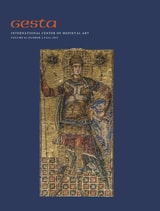
This is volume 62 issue 1 of Gesta. Gesta publishes original research on medieval art and architecture. The journal embraces all facets of artistic production from ca. 300 to ca. 1500 C.E. in every corner of the medieval world.
[more]
cover of Gesta, volume 62 number 2 (Fall 2023)

Gesta, volume 62 number 2 (Fall 2023)

The University of Chicago Press

University of Chicago Press Journals, 2023
This is volume 62 issue 2 of Gesta. Gesta publishes original research on medieval art and architecture. The journal embraces all facets of artistic production from ca. 300 to ca. 1500 C.E. in every corner of the medieval world.
[more]
cover of Gesta, volume 63 number 1 (Spring 2024)

Gesta, volume 63 number 1 (Spring 2024)

The University of Chicago Press

University of Chicago Press Journals, 2024
This is volume 63 issue 1 of Gesta. Gesta publishes original research on medieval art and architecture. The journal embraces all facets of artistic production from ca. 300 to ca. 1500 C.E. in every corner of the medieval world.
[more]
cover of Gesta, volume 63 number 2 (Fall 2024)

Gesta, volume 63 number 2 (Fall 2024)

The University of Chicago Press

University of Chicago Press Journals, 2024
This is volume 63 issue 2 of Gesta. Gesta publishes original research on medieval art and architecture. The journal embraces all facets of artistic production from ca. 300 to ca. 1500 C.E. in every corner of the medieval world.
[more]
cover of Gesta, volume 64 number 1 (Spring 2025)

Gesta, volume 64 number 1 (Spring 2025)

The University of Chicago Press

University of Chicago Press Journals, 2025
This is volume 64 issue 1 of Gesta. Gesta publishes original research on medieval art and architecture. The journal embraces all facets of artistic production from ca. 300 to ca. 1500 C.E. in every corner of the medieval world.
[more]
cover of Gesta, volume 64 number 2 (Fall 2025)

Gesta, volume 64 number 2 (Fall 2025)

The University of Chicago Press

University of Chicago Press Journals, 2025
This is volume 64 issue 2 of Gesta. Gesta publishes original research on medieval art and architecture. The journal embraces all facets of artistic production from ca. 300 to ca. 1500 C.E. in every corner of the medieval world.
[more]
cover of Gesta, volume 65 number 1 (Spring 2026)

Gesta, volume 65 number 1 (Spring 2026)

The University of Chicago Press

University of Chicago Press Journals, 2026
This is volume 65 issue 1 of Gesta. Gesta publishes original research on medieval art and architecture. The journal embraces all facets of artistic production from ca. 300 to ca. 1500 C.E. in every corner of the medieval world.
[more]
cover of Getting Medieval: Sexualities and Communities, Pre- and Postmodern

Getting Medieval

Sexualities and Communities, Pre- and Postmodern

Carolyn Dinshaw

Duke University Press, 1999

In Getting Medieval Carolyn Dinshaw examines communities—dissident and orthodox—in late-fourteenth and early-fifteenth-century England to create a new sense of queer history. Reaching beyond both medieval and queer studies, Dinshaw demonstrates in this challenging work how intellectual inquiry into pre-modern societies can contribute invaluably to current issues in cultural studies. In the process, she makes important connections between past and present cultures that until now have not been realized.

In her pursuit of historical analyses that embrace the heterogeneity and indeterminacy of sex and sexuality, Dinshaw examines canonical Middle English texts such as the Canterbury Tales and TheBook of Margery Kempe. She examines polemics around the religious dissidents known as the Lollards as well as accounts of prostitutes in London to address questions of how particular sexual practices and identifications were normalized while others were proscribed. By exploring contemporary (mis)appropriations of medieval tropes in texts ranging from Quentin Tarantino’s Pulp Fiction to recent Congressional debates on U.S. cultural production, Dinshaw demonstrates how such modern media can serve to reinforce constrictive heteronormative values and deny the multifarious nature of history. Finally, she works with and against the theories of Michel Foucault, Homi K. Bhabha, Roland Barthes, and John Boswell to show how deconstructionist impulses as well as historical perspectives can further an understanding of community in both pre- and postmodern societies.

This long-anticipated volume will be indispensable to medieval and queer scholars and will be welcomed by a larger cultural studies audience.


[more]
cover of Ghosts in the Middle Ages: The Living and the Dead in Medieval Society

Ghosts in the Middle Ages

The Living and the Dead in Medieval Society

Jean-Claude Schmitt

University of Chicago Press, 1998

Through this vivid study, Jean-Claude Schmitt examines medieval religious culture and the significance of the widespread belief in ghosts, revealing the ways in which the dead and the living related to each other during the middle ages. Schmitt also discusses Augustine's influence on medieval authors; the link between dreams and autobiographical narratives; and monastic visions and folklore. Including numerous color reproductions of ghosts and ghostly trappings, this book presents a unique and intriguing look at medieval culture.

"Valuable and highly readable. . . . [Ghosts in the Middle Ages] will be of interest to many students of medieval thought and culture, but especially to those seeking a general overview of this particularly conspicuous aspect of the medieval remembrance of the dead."—Hans Peter Broedel, Medieval Review

"A fascinating study of the growing prevalence of ghost imagery in ecclesiastical and popular writing from the fifth to the fifteenth century."—Choice
[more]
cover of God's Plagiarist: Being an Account of the Fabulous Industry and Irregular Commerce of the Abbe Migne

God's Plagiarist

Being an Account of the Fabulous Industry and Irregular Commerce of the Abbe Migne

R. Howard Bloch

University of Chicago Press, 1994

God's Plagiarist is an entertaining account of the abbe Jacques-Paul Migne, one of the great entrepreneurs of the nineteenth century. A priest in Orleans from 1824 to 1833, Migne then moved to Paris, where, in the space of a decade, he built one of the most extensive publishing ventures of all time.

How did he do it?

Migne harnessed a deep well of personal energy and a will of iron to the latest innovations in print technology, advertising, and merchandising. His assembly-line production and innovative marketing of the massive editions of the Church Fathers placed him at the forefront of France's new commerce. Characterized by the police as one of the great "schemers" of the century, this priest-entrepreneur put the most questionable of business practices in the service of his devotion to Catholicism.

Part detective novel, part morality tale, Bloch's narrative not only will interest scholars of nineteenth-century French intellectual history but will appeal also to general readers interested in the history of publishing or just a good historical yarn.

"An unforgettable, Daumier-like portrait, sharp and satirical, of this enterprising, austere and somewhat crazed merchandiser of sacred learning. . . . Bloch deserves great credit for the wit and style of his effort to explore the Pedantic Park of nineteenth-century learning, that island of monsters which scholars have found, as yet, no escape."—Anthony Grafton, New Republic

"Bloch is an exhilarating guide to the methods which made Migne the Napoleon of the Prospectus, a publicist of genius, Buffalo Bill and P.T. Barnum rolled into one."—David Coward, Times Literary Supplement

"Mercifully, Bloch's sense of humour has none of that condescending mock-bewilderment commonly applied to the foreign or ancient. . . . It enables Bloch to promote Migne as a forerunner of the department store and to place him on a continuum running from St. Paul to the Tupperware party: the quality of the merchandise is increasingly irrelevant, still more the nature of its contents."—Graham Robb, London Review of Books
[more]
cover of Godliness and Governance in Tudor Colchester

Godliness and Governance in Tudor Colchester

Laquita M. Higgs

University of Michigan Press, 1999

The Tudor period was a time of extremes, when King Henry VIII beheaded wives and Queen Mary executed her subjects by burning. As an early supporter of Henry's Protestant Reformation, the borough of Colchester took the full brunt of Catholic Mary's wrath, and at least thirteen Colchester Protestants were burned for their faith. When the Protestant Elizabeth came to the throne, Colchester leaders, influenced by returning refugees, determined to try to produce a godly society on the Genevan model. They hired their own preacher, but their efforts to reform sinful behavior through civil government met with strong resistance.
In Godliness and Governance in Tudor Colchester Laquita M. Higgs traces the governance and the religion of that town. Though traditional piety held sway early in the Tudor era, there was a strong undercurrent of hereticism, even among town leaders. Such sympathy helps explain Colchester's embrace of Henry VIII's religious reforms. Town governors also found it advantageous to cooperate with the local nobleman, the earl of Oxford, and with their own Thomas Audley, who helped the King shape the reformation. Queen Mary's attempts to root out Protestantism strengthened Colchester's commitment to reform. Under Elizabeth, reformers gradually took over governance of the borough.
Colchester provides one of the earliest illustrations of the workings and tensions of Puritan town governance. Higgs examines the connections between governance and religion with special emphasis on the Elizabethan period. The town's development toward religious radicalism is shown by a comparison of the aldermen of 1530, 1560, and 1590. Higgs explores the camaraderie of the reformers, the attempt of town leaders to correct immoral behavior, and the resultant tensions that produced deep divisions between moderate reformers and radical Puritans. An analysis of extant wills shows the extent to which Puritan governors achieved some degree of success.
Godliness and Governance in Tudor Colchester will be of interest to historians of the Tudor period, Catholicism, Lollardy, and the English Protestant Reformation.
Laquita M. Higgs is Adjunct Lecturer in History, University of Michigan, Dearborn.

[more]
cover of Greater than Emperor: Cola di Rienzo (ca. 1313-54) and the World of Fourteenth-Century Rome

Greater than Emperor

Cola di Rienzo (ca. 1313-54) and the World of Fourteenth-Century Rome

Amanda Collins

University of Michigan Press, 2002

Greater than Emperor charts the remarkable process by which Rome tried to forge a new civic identity, similar in constitution to contemporary city-republics but conceptually much greater. At the forefront of the process stood the idiosyncratic and astonishing young notary Cola di Rienzo. On May 21, 1347, Cola staged a bloodless coup. Rome entered a new age that would witness both the resurrection of the ancient power of the Empire and Rome's apotheosis as God's chosen city. Yet within seven months, the theatricality and violence of Cola's regime led to exile. Cola's triumphal return some years later ended in his assassination.

Cola was eventually resurrected as a hero of nineteenth-century nationalism, leaving the realities of Trecento Rome far behind. Yet it is only in terms of the very real models and methods that Cola welded together that his revolution can be understood.

Greater than Emperor describes Cola's reliance on the past of rhetoric, pageantry, and Roman law. It then discusses the future, tracing the dynamic contemporary influences of apocalyptic fervor, prophetic literature, and radical Franciscan imagery of Cola's world. Amanda Collins assesses Cola's legal and political career within both the complex mechanics of municipal administration and the multiple hierarchies of Roman society.

Amanda Collins offers a new assessment of the dramatic events of 1347 and an analysis of Cola within his late medieval Roman context. Bringing depth and substance to Cola's backdrop, Trecento Rome and the economic and spiritual ambitions of its citizen body, Collins provides information crucial to understanding the longer-term economic and political drive to civic autonomy in Rome before 1400.

Historians and generalists alike will relish the story of a remarkable individual, set within the cultural climate of a famous and fascinating city, during an often-overlooked period. This book sheds new light on a crucial political figure that brought a dazzling civil independence to Rome.

Amanda Collins held the Junior Research Fellowship in Intellectual History at Wolfson College, Oxford from 1997-2000, and has more recently been employed at the University of Sussex.

[more]