Results by title
1109 books match the query 'Memoirs' and 29 start with g
Gaining Daylight
Life on Two IslandsSara Loewen
University of Alaska Press, 2013
Loewen’s writing is richly descriptive; readers can almost feel heat from wood stoves, smell smoking salmon, and spot the ways the ocean blues change with the season. With honesty and humor, Loewen easily draws readers into her world, sharing the rewards of subsistence living and the peace brought by miles of crisp solitude.
Garbage
The Saga of a Boss Scavenger in San FranciscoLeonard Dominic Stefanelli
University of Nevada Press, 2017
Stefanelli was trained to be a scavenger by his uncles in the 1940s and 50s at a time when rampant discrimination prevented Italian immigrants and their families from pursuing any other career. From there, he became a ‘boss scavenger’, married a garbage man’s daughter, and climbed the ranks of the Sunset Scavenger Company where he eventually took part in a corporate shakeup that made him the company’s president at only 31 years old. As one of the men at the helm of this booming industry, he became the chief advocate for increasingly innovative recycling and waste management practices in the Bay Area, and a foremost leader of environmentally-conscious business in the world.
Stefanelli’s lively memoir will enlighten readers to the waste management business, an industry that was once considered the lowest rung on the social ladder, but will also show his unparalleled capacity for transformation and vision.
Gasa Gasa Girl Goes to Camp
A Nisei Youth Behind A World War II FenceLily Yuriko Nakai Havey
University of Utah Press, 2014
In this creative memoir, Lily Havey combines storytelling, watercolor, and personal photographs to recount her youth in two Japanese-American internment camps during World War II. In short vignettes snapshots of people, recreated scenes and events a ten-year-old girl develops into a teenager while confined. Vintage photographs reveal the historical, cultural, and familial contexts of that growth and of the Nakais’ dislocation. The paintings and her animated writing together pull us into a turbulent era when America disgracefully incarcerated, without due process, thousands of American citizens because of their race.
These stories of love, loss, and discovery recall a girl balancing precariously between childhood and adolescence. In turn wrenching, funny, touching, and biting but consistently engrossing, they elucidate the daily challenges of life in the camp and the internees’ many adaptations.
Winner of the Evans Biography Award.
Selected by the American Library Association as one the Best of the Best from University Presses.
Finalist in the cover design category in the Southwest Book Design and Production Awards.
Gathering Noise from My Life
A Camouflaged MemoirDonald Anderson
University of Iowa Press, 2012
The noise gathered from a lifetime of engaging with war, race, religion, memory, illness, and family echoes through the vignettes, quotations, graffiti, and poetry that Donald Anderson musters here, fragments of the humor and horror of life, the absurdities that mock reason and the despair that yields laughter. Gathering Noise from My Life offers sonic shards of a tune at once jaunty and pessimistic, hopeful and hopeless, and a model for how we can make sense of the scraps of our lives. “We are where we’ve been and what we’ve read,” the author says, and gives us his youth in Montana, the family tradition of boxing, careers in writing and fighting, the words of Mike Tyson, Frederick the Great, Fran Lebowitz, and Shakespeare. In his camouflaged memoir, the award-winning short-story writer cobbles together the sources of the vision of life he has accrued as a consequence of his six decades of living and reading.
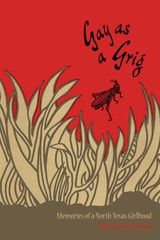
Gay as a Grig
Memories of a North Texas GirlhoodBy Ellen Bowie Holland
University of Texas Press, 1963
Ellen Bowie Holland grew up in a house at Weatherford, Texas, that had the "motherly look of a large and gallant hen hovering over too many chicks" and that was inhabited by a "lively, warm-hearted family." This book is her record of the "whole world of little things which enriched young lives" in her small town.
Blessed with a discerning and sympathetic eye, she had much happiness to remember and record, and she employs a charming combination of nostalgia and comedy as she brings to life again these bygone days. Her childhood experiences are illuminated by the wisdom of maturity, and the whole is infused with a deft humor, developed through her skilled use of fantasy and through her ability to laugh at the pretensions of the Victorian life she saw.
Holland's book also is memorable as a record of her unforgettable parents:
"Mother was born on Columbus Day, and she and Columbus had a lot in common. She liked to discover things for herself and nothing pleased her more than to nicely finish off a job that she had been told could not be done" . . . "She wasn't geared for solitary musing. Like a salmon at spawning time she liked to swim upstream against rushing waters and bash into boulders" . . . "Mother's pattern of neatness reached out in all directions" . . . "Mother, sheathed like an armadillo" . . .
"Father, silk-hatted, or swallow-tailed, distinguished almost beyond belief" . . . "I never heard him raise his voice or laugh aloud" . . . "Father was not witty but he had an absolutely delightful sense of nonsense. His humor came smoothly upon the scene" . . .
Throughout the book the reader shares the author's consciousness of the vast distance between her own childhood and that of the grandchildren to whom the book is dedicated—a distance created by rapid technological change.
"From my window I look over an air-conditioned city and I see jets streaking across the sky and occasionally I hear one of them breaking the sound barrier" . . . "When I really want to awe myself I think about the fact that only one generation ago Mother saw friendly or marauding Indians roaming these same acres" . . . "Those of my age have come into a span of years where living conditions of all kinds have changed so abruptly, where obsolescence sets in so rapidly, that there is little in common between our infancy and our present."
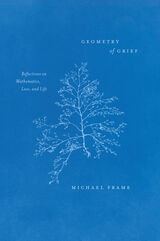
Geometry of Grief
Reflections on Mathematics, Loss, and LifeMichael Frame
University of Chicago Press, 2021
We all know the euphoria of intellectual epiphany—the thrill of sudden understanding. But coupled with that excitement is a sense of loss: a moment of epiphany can never be repeated. In Geometry of Grief, mathematician Michael Frame draws on a career’s worth of insight—including his work with a pioneer of fractal geometry Benoit Mandelbrot—and a gift for rendering the complex accessible as he delves into this twinning of understanding and loss. Grief, Frame reveals, can be a moment of possibility.
Frame investigates grief as a response to an irrevocable change in circumstance. This reframing allows us to see parallels between the loss of a loved one or a career and the loss of the elation of first understanding a tricky concept. From this foundation, Frame builds a geometric model of mental states. An object that is fractal, for example, has symmetry of magnification: magnify a picture of a mountain or a fern leaf—both fractal—and we see echoes of the original shape. Similarly, nested inside great loss are smaller losses. By manipulating this geometry, Frame shows us, we may be able to redirect our thinking in ways that help reduce our pain. Small‐scale losses, in essence, provide laboratories to learn how to meet large-scale losses.
Interweaving original illustrations, clear introductions to advanced topics in geometry, and wisdom gleaned from his own experience with illness and others’ remarkable responses to devastating loss, Frame’s poetic book is a journey through the beautiful complexities of mathematics and life. With both human sympathy and geometrical elegance, it helps us to see how a geometry of grief can open a pathway for bold action.
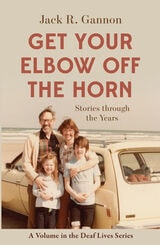
Get Your Elbow Off the Horn
Stories through the YearsJack R. Gannon
Gallaudet University Press, 2020
Many of his recollections are brief sketches that reveal much about being Deaf—and about being human. From reflecting on the difficult choices parents must make for their children, to recounting awkward communication exchanges, Gannon marries good humor with a poignant advocacy for sign language rights. His stories preserve and share Deaf American life and culture as he experienced it.
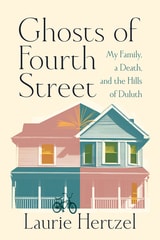
Ghosts of Fourth Street
My Family, a Death, and the Hills of DuluthLaurie Hertzel
University of Minnesota Press, 2026
An open, frank rumination on a brother’s death and its reverberations throughout a family
Every family has its stories and secrets. Laurie Hertzel’s family had more than its share. At an early age, Laurie, the seventh of the ten Hertzel children, took on the challenge of sorting them out. Not old enough to be one of the Big Kids, yet too old to be with the Three Little Kids, she spent most of her time alone, reading, wandering, and observing her family as they moved around her in their house in Duluth. Though her parents were not warm, there were moments of closeness in those years—gifts of Laura Ingalls Wilder’s Little House books and special trips to the dairy for a sundae—but everything shattered after the sudden death of Laurie’s oldest sibling, eighteen-year-old Bobby, when she was just nine years old.
Moving back and forth in time, Laurie reflects on Bobby’s death and what happens to a family’s story when no one can talk about a tragedy and its toll. In Ghosts of Fourth Street, readers witness how the apparition of memories, the shadow of needs unmet, and the spirit of a family once whole all linger long after the death of a child and brother. As Laurie shares her experiences, we see the emergence of her fascination with story and truth as she teaches herself to read and finds solace and inspiration in books amid the tensions and competing agendas within her big, complicated family.
With keen attention, candor, and grace, Laurie paints a vivid portrait of 1960s Duluth as she poignantly examines a family contending with grief and the fact that life steadily goes on—snow and school buses, Christmases and Thanksgivings, ice skating and tobogganing and climbing trees, with ghosts always lingering at the edges.
Retail e-book files for this title are screen-reader friendly.
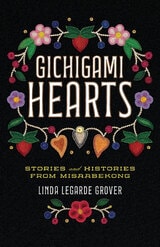
Gichigami Hearts
Stories and Histories from MisaabekongLinda LeGarde Grover
University of Minnesota Press, 2021
Award-winning author Linda LeGarde Grover interweaves family and Ojibwe history with stories from Misaabekong (the place of the giants) on Lake Superior
Long before there was a Duluth, Minnesota, the massive outcropping that divides the city emerged from the ridge of gabbro rock running along the westward shore of Lake Superior. A great westward migration carried the Ojibwe people to this place, the Point of Rocks. Against this backdrop—Misaabekong, the place of the giants—the lives chronicled in Linda LeGarde Grover’s book unfold, some in myth, some in long-ago times, some in an imagined present, and some in the author’s family history, all with a deep and tenacious bond to the land, one another, and the Ojibwe culture.
Within the larger history, Grover tells the story of her ancestors’ arrival at the American Fur Post in far western Duluth more than two hundred years ago. Their fortunes and the family’s future are inextricably entwined with tales of marriages to voyageurs, relocations to reservation lands, encounters with the spirits of the lake and wood creatures, the renewal of life—in myth and in art, the search for meaning in the transformations of our day is always vital. Finally, in one man’s struggles, age-old tribulations, the intergenerational traumas of extended families and communities, and a uniquely Ojibwe appreciation for the natural and spiritual worlds converge, forging the Ojibwe worldview and will to survive as his legacy to his descendants.
Blending the seen and unseen, the old and the new, the amusing and the tragic and the hauntingly familiar, this lyrical work encapsulates a way of life forever vibrant at the Point of Rocks.
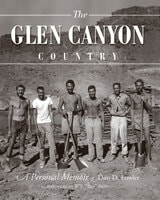
Glen Canyon Country, The
A Personal MemoirDon D Fowler
University of Utah Press, 2011
In his new book, The Glen Canyon Country, archaeologist Don D. Fowler shares the history of a place and the peoples who sojourned there over the course of several thousand years. To tell this story, he weaves his personal experience as a student working on the Glen Canyon Salvage Project with accounts of early explorers, geologists, miners, railroad developers, settlers, river runners, and others who entered this magical place. The book details the canyon’s story via historical and scientific summaries, biographical sketches, personal memoir, and previously unpublished photos of the land and its explorers.
Glorious Indiscretions
Virginia M. Scott
University of Wisconsin Press, 2027
Spanning three continents and nearly six decades, this engrossing memoir traces one woman’s sexual awakening amid a reckoning with family secrets. After a teenage Virginia stumbles onto her father’s closeted homosexuality and rampant infidelity, she spends the next few years suppressing memories of the discovery and the traumatic night when she first realized her family had a secret. Simultaneously, the glamorous jet-setting existence she had known throughout her childhood—following her father’s business ventures in France, Kenya, and Denmark—comes to a sudden end.
Years later, when she confides in her father about her own lesbian awakening, he advises her to “live it on the side” as he had. The consequences of this advice are disastrous: A failed marriage results in loss of custody of her children, forcing her to reckon with her sexuality and its place in her life. Forthright and unflinching, Virginia Scott’s memoir follows her path from trauma to healing, from secrets to truth, and from denying to embracing her identity.
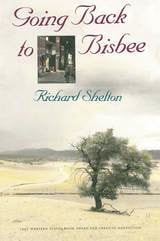
Going Back to Bisbee
Richard Shelton
University of Arizona Press, 1992
Couched within the narrative of his journey are passages revealing Shelton's deep familiarity with the region's natural and human history. Whether conveying the mystique of tarantulas or describing the mountain-studded topography, he brings a poet's eye to this seemingly desolate country. His observations on human habitation touch on Tombstone, "the town too tough to die," on ghost towns that perhaps weren't as tough, and on Bisbee itself, a once prosperous mining town now an outpost for the arts and a destination for tourists. What he finds there is both a broad view of his past and a glimpse of that city's possible future.
Going Back to Bisbee explores a part of America with which many readers may not be familiar. A rich store of information embedded in splendid prose, it shows that there are more than miles on the road to Bisbee.
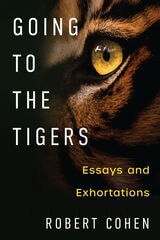
Going to the Tigers
Essays and ExhortationsRobert Cohen
University of Michigan Press, 2022
In this funny and perceptive collection, novelist and essayist Robert Cohen shares his thoughts on the writing process and then puts these prescriptions into practice—from how to rant effectively as an essayist and novelist (“The Piano Has Been Drinking”), how to achieve your own style, naming characters (and creating them), how one manages one’s own identity with being “a writer” in time and space, to the use of reference and allusion in one’s work. Cohen is a deft weaver of allusion himself. In lieu of telling the reader how to master the elements of writing fiction, he shows them through the work of the writers who most influenced his own development, including Roth, Ellison, Kafka, and Robinson. Rooted in his own experiences, this collection of essays shows readers how to use their influences and experiences to create bold, personal, and individual work. While the first part of the book teaches writing, the essays in the second part show how these elements come together.
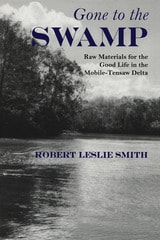
Gone to the Swamp
Raw Materials for the Good Life in the Mobile-Tensaw DeltaRobert Leslie Smith
University of Alabama Press, 2008
Normal0falsefalsefalseMicrosoftInternetExplorer4Normal0falsefalsefalseMicrosoftInternetExplorer4
To make a living here, one had to be capable, confident, clever and inventive, know a lot about survival, be able to fashion and repair tools, navigate a boat, fell a tree, treat a snakebite, make a meal from whatever was handy without asking too many questions about it, and get along with folks.
This fascinating and instructive book is the careful and unpretentious account of a man who was artful in all the skills needed to survive and raise a family in an area where most people would be lost or helpless. Smith’s story is an important record of a way of life beginning to disappear, a loss not fully yet realized. We are lucky to have a work that is both instructive and warm-hearted and that preserves so much hard-won knowledge.
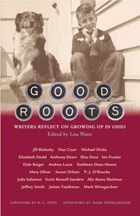
Good Roots
Writers Reflect on Growing Up in OhioLisa Watts
Ohio University Press, 2007
Winner of the Ohioana Library’s 2008 Ohio Legacy Citation
2014-2015 Choose to Read Ohio selection
“A good place to be from.” That’s how some people might characterize the Buckeye State. The writings in Good Roots: Writers Reflect on Growing Up in Ohio, are testimony to the truth of that statement. By prominent writers such as P. J. O’Rourke, Susan Orlean, and Alix Kates Shulman, these contributions are alternately nostalgic, irreverent, and sincere, and offer us a personal sense of place. Their childhoods are as varied as their work. Some were raised in urban Cleveland, Akron, and Cincinnati, others in the small Ohio towns that typify the Midwest, and still others in the countryside. Yet what they have to tell us about their roots resonates with a shared heritage, a sense of what is universal and enduring about growing up in the heartland.
Their collective résumé reads like a literary Who’s Who, including four Pulitzer Prizes, several National Book Awards, and many prestigious fellowships. Good Roots is also plain good reading from some of our country’s most accomplished contemporary writers.
Contributors include: Jill Bialosky, Dan Cryer, Michael Dirda, Elizabeth Dodd, Anthony Doerr, Rita Dove, Ian Frazier, Dale Keiger, Andrea Louie, Kathleen Dean Moore, Mary Oliver, Susan Orlean, P. J. O’Rourke, Julie Salamon, Scott Russell Sanders, Alix Kates Shulman, Jeffery Smith, James Toedtman, and Mark Winegardner.

Good Water
Kevin Holdsworth
University Press of Colorado, 2016
In essays that combine memoir with biography of place, Kevin Holdsworth creates a public history of the land he calls home: Good Water, Utah. The high desert of south-central Utah is at the heart of the stories he tells here—about the people, the “survivors and casualties” of the small, remote town—and is at the heart of his own story.
Holdsworth also explores history at a personal level: how Native American history is preserved by local park officials; how Mormon settlers adapted to remote, rugged places; how small communities attract and retain those less likely to thrive closer to population centers; and how he became involved in local politics. He confronts the issues of land use and misuse in the West, from the lack of water to greed and corruption over natural resources, but also considers life’s simple pleasures like the value of scenery and the importance of occasionally tossing a horseshoe.
Good Water’s depiction of modern-day Utah and exploration of friendships and bonding on the Western landscape will fascinate and entice readers in the West and beyond.
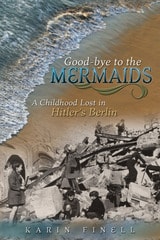
Good-bye to the Mermaids
A Childhood Lost in Hitler's BerlinKarin Finell
University of Missouri Press, 2026
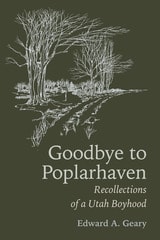
Goodbye to Poplarhaven
Recollections of a Utah BoyhoodEdward A. Geary
University of Utah Press, 2017
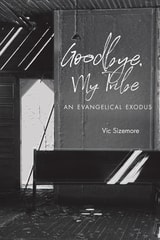
Goodbye, My Tribe
An Evangelical ExodusVic Sizemore
University of Alabama Press, 2020
Sizemore began writing these essays with the aim of exploring and understanding what happened when the mythology of his “tribe” crumbled from beneath his feet. He draws heavily on his upbringing and his family history as a framework for how his “tribe” of white evangelicals have found ways to reconcile Christianity with what the author finds to be troubling stances on many social issues, among them race, gender, sexuality, materialism, anti-intellectualism, and white supremacy.
In a clear-eyed and eloquent voice, Sizemore grapples movingly with his own bewilderment and chagrin as he struggles to reconcile the essential philosophical and moral decay that he believes many evangelicals have come to embrace. His insights, arranged topically and thematically and told through graceful and accessible prose, toggle between memoir and literary journalism, along a spectrum that touches on history, philosophy, theology, and personal reflections.
.
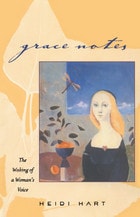
Grace Notes
Heidi Hart
University of Utah Press, 2004
"Ever since I was 10 years old, I’d felt myself yearning to 'go astray.' For me, that didn’t mean drinking and cavorting with boys; it meant being myself without fear."—from the book
What happens when a trained singer who grew up in a "house of vowels" finds that her voice is not her own? What happens when a woman loses the Mormon faith of her childhood and abandons the rituals she’s always known? What does a woman, already married for thirteen years by her early thirties, do when she realizes she has been "lying for years?" How does one sing, with grace, from the heart?
In the spirit of Mary Catherine Bateson’s Composing a Life and Kathleen Norris’s Cloister Walk, Heidi Hart’s luminous memoir retraces her search for an opening to her heart’s path. She finds that the religious life of her Latter-day Saint family—which includes a revered General Authority—robs her of her voice and her spirit. When she discovers Catharine, a mute, Quaker ancestor, Hart begins a vital journey—a journey blessed by her devout and devoted husband; a journey that leads her as she studies Zuni mythology, Jewish tradition, Benedictine monastic ritual, Emily Dickinson, and Saint Hildegard of Bingen—a journey that leads her to a place that feels like home: the company of Friends, the Quaker community of Salt Lake City.
With grace and lyricism, Hart shares the private, personal wisdom she has earned in her community of friends, a community that embraces silences and dissonance, a place where she can't keep from singing.
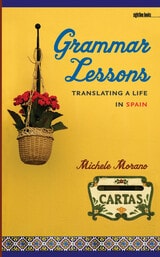
Grammar Lessons
Translating a Life in SpainMichele Morano
University of Iowa Press, 2007
Morano focuses first on her year of living in Oviedo, in the early 1990s, a time spent immersing herself in a new culture and language while working through the relationship she had left behind with an emotionally dependent and suicidal man. Next, after subsequent trips to Spain, she explores the ways that travel sparks us to reconsider our personal histories in the context of larger historical legacies. Finally, she turns to the aftereffects of travel, to the constant negotiations involved in retelling and understanding the stories of our lives. Throughout she details one woman’s journey through vocabulary and verb tense toward a greater sense of her place in the world.
Grammar Lessons illustrates the difficulty and delight, humor and humility of living in a new language and of carrying that pivotal experience forward. Michele Morano’s beautifully constructed essays reveal the many grammars and many voices that we collect, and learn from, as we travel.
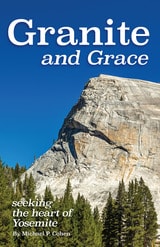
Granite and Grace
Seeking the Heart of YosemiteMichael P. Cohen
University of Nevada Press, 2019
Drawing together the humanistic and scientific significance of the wild landscapes he traverses, Michael uncovers relationships between people and places and meaning and substance, rendering this text part memoir—but also considerably more. On-the-rock encounters by hand and foot open up a dialogue between the heart of a philosopher and the mind of a geologist. Michael adds a literary softness to this hard landscape, blending excursions with exposition and literature with science. It is through his graceful representations that the geological becomes metaphorical, while the science turns mythological.
This high country, where in 1889 John Muir and Robert Underwood Johnson planned what would become Yosemite National Park, is significant for cultural as well as natural reasons. Discoursing on everything from Camus’s “Myths of Sisyphus” to the poems of Gary Snyder, Michael adds depth to an already splendorous landscape. Premier early geologists, such as François Matthes, shaped the language of Yosemite’s landscape. Even though Yosemite has changed over half a century, the rock has not. As Michael explores the beauty and grace of his familiar towering vistas, he demonstrates why, of the many aspects of the world to which one might get attached, the most secure is granite.
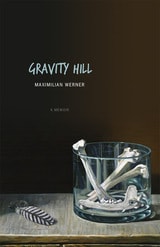
Gravity Hill
A MemoirMaximilian Werner
University of Utah Press, 2013
“The sound of parenthood is the sigh.” So begins Gravity Hill, written from the perspective of a new father seeking hope, beauty, and meaning in an uncertain world. Many memoirs recount the author’s experiences of growing up and struggling with demons; Werner’s shows how old demons sometimes return on the heels of something as beautiful as children. Werner’s memoir is about growing up, getting older, looking back, and wondering what lies ahead—a process that becomes all the more complicated and intense when parenting is involved. Moving backward and forward between past, present, and future, Gravity Hill does not delineate time so much as collapse it.
Werner narrates his struggle growing up in suburban Utah as anon-Mormon and what it took for him, his siblings, and his friends to feel like they belonged. Bonding in separation, they indulged in each other, in natural and urban landscapes, and sometimes in the destructive behaviors that are the native resort of outsidersincluding promiscuous and occasionally violent sexual behavior—and for some, paths to death and suicide. Gravity Hill is the story of the author’s descent into and eventual emergence from his dysfunction and into a newfound life. Infused with humor, honesty, and reflection, this literary memoir will resonate with readers young and old.
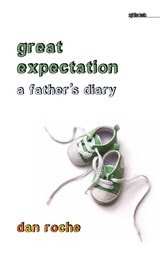
Great Expectation
A Father's DiaryDan Roche
University of Iowa Press, 2008
With five years of parenting his irrepressible daughter Maeve under his belt, Roche, already forty-five years old, and his wife, Maura, face the prospect of another arrival and the myriad of emotions that come with a second child. From revelling in the joys of pregnancy such as Maura's delight at "having cleavage" and being able to eat whatever she desires; to assuaging the parental anxieties of choosing the right obstetrician, correcting the mistakes one made with the first child, and sending children to college in the future; to navigating the unforeseen, experiencing the unexpected death of a parent, and feeling trepidation toward the thought of having a son, Roche records his emotions with unusual candidness and intimacy.
Reflecting on day-to-day events and their significance in his family’s life together, Roche wonders what he is getting himself into and how much deeper he can immerse himself into parenting. Together, he and his wife face the bittersweet intersections of death and new life, menace and hopefulness. With sincerity and a mature wit, Great Expectation stands as a wise recounting of nine months’ time, with all of its chaos and charms, and offers a fresh perspective for first-time and veteran parents alike.
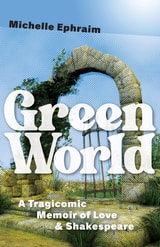
Green World
A Tragicomic Memoir of Love & ShakespeareMichelle Ephraim
University of Massachusetts Press, 2024
Shortlisted for the 2026William Saroyan International Prize for Writing • Shortlisted for the Story Circle Network Gilda Prize • Winner of the Wisconsin Library Association's Literary Award for Nonfiction • Shortlisted for the Rubery Book Award • A 2025 IPPY Awards Silver Medal Winner in Autobiography/Memoir • Winner of the 2025 Friends of American Writers Adult Literature Award • A 2024 Foreword INDIES Finalist • A 2025 Sophie Brody Medal Notable Book • A Jewish Women's Archive Summer Book Club Pick
At twenty-three, Michelle Ephraim was failing at everything. The only child of reclusive Holocaust-survivor parents who were dismayed by her literary studies, she found herself dumped by her boyfriend and bombing out of graduate school. Then, one night, she crashed a Shakespeare recitation party. Loopy from vodka and never having read a single line of Shakespeare, she was transfixed. Shakespeare, she decided, was the lifeline she needed.
Green World is the hilarious and heartbreaking story of Ephraim’s quest to become a Shakespeare scholar and to find community and home. As she studies Shakespeare, Ephraim’s world uncannily begins to mirror the story of the Jewish daughter in The Merchant of Venice, and she finds herself in a Green World, an idyllic place where Shakespeare’s heroines escape their family trauma. Green World reckons with global, historical, and personal tragedy and shows how literature—comic and tragic—can help us brave every kind of anguish.
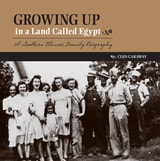
Growing Up in a Land Called Egypt
A Southern Illinois Family BiographyCleo Caraway
Southern Illinois University Press, 2010
In Growing Up in a Land Called Egypt: A Southern Illinois Family Biography,author Cleo Caraway fondly recalls how she and her siblings came of age on the family farm in the 1930s and 1940s. Like many others, the Caraways were affected by the economic hardships of the Great Depression, but Cleo’s parents strived to shelter her and her six siblings from the dire circumstances affecting the nation and their home and allowed them to bask in their idealistic existence. Her love for her family clearly shines from every page as she writes of a simpler time, before World War II divided the family.
Caraway revels in the life her family lived on a southern Illinois hilltop in Murphysboro township, marveling at the mix of commonplace and adventure she experienced in her childhood. She remembers her first day of school, walking three miles to the wondrous one-room building with her siblings; reminisces about strolling through the countryside with her mother, investigating the various plants and flowers, fruits and nuts; and recollects her fascination with the Indian relics she found buried near her home, a hobby she shared with her father. She also writes of seeing Gone with the Wind on the big screen at the Hippodrome in Murphysboro, of learning to sew dresses for her dolls, and of idyllic life on the farm—milking cows, hatching chicks, feeding pigs. Along with her personal memories Caraway includes interviews with neighbors and many fascinating photographs with detailed captions that make the images come alive.
A delightful follow-up to her father’s popular Foothold on a Hillside: Memories of a Southern Illinoisan,Caraway’s book is a pleasant change from the typical accounts of southern Illinois before, during, and after the Great Depression. Instead of hardscrabble grit, Growing Up in a Land Called Egypt offers a refreshingly different view of the period and is certain to be embraced by southern Illinois natives as well as anyone interested in the experiences of a rural family that thrived despite the difficult times. The author’s lighthearted prose, self-deprecating humor, and genuine affection for her family make reading this book a rich and memorable experience.
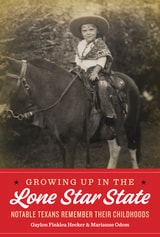
Growing Up in the Lone Star State
Notable Texans Remember Their ChildhoodsBy Gaylon Finklea Hecker and Marianne Odom
University of Texas Press, 2021
Gaylon Finklea Hecker and Marianne Odom began the interviews for this book in 1981 and devoted a professional lifetime to collecting the memories of accomplished Texans to determine what, if anything, about growing up in the Lone Star State prepared them for success.
The resulting forty-seven oral history interviews begin with tales from the early 1900s, when Texas was an agrarian state, and continue through the growth of major cities and the country’s race to the moon. Interviewees recalled life in former slave colonies; on gigantic ranches, tiny farms, and sharecropper fields; and in one-horse towns and big-city neighborhoods, with relatable stories as diverse as the state’s geography.
The oldest interviewees witnessed women earning the right to vote and weathered the Great Depression. Many remembered two world wars, while others recalled the Texas City explosion of 1947 and the tornado that devastated Waco in 1953. They witnessed the advent of television and the nightly news, which helped many come to terms with the assassination of a president that took place too close to home.
Their absorbing reflections are stories of good and bad, hope and despair, poverty and wealth, depression and inspiration, which would have been different if lived anywhere but Texas.
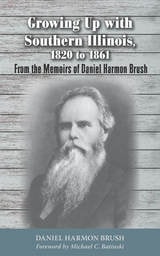
Growing Up with Southern Illinois, 1820 to 1861
From the Memoirs of Daniel Harmon BrushDaniel Harmon Brush, with a Foreword by Michael C. Batinski
Southern Illinois University Press, 2017

Guns of February
Ordinary Japanese Soldiers' Views of the Malayan Campaign and the Fall of Singapore, 1941-42Henry Frei
National University of Singapore Press, 1990