64 books match the query 'Middle Ages' and 3 start with g
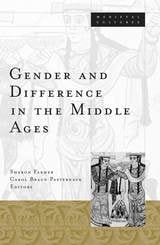
cover of Gender and Difference in the Middle Ages

Gender and Difference in the Middle Ages

Sharon Farmer

University of Minnesota Press, 2002

Exposes complex intersections between genders and other identities in medieval cultures.

Nothing less than a rethinking of what we mean when we talk about "men" and "women" of the medieval period, this volume demonstrates how the idea of gender-in the Middle Ages no less than now-intersected in subtle and complex ways with other categories of difference. Responding to the insights of postcolonial and feminist theory, the authors show that medieval identities emerged through shifting paradigms-that fluidity, conflict, and contingency characterized not only gender, but also sexuality, social status, and religion. This view emerges through essays that delve into a wide variety of cultures and draw on a broad range of disciplinary and theoretical approaches. Scholars in the fields of history as well as literary and religious studies consider gendered hierarchies in western Christian, Jewish, Byzantine, and Islamic areas of the medieval world.

Contributors: Daniel Boyarin, U of California, Berkeley; Ruth Mazo Karras, U of Minnesota; Mathew Kuefler, San Diego State U; Martha Newman, U of Texas; Kathryn M. Ringrose, U of California, San Diego; Elizabeth Robertson, U of Colorado; Everett Rowson, U of Pennsylvania; Michael Uebel, U of Kentucky; Ulrike Wiethaus, Wake Forest U.
[more]
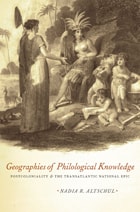
cover of Geographies of Philological Knowledge: Postcoloniality and the Transatlantic National Epic

Geographies of Philological Knowledge

Postcoloniality and the Transatlantic National Epic

Nadia R. Altschul

University of Chicago Press, 2012
Geographies of Philological Knowledge examines the relationship between medievalism and colonialism in the nineteenth-century Hispanic American context through the striking case of the Creole Andrés Bello (1781–1865), a Venezuelan grammarian, editor, legal scholar, and politician, and his lifelong philological work on the medieval heroic narrative that would later become Spain’s national epic, the Poem of the Cid. Nadia R. Altschul combs Bello’s study of the poem and finds throughout it evidence of a “coloniality of knowledge.”
 
Altschul  reveals how, during the nineteenth century, the framework for philological scholarship established in and for core European nations—France, England, and especially Germany—was exported to Spain and Hispanic America as the proper way of doing medieval studies. She argues that the global designs of European philological scholarship are conspicuous in the domain of disciplinary historiography, especially when examining the local history of a Creole Hispanic American like Bello, who is neither fully European nor fully alien to European culture. Altschul likewise highlights Hispanic America’s intellectual internalization of coloniality and its understanding of itself as an extension of Europe.  
 
A timely example of interdisciplinary history, interconnected history, and transnational study, Geographies of Philological Knowledge breaks with previous nationalist and colonialist histories and thus forges a new path for the future of medieval studies.
[more]
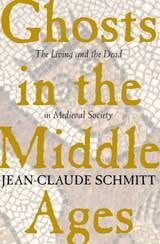
cover of Ghosts in the Middle Ages: The Living and the Dead in Medieval Society

Ghosts in the Middle Ages

The Living and the Dead in Medieval Society

Jean-Claude Schmitt

University of Chicago Press, 1998

Through this vivid study, Jean-Claude Schmitt examines medieval religious culture and the significance of the widespread belief in ghosts, revealing the ways in which the dead and the living related to each other during the middle ages. Schmitt also discusses Augustine's influence on medieval authors; the link between dreams and autobiographical narratives; and monastic visions and folklore. Including numerous color reproductions of ghosts and ghostly trappings, this book presents a unique and intriguing look at medieval culture.

"Valuable and highly readable. . . . [Ghosts in the Middle Ages] will be of interest to many students of medieval thought and culture, but especially to those seeking a general overview of this particularly conspicuous aspect of the medieval remembrance of the dead."—Hans Peter Broedel, Medieval Review

"A fascinating study of the growing prevalence of ghost imagery in ecclesiastical and popular writing from the fifth to the fifteenth century."—Choice
[more]