Results by title
94 books match the query 'Middle Ages, 600-1500' and 5 start with g
Ghosts in the Middle Ages
The Living and the Dead in Medieval SocietyJean-Claude Schmitt
University of Chicago Press, 1998
Through this vivid study, Jean-Claude Schmitt examines medieval religious culture and the significance of the widespread belief in ghosts, revealing the ways in which the dead and the living related to each other during the middle ages. Schmitt also discusses Augustine's influence on medieval authors; the link between dreams and autobiographical narratives; and monastic visions and folklore. Including numerous color reproductions of ghosts and ghostly trappings, this book presents a unique and intriguing look at medieval culture.
"Valuable and highly readable. . . . [Ghosts in the Middle Ages] will be of interest to many students of medieval thought and culture, but especially to those seeking a general overview of this particularly conspicuous aspect of the medieval remembrance of the dead."—Hans Peter Broedel, Medieval Review
"A fascinating study of the growing prevalence of ghost imagery in ecclesiastical and popular writing from the fifth to the fifteenth century."—Choice
[more]
God's Knowledge of the World
Medieval Theories of Divine Ideas from Bonaventure to OckhamCarl A. Vater
Catholic University of America Press, 2022
A theory of divine ideas was the standard Scholastic response to the question how does God know and produce the world? A theory was deemed to be successful only if it simultaneously upheld that God has perfect knowledge and that he is supremely simple and one. In articulating a theory of divine ideas, Carl Vater answers two sorts of questions. First, what is an idea? Does God have ideas? Are there many divine ideas? What sort of existence does an idea enjoy? Second, he answers questions about the scope of divine ideas: does God have ideas of individuals, species, genera, accidents, matter, evil, etc.? How many divine ideas are there?
These questions cause the Scholastic authors to articulate clearly, among other things, their positions on the nature of knowledge, relation, exemplar causality, participation, infinity, and possibility. An author’s theory of divine ideas, then, is the locus for him to test the coherence of his metaphysical, epistemological, and logical principles. Many of the debates over divine ideas have their roots in disagreements over whether a given theory adequately articulates one of the underlying positions or the overall coherence of those positions. Peter John Olivi, for example, argues that his predecessors’ theories of knowledge and theories of relations are at odds, and this critique results in a major shift in theories of divine ideas.
God's Knowledge of the World examines theories of divine ideas from approximately 1250–1325 AD (St. Bonaventure through Ockham). It will be the only work dedicated to categorizing and comparing the major theories of divine ideas in the Scholastic period.
[more]
Good and Evil Actions
A Journey through Saint Thomas AquinasSteven J. Jensen
Catholic University of America Press, 2010
In Good and Evil Actions, Steven J. Jensen navigates a path through the debate, retrieving what is of value from each interpretation
[more]
Gratian the Theologian
John C. Wei
Catholic University of America Press, 2016
Gratian the Theologian shows how one of the best-known canonists of the medieval period was also an accomplished theologian. Well into the twelfth century, compilations of Church law often dealt with theological issues. Gratian's Concordia discordantium canonum or Decretum, which was originally compiled around 1140, was no exception, and so Wei claims in this provocative book. The Decretum is the fundamental canon law work of the twelfth century, which served as both the standard textbook of canon law in the medieval schools and an authoritative law book in ecclesiastical and secular courts. Yet theology features prominently throughout the Decretum, both for its own sake and for its connection to canon law and canonistic jurisprudence.
[more]
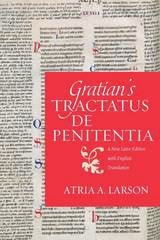
Gratian's Tractatus de penitentia
Atria A. Larson
Catholic University of America Press, 2016
Gratian's Decretum is one of the major works in European history, a text that in many ways launched the field of canon law. In this new volume, Atria Larson presents to students and scholars alike a critical edition of De penitentia (Decretum C.33 q.3), the foundational text on penance, both for canon law and for theology, of the twelfth century. This edition takes into account recent manuscript discoveries and research into the various recensions of Gratian's text and proposes a model for how a future critical edition of the entire Decretum could be formatted by offering a facing-page English translation. This translation is the first of this section of Gratian's De penitentia into any modern language and makes the text accessible to a wider audience. Both the Latin and the English text are presented in a way to make clear the development of Gratian's text in various stages within two main recensions. The edition and translation are preceded by an introduction relating the latest scholarship on Gratian and his text and are followed by three appendices, including one that provides a transcription of the relevant text from the debated manuscript Sankt Gallen, Stiftsbibliothek 673, and one that lists possible formal sources and related contemporary texts. This book provides a full edition and translation of the text studied in depth in Master of Penance: Gratian and the Development of Penitential Thought and Law in the Twelfth Century (CUA Press, 2014) by the same author.
[more]