Results by title
159 books match the query 'Minnesota' and 7 start with g

Gichigami Hearts
Stories and Histories from MisaabekongLinda LeGarde Grover
University of Minnesota Press, 2021
Award-winning author Linda LeGarde Grover interweaves family and Ojibwe history with stories from Misaabekong (the place of the giants) on Lake Superior
Long before there was a Duluth, Minnesota, the massive outcropping that divides the city emerged from the ridge of gabbro rock running along the westward shore of Lake Superior. A great westward migration carried the Ojibwe people to this place, the Point of Rocks. Against this backdrop—Misaabekong, the place of the giants—the lives chronicled in Linda LeGarde Grover’s book unfold, some in myth, some in long-ago times, some in an imagined present, and some in the author’s family history, all with a deep and tenacious bond to the land, one another, and the Ojibwe culture.
Within the larger history, Grover tells the story of her ancestors’ arrival at the American Fur Post in far western Duluth more than two hundred years ago. Their fortunes and the family’s future are inextricably entwined with tales of marriages to voyageurs, relocations to reservation lands, encounters with the spirits of the lake and wood creatures, the renewal of life—in myth and in art, the search for meaning in the transformations of our day is always vital. Finally, in one man’s struggles, age-old tribulations, the intergenerational traumas of extended families and communities, and a uniquely Ojibwe appreciation for the natural and spiritual worlds converge, forging the Ojibwe worldview and will to survive as his legacy to his descendants.
Blending the seen and unseen, the old and the new, the amusing and the tragic and the hauntingly familiar, this lyrical work encapsulates a way of life forever vibrant at the Point of Rocks.

Gone Writing
The Poems of Moore on SundayPeter Moore
University of Minnesota Press, 1999
Humorous poetry from the television program hosted by a beloved Minnesota news anchor.
In the 1950s, Dave Moore, a young actor born and raised in Minneapolis, accepted a newscaster position with the local CBS affiliate, WCCO-TV-a job Walter Cronkite turned down. For the next three decades, until his death in 1998, he delivered the evening news with integrity, conviction, humor, and flair, making him a fixture in Minnesota living rooms.
At the end of his weekly news-in-review program, Moore on Sunday (or, as he liked to call it, “Moron Sunday”), Moore often signed off by reciting a poem. These poems, composed by Moore’s son Peter and collected here for the first time, offer a fresh and funny take on the common and not-so-common stuff of our everyday lives. Reminiscent of Ogden Nash and Tom Lehrer, with a dash of Dr. Seuss, Peter Moore’s verse captures the essence of his father’s wit, common sense, honesty, and warmth.

Greed, Rage, and Love Gone Wrong
Murder in MinnesotaBruce Rubenstein
University of Minnesota Press, 2006

Grocery Activism
The Radical History of Food Cooperatives in MinnesotaCraig B. Upright
University of Minnesota Press, 2020
A key period in the history of food cooperatives that continues to influence how we purchase organic food today
Our notions of food co-ops generally don’t include images of baseball bat–wielding activists in the aisles. But in May 1975, this was the scene as a Marxist group known as the Co-op Organization took over the People’s Warehouse, a distribution center for more than a dozen small cooperative grocery stores in the Minneapolis area. The activist group’s goal: to curtail the sale of organic food. The People’s Warehouse quickly became one of the principal fronts in the political and social battle that Craig Upright explores in Grocery Activism. The story of the fraught relationship of new-wave cooperative grocery stores to the organic food industry, this book is an instructive case study in the history of activists intervening in capitalist markets to promote social change.
Focusing on Minnesota, a state with both a long history of cooperative enterprise and the largest number of surviving independent cooperative stores, Grocery Activism looks back to the 1970s, when the mission of these organizations shifted from political activism to the promotion of natural and organic foods. Why, Upright asks, did two movements—promoting cooperative enterprise and sustainable agriculture—come together at this juncture? He analyzes the nexus of social movements and economic sociology, examining how new-wave cooperatives have pursued social change by imbuing products they sell with social values. Rather than trying to explain the success or failure of any individual cooperative, his work shows how members of this fraternity of organizations supported one another in their mutual quest to maintain fiscal solvency, promote better food-purchasing habits, support sustainable agricultural practices, and extol the virtues of cooperative organizing. A foundational chapter in the history of organic food, Grocery Activism clarifies the critical importance of this period in transforming the politics and economics of the grocery store in America.
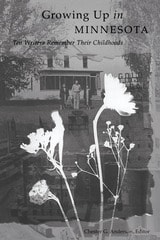
Growing up in Minnesota
Ten Writers Remember Their ChildhoodsChester Anderson
University of Minnesota Press, 1976

Gunflint Falling
Blowdown in the Boundary WatersCary J. Griffith
University of Minnesota Press, 2023
Stories from survivors of the Boundary Waters Canoe Area Wilderness’s epochal weather disaster
On July 4, 1999, in the Boundary Waters Canoe Area Wilderness (BWCAW), a bizarre confluence of meteorological events resulted in the most damaging blowdown in the region’s history. Originating over the Dakotas, the midsummer windstorm developed amid unusually high heat and water-saturated forests and moved steadily east, bearing down on Fargo, North Dakota, and damaging land as it crossed the Minnesota border. Gunflint Falling tells the story of this devastating storm from the perspectives of those who were on the ground before, during, and after the catastrophic event—from first-time visitors to the north woods to returning paddlers to Forest Service Rangers.
The pre-dawn forecasts from the National Weather Service in Duluth for that Sunday of the holiday weekend predicted the day would be “warm and humid. Partly sunny with a thirty percent chance of thunderstorms.” But as the afternoon and evening settled over the Boundary Waters, the first eyewitness accounts began to tell a dramatic and terrifying story. Five friends camping on Lake Polly watched in wonder as the sky turned green and the winds began to whip. They scrambled to pull canoes on shore and secure tarps when a tree snapped and struck one of them in the head, rendering her unconscious. Three women enjoying their last day of a camping trip near the end of the Gunflint Trail took shelter in their tent as winds increased. Water drenched the nylon walls as trees crashed around them, one flattening the tent and pinning a woman beneath its weight. A family vacationing at their cabin dodged falling trees and strained against straight-line winds as they sprinted from the cabin to the safest place they knew: a crawl space underneath it. They watched in awe as trees snapped and toppled, their twisted root balls torn out of the water-logged earth—as they prayed their cabin would hold.
By the time the storm began to subside, falling trees had injured approximately sixty people, and most needed to be medevacked to safety. Amazingly, no one died. The historic storm laid down timber that would later blaze in the Ham Lake fire of 2007, ultimately reshaping the region’s forests in ways we have yet to fully understand.

Gunflint
Reflections on the TrailJustine Kerfoot
University of Minnesota Press, 1991
“The best way to get to know Justine Kerfoot would be to explore a northern forest with her. The next best way to know ‘Just’ is on these pages. Here Justine is at her best, sharing with us her romantic and colorful, and sometimes a tad dangerous, life.” —Les Blacklock
Step off the Gunflint Trail, stride to a high point, and savor the view. Only the dark, cool waters and the rugged granite shores interrupt the panorama of the sweeping forest. In this engaging memoir, local pioneer Justine Kerfoot chronicled a year’s worth of experiences and insights while living on the legendary Gunflint Trail. The unique month-by-month chapters of Gunflint and Kerfoot’s rich memories provide a year-round view of a wilderness life that most of us glimpse only in all-too-short weekend interludes.
Justine Kerfoot (1906–2001) lived on Minnesota’s remote Gunflint Trail for more than six decades. She wrote of her adventures and travel in a weekly column for the Cook County News-Herald for forty-five years and is the author of Woman of the Boundary Waters (Minnesota, 1994).