Results by title
527 books match the query 'Novel' and 17 start with g
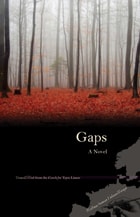
Gaps
A NovelBohumil Hrabal
Northwestern University Press, 2011
Gaps is a more overtly political novel than either In-House Weddings or Vita Nuova. The 1968 Soviet invasion of Czechoslovakia and the subsequent repression of artistic freedom figure prominently. Hrabal is placed on the "liquidated writers" list, and copies of his novel Poupata (Buds) are disposed of at the paper salvage where he once worked. Hrabal's decision to tell his autobiography in his wife Eliska's voice highlights their very close relationship and lovingly details her deep influence on his work. Every movement, sound, fragrance, and color is detailed, creating a collage of Bohumil and Eliska's life together, an unforgettable picture that reveals the author's innermost attitudes to life, love, and the pursuit of his own art.
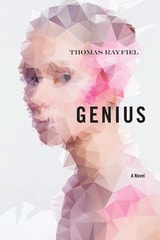
Genius
A NovelThomas Rayfiel
Northwestern University Press, 2016
Kara Bell spent her youth plotting escape from Witch’s Falls, Arkansas. Relentless focus and the spurning of all emotional attachment led to the doctoral program in philosophy at Columbia University. But Kara’s careful plans are upended by cancer, and suddenly she is home again, where she finds herself subject to her mother’s suffocating care, her brother’s puzzling love life, the local doctor’s meddling, and the strong gravitational pull of her old friend and obsession, Christy Lee. Will Kara find health and sanity? Will she learn what really happened to her father? Can she escape Witch’s Falls a second time, or will she succumb to the slow poison of local kindness and Snickers Salad?
In Genius, Thomas Rayfiel finds both poignancy and dark humor in deathly illness, family secrets, organized religion, parenting, abortion, gossip, senility, and the mysterious rhythms of small-town life.
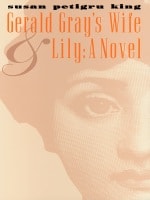
Gerald Gray's Wife and Lily
A NovelSusan Petigru King. Edited by William H. Pease and Jane H. Pease.
Duke University Press, 1993
Lily, King's best known novel, was originally published by Harper and Brothers in 1855. In this work, King skewers the rituals of courtship that propel its wealthy young heroine toward marriage and a melodramatic death. Gerald Gray's Wife, King's last novel, plays out the ironies of a plain woman who survives—but barely—the revelations that destroy her seemingly perfect marriage and acquired beauty. In both novels, women's jealousies and men's deceptions are the forces that propel King's often satirical pen. Largely lacking the moral instruction so common among nineteenth-century domestic novelists, King's novels are differentiated by their critical perspective on women's position, their exploration of themes of failure and frustration, and their focus on the drawing room and ballroom rather than the kitchen and nursery.

Ghosts of New York
A NovelJim Lewis
West Virginia University Press, 2021
“A wondrous novel, with prose that sparkles like certain sidewalks after rain. . . . That’s it, I thought. That’s exactly what it’s like to live in New York.” —New York Times Book Review
Ghosts of New York is a novel in which the laws of time and space have been subtly suspended. It interweaves four strands: a photographer newly returned to the neighborhood where she grew up, after years spent living overseas; a foundling raised on 14th Street; a graduate student, his romantic partner, and his best friend entangled in a set of relationships with far-reaching personal and political repercussions; and a shopkeeper suffering from first love late in life. Mixing prophecy, history, and a hint of speculative fiction, its stories are bound together even as they are propelled into stranger territory. And undergirding it all is a song, which appears, disappears, and then resurfaces.
Ghosts of New York explores complex lives through indelible renderings of settings—a bar, a night market, a recording studio—that alternate between familiar and unsettling. The work of a celebrated novelist and veteran of the art, film, and music scenes in New York and Austin (described as “a rare talent” by the New York Times and “a powerful literary voice” by Jeffrey Eugenides), this novel will immediately absorb readers intrigued by creative people and the places that sustain and challenge them.

Gichigami
A NovelLindsey Steffes
University of Massachusetts Press, 2025
Winner, Edna Ferber Fiction Book Award
An eerie coming-of-age story of a young girl’s quest for her absent mother across the frozen terrain of Lake Superior
One December evening, when 13-year-old Marta crosses the frozen Lake Superior and reaches the home she shares with her father, she finds a woman standing at their door. As Marta approaches, she realizes the woman, who looks like a tropical bird caught in the snow, is her mother who’d abruptly left them six years before. Marta hopes this is a turning point, that her mother will stay this time—despite hating this town, this island, and their creaky, towering Victorian house. But not everyone in town is thrilled with her mother’s arrival, least of all her dad.
Almost as soon as she arrives, however, Marta’s mother abruptly vanishes again, nowhere to be found, leaving Marta with more questions than answers. Her father denies her mother was ever there and Marta is left with the mystery of her mother’s homecoming. She begins to wonder if he is lying, or if there is a deeper secret being kept from her by the entire tight-knit community. As Marta delves into her mother's sudden reappearance and subsequent disappearance, she seeks answers, visiting places that were significant to her mother and questioning people she knew. Desperate for answers that will shed light on the mystery, this quest leads her to uncover a web of secrets that threaten to unravel everything she thought she knew about her family and herself.
Gichigami is an eerie coming-of-age novel, weaving between Marta and the person desperately trying to keep Marta and her mother apart. This poignant exploration of the lives of women and girls of the Midwest shines a light on the struggles of absent mothers, runaway daughters, and those who yearn for more than life has offered them. With rich prose and vivid imagery, Lindsey Steffes spins a tale of loss, longing, and betrayal set against the backdrop of the harsh yet beautiful landscape of Lake Superior.
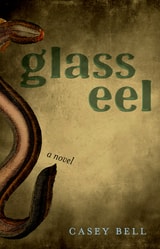
Glass Eel
A NovelCasey Bell
University of Massachusetts Press, 2027
Exploring the power of female friendships in times of despair
In the near-future United States, abortion is criminalized. Women are not only stripped of bodily autonomy but are also arrested and put through various punishments, including a Christian fundamentalist rehabilitation program and manual labor. Thrown together in this harrowing corrections process, two women, E and M, form a deep bond. Rippling through time and space, Glass Eel illuminates an imminent nightmare while exploring the unbreakable force of female friendship in times of despair.
Before serving their sentences, E is a romantic who is prone to vivid, maladaptive daydreaming, and M is an empiricist studying to become a marine biologist. Isolated by her devout mother, E turns inward, developing a passion for poetry and myth. At the exact wrong time, she becomes involved with a married man. When E becomes pregnant, he gaslights her, denying their entire relationship. M, while working as a part-time performer at an underwater mermaid theater, carries the heavy responsibility of being the sole provider for her sick mother. One night, she reluctantly accompanies her roommate to a party where she’s raped. Both E and M make the difficult decision to terminate their pregnancies and are eventually arrested for it.
Brought together to serve their sentences, E and M painstakingly labor underground to unclog the Chicago sewers at night. By day, they wander the bleak shore of a radioactive industrial lake, home to mysterious unearthly creatures. E and M unravel psychologically, desperate to cope with their impossible new reality as they grasp at their last real connection—their friendship—to make it through this dystopian time. Glass Eel explores the bond between E and M to show how people hold each other together when everything feels like it is falling apart.
Glimmering Girls
A Novel of the FiftiesMerrill Joan Gerber
University of Wisconsin Press, 2005
Glory
The Gospel of Judas, A NovelGiuseppe Berto
Rutgers University Press, 2024
In Glory, Italian modernist Giuseppe Berto’s final novel, Judas finally tells his side of the story. From his perspective, Jesus is the betrayer, a would-be political activist and social reformer who fails to live up to his promises. And by fulfilling his predestined role in the drama of Christ’s death and resurrection, Judas himself is partly responsible for humanity’s salvation, enabling them to be redeemed by Christ’s sacrifice. As the novel probes into the psychological motivations behind his rejection of Jesus’ authority, Judas emerges as a compelling conflicted character, a man who seeks to have agency even when he knows his actions are being scripted by a higher power. Through Judas’s searing tortured monologues, this late masterpiece from one of Italy’s greatest writers investigates deep questions about the nature of faith, rebellion, fate, and free will.
God Went Like That
A NovelYxta Maya Murray
Northwestern University Press, 2023
In award-winning legal scholar and novelist Yxta Maya Murray’s new novel, federal agent Reyna Rodriguez reports on a real-life nuclear reactor meltdown and accidents that occurred in 1959, 1964, and 1968 at the Santa Susana Field Laboratory. An infamous research and development complex in California’s Simi Valley, the lab was eventually dismantled by the US government—but not before it created a toxic legacy of contamination and numerous cancer clusters. Toxins and nuclear residue may have been further released by the 2018 Woolsey Fire and 2019 floods in the area.
God Went Like That takes the form of an EPA report in which Reyna presents riveting interviews with individuals affected by the disasters. With imagination and artistry, Murray brings to life an actual 2011 Department of Energy dossier that detailed the catastrophes and the ensuing public health fallout and highlights the high costs of governmental malfeasance and environmental racism.
God of River Mud
A NovelVic Sizemore
West Virginia University Press, 2024
Winner, 2025 Tennessee Book Award, Fiction
Grappling with innate desires and LGBTQ identity, a family struggles under the oppressive expectations foisted on them by fundamentalist Christianity.
Told through alternating perspectives, God of River Mud chronicles the lives of Berna Minor, her husband, their four children, and Berna’s secret lover.
To escape a life of poverty and abuse, Berna Cannaday marries Zechariah Minor, a fundamentalist Baptist preacher, and commits herself to his faith, trying to make it her own. After Zechariah takes a church beside the Elk River in rural Clay, West Virginia, Berna falls in love with someone from their congregation—Jordan, a woman who has known since childhood that he was meant to be a man. Berna keeps her secret hidden as she struggles to be the wife and mother she believes God wants her to be. Berna and Zechariah’s children struggle as well, trying to reconcile the theology they are taught at home with the fast-changing world around them. And Jordan struggles to find a community and a life that allow him both to be safely and fully himself, as Jay, and to be loved for who he is.
As the decades and stories unfold, traditional evangelical Bible culture and the values of rural Appalachia clash against innate desires, LGBTQ identity, and gender orientation. Sympathies develop—sometimes unexpectedly—as the characters begin to reconcile their faith and their love. God of River Mud delves into the quandary of those marginalized and dehumanized within a religious patriarchy and grapples with the universal issues of identity, faith, love, and belonging.
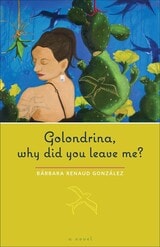
Golondrina, why did you leave me?
A NovelBy Bárbara Renaud González
University of Texas Press, 2009
Runner-up, Best Popular Fiction in English, Latino Book Awards Competition, 2010
The golondrina is a small and undistinguished swallow. But in Spanish, the word has evoked a thousand poems and songs dedicated to the migrant's departure and hoped-for return. As such, the migrant becomes like the swallow, a dream-seeker whose real home is nowhere, everywhere, and especially in the heart of the person left behind.
The swallow in this story is Amada García, a young Mexican woman in a brutal marriage, who makes a heart-wrenching decision—to leave her young daughter behind in Mexico as she escapes to el Norte searching for love, which she believes must reside in the country of freedom. However, she falls in love with the man who brings her to the Texas border, and the memories of those three passionate days forever sustain and define her journey in Texas. She meets and marries Lázaro Mistral, who is on his own journey—to reclaim the land his family lost after the U.S.-Mexican War. Their opposing narratives about love and war become the legacy of their first-born daughter, Lucero, who must reconcile their stories into her struggle to find "home," as her mother, Amada, finally discovers the country where love beats its infinite wings.
Bárbara Renaud González, a native-born Tejana and acclaimed journalist, has written a lyrical story of land, love, and loss, bringing us the first novel of a working-class Tejano family set in the cruelest beauty of the Texas panhandle. Her story exposes the brutality, tragedy, and hope of her homeland and helps to fill a dearth of scholarly and literary works on Mexican and Mexican American women in post–World War II Texas.
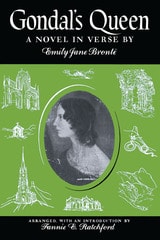
Gondal's Queen
A Novel in VerseBy Emily Jane Brontë
University of Texas Press, 1955
In Gondal’s Queen, Fannie Elizabeth Ratchford presents a cycle of eighty-four poems by Emily Jane Brontë, for the first time arranged in logical sequence, to re-create the “novel in verse” which Emily wrote about their beloved mystical kingdom of Gondal and its ruler, Augusta Geraldine Almeda, who brought tragedy to those who loved her.
Thanks to previous publications by Ratchford, the imaginative world of Gondal is well known not only to Brontë scholars but also to general readers. Only in the present book, however, with Emily’s lovely poems restored to the setting which gave them being, can the full impact of this extraordinary literary creation be realized.
The life story of Gondal’s Queen, from portentous birth to tragic death, is set in a world compounded of dark Gothic romance and Byronic extravagance; yet out of it emerges not only a real country of wild moor sheep and piercingly beautiful nights but also the portrait of a real woman, whose doom was wrought not by the stars but by the clashing complications of her own nature.
In A.G.A. (the appellation most usually applied to the Queen), Emily Brontë created a personality, not a puppet reciting lovely lines. And Ratchford, in reconstructing her story, has re-affirmed the dignity, beauty, and richness of Emily’s poetry.
Gondal’s Queen is the end of a long trail of research and literary detection which has led Ratchford to all known Brontë documentary sources. This quest was originally stimulated by curiosity over a tiny booklet signed, “C. Brontë, June 29th, 1837,” in the Wrenn Library at the University of Texas at Austin. Ratchford’s intense and astonishingly fruitful interest in the Brontës had its origin in her attempt to unravel the fascinating puzzle presented by this little book, which seemed to be merely a series of childish vignettes held together by “a shadow of a common character” and a “tendency toward a unified plot.”
Bit by bit, Ratchford assembled clues from manuscripts and obscure publications until the significance of the play world of the Brontë children began to emerge. In spite of the fact that the Brontës had been the subject of the liveliest literary speculation since their deaths, it remained for Ratchford to establish the importance of their juvenile writings to the later writings of Charlotte. In successive publications she presented the accumulating evidence. For a time her curiosity was centered on Charlotte and the group, but it finally became focused on Emily through a manuscript journal fragment which fortunately came to hand.
Unlike Charlotte, Emily left no prose works from her childhood. But it is apparent from journal entries and birthday notes written by Emily and Anne (whose shared creation Gondal was) not only that the two younger Brontës lived in and sustained daily an imaginary world which had evolved from the earlier play of the four children together, but also that they had written separately voluminous histories and “novels” about it. Of Emily’s vast Gondal literature, only a small body of verse has survived, poems originally intended for no eye but her own and possibly Anne’s. But it is clear that Gondal was not only Emily Brontë’s childhood dream world but also the major preoccupation of her adult creative life.
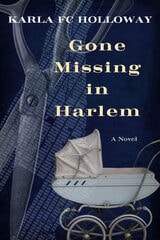
Gone Missing in Harlem
A NovelKarla FC Holloway
Northwestern University Press, 2021
The family arrives as Harlem staggers under the flu pandemic that follows the First World War. DeLilah Mosby and her daughter, Selma, meet difficulties with backbone and resolve to make a home for themselves in the city, and Selma has a baby, Chloe. As the Great Depression creeps across the world at the close of the twenties, however, the farsighted see hard times coming.
The panic of the early thirties is embodied in the kidnapping and murder of the infant son of the nation’s dashing young aviator, Charles Lindbergh. A transfixed public follows the manhunt in the press and on the radio. Then Chloe goes missing—but her disappearance does not draw the same attention. Wry and perceptive Weldon Haynie Thomas, the city’s first “colored” policeman, takes the case.
The urgent investigation tests Thomas’s abilities to draw out the secrets Harlem harbors, untangling the color-coded connections and relationships that keep company with greed, ghosts, and grief. With nuanced characters, lush historical detail, and a lyrical voice, Gone Missing in Harlem affirms the restoring powers of home and family.
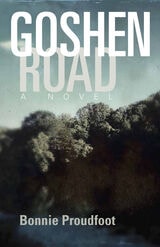
Goshen Road
A NovelBonnie Proudfoot
Ohio University Press, 2020
Goshen Road is an elegiac, unvarnished, and empathetic portrait of one working-class family over two decades in rural West Virginia, with sisters Dessie and Billie Price as its urgently beating heart. Bonnie Proudfoot captures them, their husbands, and their children as they balance on the divide between Appalachia old and new, struggling for survival and reconciling themselves with past hurts and future uncertainties as the economy and culture shift around them.
The story opens in 1967 with a logging accident and the teenaged Lux Cranfield’s headlong plunge into the courtship of Dessie—a leap he takes not only in the wake of his near-death experience but to exchange his bitter home life for a future with the Prices, a family that appears to have the stability and peace that his own lacks. Within the year Lux and Dessie marry. Meanwhile, Dessie’s rebellious younger sister, Billie, fights her way through adolescence with an eye toward an escape of her own, only to land with Lux’s friend Alan Ray Munn and settle into a life of hardship. Ultimately, the voices and passions of Dessie, Billie, Lux, Alan Ray, and the Cranfield children build on one another to create an unforgettable chorus about the promises and betrayals of love—and what it takes to preserve a family when everything else is uncertain.
Grace Period
A NovelGerald W. Haslam
University of Nevada Press, 2006
A masterpiece by one of the West’s best-loved authorsJust when Sacramento journalist Marty Martinez thinks his life can’t get any worse, it does. His beloved son has died of AIDS, his wife has divorced him and joined a cult, and his daughter blames him for the disintegration of their family. Then a chance medical examination reveals that he has prostate cancer. Marty faces his new role as a cancer patient with awkward grit and desperation. He is a sympathetic, utterly convincing character seeking faith in a Catholic Church as troubled as he is. He brings increased intensity to his career as he investigates a far-reaching political scandal, reunites his family in unexpected ways, and finds love with a fellow cancer patient. Grace Period is a profound and sometimes hilarious novel about living with serious illness. Marty copes with fear and the painful, sometimes embarrassing, treatment of his disease, but instead of winding down his life he finds fresh purpose and a joyful new love. Haslam brilliantly depicts the complexities of everyday life and the intricate, sometimes tortured bonds of family and friendship. In Grace Period, Haslam shows us that existence at the precarious edge of life offers not only pain and loss but hope, a chance at redemption, love, and even happiness. Grace Period is his masterwork.
Grace
A NovelJane Roberts Wood
University of North Texas Press, 2001
Graziella
A NovelAlphonse de Lamartine
University of Minnesota Press, 2018
In its first modern translation, a novel-cum-memoir of a Frenchman’s erotic awakening in Italy by a preeminent writer of the Romantic period
In 1812 Alphonse de Lamartine, a young man of means, traveled through southern Italy, where, during a sojourn in Naples, he fell in love with a young woman who worked in a cigar factory—and whose death after he returned to France would haunt him throughout his writing life. Graziella, Lamartine called this lost girl in his poetry and memoirs—and also in Graziella, a novel that closely follows the story of his own romance.
“When I was eighteen,” the narrator begins, as if penning his memoir, “my family entrusted me to the care of a relative whose business affairs called her to Tuscany.” The tale that unfolds, of the young man’s amorous experiences amid the natural grandeur and subtle splendors of the Italian countryside, is one of the finest works of fiction in the French Romantic tradition, a bildungsroman that is also a melancholy portrait of the artist as a young man discovering the muse who would both inspire and elude him.
Remarkable for its contemplative prose, its dreamy passions and seductive drawing of the Italian landscape, and its place in the Romantic canon, Graziella is a timeless portrait of love, chronicling the remorse and the misguided ideals of youth that find their expression, if not their amends, in art.