Results by title
19 books match the query 'Materiality'
Ancient Latin Poetry Books
Materiality and ContextGabriel Nocchi Macedo
University of Michigan Press, 2021
Before the invention of printing, all forms of writing were done by hand. For a literary text to circulate among readers, and to be transmitted from one period in time to another, it had to be copied by scribes. As a result, two copies of an ancient book were different from one another, and each individual book or manuscript has its own history. The oldest of these books, those that are the closest to the time in which the texts were composed, are few, usually damaged, and have been often neglected in the scholarship. Ancient Latin Poetry Books presents a detailed study of the oldest manuscripts still extant that contain texts by Latin poets, such as Virgil, Terence, and Ovid. Analyzing their physical characteristics, their script, and the historical contexts in which they were produced and used, this volume shows how manuscripts can help us gain a better understanding of the history of texts, as well as of reading habits over the centuries. Since the manuscripts originated in various places of the Latin-speaking world, Ancient Latin Poetry Books investigates the readership and reception of Latin poetry in many different contexts, such schools in the Egyptian desert, aristocratic circles in southern Italy, and the Christian élite in late antique Rome. The research also contributes to our knowledge about the use of writing and the importance of the written text in antiquity. This is an innovative approach to the study of ancient literature, one that takes the materiality of texts into consideration.
Archival Fictions
Materiality, Form, and Media History in Contemporary LiteraturePaul Benzon
University of Massachusetts Press, 2021
Taking up works from Andy Warhol, Kevin Young, Don DeLillo, and Hari Kunzru, Archival Fictions considers how these writers have constructed a speculative history of media technology through formal experimentation. Although media technologies have determined the extent of what can be written, recorded, and remembered in the immediate aftermath of print's hegemony, Paul Benzon argues that literary form provides a vital means for critical engagement with the larger contours of media history. Drawing on approaches from media poetics, film studies, and the digital humanities, this interdisciplinary study demonstrates how authors who engage technology through form continue to imagine new roles for print literature across the late twentieth and early twenty-first centuries.
Between Pen and Pixel
Comics, Materiality, and the Book of the FutureAaron Jacob Kashtan
The Ohio State University Press, 2018
In Between Pen and Pixel: Comics, Materiality, and the Book of the Future, Aaron Kashtan argues that paying attention to comics helps us understand the future of the book. Debates over the future of the book tend to focus on text-based literature, particularly fiction. However, because comics make the effects of materiality visible, they offer a clearer demonstration than prose fiction of how the rise of digital reading platforms transforms the reading experience. Comics help us see the effects of alterations in features such as publication design and typography, whereas in print literature, such transformations often go unnoticed.
With case studies of the work of Alison Bechdel, Matt Kindt, Lynda Barry, Carla Speed McNeil, Chris Ware, and Randall Munroe, Kashtan examines print comics that critique digital technology, comics that are remediated from print to digital and vice versa, and comics that combine print and digital functionality. Kashtan argues that comics are adapting to the rise of digital reading technologies more effectively than print literature has yet done. Therefore, looking at comics gives us a preview of what the future of the book looks like. Ultimately, Between Pen and Pixel argues that as print literature becomes more sensitive to issues of materiality and mediacy, print books will increasingly start to resemble to comic books.
Book Anatomy
Body Politics and the Materiality of Indigenous Book HistoryAmy Gore
University of Massachusetts Press, 2023
Winner of the Beatrice Medicine Award for Scholarship in American Indian Studies
From the marginalia of their readers to the social and cultural means of their production, books bear the imprint of our humanity. Embodying the marks, traces, and scars of colonial survival, Indigenous books are contested spaces. A constellation of nontextual components surrounded Native American–authored publications of the long nineteenth century, shaping how these books were read and understood—including illustrations, typefaces, explanatory prefaces, appendices, copyright statements, author portraits, and more.
Centering Indigenous writers, Book Anatomy explores works from John Rollin Ridge, Sarah Winnemucca Hopkins, Pretty Shield, and D’Arcy McNickle published between 1854 and 1936. In examining critical moments of junction between Indigenous books and a mainstream literary marketplace, Amy Gore argues that the reprints, editions, and paratextual elements of Indigenous books matter: they embody a frontline of colonization in which Native authors battle the public perception and reception of Indigenous books, negotiate representations of Indigenous bodies, and fight for authority and ownership over their literary work.
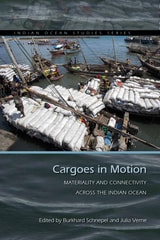
Cargoes in Motion
Materiality and Connectivity across the Indian OceanBurkhard Schnepel
Ohio University Press, 2022
An innovative collection of essays that foregrounds specific cargoes as a means to understand connectivity and mobility across the Indian Ocean world.
Scholars have long appreciated the centrality of trade and commerce in understanding the connectivity and mobility that underpin human experience in the Indian Ocean region. But studies of merchant and commercial activities have paid little attention to the role that cargoes have played in connecting the disparate parts of this vast oceanic world. Drawing from the work of anthropologists, geographers, and historians, Cargoes in Motion tells the story of how material objects have informed and continue to shape processes of exchange across the Indian Ocean.
By following selected cargoes through both space and time, this book makes an important and innovative contribution to Indian Ocean studies. The multidisciplinary approach deepens our understanding of the nature and dynamics of the Indian Ocean world by showing how transoceanic connectivity has been driven not only by economic, social, cultural, and political factors but also by the materiality of the objects themselves.
Essays by:
- Edward A. Alpers
- Fahad Ahmad Bishara
- Eva-Maria Knoll
- Karl-Heinz Kohl
- Lisa Jenny Krieg
- Pedro Machado
- Rupert Neuhöfer
- Mareike Pampus
- Hannah Pilgrim
- Burkhard Schnepel
- Hanne Schönig
- Tansen Sen
- Steven Serels
- Julia Verne
- Kunbing Xiao
Feenin
R&B Music and the Materiality of BlackFem Voices and TechnologyAlexander Ghedi Weheliye
Duke University Press, 2023
Latin American Textualities
History, Materiality, and Digital MediaEdited by Heather J. Allen and Andrew R. Reynolds
University of Arizona Press, 2018
Latin American Textualities is a wide-ranging, interdisciplinary look at textual history, textual artifacts, and digital textualities across Latin America from the colonial era to the present. Editors Heather J. Allen and Andrew R. Reynolds gather a wide range of scholars to investigate the region’s textual scholarship. Contributors offer engaging examples of not just artifacts but also the contexts in which the texts are used. Topics include Guamán Poma’s library, the effect of sound recordings on writing in Argentina, Sudamericana Publishing House’s contribution to the Latin American literary boom, and Argentine science fiction. Latin American Textualities provides new paths to reading Latin American history, culture, and literatures.
Contributors:
Heather J. Allen
Catalina Andrango-Walker
Sam Carter
Sara Castro-Klarén
Edward King
Rebecca Kosick
Silvia Kurlat Ares
Walther Maradiegue
Clayton McCarl
José Enrique Navarro
Andrew R. Reynolds
George Antony Thomas
Zac Zimmer
Materiality
Daniel Miller, ed.
Duke University Press, 2005
Considering topics as diverse as theology, technology, finance, and art, the contributors—most of whom are anthropologists—examine the many different ways in which materiality has been understood and the consequences of these differences. Their case studies show that the latest forms of financial trading instruments can be compared with the oldest ideals of ancient Egypt, that the promise of software can be compared with an age-old desire for an unmediated relationship to divinity. Whether focusing on the theology of Islamic banking, Australian Aboriginal art, derivatives trading in Japan, or textiles that respond directly to their environment, each essay adds depth and nuance to the project that Materiality advances: a profound acknowledgment and rethinking of one of the basic properties of being human.
Contributors. Matthew Engelke, Webb Keane, Susanne Küchler, Bill Maurer, Lynn Meskell, Daniel Miller, Hirokazu Miyazaki, Fred Myers, Christopher Pinney, Michael Rowlands, Nigel Thrift
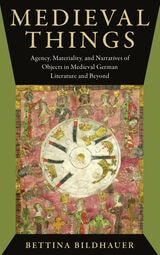
Medieval Things
Agency, Materiality, and Narratives of Objects in Medieval German Literature and BeyondBettina Bildhauer
The Ohio State University Press, 2020
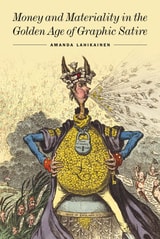
Money and Materiality in the Golden Age of Graphic Satire
Amanda Lahikainen
University of Delaware Press, 2022
This book examines the entwined and simultaneous rise of graphic satire and cultures of paper money in late eighteenth- and early nineteenth-century Britain. Asking how Britons learned to value both graphic art and money, the book makes surprising connections between two types of engraved images that grew in popularity and influence during this time. Graphic satire grew in visual risk-taking, while paper money became a more standard carrier of financial value, courting controversy as a medium, moral problem, and factor in inflation. Through analysis of satirical prints, as well as case studies of monetary satires beyond London, this book demonstrates several key ways that cultures attach value to printed paper, accepting it as social reality and institutional fact. Thus, satirical banknotes were objects that broke down the distinction between paper money and graphic satire altogether.
Newborn Socialist Things
Materiality in Maoist ChinaLaurence Coderre
Duke University Press, 2021
Object—Event— Performance
Art, Materiality, and Continuity Since the 1960sEdited by Hanna B. Hölling
Bard Graduate Center, 2021
Much of the artwork that rose to prominence in the second half of the twentieth century took on novel forms—such as installation, performance, event, video, film, earthwork, and intermedia works with interactive and networked components—that pose a new set of questions about what art actually is, both physically and conceptually. For conservators, this raises an existential challenge when considering what elements of these artworks can and should be preserved.
This provocative volume revisits the traditional notions of conservation and museum collecting that developed over the centuries to suit a conception of art as static, fixed, and permanent objects. Conservators and museums increasingly struggle with issues of conservation for works created from the mid-twentieth to the twenty-first century that are unstable over time. The contributors ask what it means to conserve artworks that fundamentally address and embody the notion of change and, through this questioning, guide us to reevaluate the meaning of art, of objects, and of materiality itself. Object—Event—Performance considers a selection of post-1960s artworks that have all been chosen for their instability, changeability, performance elements, and processes that pose questions about their relationship to conservation practices. This volume will be a welcome resource on contemporary conservation for art historians, scholars of dance and theater studies, curators, and conservators.
Operatic Infrastructures
Materiality and Meaning in 1890s London, Paris, and New YorkFlora Willson
University of Chicago Press, 2026
An exploration of the fundamental relationship between opera and urban modernity in three iconic cities: London, Paris, and New York.
At the end of the nineteenth century, London, Paris, and New York were quintessential modern metropolises and vital centers for opera. In Operatic Infrastructures, Flora Willson examines opera’s roots in the material worlds of these cities. Reaching beyond histories of opera as spectacle, she investigates the physical underpinnings of opera at the century’s end as an inter-urban, multimedia network.
Operatic Infrastructures considers emergent technologies such as the telephone and the subway, but it also retrieves the hidden, forgotten, and otherwise effaced traces of systems such as storage facilities and colonial trade routes. It takes seriously the mundane aspects of materiality, from the blandest clichés of newspaper columns to the fine print of insurance certificates. In doing so, the book reveals just how far these interfaces with modern urban life reached into opera’s own systems of meaning-making and performance in the 1890s—making it impossible to demarcate neatly between “opera” and its “context.” Without such operatic infrastructures, Willson shows, there would be no opera at all.
Purity Is a Myth
The Materiality of Concrete Art from Argentina, Brazil, and UruguayZanna Gilbert
J. Paul Getty Trust, The, 2021
Purity Is a Myth presents new scholarship on Concrete art in Argentina, Brazil, and Uruguay from the 1940s to the 1960s. Originally coined by the Dutch artist Theo van Doesburg in 1930, the term concrete denotes abstract painting with no reference to external reality. Van Doesburg argued that there was nothing more real than a line, color, or plane. Artists such as Willys de Castro, Lygia Clark, Waldemar Cordeiro, Hermelindo Fiaminghi, Judith Lauand, Raúl Lozza, Tomás Maldonado, Hélio Oiticica, and Rhod Rothfuss would reinvent this concept in postwar Latin America.
Drawing on research conducted by Getty and international partners, the essays in this volume address a variety of topics, including the general history, emergence, and reception of Concrete art; processes and color; scientific analysis of works; illustrated chronologies of the paint industry in Brazil and Argentina; and Concrete design on paper. An innovative technical study of the Concrete art movement in Latin America, this volume will be indispensable to scholars, practitioners, and students of Latin American art.
Spectral Characters
Genre and Materiality on the Modern StageSarah Balkin
University of Michigan Press, 2019
Theater’s materiality and reliance on human actors has traditionally put it at odds with modernist principles of aesthetic autonomy and depersonalization. Spectral Characters argues that modern dramatists in fact emphasized the extent to which humans are fictional, made and changed by costumes, settings, props, and spoken dialogue. Examining work by Ibsen, Wilde, Strindberg, Genet, Kopit, and Beckett, the book takes up the apparent deadness of characters whose selves are made of other people, whose thoughts become exteriorized communication technologies, and whose bodies merge with walls and furniture. The ghostly, vampiric, and telepathic qualities of these characters, Sarah Balkin argues, mark a new relationship between the material and the imaginary in modern theater. By considering characters whose bodies respond to language, whose attempts to realize their individuality collapse into inanimacy, and who sometimes don’t appear at all, the book posits a new genealogy of modernist drama that emphasizes its continuities with nineteenth-century melodrama and realism.
Surface
Matters of Aesthetics, Materiality, and MediaGiuliana Bruno
University of Chicago Press, 2014
Arguing that materiality is not a question of the materials themselves but rather the substance of material relations, Bruno investigates the space of those relations, examining how they appear on the surface of different media—on film and video screens, in gallery installations, or on the skins of buildings and people. The object of visual studies, she contends, goes well beyond the image and engages the surface as a place of contact between people and art objects. As Bruno threads through these surface encounters, she unveils the fabrics of the visual—the textural qualities of works of art, whether manifested on canvas, wall, or screen. Illuminating the modern surface condition, she notes how façades are becoming virtual screens and the art of projection is reinvented on gallery walls. She traverses the light spaces of artists Robert Irwin, James Turrell, Tacita Dean, and Anthony McCall; touches on the textured surfaces of Isaac Julien’s and Wong Kar-wai’s filmic screens; and travels across the surface materiality in the architectural practices of Diller Scofidio + Renfro and Herzog & de Meuron to the art of Doris Salcedo and Rachel Whiteread, where the surface tension of media becomes concrete. In performing these critical operations on the surface, she articulates it as a site in which different forms of mediation, memory, and transformation can take place.
Surveying object relations across art, architecture, fashion, design, film, and new media, Surface is a magisterial account of contemporary visual culture.
The Matter of Disability
Materiality, Biopolitics, Crip AffectDavid T. Mitchell, Susan Antebi, and Sharon L. Snyder, Editors
University of Michigan Press, 2019
Voluminous States
Sovereignty, Materiality, and the Territorial ImaginationFranck Billé
Duke University Press, 2020
Contributors. Debbora Battaglia, Franck Billé, Wayne Chambliss, Jason Cons, Hilary Cunningham (Scharper), Klaus Dodds, Elizabeth Cullen Dunn, Gastón Gordillo, Sarah Green, Tina Harris, Caroline Humphrey, Marcel LaFlamme, Lisa Sang Mi Min, Aihwa Ong, Clancy Wilmott, Jerry Zee
When the Earth Was New
Memory, Materiality, and Numic RitualAlex K. Ruuska
University of Utah Press, 2025
In When the Earth Was New, Alex K. Ruuska explores riveting multigenerational memories of Numic-speaking communities that extend back, potentially, to the late Pleistocene. These diverse oral traditions describe geological, climatic, and ecological events that occurred over thousands of years and were passed down across many generations. Through the examination of place-based memories and the architecture of Numic knowledge, Ruuska demonstrates convergences of oral traditions, ethnography, ethnohistory, archaeology, and geology.
When the Earth Was New critically compares and considers multiple forms of knowledge that contribute to overlapping as well as disparate understandings of both recent and distant pasts in the regions of California, the Great Basin, and the Colorado Plateau. It works at balancing key themes in these regions’ histories within a more holistic framework, exploring ancient and modern strands of knowledge with the assistance of twenty-four Tribes and Consolidated Organizations.