Results by title
106 books match the query 'Older people' and 5 start with g
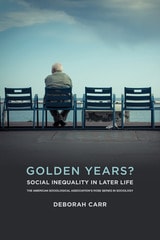
Golden Years?
Social Inequality in Later LifeDeborah Carr
Russell Sage Foundation, 2019
Thanks to advances in technology, medicine, Social Security, and Medicare, old age for many Americans is characterized by comfortable retirement, good health, and fulfilling relationships. But there are also millions of people over 65 who struggle with poverty, chronic illness, unsafe housing, social isolation, and mistreatment by their caretakers. What accounts for these disparities among older adults? Sociologist Deborah Carr’s Golden Years? draws insights from multiple disciplines to illuminate the complex ways that socioeconomic status, race, and gender shape the nearly every aspect of older adults’ lives. By focusing on an often-invisible group of vulnerable elders, Golden Years? reveals that disadvantages accumulate across the life course and can diminish the well-being of many.
Carr connects research in sociology, psychology, epidemiology, gerontology, and other fields to explore the well-being of older adults. On many indicators of physical health, such as propensity for heart disease or cancer, black seniors fare worse than whites due to lifetimes of exposure to stressors such as economic hardships and racial discrimination and diminished access to health care. In terms of mental health, Carr finds that older women are at higher risk of depression and anxiety than men, yet older men are especially vulnerable to suicide, a result of complex factors including the rigid masculinity expectations placed on this generation of men. Carr finds that older adults’ physical and mental health are also closely associated with their social networks and the neighborhoods in which they live. Even though strong relationships with spouses, families, and friends can moderate some of the health declines associated with aging, women—and especially women of color—are more likely than men to live alone and often cannot afford home health care services, a combination that can be isolating and even fatal. Finally, social inequalities affect the process of dying itself, with white and affluent seniors in a better position to convey their end-of-life preferences and use hospice or palliative care than their disadvantaged peers.
Carr cautions that rising economic inequality, the lingering impact of the Great Recession, and escalating rates of obesity and opioid addiction, among other factors, may contribute to even greater disparities between the haves and the have-nots in future cohorts of older adults. She concludes that policies, such as income supplements for the poorest older adults, expanded paid family leave, and universal health care could ameliorate or even reverse some disparities.
A comprehensive analysis of the causes and consequences of later-life inequalities, Golden Years? demonstrates the importance of increased awareness, strong public initiatives, and creative community-based programs in ensuring that all Americans have an opportunity to age well.
[more]
Gray Love
Stories About Dating and New Relationships After 60Rutgers University Press, 2023
Gray Love narrates stories about the most common themes – searching for and (perhaps) finding love. Forty-five men and women between ages 60 and 94 from diverse backgrounds talk about dating, starting or ending a relationship, embracing life alone or enjoying a partnered one. The longing for connection as old age encroaches is palpable here, with more and more senior singles searching online. Those who find new partners explore issues that most relationships encounter at any age, as well as some that are unique to elder relationships. These include having had previous partners and a complicated and deep personal history; family and friends’ reactions to an older person’s dating; alternative models to marriage (such as sharing space or living apart); having more than one partner at the same time; one’s aging body, appearance, and sexuality; and the pressure of time and the specter of illness and death.
[more]
Gray Matters
Finding Meaning in the Stories of Later LifeEllyn Lem
Rutgers University Press, 2020
Winner of the 2021 Excellence in Research and Scholarly Activity Award from the University of Wisconsin-Milwaukee
Finalist for the 2021 American Book Fest Best Book Awards
Aging is one of the most compelling issues today, with record numbers of seniors over sixty-five worldwide. Gray Matters: Finding Meaning in the Stories of Later Life examines a diverse array of cultural works including films, literature, and even art that represent this time of life, often made by people who are seniors themselves. These works, focusing on important topics such as housing, memory loss, and intimacy, are analyzed in dialogue with recent research to explore how “stories” illuminate the dynamics of growing old by blending fact with imagination. Gray Matters also incorporates the life experiences of seniors gathered from over two hundred in-depth surveys with a range of questions on growing old, not often included in other age studies works. Combining cultural texts, gerontology research, and observations from older adults will give all readers a fuller picture of the struggles and pleasures of aging and avoids over-simplified representations of the process as all negative or positive.
[more]
Growing Old in a New China
Transitions in Elder CareRose K. Keimig
Rutgers University Press, 2021
Growing Old in a New China: Transitions in Elder Care is an accessible exploration of changing care arrangements in China. Combining anthropological theory, ethnographic vignettes, and cultural and social history, it sheds light on the growing movement from home-based to institutional elder care in urban China. The book examines how tensions between old and new ideas, desires, and social structures are reshaping the experience of caring and being cared for. Weaving together discussions of family ethics, care work, bioethics, aging, and quality of life, this book puts older adults at the center of the story. It explores changing relationships between elders and themselves, their family members, caregivers, society, and the state, and the attempts made within and across these relational webs to find balance and harmony. The book invites readers to ponder the deep implications of how and why we care and the ways end-of-life care arrangements complicate both living and dying for many elders.
[more]
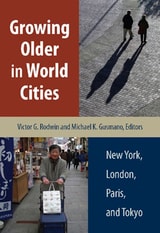
Growing Older in World Cities
New York, London, Paris, and TokyoVictor G. Rodwin
Vanderbilt University Press, 2006
Population aging often provokes fears of impending social security deficits, uncontrollable medical expenditures, and transformations in living arrangements, but public policy could also stimulate social innovations. These issues are typically studied at the national level; yet they must be resolved where most people live--in diverse neighborhoods in cities.
New York, London, Paris, and Tokyo are the four largest cities among the wealthiest, most developed nations of the world. The essays commissioned for this volume compare what it is like to grow older in these cities with respect to health care, quality of life, housing, and long-term care. The contributors look beyond aggregate national data to highlight the importance of how local authorities implement policies.
[more]