Results by title
183 books match the query 'Places' and 7 start with g

Gagaan X'usyee/Below the Foot of the Sun
PoemsX'unei Lance Twitchell
University of Alaska Press, 2023
The collection is divided into four sections based on how the Lingít talk about g̱agaan—the sun. Featuring some poems in English, some in Lingít, and some that combine the beauty of the two, Gagaan Xʼusyee / Beneath the Foot of the Sun displays an equal dignity in both languages that transcends monolingual constrictions.
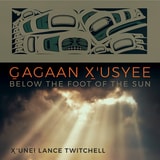
Gagaan X'usyee/Below the Foot of the Sun
PoemsX'unei Lance Twitchell
University of Alaska Press, 2023
The collection is divided into four sections based on how the Lingít talk about g̱agaan—the sun. Featuring some poems in English, some in Lingít, and some that combine the beauty of the two, Gagaan Xʼusyee / Beneath the Foot of the Sun displays an equal dignity in both languages that transcends monolingual constrictions.
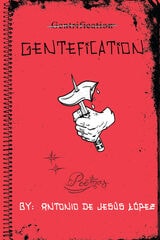
Gentefication
Antonio de Jesús López
Four Way Books, 2021
“Gentefication” nuances Latinidad as not just an immigration question, but an academic one. It deals with Latinx death not as the literal passing
of bodies, but as first tied with language. It asks, what are the hauntings of a tongue that is repeatedly told, ‘one must learn English in order to succeed in this country’? What is the psychological trauma deployed not by right-wing bigots, but of white liberal institutions that give scholarships to Latinx students, but nevertheless prop up white supremacy by viewing their payments as charity? How do Latinx students become complicit in this tokenizing? “Gentefication” wrestles with this ‘survivor’s guilt’ of higher education, of feeling as if you’re the only one among your homies that ‘made it.’ And in an American moment dealing with scandals across multiple universities this work is a timely intervention that advocates for first-generation audiences, for readers of color, and for all those vested in the protracted struggle for our fair shot.
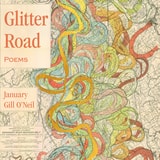
Glitter Road
January Gill O’Neil
CavanKerry Press, 2024
“My poems brought me to Oxford, Mississippi a.k.a. the velvet ditch: / a place you can fall into, get comfortable among confederate rebels,” writes January Gill O’Neil in her stunning new collection, Glitter Road. The poems in this book look back at the end of a marriage, a heartbreaking loss, and a new relationship against the backdrop of a Mississippi season. O’Neil reflects on the history and legacy of Emmett Till, how his story is intertwined with her own, and wades through the incredible grief she feels for herself, her children, and the Black children who won’t come home tonight. These poems reclaim the vulnerable, intimate parts of a life in transition and celebrate womanhood through awakenings, landscapes, meanders, and possibilities. She declares, with both self-love and conviction, “I am done telling the kinder story. I am a myth of my own making.”
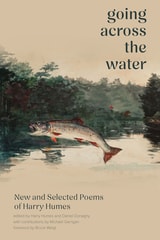
Going Across the Water
New and Selected Poems of Harry HumesHarry Humes
Ohio University Press, 2026
Harry Humes carved out a unique place in American literature by chronicling Appalachian working-class life, natural landscapes, and disappearing rural traditions in Appalachian Pennsylvania with rare lyricism, humility, and precision. He wrote unflinchingly about the austerity and horrors of extraction as well as his deep connection with family and the area mountains and valleys not gutted by the anthracite coal industry.
This volume of Humes’s new and selected poems not only preserves the work of a significant American poet, offering scholars, teachers, and general readers a generous overview of the clarity, beauty, craft, and emotional depth of his substantial body of work. It allows future generations to rediscover poetry that deepens our understanding of how our labor, our landscapes, and our love shape us and change the ways we live and what we care about.
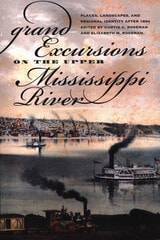
Grand Excursions on the Upper Mississippi River
Places, Landscapes, and Regional Identity after 1854Curtis C. & Elizabeth M. Roseman & Roseman
University of Iowa Press, 2004
One hundred and fifty years later, the thirteen essays in this volume examine the activities and environments of the 1854 Grand Excursion and place them in the context of an evolving regional identity for the Upper Mississippi River Valley based on the economy, culture, geography, and history of the area. In a series of “excursions,” the contributors explore the building of the Chicago and Rock Island Railroad, eastern newspaper accounts of the 1854 excursion, steamboating, the area’s pictorial landscape, passenger trains along the scenic river, the genesis and features of river towns, the control of the river for navigation, the development of preserves, parks, and recreation areas, the lumber industry, and commercial fishing. The book concludes by examining the resurgence of river-oriented development, as river towns are once again embracing the Mississippi.
Generously illustrated with maps, engravings, ephemera, and historic and present-day photographs, Grand Excursions on the Upper Mississippi River will be of interest to tourists and residents of the area, river aficionados, railroad and steamboat history buffs, as well as academics interested in the history, geography, and regional development of the area.
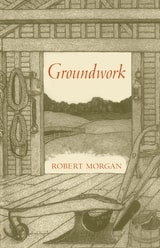
Groundwork
Robert Morgan
Ohio University Press, 1979
Published in 1979 by Gnomon Press
In Groundwork, Robert Morgan offers a vivid poetic excavation of Appalachian life, memory, and landscape. Drawing deeply from his upbringing in the Blue Ridge Mountains of North Carolina, Morgan crafts a collection that is both intimate and elemental. These poems explore the textures of rural existence—its labor, rituals, and natural rhythms—through language that is spare, musical, and richly evocative.
Morgan’s verse is rooted in place, yet it transcends regionalism through its mythic resonance and emotional clarity. He sifts through family lore, childhood recollections, and local history to recover what he calls “pieces of the morgenland”—a personal and cultural terrain shaped by hardship, resilience, and wonder. The poems in Groundwork are populated by grandparents, farmers, and mountain folk, rendered with a quiet reverence that elevates the everyday to the numinous.
This collection marks a foundational moment in Morgan’s career, establishing the poetic voice that would inform his later fiction and nonfiction. With titles like “Mountain Bride,” “Burning the Hornet’s Nest,” and “Baptism of Fire,” the poems evoke both the physical and spiritual dimensions of Appalachian life. Groundwork remains one of Morgan’s most concentrated and enduring tributes to the Southern mountains and their people.
Essential for readers of American poetry, Appalachian studies, and environmental literature, Groundwork is a lyrical testament to the power of memory and place.