325 books match the query 'Race identity' and 6 start with g
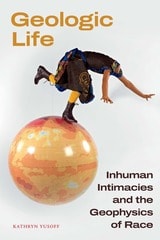
cover of Geologic Life: Inhuman Intimacies and the Geophysics of Race

Geologic Life

Inhuman Intimacies and the Geophysics of Race

Kathryn Yusoff

Duke University Press, 2024
In Geologic Life, Kathryn Yusoff theorizes the processes by which race and racialization emerged geologically. Examining both the history of geology as a discipline and ongoing mineral and resource extraction, Yusoff locates forms of imperial geology embedded in Western and Enlightenment thought and highlights how it creates anti-Black, anti-Indigenous, and anti-Brown environmental and racial injustices. Throughout, she outlines how the disciplines of geology and geography—and their conventions: surveying, identifying, classifying, valuing, and extracting—established and perpetuated colonial practices that ordered the world and people along a racial axis. Examining the conceptualization of the inhuman as political, geophysical, and paleontological, Yusoff unearths an apartheid of materiality as distinct geospatial forms. This colonial practice of geology organized and underpinned racialized accounts of space and time in ways that materially made Anthropocene Earth. At the same time, Yusoff turns to Caribbean, Indigenous, and Black thought to chart a parallel geologic epistemology of the "earth-bound" that challenges what and who the humanities have chosen to overlook in its stories of the earth. By reconsidering the material epistemologies of the earth as an on-going geotrauma in colonial afterlives, Yusoff demonstrates that race is as much a geological formation as a biological one.
[more]
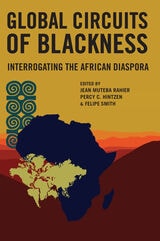
cover of Global Circuits of Blackness: Interrogating the African Diaspora

Global Circuits of Blackness

Interrogating the African Diaspora

Edited by Jean Muteba Rahier, Percy C. Hintzen, and Felipe Smith

University of Illinois Press, 2010
Global Circuits of Blackness is a sophisticated analysis of the interlocking diasporic connections between Africa, Europe, the Caribbean, and the Americas. A diverse and gifted group of scholars delve into the contradictions of diasporic identity by examining at close range the encounters of different forms of blackness converging on the global scene.
 
Contributors examine the many ways blacks have been misrecognized in a variety of contexts. They also explore how, as a direct result of transnational networking and processes of friction, blacks have deployed diasporic consciousness to interpellate forms of white supremacy that have naturalized black inferiority, inhumanity, and abjection. Various essays document the antagonism between African Americans and Africans regarding heritage tourism in West Africa, discuss the interaction between different forms of blackness in Toronto's Caribana Festival, probe the impact of the Civil Rights movement in America on diasporic communities elsewhere, and assess the anxiety about HIV and AIDS within black communities. The volume demonstrates that diaspora is a floating revelation of black consciousness that brings together, in a single space, dimensions of difference in forms and content of representations, practices, and meanings of blackness. Diaspora imposes considerable flexibility in what would otherwise be place-bound fixities.
 
Contributors are Marlon M. Bailey, Jung Ran Forte, Reena N. Goldthree, Percy C. Hintzen, Lyndon Phillip, Andrea Queeley, Jean Muteba Rahier, Stéphane Robolin, and Felipe Smith.
[more]
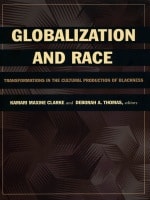
cover of Globalization and Race: Transformations in the Cultural Production of Blackness

Globalization and Race

Transformations in the Cultural Production of Blackness

Kamari Maxine Clarke and Deborah A. Thomas, eds.

Duke University Press, 2006

Kamari Maxine Clarke and Deborah A. Thomas argue that a firm grasp of globalization requires an understanding of how race has constituted, and been constituted by, global transformations. Focusing attention on race as an analytic category, this state-of-the-art collection of essays explores the changing meanings of blackness in the context of globalization. It illuminates the connections between contemporary global processes of racialization and transnational circulations set in motion by imperialism and slavery; between popular culture and global conceptions of blackness; and between the work of anthropologists, policymakers, religious revivalists, and activists and the solidification and globalization of racial categories.

A number of the essays bring to light the formative but not unproblematic influence of African American identity on other populations within the black diaspora. Among these are an examination of the impact of “black America” on racial identity and politics in mid-twentieth-century Liverpool and an inquiry into the distinctive experiences of blacks in Canada. Contributors investigate concepts of race and space in early-twenty-first century Harlem, the experiences of trafficked Nigerian sex workers in Italy, and the persistence of race in the purportedly non-racial language of the “New South Africa.” They highlight how blackness is consumed and expressed in Cuban timba music, in West Indian adolescent girls’ fascination with Buffy the Vampire Slayer, and in the incorporation of American rap music into black London culture. Connecting race to ethnicity, gender, sexuality, nationality, and religion, these essays reveal how new class economies, ideologies of belonging, and constructions of social difference are emerging from ongoing global transformations.

Contributors. Robert L. Adams, Lee D. Baker, Jacqueline Nassy Brown, Tina M. Campt, Kamari Maxine Clarke, Raymond Codrington, Grant Farred, Kesha Fikes, Isar Godreau, Ariana Hernandez-Reguant, Jayne O. Ifekwunigwe, John L. Jackson Jr., Oneka LaBennett, Naomi Pabst, Lena Sawyer, Deborah A. Thomas

[more]
cover of Goin' Viral: Uncontrollable Black Performance

Goin' Viral

Uncontrollable Black Performance

Gabriel A. Peoples

University of Illinois Press, 2025

Black virality refers to the spread of Black performance that becomes uncontrollable because of its rapid and ubiquitous circulation through popular media. Gabriel A. Peoples examines Black people and representations of Black people that have gone viral from the eighteenth century to today.

Peoples’s analysis ranges from abolitionist and proslavery visual culture to Do the Right Thing to “Bed Intruder Song” and the cellphone video of Derrion Albert’s murder. After identifying these moments, he considers how performances go viral in Black ways. He also thinks through the ways Black virality circulates ideas that materially affect Black life. As he shows, an interacting person’s vulnerability to racialized gender and racialized sexuality knowledge inspires how they spread a performance. Non-iconic elements of viral moments reveal hard-to-find nuances of Black life while the artists and others represented in viral moments promote both collective and individual liberation by harnessing their visibility and audibility.

Rigorous and expansive, Goin’ Viral uses Black virality as a new way to understand and frame Black performances.
[more]
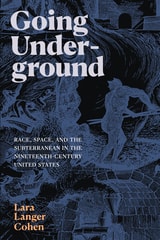
cover of Going Underground: Race, Space, and the Subterranean in the Nineteenth-Century United States

Going Underground

Race, Space, and the Subterranean in the Nineteenth-Century United States

Lara Langer Cohen

Duke University Press, 2023

First popularized by newspaper coverage of the Underground Railroad in the 1840s, the underground serves as a metaphor for subversive activity that remains central to our political vocabulary. In Going Underground, Lara Langer Cohen excavates the long history of this now familiar idea while seeking out versions of the underground that were left behind along the way. Outlining how the underground’s figurative sense first took shape through the associations of literal subterranean spaces with racialized Blackness, she examines a vibrant world of nineteenth-century US subterranean literature that includes Black radical manifestos, anarchist periodicals, sensationalist exposés of the urban underworld, manuals for sex magic, and the initiation rites of secret societies. Cohen finds that the undergrounds in this literature offer sites of political possibility that exceed the familiar framework of resistance, suggesting that nineteenth-century undergrounds can inspire new modes of world-making and world-breaking for a time when this world feels increasingly untenable.
[more]
cover of Grime, Glitter, and Glass: The Body and the Sonic in Contemporary Black Art

Grime, Glitter, and Glass

The Body and the Sonic in Contemporary Black Art

Nikki A. Greene

Duke University Press, 2024

In Grime, Glitter, and Glass, Nikki A. Greene examines how contemporary Black visual artists use sonic elements to refigure the formal and philosophical developments of Black art and culture. Focusing on the multimedia art of Renée Stout, Radcliffe Bailey, and María Magdalena Campos-Pons, Greene traces the intersection of the visual’s sonic possibilities with the Black body’s physical, representational, and metaphorical use in art. She employs her concept of “visual aesthetic musicality” to interpret Black visual art by examining the musical genres of jazz and rap, along with the often-overlooked innovations of funk and rumba, within art historiography. From Bailey’s use of multilayered surfaces of glitter, mud, and recycled materials to meditate on Sun Ra’s Afrofuturism to Stout’s life-size cast of her own body that recalls funk musician Betty Davis to Campos-Pons’s performative and sculptural references to sugar that resonate with the legacy of Celia Cruz, Greene outlines how these artists use mediums such as molded glass sculptures, viscous wet plaster, and dazzling mannequin heads to enhance the manifestations of Black identity. By foregrounding the sonic elements of their work, Greene demonstrates that these artists use sound to make themselves legible, recognizable, and audible.
[more]