Results by title
4743 books match the query 'Religion' and 138 start with g

Galileo, Science and the Church
Jerome J. Langford
University of Michigan Press, 1992
Jerome J. Langford's Galileo, Science, and the Church is widely recognized as a classic, balanced account of Galileo Galilei’s legendary 1633 confrontation with the Roman Catholic Inquisition. Moving past the overly polarized arguments of traditional polemicists and apologists, Langford contextualizes the "Galileo Affair" within its proper 17th-century historical, theological, and philosophical milieu. The book meticulously explores how the clash was less a fundamental war between science and faith, and more a complex dispute over scriptural interpretation, ecclesiastical authority, and the academic rigidities of Aristotelian philosophy. Through objective research, Langford demonstrates that this momentous historical drama still serves as a timeless case study on the enduring friction between institutional authority and the freedom of individual thought and expression.

Game Changers
AJ Dybantsa, BYU, and the Struggle for the Soul of BasketballMatthew Bowman, Wayne LeCheminant
Signature Books, 2025
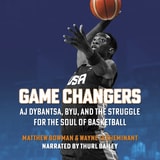
In one of the most unlikely coups in college basketball history, a religious school in Utah signed basketball phenomenon AJ Dybantsa. He will play for Brigham Young University—hardly the sort of basketball powerhouse that typically attracts exceptional and non-Mormon players like him.
Game Changers explores how BYU managed this stunning feat. A year before signing Dybantsa, the university lured coaching star Kevin Young from the NBA to run its basketball program. In the decade before, court rulings and institutional reform put money at the forefront of college sports in ways the American public had never seen. And for generations before that, The Church of Jesus Christ of Latter-day Saints built a theological structure and institutional commitment to basketball that put the sport front and center at BYU.
Game Changers places Dybantsa in the context of this history and culture and explores the tensions in the sport. For Latter-day Saints and many other basketball fans, the sport is about personal discipline, character, and a commitment to success. But more and more, universities, the NCAA, and the professional leagues place money above everything else. These dual impulses have pulled the sport in general, and the church-owned BYU in particular, in opposite directions. The book reveals why Dybantsa decided to attend BYU and what he means to the sports world—in Provo, in the United States, and around the globe—as his career unfolds.
Game Changers
AJ Dybantsa, BYU, and the Struggle for the Soul of BasketballMatthew Bowman, Wayne LeCheminant
Signature Books, 2026
In one of the most unlikely coups in college basketball history, a religious school in Utah signed basketball phenomenon AJ Dybantsa. He will play for Brigham Young University—hardly the sort of basketball powerhouse that typically attracts exceptional and non-Mormon players like him.
Game Changers explores how BYU managed this stunning feat. A year before signing Dybantsa, the university lured coaching star Kevin Young from the NBA to run its basketball program. In the decade before, court rulings and institutional reform put money at the forefront of college sports in ways the American public had never seen. And for generations before that, The Church of Jesus Christ of Latter-day Saints built a theological structure and institutional commitment to basketball that put the sport front and center at BYU.
Game Changers places Dybantsa in the context of this history and culture and explores the tensions in the sport. For Latter-day Saints and many other basketball fans, the sport is about personal discipline, character, and a commitment to success. But more and more, universities, the NCAA, and the professional leagues place money above everything else. These dual impulses have pulled the sport in general, and the church-owned BYU in particular, in opposite directions. The book reveals why Dybantsa decided to attend BYU and what he means to the sports world—in Provo, in the United States, and around the globe—as his career unfolds.
Games of Inheritance
Kabbalah, Tradition, and Authorship in Jorge Luis BorgesYitzhak Lewis
Rutgers University Press, 2025

Gardens
An Essay on the Human ConditionRobert Pogue Harrison
University of Chicago Press, 2008
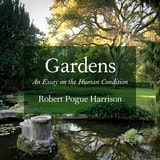
Humans have long turned to gardens—both real and imaginary—for sanctuary from the frenzy and tumult that surrounds them. Those gardens may be as far away from everyday reality as Gilgamesh’s garden of the gods or as near as our own backyard, but in their very conception and the marks they bear of human care and cultivation, gardens stand as restorative, nourishing, necessary havens.
With Gardens, Robert Pogue Harrison graces readers with a thoughtful, wide-ranging examination of the many ways gardens evoke the human condition. Moving from from the gardens of ancient philosophers to the gardens of homeless people in contemporary New York, he shows how, again and again, the garden has served as a check against the destruction and losses of history. The ancients, explains Harrison, viewed gardens as both a model and a location for the laborious self-cultivation and self-improvement that are essential to serenity and enlightenment, an association that has continued throughout the ages. The Bible and Qur’an; Plato’s Academy and Epicurus’s Garden School; Zen rock and Islamic carpet gardens; Boccaccio, Rihaku, Capek, Cao Xueqin, Italo Calvino, Ariosto, Michel Tournier, and Hannah Arendt—all come into play as this work explores the ways in which the concept and reality of the garden has informed human thinking about mortality, order, and power.
Alive with the echoes and arguments of Western thought, Gardens is a fitting continuation of the intellectual journeys of Harrison’s earlier classics, Forests and The Dominion of the Dead. Voltaire famously urged us to cultivate our gardens; with this compelling volume, Robert Pogue Harrison reminds us of the nature of that responsibility—and its enduring importance to humanity.
"I find myself completely besotted by a new book titled Gardens: An Essay on the Human Condition, by Robert Pogue Harrison. The author . . . is one of the very best cultural critics at work today. He is a man of deep learning, immense generosity of spirit, passionate curiosity and manifold rhetorical gifts."—Julia Keller, Chicago Tribune
"This book is about gardens as a metaphor for the human condition. . . . Harrison draws freely and with brilliance from 5,000 years of Western literature and criticism, including works on philosophy and garden history. . . . He is a careful as well as an inspiring scholar."—Tom Turner, Times Higher Education
"When I was a student, my Cambridge supervisor said, in the Olympian tone characteristic of his kind, that the only living literary critics for whom he would sell his shirt were William Empson and G. Wilson Knight. Having spent the subsequent 30 years in the febrile world of academic Lit. Crit. . . . I’m not sure that I’d sell my shirt for any living critic. But if there had to be one, it would unquestionably be Robert Pogue Harrison, whose study Forests: The Shadow of Civilization, published in 1992, has the true quality of literature, not of criticism—it stays with you, like an amiable ghost, long after you read it.
“Though more modest in scope, this new book is similarly destined to become a classic. It has two principal heroes: the ancient philosopher Epicurus . . . and the wonderfully witty Czech writer Karel Capek, apropos of whom it is remarked that, whereas most people believe gardening to be a subset of life, ‘gardeners, including Capek, understand that life is a subset of gardening.’”—Jonathan Bate, The Spectator
Gardens
An Essay on the Human ConditionRobert Pogue Harrison
University of Chicago Press, 2008
Humans have long turned to gardens—both real and imaginary—for sanctuary from the frenzy and tumult that surrounds them. Those gardens may be as far away from everyday reality as Gilgamesh’s garden of the gods or as near as our own backyard, but in their very conception and the marks they bear of human care and cultivation, gardens stand as restorative, nourishing, necessary havens.
With Gardens, Robert Pogue Harrison graces readers with a thoughtful, wide-ranging examination of the many ways gardens evoke the human condition. Moving from from the gardens of ancient philosophers to the gardens of homeless people in contemporary New York, he shows how, again and again, the garden has served as a check against the destruction and losses of history. The ancients, explains Harrison, viewed gardens as both a model and a location for the laborious self-cultivation and self-improvement that are essential to serenity and enlightenment, an association that has continued throughout the ages. The Bible and Qur’an; Plato’s Academy and Epicurus’s Garden School; Zen rock and Islamic carpet gardens; Boccaccio, Rihaku, Capek, Cao Xueqin, Italo Calvino, Ariosto, Michel Tournier, and Hannah Arendt—all come into play as this work explores the ways in which the concept and reality of the garden has informed human thinking about mortality, order, and power.
Alive with the echoes and arguments of Western thought, Gardens is a fitting continuation of the intellectual journeys of Harrison’s earlier classics, Forests and The Dominion of the Dead. Voltaire famously urged us to cultivate our gardens; with this compelling volume, Robert Pogue Harrison reminds us of the nature of that responsibility—and its enduring importance to humanity.
"I find myself completely besotted by a new book titled Gardens: An Essay on the Human Condition, by Robert Pogue Harrison. The author . . . is one of the very best cultural critics at work today. He is a man of deep learning, immense generosity of spirit, passionate curiosity and manifold rhetorical gifts."—Julia Keller, Chicago Tribune
"This book is about gardens as a metaphor for the human condition. . . . Harrison draws freely and with brilliance from 5,000 years of Western literature and criticism, including works on philosophy and garden history. . . . He is a careful as well as an inspiring scholar."—Tom Turner, Times Higher Education
"When I was a student, my Cambridge supervisor said, in the Olympian tone characteristic of his kind, that the only living literary critics for whom he would sell his shirt were William Empson and G. Wilson Knight. Having spent the subsequent 30 years in the febrile world of academic Lit. Crit. . . . I’m not sure that I’d sell my shirt for any living critic. But if there had to be one, it would unquestionably be Robert Pogue Harrison, whose study Forests: The Shadow of Civilization, published in 1992, has the true quality of literature, not of criticism—it stays with you, like an amiable ghost, long after you read it.
“Though more modest in scope, this new book is similarly destined to become a classic. It has two principal heroes: the ancient philosopher Epicurus . . . and the wonderfully witty Czech writer Karel Capek, apropos of whom it is remarked that, whereas most people believe gardening to be a subset of life, ‘gardeners, including Capek, understand that life is a subset of gardening.’”—Jonathan Bate, The Spectator
Gates of Awe
Holy Day Prayers for Young ChildrenRabbi Howard I. Bogot
Central Conference of American Rabbis, 1991
Gates of Forgiveness
Shaarei SelichaChaim Stern
Central Conference of American Rabbis, 1993

Gates of Healing
Hirshel Jaffe
Central Conference of American Rabbis, 0
Gates of Healing
A Message of Comfort and HopeHirshel Jaffe
Central Conference of American Rabbis, 0
Gates of Mitzvah
Simeon J. Maslin
Central Conference of American Rabbis, 1972
Gates of Prayer - English Open
Chaim Stern
Central Conference of American Rabbis, 0
Gates of Prayer WHM - Hebrew Open
Chaim Stern
Central Conference of American Rabbis, 1992
Gates of Prayer for Shabbat and Weekdays - English-opening, Gender-Inclusive
Chaim Stern
Central Conference of American Rabbis, 1994
Gates of Prayer for Shabbat and Weekdays-Hebrew-opening, Gender-Inclusive
Chaim Stern
Central Conference of American Rabbis, 1994
Gates of Prayer for Weekdays and at a House of Mourning
Chaim Stern
Central Conference of American Rabbis, 1992
Gates of Prayer for Young People
Roy A. Walter
Central Conference of American Rabbis, 1997
Gates of Prayer, Large Print, Hebrew Opening
Chaim Stern
Central Conference of American Rabbis, 0
Gates of Prayer
Shaarei Tefila - Hebrew-opening: The New Union Prayerbook for Weekdays, Sabbaths and FestivalsChaim Stern
Central Conference of American Rabbis, 0
Gates of Repentance - English Open
Chaim Stern
Central Conference of American Rabbis, 0
Gates of Repentance - Hebrew Open
Chaim Stern
Central Conference of American Rabbis, 0
Gates of Repentance - LP - Hebrew
Chaim Stern
Central Conference of American Rabbis, 1997
Gates of Repentance for Young People
Rabbi Judith Abrams
Central Conference of American Rabbis, 2002
Gates of Shabbat
Neil Waldman
Central Conference of American Rabbis, 1991
Gates of Shabbat - Shaarei Shabbat
A Guide for Observing Shabbat, Revised EditionRabbi Mark Dov Shapiro
Central Conference of American Rabbis, 2016
This book is about Shabbat--the Jewish treasure that comes around every seven days. In the midst of our freedom, Shabbat offers roots and inspiration along with joy and hope. In the midst of a world of endless choices and paths, Judaism provides the rich resources developed for living a life of meaning over centuries of practice. In particular, Judaism offers Shabbat as a way to deepen, renew, and refresh our lives.
Through additional essays, poetry, and personal insights, as well as many new inspiring and creative ideas, this updated edition of Gates of Shabbat offers a roadmap to discovering and exploring what Shabbat can mean to you.
Gates of Understanding Volume 1 - PDF Electronic Version
A Companion Volume to Gates of PrayerRabbi Chaim Stern
Central Conference of American Rabbis, 1977
This ebook is not sold by CCAR Press and must be ordered from the external ebook stores below.
This companion volume to Gates of Prayer includes essays on worship, liturgy, holiness, theology, music, and more, written by leading thinkers of their day. Also included are notes on Gates of Prayer written by Chaim Stern and A. Stanley Dreyfus. An invaluable resource for anyone interested in the history and development of liturgy and Reform Jewish practice.
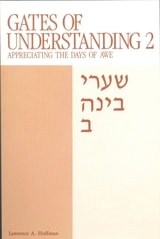
Gates of Understanding
Shaarei Bina - Vol. II: Appreciating the Days of AweRabbi Lawrence A. Hoffman
Central Conference of American Rabbis, 1977
A religious commentary to help High Holy Days worshipers unlock the message behind the liturgy. Covers the history and tradition of the prayers, music in the service, synagogue poetry, the role of God, sin, repentance, and much more. Also includes comprehensive notes to Gates of Repentance and a thorough index.
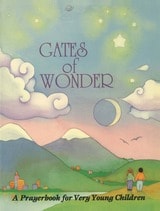
Gates of Wonder
A Prayerbook for Very Young ChildrenRabbi Howard Bogot
Central Conference of American Rabbis, 1989
Gates of the Seasons
Peter S. Knobel
Central Conference of American Rabbis, 1983
Gathered into a Church
Indigenous-English Congregationalism in Woodland New EnglandLori Rogers-Stokes
University of Massachusetts Press, 2025
Uncovering how and where Indigenous and settler communities found common ground using newly public church records
Puritans in the American colonies created Congregationalism, a Protestant denomination where power rested in each congregation rather than a larger central body. As has often been told, the official Puritan mission included outreach to Indigenous people. This may appear as nothing more than forced conversion under colonization, but church records from Massachusetts—digitized and made public for the first time—reveal the authenticity of this Indigenous religious experience, as evidenced by commonalities between the Congregational way and some aspects of local Native American cultures. The records also show how the decentralized churches stood in contrast to a growing civil government in the colonies.
Lori Rogers-Stokes focuses on the Massachusetts Bay Colony during the decades around the turn of the eighteenth century, a period bookended by King Philip’s War and the First Great Awakening. She uses as her primary source the many records kept by individual Congregational churches of the time. These records, accumulated over generations, have been missing from the historical record, allowing overly simplistic accounts of this religious community to circulate. With church records now available, Rogers-Stokes reveals a more realistic picture of diverse congregations and contrasts their internal workings—which show inherent flexibility and a focus on a shared creation of community—with a developing civil government focused on consolidating power around white landowners. The result is a story that can expand how scholars write about this period, this region, and these communities, both settler and Indigenous.
Gatherings In Diaspora
Religious Communities and the New Immigrationedited by Stephen R. Warner and Judith G. Wittner
Temple University Press, 1998
This book explores and analyzes the diverse religious communities of post-1965 diasporas: Christians, Hews, Muslims, Hindus, Rastafarians, and practitioners of Vodou, from countries such as China, Guatemala, Haiti, India, Iran, Jamaica, Korea, and Mexico. The contributors explore how, to a greater or lesser extent, immigrants and their offspring adapt their religious institutions to American conditions, often interacting with religious communities already established. The religious institutions they build, adapt, remodel, and adopt become worlds unto themselves, congregations, where new relations are forged within the community -- between men and women, parents and children, recent arrival and those longer settled.
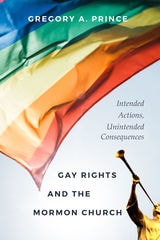
Gay Rights and the Mormon Church
Intended Actions, Unintended ConsequencesGregory A. Prince
University of Utah Press, 2019
Gregory Prince draws from over 50,000 pages of public records, private documents, and interview transcripts to capture the past half-century of the Mormon Church’s attitudes on homosexuality. Initially that principally involved only its own members, but with its entry into the Hawaiian political arena, the church signaled an intent to shape the outcome of the marriage equality battle. That involvement reached a peak in 2008 during California’s fight over Proposition 8, which many came to call the “Mormon Proposition.”
In 2015, when the Supreme Court made marriage equality the law of the land, the Mormon Church turned its attention inward, declaring same-sex couples “apostates” and denying their children access to key Mormon rites of passage, including the blessing (christening) of infants and the baptism of children.
Prince's interview with KUER: https://radiowest.kuer.org/post/gay-rights-and-mormon-church
Prince's Q-Talk with Equality Utah: https://www.youtube.com/watch?v=vcnVagLY-lM&feature=youtu.be
Prince's interview with the Press: https://conta.cc/2HHmeTm
Princes's event with Benchmark Books: https://youtu.be/Daz-TFldZDA
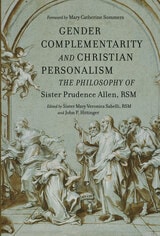
Gender Complementarity and Christian Personalism
The Philosophy of Sister Prudence Allen, RSMSister Mary Veronica Sabelli, RSM
Catholic University of America Press, 2025

Gender and Historiography
Studies in the earlier middle ages in honour of Pauline StaffordJanet L. Nelson, Susan Reynolds, and Susan M. Johns
University of London Press, 2012
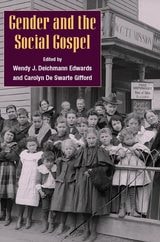
Gender and the Social Gospel
Edited by Wendy J. Deichmann Edwards and Carolyn De Swarte Gifford
University of Illinois Press, 2003
A practical theological response to the stark realities of poverty and injustice prevalent in turn-of-the-century America, the social gospel movement sought to apply the teachings of Jesus and the message of Christian salvation to society by striving to improve the lives of the impoverished and the disenfranchised. The contributors to this volume set out to broaden our understanding of this radical movement by examining the lives of some of its passionate and vibrant female participants and the ways in which their involvement expanded and enriched the scope of its activity.
In addition to examining the lives of individual women, the essays in Gender and the Social Gospel contain broader analyses of the gender and racial issues that have caused the histories of movements such as the social gospel to be viewed almost exclusively in terms of their male, European-American, intellectual participants at the expense of the women, African Americans, and Canadians whose contributions were just as worthy of attention.
Gender in medieval places, spaces and thresholds
Edited by Victoria Blud, Diane Heath, and Einat Klafter
University of London Press, 2019
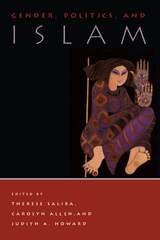
Gender, Politics, and Islam
Edited by Therese Saliba, Carolyn Allen, and Judith A. Howard
University of Chicago Press, 2002
This collection shows Islam to be a diverse set of variable practices and beliefs shaped by region, nation, ethnicity, sect, and class, as well as by responses to many cultural and economic processes. In examining women's participation in religious and nationalist projects, these critics debate controversial issues: Does Islamic feminism provide an alternative, revolutionary paradigm to Eurocentric liberal humanism and western feminism? Is Islam more oppressive to women than the modern secular state? How are the lives and texts of Arab and Muslim women constructed for local or western consumption? These essays expose the shortcomings of the secularist assumptions of many recent feminist analyses, which continue to treat religion in general and fundamentalism in particular as a tool of oppression used against women, rather than as a viable form of feminist agency producing contradictory effects for its participants.
The essays in this book first appeared in Signs: Journal of Women in Culture and Society.
Contributors:
S. M. Shamsul Alam
Amal Amireh
Mary Elaine Heglund
Shahnaz Khan
Anouar Majid
Val Moghadam
Julia Peteet
Elora Shehabbudin
Gabriele vom Bruck.

Gender, Race and Religion in Video Game Music
Thomas B. Yee
Intellect Books, 2024
This book provides semiotically focused analyses and interpretations of video game music, focusing specifically on the musical representation of three demographic diversity traits. Adopting a narratologist orientation to supplement existing ludological scholarship, these analyses apply music semiotics to crucial modern-day issues such as the representation of gender, race, and religion in video games.
An original and welcome contribution to the field, it considers musical meaning in relation to the aspects of gender, race, and religion. This book will help readers develop language and context in which to consider video game music in terms of society and representation and will encourage future research in these critical areas. Containing twenty-five detailed analytical case studies of musical representation in video game music, the book sets out theoretical and conceptual frameworks beneficial for interpreting musical meaning from video game soundtracks. Though players and commentators may be tempted to view a game’s soundtrack as mere background music, this research demonstrates video game music’s social relevance as a major factor impacting players’ cultural attitudes, values, and beliefs.
Part I explores immersion, interactivity, and interpretation in video game music, proposing a theory of interpretative interactivity to account for players’ semiotic agency in dialogue with their ludic agency. Part II explores musical gender representation in a trajectory from conventional gender construction, alternative femininities and masculinities, and the potential for nonbinary representational possibilities. Part III explores the musical representation of nationality, culture, and race, proposing the concept of racialized fantasy and applying frameworks from race scholarship to connect media representations of race to real-world racial justice movements. Part IV examines religion, introducing the concept of sonic iconography to connect theological meanings to the use of sacred music in video game music.
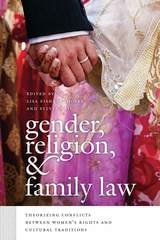
Gender, Religion, and Family Law
Theorizing Conflicts between Women’s Rights and Cultural TraditionsEdited by Lisa Fishbayn Joffe and Sylvia Neil
Brandeis University Press, 2012
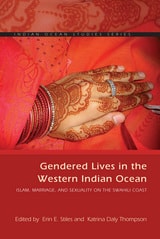
Gendered Lives in the Western Indian Ocean
Islam, Marriage, and Sexuality on the Swahili CoastErin E. Stiles
Ohio University Press, 2015
Muslim communities throughout the Indian Ocean have long questioned what it means to be a “good Muslim.” Much recent scholarship on Islam in the Indian Ocean considers debates among Muslims about authenticity, authority, and propriety. Despite the centrality of this topic within studies of Indian Ocean, African, and other Muslim communities, little of the existing scholarship has addressed such debates in relation to women, gender, or sexuality. Yet women are deeply involved with ideas about what it means to be a “good Muslim.”
In Gendered Lives in the Western Indian Ocean, anthropologists, historians, linguists, and gender studies scholars examine Islam, sexuality, gender, and marriage on the Swahili coast and elsewhere in the Indian Ocean. The book examines diverse sites of empowerment, contradiction, and resistance affecting cultural norms, Islam and ideas of Islamic authenticity, gender expectations, ideologies of modernity, and British education. The book’s attention to both masculinity and femininity, broad examination of the transnational space of the Swahili coast, and inclusion of research on non-Swahili groups on the East African coast makes it a unique and indispensable resource.
Contributors: Nadine Beckmann, Pat Caplan, Corrie Decker, Rebecca Gearhart, Linda Giles, Meghan Halley, Susan Hirsch, Susi Keefe, Kjersti Larsen, Elisabeth McMahon, Erin Stiles, and Katrina Daly Thompson
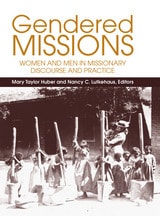
Gendered Missions
Women and Men in Missionary Discourse and PracticeMary Taylor Huber and Nancy C. Lutkehaus, Editors
University of Michigan Press, 1999
Missionary groups thus faced more immediately the destabilizing challenges that colonial experience posed to their own ways of organizing relations between women and men. Examining the changing prospects for professional women in the missions, the contributors to Gendered Missions ask how these shaped, and were shaped by, crucial practical, political, and religious developments at home and abroad. While the focus is on the tumultuous period that historian Eric Hobsbawm calls "The Age of Empire" (1875-1914), attention also is paid to how gender has been debated in later colonial and post-colonial missions.
Scholars from any field concerned with colonial and postcolonial societies or with gender and women's history should find this book of special interest. In addition, Gendered Missions should appeal to readers in church history, mission studies, and the sociology of religion.
Mary Taylor Huber is Senior Scholar, The Carnegie Foundation for the Advancement of Teaching. Nancy C. Lutkehaus is Associate Professor of Anthropology, University of Southern California.
General Principles of Sacramental Theology
Roger W. Nutt
Catholic University of America Press, 2017
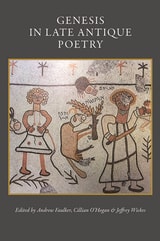
Genesis in Late Antique Poetry
Andrew Faulkner
Catholic University of America Press, 2022
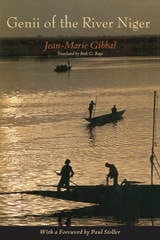
Genii of the River Niger
Jean-Marie Gibbal
University of Chicago Press, 1993
Gibbal portrays the river as the dominant, cohesive force among people in the face of social and environmental strife. He focuses on the Ghimbala healing cult, which centers on the river, and how the cult structures social relations in the region. Gibbal vividly recreations the Ghimbala rites, nocturnal ceremonies of spirit possession and seance which animate the water spirits, or genii, that inhabit the river. The genii, he finds, provide the strength of social identity in a world where famine and competing versions of Islam threaten to overpower traditional culture.
In its original French publication, The Genii of the River Niger was honored with an Alexandra David-Neel literary prize in 1989. Its powerful lyricism, combined with fascinating ethnographic depth, will delight general readers and specialists alike and will stir debates among specialists in African studies, the anthropology of religion, and literature.
Genre and Openness in Proverbs 10
1-22:16Suzanna R. Millar
SBL Press, 2020
A fruitful reading strategy that reveals expansive meaning in Proverbs
Interpreters often characterize Proverbs 10:1–22:16 as a dead-end of cold, disengaged dogma closed off from the realities of the world. In Genre and Openness in Proverbs 10:1–22:16, Suzanna R. Millar takes a different view, arguing that the didactic proverbs in these chapters are not dull and dry but are filled with poetic complexities open to many possible interpretations and uses. By incorporating paremiology, the technical study of the proverb genre, Millar sheds light on important debates such as character development, kingship, the connection between act and consequence, and the acquisition of wisdom.
Features
- A clarification of the genre of the sayings in light of modern genre theory
- A linguistic analysis of how openness is generated in biblical proverbs
- An examination of the didactic use of proverbs to train the hearer’s mind
George Eliot's Religious Imagination
A Theopoetics of EvolutionMarilyn Orr
Northwestern University Press, 2018
Orr’s wide-ranging and fascinating analysis situates George Eliot in the fertile intellectual landscape of the nineteenth century, among thinkers as diverse as Ludwig Feuerbach, David Strauss, and Søren Kierkegaard. She also argues for a connection between George Eliot and the twentieth-century evolutionary Christian thinker Pierre Teilhard de Chardin. Her analysis draws on the work of contemporary philosopher Richard Kearney as well as writers on mysticism, particularly Karl Rahner.
The book takes an original look at questions many believe settled, encouraging readers to revisit George Eliot’s work. Orr illuminates the creative tension that still exists between science and religion, a tension made fruitful through the exercise of the imagination. Through close readings of Eliot's writings, Orr demonstrates how deeply the novelist's religious imagination continued to operate in her fiction and poetry.
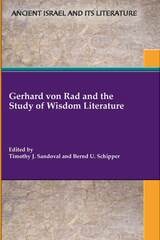
Gerhard von Rad and the Study of Wisdom Literature
Timothy J. Sandoval
SBL Press, 2022
Gerhard von Rad's study of biblical wisdom literature in Weisheit in Israel (1970) is widely regarded as one of the most important studies in the field of ancient Israelite wisdom literature. More than fifty years later, contributors to Gerhard von Rad and the Study of Wisdom Literature reevaluate the significance and shortcomings of the late scholar's work and engage new methods and directions for wisdom studies today. Contributors include George J. Brooke, Ariel Feldman, Edward L. Greenstein, Arthur Jan Keefer, Jennifer L. Koosed, Will Kynes, Christl M. Maier, Timothy J. Sandoval, Bernd U. Schipper, Mark Sneed, Hermann Spieckermann, Anne W. Stewart, Raymond C. Van Leeuwen, Stuart Weeks, and Benjamin G. Wright III. This collection of essays is essential reading not only for specialists in wisdom studies but also for scholars and advanced students of the Hebrew Bible in general.
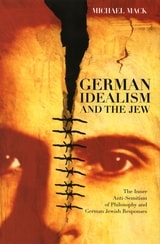
German Idealism and the Jew
The Inner Anti-Semitism of Philosophy and German Jewish ResponsesMichael Mack
University of Chicago Press, 2003
Offering the first analytical account of the connection between anti-Semitism and philosophy, Mack begins his exploration by showing how the fundamental thinkers in the German idealist tradition—Kant, Hegel, and, through them, Feuerbach and Wagner—argued that the human world should perform and enact the promises held out by a conception of an otherworldly heaven. But their respective philosophies all ran aground on the belief that the worldly proved incapable of transforming itself into this otherworldly ideal. To reconcile this incommensurability, Mack argues, philosophers created a construction of Jews as symbolic of the "worldliness" that hindered the development of a body politic and that served as a foil to Kantian autonomy and rationality.
In the second part, Mack examines how Moses Mendelssohn, Heinrich Heine, Franz Rosenzweig, and Freud, among others, grappled with being both German and Jewish. Each thinker accepted the philosophies of Kant and Hegel, in varying degrees, while simultaneously critiquing anti-Semitism in order to develop the modern Jewish notion of what it meant to be enlightened—a concept that differed substantially from that of Kant, Hegel, Feuerbach, and Wagner. By speaking the unspoken in German philosophy, this book profoundly reshapes our understanding of it.
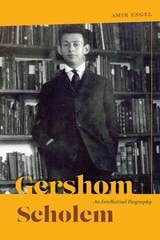
Gershom Scholem
An Intellectual BiographyAmir Engel
University of Chicago Press, 2017
As Engel shows, in his search for the truth of Jewish mysticism Scholem molded the vast literature of Jewish mystical lore into a rich assortment of stories that unveiled new truths about the modern condition. Positioning Scholem’s work and life within early twentieth-century Germany, Palestine, and later the state of Israel, Engel intertwines Scholem’s biography with his historiographical work, which stretches back to the Spanish expulsion of Jews in 1492, through the lives of Rabbi Isaac Luria and Sabbatai Zevi, and up to Hasidism and the dawn of the Zionist movement. Through parallel narratives, Engel touches on a wide array of important topics including immigration, exile, Zionism, World War One, and the creation of the state of Israel, ultimately telling the story of the realizations—and failures—of a dream for a modern Jewish existence.
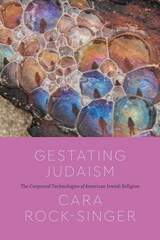
Gestating Judaism
The Corporeal Technologies of American Jewish ReligionCara Rock-Singer
University of Chicago Press, 2026
An ethnography of how people use reproductive practices to transmit and reinvent American Judaism.
In Gestating Judaism, Cara Rock-Singer develops a new analytic technique called ethnodrashy (a combination of rabbinical midrash and sociological ethnography) to explore the centrality of reproductive bodies to the intellectual, political, and spiritual life of American Judaism. She considers how, in reproduction, religious practices like the mikveh combine with secular practices like fertility treatments in ways that challenge the popular idea that religion occupies a separate sphere of life from politics or science. In fact, Rock-Singer shows how Jewish feminists have leveraged the work of reproduction to intervene in important conversations about both politics and theology. Drawing together religious studies, gender studies, and science and technology studies, Gestating Judaism shows how Jewish tradition is transmitted and reinvented through the ongoing labor of reproduction.