598 books match the query 'Religious' and 15 start with g
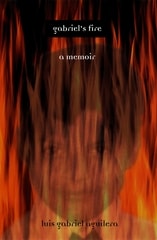
cover of Gabriel's Fire: A Memoir

Gabriel's Fire

A Memoir

Luis Gabriel Aguilera

University of Chicago Press, 2000

Like many boys, Luis Gabriel Aguilera grew up with cartoons, music, friends, and first loves. As he entered his teenage years, he faced the typical questions of adolescence—what kind of person did he want to be? how should he live his life? But for Aguilera, now in his twenties, these questions had a particular urgency. A Mexican immigrant, he came of age in a Polish neighborhood on the South Side of Chicago that was encroached upon by threats of gangs and drugs. He attended Catholic school and, at age thirteen, began an affair with one of the teachers at the local elementary school. All the while he documented his teenage years in a series of journals, which have now grown into Gabriel's Fire.

Aguilera's memoir is not just an account of race relations and street life in the inner city, nor of the plight of the immigrant and the dilemma of class identity for a "minority" family. Gabriel's Fire also movingly recounts the peculiarly daunting and inspiring moments of a particular age, riddled with confusion, desires, and duties and recorded by an exceptionally observant and articulate young man. Aguilera writes that he "grew into" the English language when he was eleven or twelve, and his recollections reflect his newfound delight with words—the conversations, arguments, taunts, song lyrics, and casual interchanges of his youth are rendered here with an immediacy and directness rare in contemporary memoirs.

Both a picture of American culture of the 1980s and 1990s and a coming-of-age story, Gabriel's Fire counters mainstream and mass-mediated images of the inner city, Hispanic culture, and troubled youth. In its honesty and energy, it is a poignant and compelling story of one man's formative years.
[more]
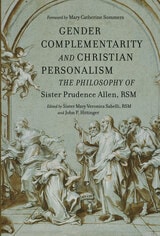
cover of Gender Complementarity and Christian Personalism: The Philosophy of Sister Prudence Allen, RSM

Gender Complementarity and Christian Personalism

The Philosophy of Sister Prudence Allen, RSM

Sister Mary Veronica Sabelli, RSM

Catholic University of America Press, 2025
When, in the 1970’s, Sister Prudence Allen, RSM began to investigate philosophical thought on woman, the question was considered to be, at best, a marginal area for philosophical research. Rather, it was seen as a sociological, anthropological, psychological, or political issue. This book confirms that today, partly due to Allen’s groundbreaking work, the complementarity of man and woman is an important and fruitful area of research in philosophy providing an evaluative framework that enriches and challenges many other disciplines. No one could have foreseen the centrality of her research for questions of gender theory that are, in the third decade of the 21st century, in the forefront of public attention. In the present volume, leading authors in the area of sex/gender complementarity reflect upon and further develop various aspects of Allen’s research. In 16 original, scholarly essays, some contributors build upon Allen’s project of exploring “the concept of woman” throughout the history of philosophy. Others explore the work of 20th century philosophers, most of them Christian Personalists, whom Allen credits with significant influence on the development of integral gender complementarity, such as Karol Wojtyła/ John Paul II, Jacques Maritain, Edith Stein, Emmanuel Mounier, W. Norris Clarke, SJ, and Bernard Lonergan, SJ. Still other contributors consider Marian spirituality, analogies between Benedictine spirituality and the physiological realities of a woman’s body during pregnancy, seminary education in the writings of Allen and others, and the impact of Allen’s work on the real lives of women in families, the Church, and professional life. Upon completing her magisterial, three-volume work, The Concept of Woman, Allen passed the baton to a new generation of scholars, stating, “The next phases will be developed by those who themselves take the argument further and deeper in their own research, writing, living, and lecturing.” The present volume takes up the baton, carrying Allen’s work forward and paying tribute to the lifetime achievement of a great scholar.
[more]
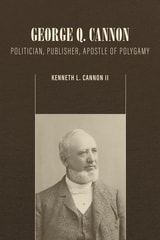
cover of George Q. Cannon: Politician, Publisher, Apostle of Polygamy

George Q. Cannon

Politician, Publisher, Apostle of Polygamy

Kenneth L. Cannon II

Signature Books, 2023
George Q. Cannon is generally acknowledged as second only to Brigham Young as the most visible leader of Mormonism in the mid- to late-nineteenth century. He became Young’s protégé and was an influential first counselor in the First Presidency of the Church of Jesus Christ of Latter-day Saints for almost twenty-five years, serving with presidents Brigham Young, John Taylor, Wilford Woodruff, and Lorenzo Snow. Known as the “spokesman for the kingdom,” Cannon was the central political figure of the church, not only serving as Utah territory’s delegate to Congress for ten years but also as chief political advisor and long-term editor of the Deseret News. Cannon helped shape doctrine, church governance, and administration during a period of significant change, defending and promulgating plural marriage both before and after the 1890 Manifesto. He was at the center of business life in Salt Lake City, serving as president of the largest publishing house, banks, a railroad, mining companies, electric companies, and other businesses. Though Cannon was loved and revered by his people, controversy sometimes touched his life and family. 
[more]
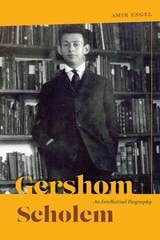
cover of Gershom Scholem: An Intellectual Biography

Gershom Scholem

An Intellectual Biography

Amir Engel

University of Chicago Press, 2017

Gershom Scholem (1897–1982) was ostensibly a scholar of Jewish mysticism, yet he occupies a powerful role in today’s intellectual imagination, having influential contact with an extraordinary cast of thinkers, including Hans Jonas, Martin Buber, Walter Benjamin, Hannah Arendt, and Theodor Adorno. In this first biography of Scholem, Amir Engel shows how Scholem grew from a scholar of an esoteric discipline to a thinker wrestling with problems that reach to the very foundations of the modern human experience.
           
As Engel shows, in his search for the truth of Jewish mysticism Scholem molded the vast literature of Jewish mystical lore into a rich assortment of stories that unveiled new truths about the modern condition. Positioning Scholem’s work and life within early twentieth-century Germany, Palestine, and later the state of Israel, Engel intertwines Scholem’s biography with his historiographical work, which stretches back to the Spanish expulsion of Jews in 1492, through the lives of Rabbi Isaac Luria and Sabbatai Zevi, and up to Hasidism and the dawn of the Zionist movement. Through parallel narratives, Engel touches on a wide array of important topics including immigration, exile, Zionism, World War One, and the creation of the state of Israel, ultimately telling the story of the realizations—and failures—of a dream for a modern Jewish existence.
 
[more]
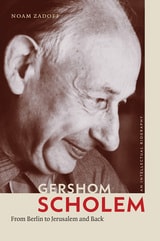
cover of Gershom Scholem: From Berlin to Jerusalem and Back

Gershom Scholem

From Berlin to Jerusalem and Back

Noam Zadoff

Brandeis University Press, 2017
German-born Gerhard (Gershom) Scholem (1897–1982), the preeminent scholar of Jewish mysticism, delved into the historical analysis of kabbalistic literature from late antiquity to the twentieth century. His writings traverse Jewish historiography, Zionism, the phenomenology of mystical religion, and the spiritual and political condition of contemporary Judaism and Jewish civilization. Scholem famously recounted rejecting his parents’ assimilationist liberalism in favor of Zionism and immigrating to Palestine in 1923, where he became a central figure in the German Jewish immigrant community that dominated the nation’s intellectual landscape in Mandatory Palestine. Despite Scholem’s public renunciation of Germany for Israel, Zadoff explores how the life and work of Scholem reflect ambivalence toward Zionism and his German origins.
[more]
cover of Give Them Stones

Give Them Stones

Mary Beckett

Catholic University of America Press, 2024
Give Them Stones follows Martha Murtagh’s life in Belfast during the Troubles. A working-class Catholic wife and mother, Martha struggles to find work and safe shelter for her children amid growing civil strife. Having renounced an education in order to financially support her family and living in one of the most precarious parts of the city, Martha discovers her passion for home-baking. Her bread provides sustenance and community for her neighbors, and for Martha herself it brings economic independence and spiritual communion. Mary Beckett’s novel is a skillfully written, moving narrative of one woman’s coming of age amid violence. It won the Sunday Tribune Arts Award in 1987 then fell out of print by the end of the century, while male writers of the Troubles rose to prominence. This restored edition brings Give Them Stones to a new readership, for whom Martha’s struggle for financial and personal independence remains an acutely relevant meditation on the burdens carried by women during war and the redemptive power of simple things.
[more]
cover of God Being Nothing: Toward a Theogony

God Being Nothing

Toward a Theogony

Ray L. Hart

University of Chicago Press, 2016

In this long-awaited work, Ray L. Hart offers a radical speculative theology that profoundly challenges classical understandings of the divine. God Being Nothing contests the conclusions of numerous orthodoxies through a probing question: How can thinking of God reach closure when the subjects of creation are themselves unfinished, when God’s self-revelation in history is ongoing, when the active manifestation of God is still occurring?

Drawing on a lifetime of reading in philosophy and religious thought, Hart unfolds a vision of God perpetually in process: an unfinished God being self-created from nothingness. Breaking away from the traditional focus on divine persons, Hart reimagines the Trinity in terms of theogony, cosmogony, and anthropogony in order to reveal an ever-emerging Godhead who encompasses all of temporal creation and, within it, human existence. The book’s ultimate implication is that Being and Nonbeing mutually participate in an ongoing process of divine coming-to-birth and dying that implicates all things, existent and nonexistent, temporal and eternal. God’s continual generation from nothing manifests the full actualization of freedom: the freedom to create ex nihilo.
[more]
cover of God Owes Us Nothing: A Brief Remark on Pascal's Religion and on the Spirit of Jansenism

God Owes Us Nothing

A Brief Remark on Pascal's Religion and on the Spirit of Jansenism

Leszek Kolakowski

University of Chicago Press, 1995

God Owes Us Nothing reflects on the centuries-long debate in Christianity: how do we reconcile the existence of evil in the world with the goodness of an omnipotent God, and how does God's omnipotence relate to people's responsibility for their own salvation or damnation. Leszek Kolakowski approaches this paradox as both an exercise in theology and in revisionist Christian history based on philosophical analysis. Kolakowski's unorthodox interpretation of the history of modern Christianity provokes renewed discussion about the historical, intellectual, and cultural omnipotence of neo-Augustinianism.

"Several books a year wrestle with that hoary conundrum, but few so dazzlingly as the Polish philosopher's latest."—Carlin Romano, Washington Post Book World

"Kolakowski's fascinating book and its debatable thesis raise intriguing historical and theological questions well worth pursuing."—Stephen J. Duffy, Theological Studies

"Kolakowski's elegant meditation is a masterpiece of cultural and religious criticism."—Henry Carrigan, Cleveland Plain Dealer
[more]
cover of God Without Being: Hors-Texte, Second Edition

God Without Being

Hors-Texte, Second Edition

Jean-Luc Marion

University of Chicago Press, 2012

 Jean-Luc Marion is one of the world’s foremost philosophers of religion as well as one of the leading Catholic thinkers of modern times. In God Without Being, Marion challenges a fundamental premise of traditional philosophy, theology, and metaphysics: that God, before all else, must be. Taking a characteristically postmodern stance and engaging in passionate dialogue with Heidegger, he locates a “God without Being” in the realm of agape, or Christian charity and love. If God is love, Marion contends, then God loves before he actually is.
First translated into English in 1991, God Without Being continues to be a key book for discussions of the nature of God. This second edition contains a new preface by Marion as well as his 2003 essay on Thomas Aquinas. Offering a controversial, contemporary perspective, God Without Being will remain essential reading for scholars and students of philosophy and religion.
 
“Daring and profound. . . . In matters most central to his thesis, [Marion]’s control is admirable, and his attunement to the nuances of other major postmodern thinkers is impressive.”—Theological Studies
 
“A truly remarkable work.”—First Things
 
“Very rewarding reading.”—Religious Studies Review
[more]
cover of God in the Machine: Video Games as Spiritual Pursuit

God in the Machine

Video Games as Spiritual Pursuit

Liel Leibovitz

Templeton Press, 2014

What might Heidegger say about Halo, the popular video game franchise, if he were alive today? What would Augustine think about Assassin’s Creed? What could Maimonides teach us about Nintendo’s eponymous hero, Mario? While some critics might dismiss such inquiries outright, protesting that these great thinkers would never concern themselves with a medium so crude and mindless as video games, it is impor­tant to recognize that games like these are becoming the defining medium of our time. We spend more time and money on video games than on books, television, or film, and any serious thinker of our age should be concerned with these games, what they are saying about us, and what we are learning from them.

Yet video games remain relatively unexplored by both scholars and pundits alike. Few have advanced beyond out­moded and futile attempts to tie gameplay to violent behavior. With this rumor now thoroughly and repeatedly disproven, it is time to delve deeper. Just as the Museum of Modern Art in Manhattan recently acquired fourteen games as part of its permanent collection, so too must we seek to add a serious consideration of virtual worlds to the pantheon of philosophical inquiry.

In God in the Machine, author Liel Leibovitz leads a fas­cinating tour of the emerging virtual landscape and its many dazzling vistas from which we are offered new vantage points on age-old theological and philosophical questions. Free will vs. determinism, the importance of ritual, transcendence through mastery, notions of the self, justice and sin, life, death, and resurrection all come into play in the video games that some critics so quickly write off as mind-numbing wastes of time. When one looks closely at how these games are designed, their inherent logic, and their cognitive effects on players, it becomes clear that playing these games creates a state of awareness vastly different from when we watch television or read a book. Indeed, the gameplay is a far more dynamic process that draws on various faculties of mind and body to evoke sensa­tions that might more commonly be associated with religious experience. Getting swept away in an engaging game can be a profoundly spiritual activity. It is not to think, but rather to be, a logic that sustained our ancestors for millennia as they looked heavenward for answers.

As more and more of us look “screenward,” it is crucial to investigate these games for their vast potential as fine instruments of moral training. Anyone seeking a concise and well-reasoned introduction to the subject would do well to start with God in the Machine. By illuminating both where video game storytelling is now and where it currently butts up against certain inherent limitations, Liebovitz intriguingly implies how the field and, in turn, our experiences might continue to evolve and advance in the coming years.
[more]
cover of God of River Mud: A Novel

God of River Mud

A Novel

Vic Sizemore

West Virginia University Press, 2024

Winner, 2025 Tennessee Book Award, Fiction

Grappling with innate desires and LGBTQ identity, a family struggles under the oppressive expectations foisted on them by fundamentalist Christianity.


Told through alternating perspectives, God of River Mud chronicles the lives of Berna Minor, her husband, their four children, and Berna’s secret lover.

To escape a life of poverty and abuse, Berna Cannaday marries Zechariah Minor, a fundamentalist Baptist preacher, and commits herself to his faith, trying to make it her own. After Zechariah takes a church beside the Elk River in rural Clay, West Virginia, Berna falls in love with someone from their congregation—Jordan, a woman who has known since childhood that he was meant to be a man. Berna keeps her secret hidden as she struggles to be the wife and mother she believes God wants her to be. Berna and Zechariah’s children struggle as well, trying to reconcile the theology they are taught at home with the fast-changing world around them. And Jordan struggles to find a community and a life that allow him both to be safely and fully himself, as Jay, and to be loved for who he is.

As the decades and stories unfold, traditional evangelical Bible culture and the values of rural Appalachia clash against innate desires, LGBTQ identity, and gender orientation. Sympathies develop—sometimes unexpectedly—as the characters begin to reconcile their faith and their love. God of River Mud delves into the quandary of those marginalized and dehumanized within a religious patriarchy and grapples with the universal issues of identity, faith, love, and belonging.
[more]
cover of God's Knowledge of the World: Medieval Theories of Divine Ideas from Bonaventure to Ockham

God's Knowledge of the World

Medieval Theories of Divine Ideas from Bonaventure to Ockham

Carl A. Vater

Catholic University of America Press, 2022

A theory of divine ideas was the standard Scholastic response to the question how does God know and produce the world? A theory was deemed to be successful only if it simultaneously upheld that God has perfect knowledge and that he is supremely simple and one. In articulating a theory of divine ideas, Carl Vater answers two sorts of questions. First, what is an idea? Does God have ideas? Are there many divine ideas? What sort of existence does an idea enjoy? Second, he answers questions about the scope of divine ideas: does God have ideas of individuals, species, genera, accidents, matter, evil, etc.? How many divine ideas are there? These questions cause the Scholastic authors to articulate clearly, among other things, their positions on the nature of knowledge, relation, exemplar causality, participation, infinity, and possibility. An author’s theory of divine ideas, then, is the locus for him to test the coherence of his metaphysical, epistemological, and logical principles. Many of the debates over divine ideas have their roots in disagreements over whether a given theory adequately articulates one of the underlying positions or the overall coherence of those positions. Peter John Olivi, for example, argues that his predecessors’ theories of knowledge and theories of relations are at odds, and this critique results in a major shift in theories of divine ideas. God's Knowledge of the World examines theories of divine ideas from approximately 1250–1325 AD (St. Bonaventure through Ockham). It will be the only work dedicated to categorizing and comparing the major theories of divine ideas in the Scholastic period.
[more]
cover of Goodbye, My Tribe: An Evangelical Exodus

Goodbye, My Tribe

An Evangelical Exodus

Vic Sizemore

University of Alabama Press, 2020

Goodbye, My Tribe: An Evangelical Exodus is Vic Sizemore’s collection of personal essays chronicling two simultaneous transformations. One is the gathering of unconnected—and nonpolitical—evangelical congregations across the nation into the political juggernaut called the Religious Right; the other is the author’s own coming to terms with the emotional and spiritual trauma of his life deep inside fundamentalist Christianity, and his struggle to free himself from its grasp. Sizemore, whose father was a preacher and professor at a small West Virginia Bible college, attended Liberty University in Lynchburg, Virginia, arguably the crucible of American evangelical Christianity.
 
Sizemore began writing these essays with the aim of exploring and understanding what happened when the mythology of his “tribe” crumbled from beneath his feet. He draws heavily on his upbringing and his family history as a framework for how his “tribe” of white evangelicals have found ways to reconcile Christianity with what the author finds to be troubling stances on many social issues, among them race, gender, sexuality, materialism, anti-intellectualism, and white supremacy.
 
In a clear-eyed and eloquent voice, Sizemore grapples movingly with his own bewilderment and chagrin as he struggles to reconcile the essential philosophical and moral decay that he believes many evangelicals have come to embrace. His insights, arranged topically and thematically and told through graceful and accessible prose, toggle between memoir and literary journalism, along a spectrum that touches on history, philosophy, theology, and personal reflections.

.
[more]
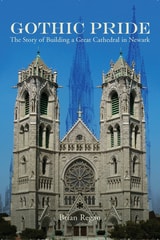
cover of Gothic Pride: The Story of Building a Great Cathedral in Newark

Gothic Pride

The Story of Building a Great Cathedral in Newark

Regan, Brian

Rutgers University Press, 2012

Newark’s Cathedral Basilica of the Sacred Heart is one of the United States’ greatest cathedrals and most exceptional Gothic Revival buildings. Rising from Newark’s highest ground and visible for miles, it spectacularly evokes its historic models. Gothic Pride sets Sacred Heart in the context of American cathedral building and, blending diverse fields, accounts for the complex circumstances that produced it.

 Calling upon a wealth of primary sources, Brian Regan describes in a compelling narrative the cathedral’s almost century-long history. He traces the project to its origins in the late 1850s and the great expectations held by the project’s prime movers—all passionate about Gothic architecture and immensely proud of Newark—that never wavered despite numerous setbacks and challenges. Construction did not begin until 1898 and, when completed in 1954, the cathedral became New Jersey’s largest church—and the most expensive Catholic church ever built in America. During Pope John Paul II’s visit to the United States in 1995, he celebrated evening prayer at the Cathedral. On that occasion, the Cathedral of the Sacred Heart was elevated to a basilica to become the Cathedral Basilica of the Sacred Heart.

 Meticulously researched, Gothic Pride brings to life the people who built, contributed to, and worshipped in Sacred Heart, recalling such remarkable personalities as George Hobart Doane, Jeremiah O’Rourke, Gonippo Raggi, and Archbishop Thomas Walsh. In many ways, the cathedral’s story is a lens that lets us look at the history of Newark itself—its rise as an industrial city and its urban culture in the nineteenth century; its transformation in the twentieth century; its immigrants and the profound effects of their cultures, especially their religion, on American life; and the power of architecture to serve as a symbol of community values and pride..
[more]
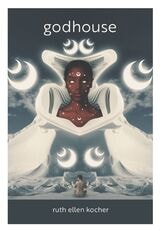
cover of godhouse

godhouse

Ruth Ellen Kocher

Omnidawn, 2023

Poems that consider the human body as a meeting place of the infinite and the mortal.
 
Starting with the idea that the human experience is the universe looking back at itself, godhouse takes the notion a few steps further by centering cosmology within a raced and gendered body. Ruth Ellen Kocher’s poems envision this body as a union of god and soul that, within our material world, encompasses love and hate, joy and despair. The body is a site of divine presence made mortal, electrified with the resonance of both the infinite and the human. In godhouse, we encounter the body as a site where the universe is made personal and celebratory, where the celestial endure the complications of flesh and friction forms between the glorious and the monstrous aspects of personhood.
 
[more]