Results by title
231 books match the query 'Revolutionary Period (1775-1800)' and 10 start with g
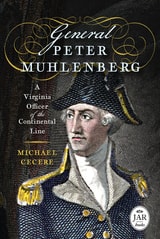
General Peter Muhlenberg
A Virginia Officer of the Continental LineMichael Cecere
Westholme Publishing, 2020
Standing at the pulpit in his church in the Shenandoah Valley, the preacher borrowed from Ecclesiastes, declaring in a firm voice that “To every thing there is a season . . . .” He then announced, “that there is a time to fight, and that time had now come,” and abruptly removed his clerical robe to reveal his colonel’s uniform. There is little doubt that this clergyman-turned-soldier uttered words to this effect, but whether he threw off his robe to reveal a gleaming uniform may be embellishment. In General Peter Muhlenberg: A Virginia Officer of the Continental Line, historian Michael Cecere cuts away the romanticism surrounding this fascinating character to present him as a highly capable and dedicated officer who served for seven long years in America’s War for Independence; a man of faith who held the high ideals of that office in his conduct with fellow officers and regular soldiers alike.
First appointed to lead the 8th Virginia Regiment of the Continental Army, Muhlenberg and his troops served under General Charles Lee in the defense of Charleston in 1776. Sent north and promoted to brigadier-general, Muhlenberg participated in the ensuing battles of Brandywine, Germantown, the winter at Valley Forge, and the major clash at Monmouth Courthouse. In 1780, he returned to Virginia and stood at the forefront of Virginia’s defense when the British invaded in 1781. At Yorktown, Muhlenberg commanded the continental light infantry troops that stormed Redoubt No. 10, sealing Cornwallis’s fate. Focusing on the military career of Muhlenberg, and relying on a judicious amount of primary source material, the author follows Muhlenberg and his troops as they battled some of the most storied adversaries of the war, including John Graves Simcoe’s Queen’s Rangers, Captain Johann Ewald’s German Jaegers, and Banastre Tarleton’s British Legion.
Admired by George Washington and his fellow officers and men, Muhlenberg was an American patriot who sacrificed much for his country’s cause, and truly “lived respected and died regretted by all good men.”
General Thomas Posey
Son of the American RevolutionJohn Thornton Posey
Michigan State University Press, 1992
Revolutionary War general Thomas Posey (1750-1818) lived his life against the backdrop of one of the most dramatic periods in American history. Posey, who played a minor role in the actual War for Independence, went on to participate in the development and foundation of several states in the transappalachian West. His experiences on the late 18th- and early 19th-century American frontier were varied and in a certain sense extraordinary; he served as Indian agent in Illinois Territory; as Lieutenant Governor of Kentucky, as U.S. Senator from Louisiana, and as Governor of Indiana during its transition from territorial status to statehood.
His biographer speculates on the contrasting influences of Thomas's ne'er-do-well father, Captain John Posey, and the family's close friend, General George Washington. Posey's progress is then followed as he raises his own family in the newly formed nation. Of particular interest is an appendix containing a detailed analysis of evidence available to support popular 29th-century speculation that Thomas Posey was, in fact, George Washington's illicit son.
George Washington and Slavery
A Documentary PortrayalFritz Hirschfeld
University of Missouri Press, 1997
"I never mean (unless some particular circumstance should compel me to it) to possess another slave by purchase; it being among my first wishes to see some plan adopted, by which slavery in this country may be abolished by slow, sure and imperceptible degrees."—George Washington, September 9, 1786
No history of racism in America can be considered complete without taking into account the role that George Washington—the principal founding father—played in helping to mold the racist cast of the new nation. Because General Washington—the universally acknowledged hero of the Revolutionary War—in the postwar period uniquely combined the moral authority, personal prestige, and political power to influence significantly the course and the outcome of the slavery debate, his opinions on the subject of slaves and slavery are of crucial importance to understanding how racism succeeded in becoming an integral and official part of the national fabric during its formative stages.The successful end of the War for Independence in 1783 brought George Washington face-to-face with a fundamental dilemma: how to reconcile the proclaimed ideals of the revolution with the established institution of slavery. So long as black human beings in America could legally be considered the chattel property of whites, the rhetoric of equality and individual freedom was hollow. Progressive voices urged immediate emancipation as the only way to resolve the contradiction; the Southern slave owners, of course, stood firm for the status quo. Washington was caught squarely in the middle.
As a Virginia plantation proprietor and a lifelong slaveholder, Washington had a substantial private stake in the economic slave system of the South. However, in his role as the acknowledged political leader of the country, his overriding concern was the preservation of the Union. If Washington publicly supported emancipation, he would almost certainly have to set an example and take steps to dispose of his Mount Vernon slaves. If he spoke out on the side of slavery, how could he legitimately and conscientiously expect to uphold and defend the humanistic goals and moral imperatives of the new nation as expressed in the Declaration of Independence and embodied in the Constitution and the Bill of Rights? His was a balancing act that became more and more difficult to sustain with the passing years.
Relying primarily on Washington's own words—his correspondence, diaries, and other written records—supplemented by letters, comments, and eyewitness reports of family members, friends, employees, aides, correspondents, colleagues, and visitors to Mount Vernon, together with contemporary newspaper clippings and official documents pertaining to Washington's relationships with African Americans, Fritz Hirschfeld traces Washington's transition from a conventional slaveholder to a lukewarm abolitionist. George Washington and Slavery will be an essential addition to the historiography of eighteenth-century America and of Washington himself.
George Washington's Enforcers
Policing the Continental ArmyHarry M. Ward
Southern Illinois University Press, 2006
A well-disciplined army was vital to win American independence, but policing soldiers during the Revolution presented challenges. George Washington’s Enforcers: Policing the Continental Army examines how justice was left to the overlapping duties of special army personnel and how an improvised police force imposed rules and regulations on the common soldier. Historian Harry M. Ward describes these methods of police enforcement, emphasizing the brutality experienced by the enlisted men who were punished severely for even light transgressions. This volume explores the influences that shaped army practice and the quality of the soldiery, the enforcement of military justice, the use of guards as military police, and the application of punishment.
Washington’s army, which adopted the organization and justice code of the British army, labored under the direction of ill-trained and arrogant officers. Ward relates how the enlisted men, who had a propensity for troublemaking and desertion, not only were victims of the double standard that existed between officers and regular troops but also lacked legal protection in the army. The enforcement of military justice afforded the accused with little due process support.
Ward discusses the duties of the various personnel responsible for training and enforcing the standards of behavior, including duty officers, adjutants, brigade majors, inspectors, and sergeant majors. He includes the roles of life guards, camp guards, quarter guards, picket men, and safe guards, whose responsibilities ranged from escorting the commander in chief, intercepting spies and stragglers, and protecting farmers from marauding soldiers to searching for deserters, rounding up unauthorized personnel, and looking for delinquents in local towns and taverns.
George Washington’s Enforcers, which includes sixteen illustrations, also addresses the executions of the period, as both ritual and spectacle, and the deterrent value of capital punishment. Ward explains how Washington himself mixed clemency with severity and examines how army policies tested the mettle of this chief disciplinarian, who operated by the dictates of military necessity as perceived at the time.
George Washington's Momentous Year
Twelve Months that Transformed the Revolution, Vol. I: The Philadelphia Campaign, July to December 1777Gary Ecelbarger
Westholme Publishing, 2027
WINNER OF THE 2025 FRAUNCES TAVERN MUSEUM BOOK AWARD
On July 4, 1777, George Washington was so consumed with where the British would strike that he ignored the nation’s first birthday. One year later, Washington created an independence celebration so spectacular that soldiers proudly recalled it in their old age. As historian Gary Ecelbarger explains in George Washington’s Momentous Year: Twelve Months that Transformed the Revolution, it was between these two antithetical anniversaries where the fight for independence under Washington’s leadership changed from a precarious regional struggle to a global conflict. In August 1777, the British landed at Head of Elk, Maryland, and defeated the Continentals at Brandywine, White Horse Tavern, and Paoli, before occupying Philadelphia. Over the next several months, the forces clashed at Germantown, Red Bank, and White Marsh, and in December, Washington and his troops fell back to Valley Forge. Despite the immediacy of the Philadelphia campaign, Washington remained in charge of the entire Continental effort, and welcomed the American victory at Saratoga that secured an alliance with France. In the new year, British forces were ordered back to New York, and as they set out across New Jersey, a newly invigorated American army engaged them at Monmouth Courthouse. This was Washington’s final time leading troops in battle and ended with his Continentals masters of the field.
George Washington's Momentous Year
Twelve Months that Transformed the Revolution—Vol. 2: Valley Forge to Monmouth, January to July 1778Gary Ecelbarger
Westholme Publishing, 2025
This engrossing history of the most significant twelve months of the American Revolution enables the reader to understand and appreciate the astounding accomplishment of George Washington and his military aides: the simultaneous emergence of a new, capable army and a strategy that would win the War for Independence.
George Washington
A Man of ActionJohn P. Kaminski
Wisconsin Historical Society Press, 2017
George William Featherstonhaugh
The First U.S. Government GeologistEdmund Berkeley and Dororthy Berkeley
University of Alabama Press, 1988
—Choice
"For anyone interested in the history of American geology, knowledge of G. W. Featherstonhaugh (1780-1866) is both essential and hard to obtain. He was the force behind the first railroad in America; a pioneer in scientific agriculture; an essayist, poet, and novelist; a lobbyist; a linguist; and a daring diplomat who saved the king and queen of France from certain death. [Yet] his strongest tie was with the geology. [This] biography is interesting, well researched and well written. It is a balanced study of a complex man who did so much work and generated such controversy."
—Earth Sciences History
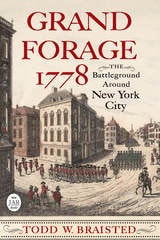
Grand Forage 1778
The Battleground Around New York CityTodd W. Braisted
Westholme Publishing, 2016
After two years of defeats and reverses, 1778 had been a year of success for George Washington and the Continental Army. France had entered the war as the ally of the United States, the British had evacuated Philadelphia, and the redcoats had been fought to a standstill at the Battle of Monmouth. While the combined French-American effort to capture Newport was unsuccessful, it lead to intelligence from British-held New York that indicated a massive troop movement was imminent. British officers were selling their horses and laying in supplies for their men. Scores of empty naval transports were arriving in the city. British commissioners from London were offering peace, granting a redress of every grievance expressed in 1775. Spies repeatedly reported conversations of officers talking of leaving. To George Washington, and many others, it appeared the British would evacuate New York City, and the Revolutionary War might be nearing a successful conclusion. Then, on September 23, 1778, six thousand British troops erupted into neighboring Bergen County, New Jersey, followed the next day by three thousand others surging northward into Westchester County, New York. Washington now faced a British Army stronger than Burgoyne’s at Saratoga the previous year. What, in the face of all intelligence to the contrary, had changed with the British?
Through period letters, reports, newspapers, journals, pension applications, and other manuscripts from archives in the United States, Canada, United Kingdom, and Germany, the complete picture of Britain’s last great push around New York City can now be told. The strategic situation of Britain’s tenuous hold in America is intermixed with the tactical views of the soldiers in the field and the local inhabitants, who only saw events through their narrow vantage points. This is the first publication to properly narrate the events of this period as one campaign. Grand Forage 1778: The Battleground Around New York City by historian Todd W. Braisted explores the battles, skirmishes, and maneuvers that left George Washington and Sir Henry Clinton playing a deadly game of chess in the lower Hudson Valley as a prelude to the British invasion of the Southern colonies.
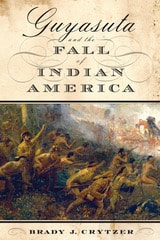
Guyasuta and the Fall of Indian America
Brady J. Crytzer
Westholme Publishing, 2013
Nearly a century before the United States declared the end of the Indian Wars, the fate of Native Americans was revealed in the battle of Fallen Timbers. In 1794, General Anthony Wayne led the first American army— the Legion of the United States—against a unified Indian force in the Ohio country. The Indians were routed and forced to vacate their lands. It was the last of a series of Indian attempts in the East to retain their sovereignty and foreshadowed what would occur across the rest of the continent. In Guyasuta and the Fall of Indian America, historian Brady J. Crytzer traces how American Indians were affected by the wars leading to American Independence through the life of one of the period’s most influential figures. Born in 1724, Guyasuta is perfectly positioned to understand the emerging political landscape of America in the tumultuous eighteenth century. As a sachem of the vaunted Iroquois Confederacy, for nearly fifty years Guyasuta dedicated his life to the preservation and survival of Indian order in a rapidly changing world, whether it was on the battlefield, in the face of powerful imperial armies, or around a campfire negotiating with his French, British, and American counterparts. Guyasuta was present at many significant events in the century, including George Washington’s expedition to Fort Le Boeuf, the Braddock disaster of 1755, Pontiac’s Rebellion and the Battle of Bushy Run in 1763, and the Battle of Oriskany during the American Revolution. Guyasuta’s involvement in the French and British wars and the American War for Independence were all motivated by a desire to retain relevance for Indian society. It was only upon the birth of the United States of America that Guyasuta finally laid his rifle down and watched as his Indian world crumbled beneath his feet. A broken man, debilitated by alcoholism, he died near Pittsburgh in 1794.
Supported by extensive research and full of compelling drama, Guyasuta and the Fall of Indian America unravels the tangled web of alliances, both white and native, and explains how the world of the American Indians could not survive alongside the emergent United States.