Results by title
131 books match the query 'Sex role in literature' and 7 start with g
Games of Property
Law, Race, Gender, and Faulkner's Go Down, MosesThadious M. Davis
Duke University Press, 2003
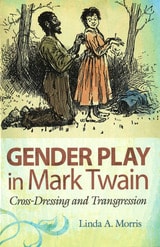
Gender Play in Mark Twain
Cross-Dressing and TransgressionLinda A. Morris
University of Missouri Press, 2007
Huckleberry Finn dressing as a girl is a famously comic scene in Mark Twain’s novel but hardly out of character—for the author, that is. Twain “troubled gender” in much of his otherwise traditional fiction, depicting children whose sexual identities are switched at birth, tomboys, same-sex married couples, and even a male French painter who impersonates his own fictive sister and becomes engaged to another man.
This book explores Mark Twain’s extensive use of cross-dressing across his career by exposing the substantial cast of characters who masqueraded as members of the opposite sex or who otherwise defied gender expectations. Linda Morris grounds her study in an understanding of the era’s theatrical cross-dressing and changing mores and even events in the Clemens household. She examines and interprets Twain’s exploration of characters who transgress gendered conventions while tracing the degree to which themes of gender disruption interact with other themes, such as his critique of race, his concern with death in his classic “boys’ books,” and his career-long preoccupation with twins and twinning.
Approaching familiar texts in surprising new ways, Morris reexamines the relationship between Huck and Jim; discusses racial and gender crossing in Pudd’nhead Wilson; and sheds new light on Twain’s difficulty in depicting the most famous cross-dresser in history, Joan of Arc. She also considers a number of his later “transvestite tales” that feature transgressive figures such as Hellfire Hotchkiss, who is hampered by her “misplaced sex.”
Morris challenges views of Twain that see his work as reinforcing traditional notions of gender along sharply divided lines. She shows that Twain depicts cross-dressing sometimes as comic or absurd, other times as darkly tragic—but that even at his most playful, he contests traditional Victorian notions about the fixity of gender roles.
Analyzing such characteristics of Twain’s fiction as his fascination with details of clothing and the ever-present element of play, Morris shows us his understanding that gender, like race, is a social construction—and above all a performance. Gender Play in Mark Twain: Cross-Dressing and Transgression broadens our understanding of the writer as it lends rich insight into his works.
Gender and Heroism in Early Modern English Literature
Mary Beth Rose
University of Chicago Press, 2001
Interweaving discourses of gender, Rose explores ways in which this heroics of endurance became the dominant model. She examines the glamorous, failed destinies of heroes in plays by Shakespeare, Jonson, and Marlowe; Elizabeth I's creation of a heroic identity in her public speeches; the autobiographies of four ordinary women thrust into the public sphere by civil war; and the seduction of heroes into slavery in works by Milton, Aphra Behn, and Mary Astell. Ultimately, her study demonstrates the importance of the female in the creation of modern heroism, while offering a critique of both idealized action and suffering.
Gender and Nation in the Spanish Modernist Novel
Roberta Johnson
Vanderbilt University Press, 2003
The book begins by tracing the history of public discourse on gender from the 1890s through the 1930s, a discourse that included the rise of feminism. Each chapter then analyzes works by female and male novelists that address key issues related to gender and nationalism: the concept of intrahistoria, or an essential Spanish soul; modernist uses of figures from the Spanish literary tradition, notably Don Quixote and Don Juan; biological theories of gender prevalent in the 1920s and 1930s; and the growth of an organized feminist movement that coincided with the burgeoning Republican movement.
This is the first book dealing with this period of Spanish literature to consider women novelists, such as Maria Martinez Sierra, Carmen de Burgos, and Concha Espina, alongside canonical male novelists, including Miguel de Unamuno, Ramon del Valle-Inclan, and Pio Baroja. With its contrasting conceptions of modernism, Johnson's work provides a compelling new model for bridging the gender divide in the study of Spanish fiction.

Gender and the Gothic in the Fiction of Edith Wharton
Kathy A. Fedorko
University of Alabama Press, 1995
Revealing the Gothic foundations of Edith Wharton's vision of gender and identity.
Gender and the Gothic in the Fiction of Edith Wharton is an innovative study that provides fresh insights into Wharton’s male characters while at the same time showing how Wharton’s imagining of a fe/male self evolves throughout her career. Using feminist archetypal theory and theory of the female Gothic, Kathy A. Fedorko shows how Wharton, in sixteen short stories and six major novels written during four distinct periods of her life, adopts and adapts Gothic elements to explore the nature of feminine and masculine ways of knowing and being and to dramatize the tension between them.
Edith Wharton’s contradictory views of women and men—her attitudes toward the feminine and the masculine—reflect a complicated interweaving of family and social environment, historical time, and individual psychology. Studies of Wharton have exhibited this same kind of contradiction, with some seeing her as disparaging men and the masculine and others depicting her as disparaging women and the feminine. The use of Gothic elements in her fiction provided Wharton, who was often considered the consummate realist, with a way to dramatize the conflict between feminine and masculine selves as she experienced them and to evolve an alternative to the dualism.
Fedorko’s work is unique in its careful consideration of Wharton’s sixteen Gothic works, which are seldom discussed. Further, the revelation of how these Gothic stories are reflected in her major realistic novels. In the novels with Gothic texts, Wharton draws multiple parallels between male and female protagonists, indicating the commonalities between women and men and the potential for a female self. Eventually, in her last completed novel and her last short story, Wharton imagines human beings who are comfortable with both gender selves.
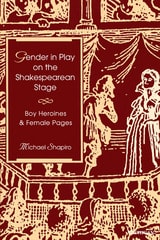
Gender in Play on the Shakespearean Stage
Boy Heroines and Female PagesMichael Shapiro
University of Michigan Press, 1996
Shapiro's study centers on the five plays in which Shakespeare employed the figure of the "female page": The Two Gentlemen of Verona, The Merchant of Venice, As You Like It, Twelfth Night, and Cymbeline. Combining theater and social history, Shapiro locates Shakespeare's work in relation to controversies over gender roles and cross-dressing in Elizabethan England.
The popularity of the "female page" is examined as a playful literary and theatrical way of confronting, avoiding, or merely exploiting issues such as the place of women in a patriarchal culture and the representation of women on stage. Looking beyond and behind the stage for the cultural anxieties that found their way into Shakespearean drama, Shapiro considers such cases as cross-dressing women in London being punished as prostitutes and the alleged homoerotic practices of the apprentices who played female roles in adult companies. Shapiro also traces other Elizabethan dramatists' varied uses of the cross-dressing motif, especially as they were influenced by Shakespeare's innovations.
"Shapiro's engaging study is distinguished by the scope of interrelated topics it draws together and the balance of critical perspectives it brings to bear on them." --Choice
Michael Shapiro is Professor of English, University of Illinois, Urbana.
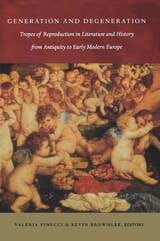
Generation and Degeneration
Tropes of Reproduction in Literature and History from Antiquity through Early Modern EuropeValeria Finucci and Kevin Brownlee, eds.
Duke University Press, 2001
The discourses on reproduction, biology, degeneration, legacy, and lineage that this book broaches not only bring to the forefront concepts of sexual identity and gender politics but also show how they were culturally constructed and reconstructed through the centuries by medicine, philosophy, the visual arts, law, religion, and literature. The contributors reflect on a wide range of topics—from what makes men “manly” to the identity of Christ’s father, from what kinds of erotic practices went on among women in sixteenth-century seraglios to how men’s hemorrhoids can be variously labeled. Essays scrutinize stories of menstruating males and early writings on the presumed inferiority of female bodily functions. Others investigate a psychomorphology of the clitoris that challenges Freud’s account of lesbianism as an infantile stage of sexual development and such topics as the geographical origins of medicine and the materialization of genealogy in the presence of Renaissance theatrical ghosts.
This collection will engage those in English, comparative, Italian, Spanish, and French studies, as well as in history, history of medicine, and ancient and early modern religious studies.
Contributors. Kevin Brownlee, Marina Scordilis Brownlee, Elizabeth Clark, Valeria Finucci, Dale Martin, Gianna Pomata, Maureen Quilligan, Nancy Siraisi, Peter Stallybrass,Valerie Traub