Results by title
1214 books match the query 'Subjects & Themes' and 27 start with g
Gagaan X'usyee/Below the Foot of the Sun
PoemsX'unei Lance Twitchell
University of Alaska Press, 2023
The collection is divided into four sections based on how the Lingít talk about g̱agaan—the sun. Featuring some poems in English, some in Lingít, and some that combine the beauty of the two, Gagaan Xʼusyee / Beneath the Foot of the Sun displays an equal dignity in both languages that transcends monolingual constrictions.
Gagaan X'usyee/Below the Foot of the Sun
PoemsX'unei Lance Twitchell
University of Alaska Press, 2023
The collection is divided into four sections based on how the Lingít talk about g̱agaan—the sun. Featuring some poems in English, some in Lingít, and some that combine the beauty of the two, Gagaan Xʼusyee / Beneath the Foot of the Sun displays an equal dignity in both languages that transcends monolingual constrictions.

Garden Theology
Seán Mac Falls
Tupelo Press, 2022
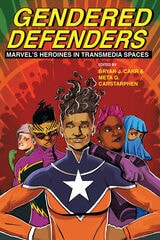
Gendered Defenders
Marvel's Heroines in Transmedia SpacesEdited by Bryan J. Carr and Meta G. Carstarphen
The Ohio State University Press, 2022
Gendered Defenders: Marvel’s Heroines in Transmedia Spaces delivers dynamic and original analyses of how women perform in super heroic spaces. Contributors from a range of disciplinary perspectives—communications, international relations, cultural and media studies, English, history, and public policy—take on Marvel’s representations of women and gender to examine how relations of power are (re)produced, understood, and challenged. Through vivid retellings of character-based scenarios, these essays examine Carol Danvers, Jessica Jones, Ms. Marvel, Shuri, Pepper Potts, Black Widow, and Squirrel Girl across media forms to characterize and critique contemporary understandings of identity, feminism, power, and gender. Collectively, Gendered Defenders challenges notions about female identity while illuminating the multidimensional portrayals that are enabled by the form of speculative fiction. Making explicit the connections between women’s lived experiences and the imagined exploits of superheroines, contributors explore how these pop culture narratives can help us understand real-world gender dynamics and prepare pedagogical, political, and social strategies for dealing with them. Contributors: Bryan J. Carr, Meta G. Carstarphen, Julie A. Davis, Rachel Grant, Annika Hagley, Amanda K. Kerhberg, Gregory P. Perreault, Mildred F. Perreault, CarrieLynn D. Reinhard, Maryanne A. Rhett, Stephanie L. Sanders, J. Richard Stevens, Anna C. Turner, Kathleen M. Turner-Ledgerwood, Robert Westerfelhaus
Gendering the Renaissance
Text and Context in Early Modern ItalyMeredith K. Ray
University of Delaware Press, 2023
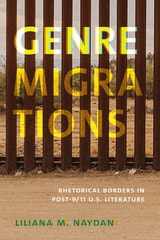
Genre Migrations
Rhetorical Borders in Post-9/11 U.S. LiteratureLiliana M. Naydan
University of Iowa Press, 2026
Genre Migrations argues that authors Jhumpa Lahiri, Valeria Luiselli, Ling Ma, Claudia Rankine, and Gary Shteyngart address immigration in both their content and innovative literary form. These authors highlight the relationship between immigrant identities and others, exposing borders—and genres—as porous and malleable constructs. Through their revisionist aesthetics and rhetorical engagements, these writers challenge the logic of globalization and xenophobia and condemn blind adherence to the limiting conventions of genres and life.
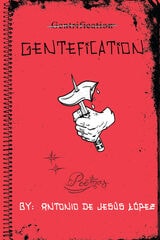
Gentefication
Antonio de Jesús López
Four Way Books, 2021
“Gentefication” nuances Latinidad as not just an immigration question, but an academic one. It deals with Latinx death not as the literal passing
of bodies, but as first tied with language. It asks, what are the hauntings of a tongue that is repeatedly told, ‘one must learn English in order to succeed in this country’? What is the psychological trauma deployed not by right-wing bigots, but of white liberal institutions that give scholarships to Latinx students, but nevertheless prop up white supremacy by viewing their payments as charity? How do Latinx students become complicit in this tokenizing? “Gentefication” wrestles with this ‘survivor’s guilt’ of higher education, of feeling as if you’re the only one among your homies that ‘made it.’ And in an American moment dealing with scandals across multiple universities this work is a timely intervention that advocates for first-generation audiences, for readers of color, and for all those vested in the protracted struggle for our fair shot.
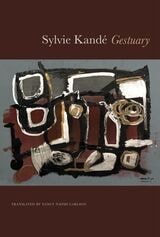
Gestuary
Sylvie Kandé
Seagull Books, 2026
Sylvie Kandé’s Gestuary offers a collection of gestures—of death and life, of tenderness and brutality—that fractures the flow of time. Senegalese riflemen from World War I are juxtaposed with migrants at borders who sew their lips shut in protest over immigration policies. In dream-like sequences, the dead refuse to stay underground and “push against the fence / that swings between our realm and theirs.” Inspired by unexpected sources, including jazz, sculpture, the legacy of the slave trade, proverbs, and elements of Diola culture, Kandé’s poems are rich in musicality and sophisticated syntax, rendered into a lyrical and luminous English by Nancy Naomi Carlson.
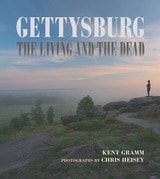
Gettysburg
The Living and the DeadKent Gramm. Photographs by Chris Heisey
Southern Illinois University Press, 2019
Creative nonfiction, fiction, dramatic dialogue, and poetry combine with full-color photographs to convey the essential reality of the famous battlefield as a place both terrible and beautiful. The living and the dead contained here include Confederates and Yankees, soldiers and civilians, male and female, young and old. Visitors to the battlefield after 1863, both well known and obscure, provide the voices of the living. They include a female admiral in the U.S. Navy and a man from rural Virginia who visits the battlefield as a way of working through the death of his son in Iraq. The ghostly voices of the dead include actual participants in the battle, like a fiery colonel and a girl in Confederate uniform, as well as their representatives, such as a grieving widow who has come to seek her husband.
Utilizing light as a central motif and fourscore and seven voices to evoke how Gettysburg continues to draw visitors and resound throughout history, alternately wounding and stitching the lives it touches, Gramm’s words and Heisey’s photographs meld for a historical experience unlike any other. Gettysburg: The Living and the Dead offers a panoramic view wherein the battle and battlefield of Gettysburg are seen through the eyes of those who lived through it and died on it as well as those who have sought meaning at the site ever since.
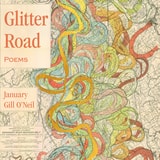
Glitter Road
January Gill O’Neil
CavanKerry Press, 2024
“My poems brought me to Oxford, Mississippi a.k.a. the velvet ditch: / a place you can fall into, get comfortable among confederate rebels,” writes January Gill O’Neil in her stunning new collection, Glitter Road. The poems in this book look back at the end of a marriage, a heartbreaking loss, and a new relationship against the backdrop of a Mississippi season. O’Neil reflects on the history and legacy of Emmett Till, how his story is intertwined with her own, and wades through the incredible grief she feels for herself, her children, and the Black children who won’t come home tonight. These poems reclaim the vulnerable, intimate parts of a life in transition and celebrate womanhood through awakenings, landscapes, meanders, and possibilities. She declares, with both self-love and conviction, “I am done telling the kinder story. I am a myth of my own making.”
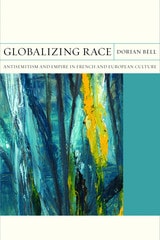
Globalizing Race
Antisemitism and Empire in French and European CultureDorian Bell
Northwestern University Press, 2018
Globalizing Race explores how intersections between French antisemitism and imperialism shaped the development of European racial thought. Ranging from the African misadventures of the antisemitic Marquis de Morès to the Parisian novels and newspapers of late nineteenth-century professional antisemites, Dorian Bell argues that France’s colonial expansion helped antisemitism take its modern, racializing form—and that, conversely, antisemitism influenced the elaboration of the imperial project itself.
Globalizing Race radiates from France to place authors like Guy de Maupassant and Émile Zola into sustained relation with thinkers from across the ideological spectrum, including Hannah Arendt, Friedrich Nietzsche, Frantz Fanon, Karl Marx, Max Horkheimer, and Theodor Adorno. Engaging with what has been called the “spatial turn” in social theory, the book offers new tools for thinking about how racisms interact across space and time. Among these is what Bell calls racial scalarity. Race, Bell argues, did not just become globalized when European racism and antisemitism accompanied imperial penetration into the farthest reaches of the world. Rather, race became most thoroughly global as a method for constructing and negotiating the different scales (national, global, etc.) necessary for the development of imperial capitalism.
As France, Europe, and the world confront a rising tide of Islamophobia, Globalizing Race also brings into fascinating focus how present-day French responses to Muslim antisemitism hark back to older, problematic modes of representing the European colonial periphery.
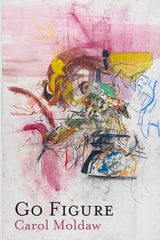
Go Figure
Carol Moldaw
Four Way Books, 2024
In Go Figure, Carol Moldaw demonstrates an incandescent mastery of figuration in its many forms. As the title suggests, these poems invite readers to draw their own conclusions. Observing, inquiring, and delving, Moldaw brings the intertwined strands of life and art to light at their most intimate. A wife-muse who interrogates the role, a mother hard-pressed by motherhood, a daughter whose own mother’s decline causes her to probe their connection, and an artist with an exacting eye and ear who contemplates the creative mysteries, Moldaw is driven to understand and articulate the self in all its manifestations. Like a skater cutting first lines in ice, Moldaw displays lyric immediacy and lyric expanse in her poems with an unswerving command. Complex and inviting, with deft wit, the poems engage public and private life and voice a necessary and resounding affirmation of the feminine and of language emerging through silence.
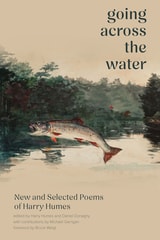
Going Across the Water
New and Selected Poems of Harry HumesHarry Humes
Ohio University Press, 2026
Harry Humes carved out a unique place in American literature by chronicling Appalachian working-class life, natural landscapes, and disappearing rural traditions in Appalachian Pennsylvania with rare lyricism, humility, and precision. He wrote unflinchingly about the austerity and horrors of extraction as well as his deep connection with family and the area mountains and valleys not gutted by the anthracite coal industry.
This volume of Humes’s new and selected poems not only preserves the work of a significant American poet, offering scholars, teachers, and general readers a generous overview of the clarity, beauty, craft, and emotional depth of his substantial body of work. It allows future generations to rediscover poetry that deepens our understanding of how our labor, our landscapes, and our love shape us and change the ways we live and what we care about.
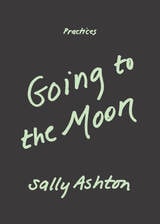
Going to the Moon
Sally Ashton
Duke University Press, 2026
In 2022, poet Sally Ashton learned that one of her poems would be included in a time capsule to be sent to the Moon via Astrobotic’s 2024 Griffin/VIPER as part of the Lunar Codex project. For her, this event seemed like the high point in a life spent chasing the Moon, from a childhood inspired by the space race of the 1960s to an adulthood spent in contemplation and conversation with the sky. In Going to the Moon, Ashton marvels at the Moon’s powerful influence since the dawn of humanity—how we have, in our own ways, gone to the Moon, and what we have found. Contemplating lunar settlement in the light of history, culture, the rise of the space industry, and geopolitical conflict, Ashton shares her sense of wonder at the simple beauty of our unchanged Moon and reveals what is at stake in our contemporary attempts to colonize it.
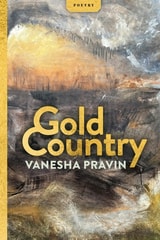
Gold Country
Vanesha Pravin
The Ohio State University Press, 2026
In Gold Country, Vanesha Pravin crafts indelible vignettes of labor, race, and contemporary existence that together offer a panoramic view of today’s United States. Through each life that she conveys line by startling line, she traces the disparity between aspiration and reality when it comes to the American dream: an undocumented worker waits on a celebrity, a government contractor compromises his integrity to secure the future of his children, a career waiter is haunted by the contrast between his inner life and reality, and an orderly steals credit cards for a fix. Wistful and weary, her protagonists wrestle with thwarted dreams and personal shame, but in stitching together a patchwork from their lives, Pravin asks us all to confront the wider realities of deprivation, greed, and their insidious influence on how we function as a society. Gold Country offers a gorgeously nuanced portrait of working life in a supposedly democratic country, airing hard truths about labor, complicity, and the rifts between us.
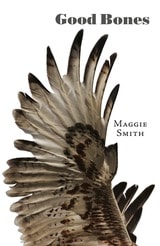
Good Bones
Maggie Smith
Tupelo Press, 2017
Good Bones is a collection of modern poetry that speaks to the world we live in. Maggie Smith contemplates the past and our future, life and death, childhood and motherhood. She writes out of the experience of motherhood, inspired by watching her own children read the world like a book they’ve just opened, knowing nothing of the characters or plot. Smith takes in the dark world around her with a critical eye, always searching for the hidden goodness: compassion, empathy, honesty. “There is a light,” she tells us, “and the light is good.” Smith skillfully reveals the layers of the world around us through lyric language and vivid imagery: “For every bird there is a stone thrown at a bird. / For every loved child, a child broken, bagged, / sunk in a lake.” These poems stare down darkness while cultivating and sustaining possibility and addressing a larger world. We come away from this collection hopeful about making the world a better place, a place to share with future generations. As Smith tells us in Good Bones, “This place could be beautiful, right? You could make this place beautiful.”
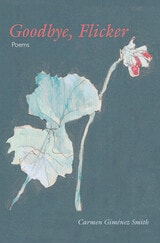
Goodbye, Flicker
PoemsCarmen Giménez Smith
University of Massachusetts Press, 2012
This distinctive collection introduces a new type of mythmaking, daring in its marriage of fairy tale tropes with American mundanities. Conspiratorial, Goodbye, Flicker describes the interior life of a girl whose prince is a deadbeat dad and whose escape into a fantasy world is also an escape into language, beauty, and the surreal.
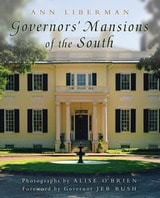
Governors' Mansions of the South
Ann Liberman & Photos by Alise O'Brien
University of Missouri Press, 2008
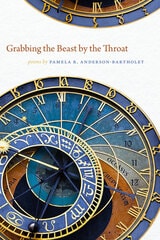
Grabbing the Beast by the Throat
Pamela R. Anderson-Bartholet
Michigan State University Press, 2027
Grabbing the Beast by the Throat is a gripping volume of historical fiction in poetry that follows the life of Pavel Svoboda, a Czechoslovakian man whose life turns upside down when Nazi Germany invades Czechoslovakia and brings Europe to the brink of World War II. Readers witness Pavel’s evolution from a carefree college student with a close-knit family into a resistance fighter who opposes Hitler’s brutal regime. When other college students are slaughtered for protesting the occupation and his Jewish girlfriend is taken to Terezín (Theresienstadt) Concentration Camp, Pavel joins the Czech resistance to protect the people he loves, undermine those in power, and help regain his country’s freedom.
In America and around the world, the clear rise of fascism makes it vitally important that we continue to learn from the past. Grounded in history, this book is a powerful—and unmistakably timely—reminder that there are times when we must fight for freedom.
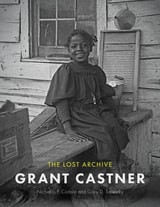
Grant Castner
The Lost ArchiveNicholas P. Ciotola
Rutgers University Press, 2026
Castner’s glass plate negatives are a visual record of New Jersey’s social and cultural history. His many human subjects are rich and poor, young and old, Black and white. They are at work, at play, at home, and in the community. Castner also documented social change brought about by electricity, engineering, education, industry, and transportation. He captured the excitement of public amusements such as parades and fairs. He recorded the aftermath of floods, fires and other disasters. Castner also had a fondness for the outdoors. He used his camera to reflect on the beauty and tranquility that he found in the natural landscapes of New Jersey.
This book presents the collective work of Grant Castner, an amateur artist whose place in New Jersey history was, until now, completely unknown. His photographic negatives forever preserve pinpoint moments in the past. They are time machines to another era. Let this long lost archive transport you on a visual journey into a New Jersey of days gone by.
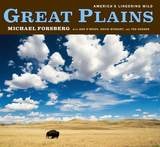
Great Plains
America's Lingering WildMichael Forsberg
University of Chicago Press, 2009
The Great Plains were once among the greatest grasslands on the planet. But as the United States and Canada grew westward, the Plains were plowed up, fenced in, overgrazed, and otherwise degraded. Today, this fragmented landscape is the most endangered and least protected ecosystem in North America. But all is not lost on the prairie. Through lyrical photographs, essays, historical images, and maps, this beautifully illustrated book gets beneath the surface of the Plains, revealing the lingering wild that still survives and whose diverse natural communities, native creatures, migratory traditions, and natural systems together create one vast and extraordinary whole.
Three broad geographic regions in Great Plains are covered in detail, evoked in the unforgettable and often haunting images taken by Michael Forsberg. Between the fall of 2005 and the winter of 2008, Forsberg traveled roughly 100,000 miles across 12 states and three provinces, from southern Canada to northern Mexico, to complete the photographic fieldwork for this project, underwritten by The Nature Conservancy. Complementing Forsberg’s images and firsthand accounts are essays by Great Plains scholar David Wishart and acclaimed writer Dan O’Brien. Each section of the book begins with a thorough overview by Wishart, while O’Brien—a wildlife biologist and rancher as well as a writer—uses his powerful literary voice to put the Great Plains into a human context, connecting their natural history with man’s uses and abuses.
The Great Plains are a dynamic but often forgotten landscape—overlooked, undervalued, misunderstood, and in desperate need of conservation. This book helps lead the way forward, informing and inspiring readers to recognize the wild spirit and splendor of this irreplaceable part of the planet.
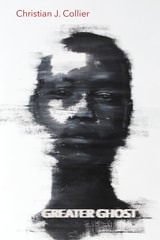
Greater Ghost
Christian J. Collier
Four Way Books, 2024
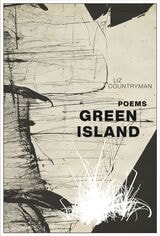
Green Island
Liz Countryman
Tupelo Press, 2024
The poems in Green Island delve into the relationship between place and imagination, examining the ways in which the physical places the speaker occupies, remembers, and imagines determine and enlarge her understanding of self.
While operating with startling self-awareness, Green Island does not simply offer poems that interrogate the circumstances of their own making. The work found in this slim volume questions the poetic tropes of beauty and romantic love and their relationships to the lyric. Ultimately working within the confines of a received tradition to expand what is possible within it, Liz Countryman shows us moments of quiet revelation in the quotidian, the comic, and in the vestiges of popular culture.
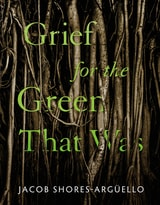
Grief for the Green That Was
Jacob Shores-Argüello
University of Arizona Press, 2026
Moving tenderly across memory, continents, and literary forms, Jacob Shores-Argüello’s tightly woven cross-genre collection evolves a private family bereavement into an exploration of collective ecological grief. Following the death of his mother, the speaker navigates between his Costa Rican heritage and his Oklahoma upbringing, eventually arriving at something like healing on the banks of New Zealand’s Whanganui River—the first river in the world granted legal personhood.
Structured around a Spanish nursery rhyme, Grief for the Green That Was finds solace in the prospect of citizenship for a more-than-human world, a possibility it approaches through perspectival shifts and innovative forms—including footnoted poems, hybrid fiction, and an experimental choose-your-own-adventure sequence—that overturn lyric and storytelling conventions.
A book about what we inherit and what we leave behind, both in families and in landscapes, Grief for the Green That Was examines how climate change affects not just the physical world but also our emotional and spiritual relationships to place. Here Shores-Argüello creates a new language for twenty-first-century grief that refuses to separate the personal from the planetary.
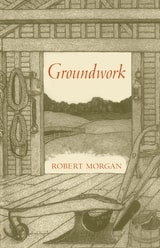
Groundwork
Robert Morgan
Ohio University Press, 1979
Published in 1979 by Gnomon Press
In Groundwork, Robert Morgan offers a vivid poetic excavation of Appalachian life, memory, and landscape. Drawing deeply from his upbringing in the Blue Ridge Mountains of North Carolina, Morgan crafts a collection that is both intimate and elemental. These poems explore the textures of rural existence—its labor, rituals, and natural rhythms—through language that is spare, musical, and richly evocative.
Morgan’s verse is rooted in place, yet it transcends regionalism through its mythic resonance and emotional clarity. He sifts through family lore, childhood recollections, and local history to recover what he calls “pieces of the morgenland”—a personal and cultural terrain shaped by hardship, resilience, and wonder. The poems in Groundwork are populated by grandparents, farmers, and mountain folk, rendered with a quiet reverence that elevates the everyday to the numinous.
This collection marks a foundational moment in Morgan’s career, establishing the poetic voice that would inform his later fiction and nonfiction. With titles like “Mountain Bride,” “Burning the Hornet’s Nest,” and “Baptism of Fire,” the poems evoke both the physical and spiritual dimensions of Appalachian life. Groundwork remains one of Morgan’s most concentrated and enduring tributes to the Southern mountains and their people.
Essential for readers of American poetry, Appalachian studies, and environmental literature, Groundwork is a lyrical testament to the power of memory and place.
godhouse
Ruth Ellen Kocher
Omnidawn, 2023
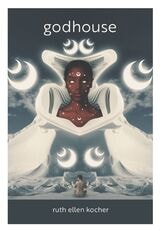
Starting with the idea that the human experience is the universe looking back at itself, godhouse takes the notion a few steps further by centering cosmology within a raced and gendered body. Ruth Ellen Kocher’s poems envision this body as a union of god and soul that, within our material world, encompasses love and hate, joy and despair. The body is a site of divine presence made mortal, electrified with the resonance of both the infinite and the human. In godhouse, we encounter the body as a site where the universe is made personal and celebratory, where the celestial endure the complications of flesh and friction forms between the glorious and the monstrous aspects of personhood.

god’s breath hovering across the waters
Henry Israeli
Four Way Books, 2016