Results by title
967 books match the query 'Theater' and 14 start with g
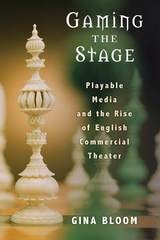
Gaming the Stage
Playable Media and the Rise of English Commercial TheaterGina Bloom
University of Michigan Press, 2018
Gaming the Stage also introduces a new archive for game studies: scenes of onstage gaming, which appear at climactic moments in dramatic literature. Bloom reveals plays to be systems of information for theater spectators: games of withholding, divulging, speculating, and wagering on knowledge. Her book breaks new ground through examinations of plays such as The Tempest, Arden of Faversham, A Woman Killed with Kindness, and A Game at Chess; the histories of familiar games such as cards, backgammon, and chess; less familiar ones, like Game of the Goose; and even a mixed-reality theater videogame.
Gender in Play on the Shakespearean Stage
Boy Heroines and Female PagesMichael Shapiro
University of Michigan Press, 1996
Shapiro's study centers on the five plays in which Shakespeare employed the figure of the "female page": The Two Gentlemen of Verona, The Merchant of Venice, As You Like It, Twelfth Night, and Cymbeline. Combining theater and social history, Shapiro locates Shakespeare's work in relation to controversies over gender roles and cross-dressing in Elizabethan England.
The popularity of the "female page" is examined as a playful literary and theatrical way of confronting, avoiding, or merely exploiting issues such as the place of women in a patriarchal culture and the representation of women on stage. Looking beyond and behind the stage for the cultural anxieties that found their way into Shakespearean drama, Shapiro considers such cases as cross-dressing women in London being punished as prostitutes and the alleged homoerotic practices of the apprentices who played female roles in adult companies. Shapiro also traces other Elizabethan dramatists' varied uses of the cross-dressing motif, especially as they were influenced by Shakespeare's innovations.
"Shapiro's engaging study is distinguished by the scope of interrelated topics it draws together and the balance of critical perspectives it brings to bear on them." --Choice
Michael Shapiro is Professor of English, University of Illinois, Urbana.

Gender, Sex, and Sexuality in Musical Theatre
He/She/They Could Have Danced All NightEdited by Kelly Kessler
Intellect Books, 2023
Critics and fans alike often mistake theatrical song and dance as simplistic, heteronormative, and traditional. This collection troubles this over-idealized notion of musical theatre, tackling divas, chorus boys, and the Rockettes; hit shows such as Hamilton and Spring Awakening; and lesser-known but groundbreaking gems like Erin Markey’s A Ride on The Irish Cream and Kirsten Childs’s Bella: An American Tall Tale.
The book takes a broad look at musical theater across a range of intersecting lenses including race, nation, form, dance, casting, marketing, pedagogy, industry, stardom, politics, and platform. Undermining the musical form’s conservative façade, scholars drive home the fact that gender and desire have long been at the heart of the musical. This exciting and vibrant collection of articles takes sex, sexuality, and gendered complexity out of the musical’s liner notes and back above the marquee.
George Gershwin
An Intimate PortraitWalter Rimler
University of Illinois Press, 2009
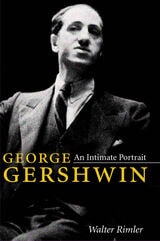
He and his siblings received little love from their mother and no direction from their father. Older brother and lyricist Ira managed to create a home when he married Leonore Strunsky, a hard-edged woman who lived for wealth and status. The closest George came to domesticity was through his longtime relationship with Kay Swift. She was his lover, musical confidante, and fellow composer. But she remained married to another man while he went endlessly from woman to woman. Only in the final hours of his life, when they were separated by a continent, did he realize how much he needed her. Fatally ill, unprotected by (and perhaps estranged from) Ira, he was exiled by Leonore from the house she and the brothers shared, and he died horribly and alone at the age of thirty-eight.
Nor was Gershwin able to find a satisfying musical harbor. For years his songwriting genius could be expressed only in the ephemeral world of show business, as his brilliance as a composer of large-scale works went unrecognized by highbrow music critics. When he resolved this quandary with his opera Porgy and Bess, the critics were unable to understand or validate it. Decades would pass before this, his most ambitious composition, was universally regarded as one of music's lasting treasures and before his stature as a great composer became secure.
In George Gershwin: An Intimate Portrait, Walter Rimler makes use of fresh sources, including newly discovered letters by Kay Swift as well as correspondence between and interviews with intimates of Ira and Leonore Gershwin. It is written with spirited prose and contains more than two dozen photographs.
Ghost Light
An Introductory Handbook for DramaturgyMichael Mark Chemers
Southern Illinois University Press, 2010
Ghost Light: An Introductory Handbook for Dramaturgy offers useful and entertaining answers to the confounding questions: “What, exactly, is dramaturgy, and what does a dramaturg do?” According to Michael Mark Chemers, dramaturgs are the scientists of the theater world—their primary responsibility is to query the creative possibilities in every step of the production process, from play selection to costume design, and then research the various options and find ways to transform that knowledge into useful ideas. To say that dramaturgs are well-rounded is an understatement: those who choose this profession must possess an acute aesthetic sensibility in combination with an extensive knowledge of theater history and practice, world history, and critical theory, and they must be able to collaborate with every member of the creative team and theater administration.
Ghost Light is divided into three sections. Part 1, “Philosophy,” describes what dramturgs do, presents a detailed history of dramaturgy, and summarizes many of the critical theories needed to analyze and understand dramatic texts. “Analysis” teaches the two essential skills of a dramaturg: reading and writing. It includes a “12-step program for script analysis” along with suggestions about how to approach various genres and play structures. “Practice,” the third part, delves into the relationships that dramaturgs forge and offers useful advice about collaborating with other artists. It also includes ideas for audience outreach initiatives such as marketing and publicity plans, educational programs, talkbacks, blogs, and program notes and lobby displays, all of which are often the responsibility of the dramaturg.
Ghost Light was written with undergraduate students in mind and is perfectly suited for the classroom (each chapter concludes with a series of practical exercises that can be used as course assignments). However, dramaturgy is a skill that is essential to all theater practitioners, not just professional or aspiring dramaturgs, making Ghost Light a valuable addition to all theater libraries.
Ghost Light
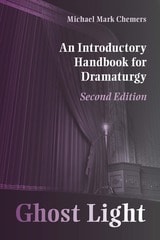
An Introductory Handbook for DramaturgyMichael Mark Chemers, with a foreword by Faedra Chatard Carpenter
Southern Illinois University Press, 2023
Since its release in 2010, Ghost Light: An Introductory Handbook for Dramaturgy has become the international standard for dramaturgy training and practice. The first textbook introduced students to the “ghost light” model of dramaturgy—a creatively engaged, artistically vibrant approach that draws on extensive knowledge of theatre history, practice, and theory—and this second edition brings the conversation up to the present.
Over three parts, author and theory creator Michael Mark Chemers helps students explore the world of the dramaturg. Part 1 describes what dramaturgs do, presents a detailed history of dramaturgy, and summarizes many of the critical theories needed to analyze and understand dramatic texts. Part 2 teaches students to read, write, and analyze scripts through a twelve-step program with suggestions about how to approach various genres and play structures. The final part delves into the relationships dramaturgs forge and offers useful advice about collaborating with other artists. It also includes ideas for audience outreach initiatives such as marketing and publicity plans, educational programs, program notes and lobby displays, and more.
Perfectly suited for the undergraduate theatre classroom, this holistic guide includes chapter exercises for students to practice the skills as they learn. The new edition also incorporates recent theory and new resources on multimedia performance and dramaturgy in the digital age. As the field of dramaturgy continues to shift and change, this new edition of Ghost Light: An Introductory Handbook for Dramaturgy prepares theatre students and practitioners to create powerful, relevant performances of all types.
Ghostly Fragments
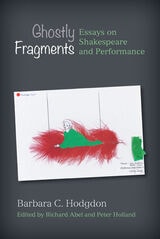
Essays on Shakespeare and PerformanceBarbara C. Hodgdon
University of Michigan Press, 2021
Ghostly Fragments gathers the essays of the late Barbara C. Hodgdon, a renowned scholar of Shakespeare and performance studies. Her influential publications over thirty years reflected a remarkable intelligence, wit, and originality, as did her lectures and conference papers. Richard Abel and Peter Holland have selected essays that represent the wide sweep of Hodgdon’s scholarship, including unpublished pieces and those from hard-to-access sources. The essays reveal a thinker and writer who grows more self-reflective over time, with a distinctive, engaging, often wryly humorous voice that is accessible even to nonspecialist readers.
Following a general introduction by Peter Holland, the book’s five subsections (Teaching Shakespeare, Analyzing Stage Performances, Editing Shakespeare Texts, Analyzing Shakespeare Films, and “Shopping” in the Archives) are introduced in turn by scholars Miriam Gilbert, W.B. Worthen, Margaret Jane Kidnie, Richard Abel, and Pascale Aebischer. Collectively, the pieces confirm the originality and élan of Hodgdon’s thinking and writing over time, and reveal her as a natural essayist and stylist, with a distinctive engaging voice. The collection is unique in not only bringing together so much of Hodgdon's work in one place (with an extensive bibliography of her published work) but also in demonstrating how groundbreaking and influential that work has been in the field.
Ghosts
Death’S Double And The Phenomena Of TheatreAlice Rayner
University of Minnesota Press, 2006
In Ghosts, Alice Rayner examines theatre as a memorial practice that is haunted by the presence of loss, looking at how aspects of stagecraft turn familiar elements into something uncanny. Citing examples from the works of Shakespeare, Beckett, and Suzan-Lori Parks as well as the films Vertigo, Gaslight, and The Sixth Sense, she begins by describing time as it is employed by theatre with multiple aspects of presence, duration, and passage. Suggesting that objects connect past to present through the sense of touch, she explores how props are suspended backstage between motion and meaning. Her final chapters consider the curtain as theatre’s means for attempting to divide real and imaginary worlds.
If ghosts hover where secrets—secrets of the past, secrets from oneself, secrets of life and death—are kept, then, according to Rayner, “theatre is where ghosts best make their appearances and let communities and individuals know that we live amid secrets hiding in plain sight.”
Alice Rayner is associate professor of drama at Stanford University and author of, most recently, To Act, To Do, To Perform: Drama and the Phenomenology of Action.

Gillioz "Theatre Beautiful"
Celebrating Springfield's Theatre History, 1926-2006James Baumlin
Moon City Press, 2006
Grassroots Theater
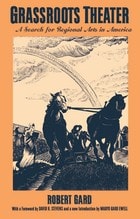
A Search for Regional Arts in AmericaRobert Gard; With a Foreword by David H. Stevens and a new Introduction by Maryo Gard Ewell
University of Wisconsin Press, 1999
Robert Gard’s timeless book is a moving account of one man’s struggle to bring his dream of community-building through creative theater to citizens around the country. He traveled across America—from New York’s Finger Lakes to the prairies of Alberta, Canada, to the backwoods of northern Wisconsin—discovering and nurturing the folklore, legends, history, and drama of the region. He talked to ballad singers, painters, the tellers of tall tales, and farm women, whose poetry and painting reflected the elemental violence of nature and quiet joys of neighborliness. Grassroots Theater reminds us that an individual’s creative vision transcends technology, current events, and changing demographics.
This reprint of Grassroots Theater was generously funded by the Robert E. Gard Wisconsin Idea Foundation, an affiliate of the Wisconsin Academy of Sciences, Arts & Letters.
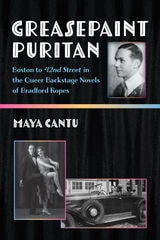
Greasepaint Puritan
Boston to 42nd Street in the Queer Backstage Novels of Bradford RopesMaya Cantu
University of Michigan Press, 2024
Greasepaint Puritan aims to find out and reclaim his story. Descended from Mayflower Pilgrims, Ropes rebelled against the “Proper Bostonian” life, in a career that touched upon the Jazz Age, American vaudeville, and theater censorship. We follow Ropes’s successful career as both a performer and the author of the trilogy of backstage novels: 42nd Street, Stage Mother, and Go Into Your Dance. Populated by scheming stage mothers, precocious stage children, grandiose bit players, and tart-tongued chorines, these novels centered on the lives and relationships of gay men on Broadway during the Jazz Age and Prohibition era. Rigorously researched, Greasepaint Puritan chronicles Ropes’s career as a successful screenwriter in 1930s and ’40s Hollywood, where he continued to be a part of a dynamic gay subculture within the movie industry before returning to obscurity in the 1950s. His legacy lives on in the Hollywood and Broadway incarnations of 42nd Street—but Greasepaint Puritan restores the “forgotten melody” of the man who first envisioned its colorful characters.
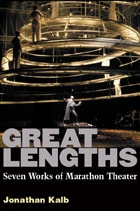
Great Lengths
Seven Works of Marathon TheaterJonathan Kalb
University of Michigan Press, 2013
"Reading this book is certainly a vigorous experience. Kalb's sense of nuance, unpredictability, and the complexity of perception brings these productions to life. He is our surrogate, our scapegoat even, enduring the length of these productions so that he can convey the essence of their power."
---Stanton B. Garner, Jr., University of Tennessee
"Jonathan Kalb takes us on a tour of monumental theater events, which flaunt the rules of economy, Aristotelian and otherwise. Kalb captures these unwieldy marathon productions by skillfully mixing personal experience and scholarly analysis. I read this engaging book in a single sitting---and came away ready to join the first theater marathon I could find."
---Martin Puchner, Harvard University
"Jonathan Kalb's Great Lengths leaps to the head of any class in theatre history. Rich with critical perspective of 'marathon' works by Peter Brook, Tony Kushner, Robert Wilson, and others, and written with panache and lucidity, Kalb's book is filled with suspense as he describes and demystifies more than the post-modern and post-dramatic haunting recent theatre. This is history as present event, embracing the Greeks, Shakespeare, and even Charles Dickens."
---Gordon Rogoff, Yale University
We know that size matters in many areas of human endeavor, but what about works of the imagination? Why do some dramatic creations extend to five hours or more, and how does their extreme length help them accomplish extraordinarily ambitious aims? In Great Lengths, theater critic and scholar Jonathan Kalb addresses these and other questions through a close look at seven internationally prominent theater productions, including Tony Kushner's Angels in America, Robert Wilson's Einstein on the Beach, and the Royal Shakespeare Company's Nicholas Nickleby. This is a book about extreme length, monumental scope, and intensive immersion in the theater in general, written by a passionate spectator reflecting on selected pinnacles of his theatergoing over thirty years.
The book's examples, deliberately chosen for their diversity, range from adapted novels and epics, to dramatic chronicles with macrohistorical and macropolitical implications, to stagings of super-size classic plays, to "postdramatic" works that negotiate the border between life and art. Kalb reconstructs each of the works, re-creating the experience of seeing it while at the same time explaining how it maintained attention and interest over so many hours, and then expanding the scope to embrace a wider view and ask broader questions. The discussion of Nicholas Nickleby, for example, considers melodrama as a basic tool of theatrical communication, and the section on Peter Brook's The Mahabharata explores the ethical problems surrounding theatrical exoticism. The chapter on Einstein on the Beach grows into a reflection on the media-age status of the much-debated Gesamtkunstwerk (or "total artwork") and a reassessment of the long avant-gardist tradition of challenging the primacy of rational language in theater. The essay on Peter Stein's Faust I + II becomes a reflection on the interpretive role of theater directors and the theatrical viability of antitheatrical closet drama. Great Lengths thus offers a remarkable panorama of the surprisingly broad field of contemporary marathon theater---an art form that diverse audiences of savvy, screen-weaned spectators continue to seek out, for the increasingly rare experiences of awe, transcendence, and sustained immersion that it provides.
Great Lengths will appeal to general readers as well as theater specialists. It situates the chosen productions in various historical and critical contexts and engages with the many lively scholarly debates that have swirled around them. At the same time, it uses the productions as springboards for wide-ranging reflections on the basic purpose and enduring power of theater in an attention-challenged, media-saturated era.
Greenwich Village 1963
Avant-Garde Performance and the Effervescent BodySally Banes
Duke University Press, 1993
A leading writer on cultural history, Banes draws a vibrant portrait of the artists and performers who gave the 1963 Village its exhilarating force, the avant-garde whose interweaving of public and private life, work and play, art and ordinary experience, began a wholesale reworking of the social and cultural fabric of America. Among these young artists were many who went on to become acknowledged masters in their fields, including Andy Warhol, John Cage, Yoko Ono, Yvonne Rainer, Lanford Wilson, Sam Shepard, Brian de Palma, Harvey Keitel, Kate Millet, and Claes Oldenburg. In live performance--Off-Off Broadway theater, Happenings, Fluxus, and dance--as well as in Pop Art and underground film, we see this generation of artists laying the groundwork for the explosion of the counterculture in the late 1960s and the emergence of postmodernism in the 1970s. Exploring themes of community, freedom, equality, the body, and the absolute, Banes shows us how the Sixties artists, though shaped by a culture of hope and optimism, helped to galvanize a culture of criticism and change. As 1963 came to define the Sixties, so this vivid account of the year will redefine a crucial generation in recent American history.
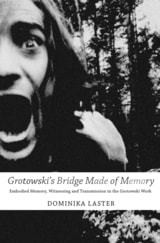
Grotowski's Bridge Made of Memory
Embodied Memory, Witnessing and Transmission in the Grotowski WorkDominika Laster
Seagull Books, 2016
Considered one of the most influential theatre practitioners of the 20th century, Polish director Jerzy Grotowski revolutionized contemporary theatre in multiple ways. Perhaps best known for his notion of ‘poor theatre,’ Grotowski went beyond the confines of conventional theatre to systematically explore the possibilities of the human being in a performative context. In Grotowski’s Bridge Made of Memory, Dominika Laster analyzes core aspects of Grotowski’s work such as body-memory, vigilance, witnessing, verticality, and transmission, arguing that these performance praxes involve a deliberate blurring of the boundaries of the self and other.
This comprehensive study traces key thematic threads across Grotowski’s research, examining lesser-known aspects of his work such as performance compositions structured around African and Afro-Caribbean traditional songs and ritual movement as well as textual material from the Christian Gnostic tradition. As an active process of research and questioning conducted through the “body-being” of the performer, Grotowski’s work represents a practical realization of the often highly theoretical and abstract discussions of one of the field’s main preoccupations: embodied practice as a way of knowing.