Results by title
265 books match the query 'To 1500' and 9 start with g
Gender and Difference in the Middle Ages
Sharon Farmer
University of Minnesota Press, 2002
Exposes complex intersections between genders and other identities in medieval cultures.
Nothing less than a rethinking of what we mean when we talk about "men" and "women" of the medieval period, this volume demonstrates how the idea of gender-in the Middle Ages no less than now-intersected in subtle and complex ways with other categories of difference. Responding to the insights of postcolonial and feminist theory, the authors show that medieval identities emerged through shifting paradigms-that fluidity, conflict, and contingency characterized not only gender, but also sexuality, social status, and religion. This view emerges through essays that delve into a wide variety of cultures and draw on a broad range of disciplinary and theoretical approaches. Scholars in the fields of history as well as literary and religious studies consider gendered hierarchies in western Christian, Jewish, Byzantine, and Islamic areas of the medieval world.
Contributors: Daniel Boyarin, U of California, Berkeley; Ruth Mazo Karras, U of Minnesota; Mathew Kuefler, San Diego State U; Martha Newman, U of Texas; Kathryn M. Ringrose, U of California, San Diego; Elizabeth Robertson, U of Colorado; Everett Rowson, U of Pennsylvania; Michael Uebel, U of Kentucky; Ulrike Wiethaus, Wake Forest U.
Gender and National Literature
Heian Texts in the Constructions of Japanese ModernityTomiko Yoda
Duke University Press, 2004
Moving back and forth between a critique of modern discourses on Heian literature and close analyses of the Heian texts themselves, Yoda sheds light on some of the most persistent interpretive models underwriting Japanese literary studies, particularly the modern paradigm of a masculine national subject. She proposes new directions for disciplinary critique and suggests that historicized understandings of premodern texts offer significant insights into contemporary feminist theories of subjectivity and agency.

Gender in medieval places, spaces and thresholds
Edited by Victoria Blud, Diane Heath, and Einat Klafter
University of London Press, 2019
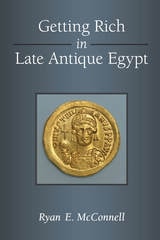
Getting Rich in Late Antique Egypt
Ryan E. McConnell
University of Michigan Press, 2017
Ryan E. McConnell connects the family’s rise in wealth and status to its role in tax collection on behalf of the Byzantine state, rather than a reliance on productive surpluses. Close analysis of low- and high-level accounts from the Apion estate, as well as documentation from comparable Roman and Byzantine Egyptian estates, corroborate this conclusion. Additionally, McConnell offers a third way into the ongoing debate over whether the Apions’ relationship with the state was antagonistic or cooperative, concluding that the relationship was that of parties in a negotiation, with each side seeking to maximize its own benefit. The application of modern economic concepts—as well as comparisons to the economies of Athens, Rome, Ptolemaic Egypt, and Early Modern France—further illuminate the structure and function of the estate in Late Antique Egypt.
Getting Rich in Late Antique Egypt will be a valuable resource for philologists, archaeologists, papyrologists, and scholars of Late Antiquity. It will also interest scholars of agricultural, social, and economic history.
Glamorous Sorcery
Magic and Literacy in the High Middle AgesDavid Rollo
University of Minnesota Press, 2000

God of Many Names
Play, Poetry and Power in Hellenic Thought, From Homer to AristotleMihai I. Spariosu
Duke University Press, 1991
Building upon the scholarship of an earlier volume, Dionysus Reborn, Spariosu her continues to draw on Dionysus—the “God of many names,” of both poetic play and sacred power—as a mythical embodiment of the two sides of the classical Greek mentality. Combining philosophical reflection with close textual analysis, the author examines the divided nature of the Hellenic mentality in such primary canonic texts as the Iliad, the Odyssey, the Theogony, Works and Days, the most well-known of the Presocratic fragments, Euripides’ Bacchae, Aristophanes’ The Frogs, Plato’s Republic and Laws, and Aristotle’s Poetics and Politics.
Spariosu’s model illuminates the many of the most enduring questions in contemporary humanistic study and addresses modern questions about the nature of the interrelation of poetry, ethics, and politics.
Gods in Dwellings
Temples and Divine Presence in the Ancient Near EastMichael B. Hundley
SBL Press, 2013
In this book devoted exclusively to temples and perceptions of the divine presences that inhabit them, Michael B. Hundley focuses on the official religions of the ancient Near East and explores the interface between the human and the divine within temple environs.
Hundley identifies common ancient Near Eastern temple systems and examines issues that include what temple structures communicate, how temples were understood to function, temple ideology, the installation of divine presence in a temple, the connection between presence and physical representation, and human service to the deity.
Drawing on architectural and spatial theory, ritual theory, theories of language, art history, archaeology, sociocultural anthropology, and comparative studies, Hundley offers a single interpretive lens through which to view temple worship.
Features:
- A close examination of temples in Egypt, Mesopotamia, Hittite Anatolia, and Syria-Palestine
- An interdisciplinary treatment of architecture, language, ritual, and art
- A dual focus on how a deity's divine presence connects to space and art and how human service to the deity maintains the deity's active presence
Gratian's Tractatus de penitentia
Atria A. Larson
Catholic University of America Press, 2016
Growing Up in Ancient Israel
Children in Material Culture and Biblical TextsKristine Henriksen Garroway
SBL Press, 2018
The first expansive reference examining the texts and material culture related to children in ancient Israel
Growing Up in Ancient Israel uses a child-centered methodology to investigate the world of children in ancient Israel. Where sources from ancient Israel are lacking, the book turns to cross-cultural materials from the ancient Near East as well as archaeological, anthropological, and ethnographic sources. Acknowledging that childhood is both biologically determined and culturally constructed, the book explores conception, birth, infancy, dangers in childhood, the growing child, dress, play, and death. To bridge the gap between the ancient world and today’s world, Kristine Henriksen Garroway introduces examples from contemporary society to illustrate how the Hebrew Bible compares with a Western understanding of children and childhood.
Features:
- More than fifty-five illustrations illuminating the world of the ancient Israelite child
- An extensive investigation of parental reactions to the high rate of infant mortality and the deaths of infants and children
- An examination of what the gendering and enculturation process involved for an Israelite child