Results by title
453 books match the query 'Wisconsin' and 13 start with g
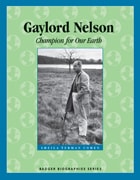
Gaylord Nelson
Champion for Our EarthSheila Terman Cohen
Wisconsin Historical Society Press, 2010
Born in Clear Lake, Wisconsin, in 1916, Gaylord grew up as immersed in his parents' political work and community service as he was in playing practical jokes and exploring the natural world surrounding his home town. Along the way he encountered experiences that would shape him in fundamental ways: as a man who stood up for what he believed in the face of opposition and yet who also understood how to treat his opponents with respect. Both traits would serve him well as he rose from law student to state senator to Wisconsin governor and finally to three terms as a United States Senator.
Nelson fought to treat all races equally and to condemn McCarthy-era paranoia, but his greatest contribution was to sound the alarm about another battle: the fight to save the natural world and the earth itself. It was his idea to use teach-ins to let people know that the environment needed their help. Thanks to him, more natural resources were conserved and new laws demanded clean air and water. Now, every year on April 22, people all over the world plant trees and pick up litter to celebrate Earth Day. The Earth and its inhabitants aren't safe yet, but Gaylord Nelson demonstrated that even one person can help to save the world.
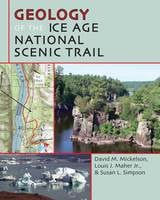
Geology of the Ice Age National Scenic Trail
David M. Mickelson
University of Wisconsin Press, 2011
The Ice Age National Scenic Trail meanders across the state of Wisconsin through scenic glacial terrain dotted with lakes, steep hills, and long, narrow ridges. David M. Mickelson, Louis J. Maher Jr., and Susan L. Simpson bring this landscape to life and help readers understand what Ice Age Wisconsin was like. An overview of Wisconsin’s geology and key geological concepts helps readers understand geological processes, materials, and landforms. The authors detail geological features along each segment of the Ice Age Trail and at each of the nine National Ice Age Scientific Reserve sites.
Readers can experience the Ice Age Trail through more than one hundred full-color photographs, scores of beautiful maps, and helpful diagrams. Science briefs explain glacial features such as eskers, drumlins, and moraines. Geology of the Ice Age National Scenic Trail also includes detailed trail descriptions that are cross referenced with the science briefs to make it easy to find the geological terms used in the trail descriptions. Whatever your level of experience with hiking or knowledge of glaciers, this book will provide lively, informative, and revealing descriptions for a new understanding of the shape of the land beneath our feet.
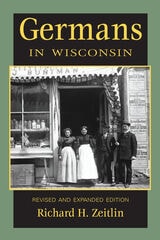
Germans in Wisconsin
Richard H. Zeitlin
Wisconsin Historical Society Press, 2001
Between 1820 and 1910, nearly five and a half million German-speaking immigrants came to the United States in search of new homes, new opportunities, and freedom from European tyrannies. Most settled in the Midwest, and many came to Wisconsin, whose rich farmlands and rising cities attracted three major waves of immigrants. By 1900, German farmers, merchants, manufacturers, editors, and educators—to say nothing of German churches (both Catholic and Lutheran), cultural institutions, food, and folkways—had all set their mark upon Wisconsin. In the most recent census (1990), more than 53 percent of the state's residents considered themselves "German"—the highest of any state in the Union.
In this best-selling book, now with updated text and additional historical photographs, Richard H. Zeitlin describes the values and ideas the Germans brought with them from the Old Country; highlights their achievements on the farm, in the workplace, and in the academy over the course of 150 years; and explains why their impact has been so profound and pervasive.
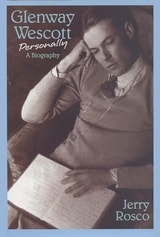
Glenway Wescott Personally
A BiographyJerry Rosco
University of Wisconsin Press, 2002
As a writer, Glenway Wescott (1901–1987) left behind several novels, including The Grandmothers and The Pilgrim Hawk, noted for their remarkable lyricism. As a literary figure, Wescott also became a symbol of his times. Born on a Wisconsin farm in 1901, he associated as a young writer with Hemingway, Stein, and Fitzgerald in 1920s Paris and subsequently was a central figure in New York’s artistic and gay communities. Though he couldn’t finish a novel after the age of forty-five, he was just as famous as an arts impresario, as a diarist, and for the company he kept: W. H. Auden, Christopher Isherwood, Marianne Moore, Somerset Maugham, E. M. Forster, Joseph Campbell, and scores of other luminaries.
In Glenway Wescott Personally, Jerry Rosco chronicles Wescott’s long and colorful life, his early fame and later struggles to write, the uniquely privileged and sometimes tortured world of artistic creation. Rosco sensitively and insightfully reveals Wescott’s private life, his long relationship with Museum of Modern Art curator Monroe Wheeler, his work with sex researcher Alfred Kinsey that led to breakthrough findings on homosexuality, and his kinship with such influential artists as Jean Cocteau, George Platt-Lynes, and Paul Cadmus.
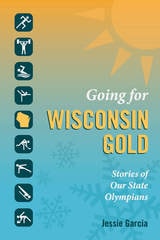
Going for Wisconsin Gold
Stories of Our State OlympiansJessie Garcia
Wisconsin Historical Society Press, 2016
U-S-A , U-S-A is a familiar refrain heard in every Olympics, but truly it could be Wis-con-sin! Since pioneering hurdler Alvin Kraenzlein got his start here in the 1890s, the Badger State has nurtured, trained, or schooled more than 400 Olympic athletes in a vast array of sports. Wisconsin’s varied landscape and climate accommodate serious athletes whether they compete on ice, on snow, in the water, or on terra firma. We tend to bring a Midwestern work ethic to our endeavors, and our Olympians have often been hailed in the press and in public as being among the most humble and down-to-earth people around. Our state boasts a thriving youth sports culture where many homegrown athletes get their start; others are drawn here by our world-class universities, athletic facilities, and coaching talent. No matter how an athlete comes to Wisconsin, the state becomes part of his or her Olympic story. In Going for Wisconsin Gold, author Jessie Garcia provides insights into the lives of athletes who grew up or spent time in Wisconsin on their journey to the Olympic Games. She shares some of our competitors most captivating tales—from those that have become legend, like Dan Jansen’s heartbreaking falls and subsequent magical gold, to unlikely brushes with glory (do you know which Green Bay Packer was almost an Olympic high jumper?). Featuring the athletes’ personal stories, many of them told here in detail for the first time, plus pictures from their private collections, Going for Wisconsin Gold provides a new and deeper understanding of the sacrifices, joy, pain, heartbreak, and complete dedication it takes to reach the world’s grandest sporting competition.

Good for the Jews
Debra Spark
University of Michigan Press, 2009
Good for the Jews is a smart, funny, sexy novel set in Madison, Wisconsin, during the Bush administration. Part mystery and part stranger-comes-to town story, Good for the Jews is loosely based on the biblical book of Esther. Like Esther, Debra Spark's characters deal with anti-Semitism and the way that powerful men—and the women who love them—negotiate bureaucracies.
At the core of the story of right and wrong are young, attractive Ellen Hirschorn and her older cousin Mose, a high school teacher who thinks he knows, in fact, what is "good for the Jews"—and for Ellen, too. Their stories intertwine with those of the school superintendent, his ex-wife and son, and a new principal. Workplace treachery, the bonds of family, coming of age, and romantic relationships all take center stage as the characters negotiate the fallout from a puzzling fire.
Spark's evocative writing style and sharp, understanding treatment of her diverse characters draw the reader into this surprising page-turner, a finalist for the 2009 Foreword Magazine Book of the Year Award.
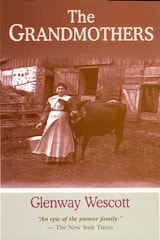
Grandmothers
A Family PortraitWith a New Introduction by Sargent Bush Jr.
University of Wisconsin Press, 1996
The Grandmothers is the chronicle of Alwyn’s ancestors: the bitter Henry Tower, who returned from Civil War battlefields to find his beautiful wife Serena lost in a fatal fever; Rose Hamilton, robust and eager, who yearned to leave the cabin of her bearded, squirrel-hunting brothers for the company of courteous Leander Tower; the boy-soldier Hilary Tower, whose worship of his brother made him desperate; fastidious Nancy Tower, whose love for her husband Jesse Davis could not overcome her disgust with the dirt under his fingernails; Ursula Duff, proud and silent, maligned among her neighbors by her venal husband; Alwyn’s parents, Ralph Tower and Marianne Duff, whose happiness is brought about only by the intervention of a determined spinster.
Grasses of Wisconsin
The Taxonomy, Ecology, and Distribution of the Gramineae Growing in the State without CultivationNorman C. Fassett
University of Wisconsin Press, 1997
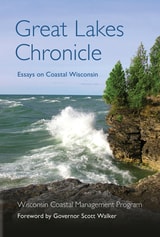
Great Lakes Chronicle
Essays on Coastal WisconsinWisconsin Coastal Management
Wisconsin Historical Society Press, 2018
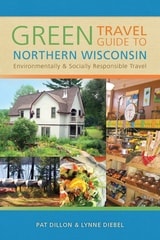
Green Travel Guide to Northern Wisconsin
Environmentally and Socially Responsible TravelPat Dillon
University of Wisconsin Press, 2011
Green Travel Guide to Northern Wisconsin showcases the best green restaurants, lodgings, shops, and activities in Wisconsin’s Northland. Learn about exploring the cliffs and caves of the Niagara Escarpment while biking the Door Peninsula. Carpool to the Midwest Renewable Energy Fair in Custer where you can stay at a nearby solar-powered inn. Take an all day eco-geo-history tour of the north woods near Hayward, explore the Chequamegon-Nicolet Forest, kayak the Mississippi River backwaters, and much more.
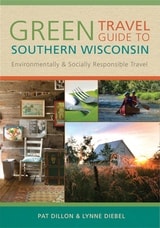
Green Travel Guide to Southern Wisconsin
Environmentally and Socially Responsible TravelPat Dillon
University of Wisconsin Press, 2010
Honorable Mention, Foreword Magazine’s Travel Guidebook of the Year
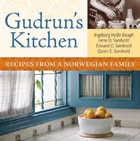
Gudrun’s Kitchen
Recipes from a Norwegian FamilyIrene O. Sandvold
Wisconsin Historical Society Press, 2011
The youngest of a large Norwegian immigrant family, Gudrun Thue Sandvold was known for her beaming blue eyes and a reserve that gave way to laughter whenever she got together with her sisters. She took immeasurable pride in her children and grandchildren, kept an exquisite home, and turned the most mundane occasion into a party. And to all who knew her, Gudrun’s cooking was the stuff of legend.
Part cookbook, part immigrant story, and part family memoir, Gudrun's Kitchen features hundreds of Gudrun Sandvold’s recipes for comfort food from a time when families and friends gathered at the table and connected with one another every single day. But this book is much more than a guide to Norwegian culinary traditions; it is an important contribution to immigrant history and a vital documentation of our nation’s multicultural heritage.
Guide to the Draper Manuscripts
Josephine L. Harper
Wisconsin Historical Society Press, 1983
In the mid-nineteenth century the Wisconsin Historical Society's first director, Lyman C. Draper, gathered outstanding materials such as the Daniel Boone papers, which include Draper's interviews with Boone's son, and the papers of Revolutionary War hero George Rogers Clark. These two collections alone are of vast significance to frontier history before 1830, but the full collection comprises nearly five hundred volumes of records, including military and government records, interviews, Draper's own research notes, and rare personal letters. For scholars, genealogists, and local historians, the Draper papers offer a wealth of information on the social, economic, and cultural conditions experienced by our frontier forebears. The 180-page index lists thousands of names and is an indispensable guide for all who wish to use the collection, which is available in libraries across the country on microfilm.