Results by title
173 books match the query 'Women in literature' and 3 start with g
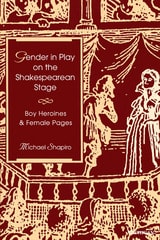
Gender in Play on the Shakespearean Stage
Boy Heroines and Female PagesMichael Shapiro
University of Michigan Press, 1996
Shapiro's study centers on the five plays in which Shakespeare employed the figure of the "female page": The Two Gentlemen of Verona, The Merchant of Venice, As You Like It, Twelfth Night, and Cymbeline. Combining theater and social history, Shapiro locates Shakespeare's work in relation to controversies over gender roles and cross-dressing in Elizabethan England.
The popularity of the "female page" is examined as a playful literary and theatrical way of confronting, avoiding, or merely exploiting issues such as the place of women in a patriarchal culture and the representation of women on stage. Looking beyond and behind the stage for the cultural anxieties that found their way into Shakespearean drama, Shapiro considers such cases as cross-dressing women in London being punished as prostitutes and the alleged homoerotic practices of the apprentices who played female roles in adult companies. Shapiro also traces other Elizabethan dramatists' varied uses of the cross-dressing motif, especially as they were influenced by Shakespeare's innovations.
"Shapiro's engaging study is distinguished by the scope of interrelated topics it draws together and the balance of critical perspectives it brings to bear on them." --Choice
Michael Shapiro is Professor of English, University of Illinois, Urbana.
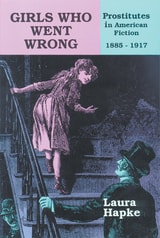
Girls Who Went Wrong
Prostitutes in American Fiction, 1885–1917Laura Hapke
University of Wisconsin Press, 1989
The period 1885 to 1917 saw thousands of American crusaders working hard to “save the fallen women,” but little on the part of American social protest writers. In this first work on the subject, Laura Hapke examines how writers attempted to turn an outcast into a heroine in a literature otherwise known for its puritanical attitude toward the fallen woman. She focuses on how these authors (all male) expressed late-Victorian conflicts about female sexuality. If, as they all maintained, women have an innate preference for chastity, how could they account for the prostitute? Was she a sinner, suggesting the potential waywardness of all women? Or, if she was a victim, what of her “depravity”?
Grace Paley
Illuminating Dark LivesBy Jacqueline Taylor
University of Texas Press, 1990
Grace Paley is a "writer's writer," admired by both scholars and the reading public for her originality and unique voice. In this first book-length study of her work, Jacqueline Taylor explores the source of Paley's originality, locating it in the way Paley transforms language to create strongly woman-centered stories.
Drawing on interviews with the author, as well as the stories themselves, Taylor emphasizes Paley's awareness that women's voices have been muted and their stories ignored or left untold in our culture's male-oriented dominant discourse. She watches Paley in the process of reshaping language at both the semantic and narrative levels to make it express women's perceptions and experiences. In Paley's stories, it becomes possible to ignore traditional heroic and dramatic themes and instead talk about women and children in such everyday settings as the playground, the kitchen, and the grocery store.
Some of the specific techniques Paley uses to accomplish this include identifying and repudiating sexist language in the dominant discourse and redefining ordinary words from the perspective of women. At the narrative level, Taylor reveals how she draws on women's oral traditions to tell open-ended stories that resist rigid beginning-middle-and-end structuring.
This transformed language enables Paley to construct a social world where woman-centered meanings can flourish. In her nontraditional stories, no single narrator or version of events dominates. Anyone can be a storyteller and no one has the last word.