Results by title
295 books match the query 'Zoology' and 6 start with g
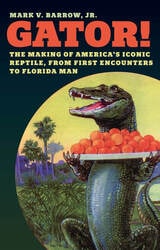
Gator!
The Making of America’s Iconic Reptile, from First Encounters to Florida ManMark V. Barrow, Jr.
University of Chicago Press, 2026
What this intriguing—and unsettling—apex predator reveals about Americans’ attempts to control and connect with the natural world.
Both a flesh-and-blood critter and the stuff of legend, the alligator inspires as much awe as it does fear. While this apex predator survives mainly on fish, birds, snakes, turtles, and small mammals, it will consume almost anything, including pets, livestock, and—in rare cases—humans. Though dreaded as a man-eater, the alligator has also been cast as a lucrative commodity, a popular roadside attraction, a prized hunting trophy, and even an unlikely household pet.
Gator! tells the riveting story of this iconic predator. Historian Mark V. Barrow, Jr.—a native of Florida, a state famous for its alligators—traces the reptile’s ancient lineage from the age of the dinosaurs to its current status as a cherished mascot and regional icon. He explores its role as a surrogate species, offering vital clues about the health of ecosystems, as well as its profound cultural weight as a totem for Indigenous communities, a mythical sewer-dweller in New York lore, and a disturbing tool of racial oppression used to dehumanize African Americans. Once over-hunted, the alligator has long been celebrated as a triumph of the federal Endangered Species Act. Barrow delves into the nuances of this comeback, one that offers both a cautionary tale of market-driven exploitation and a conservation success story.
An entertaining history of one of North America’s most charismatic animals, Gator! explores how this reptile became a Florida emblem and a national enigma, transforming humans and alligators in the process.

Genetics and the Social Behaviour of the Dog
John Paul Scott and John L. Fuller
University of Chicago Press, 1974
Scott and Fuller’s classic study of dog behavior gathers into one volume the authoritative information that came from their twenty years of research at the Jackson Laboratory. Central to their book is the role heredity plays in the development of behavior. Giving puppies an environment designed on the principles of a well-run school, Scott and Fuller tested five breeds representing the major dog groups and carried out a Mendelian experiment with two of the most different breeds: the basenji and the cocker spaniel.
They found that heredity affects almost every trait tested; that sex affects aggressiveness and the dominance order, but not trainability and problem-solving; that emotional traits profoundly influence performance; that, although breeds differ widely in emotional and motivational characteristics, none shows distinct superiority in problem solving; and that detailed statistical analyses indicate a highly complex pathway between primary gene action and its final effect on behavior.
Included is important information on:
• rearing methods
• the origin and history of dog breeds
• basic behavior patterns
• the physiological and behavioral development of puppies
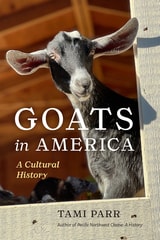
Goats in America
A Cultural HistoryTami Parr
Oregon State University Press, 2025
Since arriving in North America with cattle and other domesticated livestock in the sixteenth century, goats have provided people sustenance and valuable products, including milk, meat, and mohair. But humans did not appreciate the animals, and as a result, throughout much of American history goats were persecuted as public nuisances and symbols of degenerate behavior. Nevertheless, over the centuries the tenacious goat has overcome many of these stereotypes and secured a spot in the hearts and minds of modern Americans, who love goat cheese and embrace goats as social media stars.
Examining key moments and notable developments in goat history and culture, Goats in America outlines the history and evolving role of goats in communities across the country, from San Francisco and New York City to rural Wisconsin and the Navajo Nation. Parr shows that the evolving reputation of goats in American society ultimately reveals more about humans than it does about goats themselves. So, the next time you are enjoying your favorite goat cheese, take a moment to consider the history and role of goats within American culture.
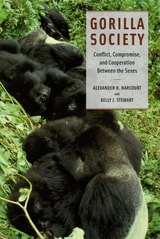
Gorilla Society
Conflict, Compromise, and Cooperation Between the SexesAlexander H. Harcourt and Kelly J. Stewart
University of Chicago Press, 2007
Societies develop as a result of the interactions of individuals as they compete and cooperate with one another in the evolutionary struggle to survive and reproduce successfully. Gorilla society is arranged according to these different and sometimes conflicting evolutionary goals of the sexes. In seeking to understand why gorilla society exists as it does, Alexander H. Harcourt and Kelly J. Stewart bring together extensive data on wild gorillas, collected over decades by numerous researchers working in diverse habitats across Africa, to illustrate how the social system of gorillas has evolved and endured.
Gorilla Society introduces recent theories explaining primate societies, describes gorilla life history, ecology, and social systems, and explores both sexes’ evolutionary strategies of survival and reproduction. With a focus on the future, Harcourt and Stewart conclude with suggestions for future research and conservation. An exemplary work of socioecology from two of the world’s best known gorilla biologists, Gorilla Society will be a landmark study on a par with the work of George Schaller—a synthesis of existing research on these remarkable animals and the societies in which they live.
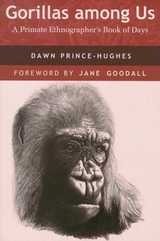
Gorillas among Us
A Primate Ethnographer’s Book of DaysDawn Prince-Hughes; Foreword by Jane Goodall
University of Arizona Press, 2001
Dawn Prince-Hughes is an extraordinary researcher. She does not experiment or measure but instead sits on a wooden bench for hours each day, watching captive gorillas through the enclosure where other visitors average five-second stops. Her patience is rewarded with astounding observations—she watches gorillas make and use tools, bury a dead crow, give birth, and comfort and care for each other.
In Gorillas among Us, Prince-Hughes has compressed years of gorilla observation into a composite diary chronicling the days of one gorilla family. She creates a blended portrait of both peoples—gorilla and human. The entries capture significant observations, which often prompt brief discussions of gorillas’ captivity, diet, communication, aesthetic preferences, social behavior, and play. Several chapters end with thought-provoking meditations on human values. The final section, “More about Gorillas,” provides a concise, accessible introduction to gorilla natural history.
This book will delight and move anyone with an interest in animals, and it also makes a significant contribution to the scarce literature on captive gorillas. Prince-Hughes's observations of tool use by gorillas will interest scientists, and even a casual reader will come away with a new sense of the power of observation. The author hopes to change the way we look at animals in the wild and in captivity, and laments that zoo visitors pause so briefly in front of the gorilla enclosure, rushing on with their assumptions unchanged, without really seeing the gorillas.
By turns opinionated and descriptive, quirky and authoritative, Prince-Hughes draws us into the family life of captive gorillas and into a consideration of our own culture. Readers will learn something new about gorillas and themselves on every page of this poignant story. The book testifies to the potential for interspecies compassion and the love that one person can find in a family of gorillas.
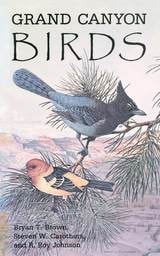
Grand Canyon Birds
Historical Notes, Natural History and EcologyBryan T. Brown
University of Arizona Press, 1987
"Will benefit all amateur naturalists because of its survey of the life zone patterns in [the] southwestern United States." —Science Books & Films
"The subtitle accurately reflects the contents of this excellent book on the birds of a unique natural wonder and national treasure. . . . An annotated checklist discusses the status and abundance of each of the over 300 species of birds known to have occurred in the Grand Canyon region, which is defined here as the river between Glen Canyon Dam and Lake Mead and the contiguous plateaus to the north and south." —Journal of Arizona History