Results by title
2646 books match the query 'History & Criticism' and 55 start with g
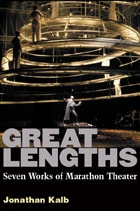
Great Lengths
Seven Works of Marathon TheaterJonathan Kalb
University of Michigan Press, 2013
"Reading this book is certainly a vigorous experience. Kalb's sense of nuance, unpredictability, and the complexity of perception brings these productions to life. He is our surrogate, our scapegoat even, enduring the length of these productions so that he can convey the essence of their power."
---Stanton B. Garner, Jr., University of Tennessee
"Jonathan Kalb takes us on a tour of monumental theater events, which flaunt the rules of economy, Aristotelian and otherwise. Kalb captures these unwieldy marathon productions by skillfully mixing personal experience and scholarly analysis. I read this engaging book in a single sitting---and came away ready to join the first theater marathon I could find."
---Martin Puchner, Harvard University
"Jonathan Kalb's Great Lengths leaps to the head of any class in theatre history. Rich with critical perspective of 'marathon' works by Peter Brook, Tony Kushner, Robert Wilson, and others, and written with panache and lucidity, Kalb's book is filled with suspense as he describes and demystifies more than the post-modern and post-dramatic haunting recent theatre. This is history as present event, embracing the Greeks, Shakespeare, and even Charles Dickens."
---Gordon Rogoff, Yale University
We know that size matters in many areas of human endeavor, but what about works of the imagination? Why do some dramatic creations extend to five hours or more, and how does their extreme length help them accomplish extraordinarily ambitious aims? In Great Lengths, theater critic and scholar Jonathan Kalb addresses these and other questions through a close look at seven internationally prominent theater productions, including Tony Kushner's Angels in America, Robert Wilson's Einstein on the Beach, and the Royal Shakespeare Company's Nicholas Nickleby. This is a book about extreme length, monumental scope, and intensive immersion in the theater in general, written by a passionate spectator reflecting on selected pinnacles of his theatergoing over thirty years.
The book's examples, deliberately chosen for their diversity, range from adapted novels and epics, to dramatic chronicles with macrohistorical and macropolitical implications, to stagings of super-size classic plays, to "postdramatic" works that negotiate the border between life and art. Kalb reconstructs each of the works, re-creating the experience of seeing it while at the same time explaining how it maintained attention and interest over so many hours, and then expanding the scope to embrace a wider view and ask broader questions. The discussion of Nicholas Nickleby, for example, considers melodrama as a basic tool of theatrical communication, and the section on Peter Brook's The Mahabharata explores the ethical problems surrounding theatrical exoticism. The chapter on Einstein on the Beach grows into a reflection on the media-age status of the much-debated Gesamtkunstwerk (or "total artwork") and a reassessment of the long avant-gardist tradition of challenging the primacy of rational language in theater. The essay on Peter Stein's Faust I + II becomes a reflection on the interpretive role of theater directors and the theatrical viability of antitheatrical closet drama. Great Lengths thus offers a remarkable panorama of the surprisingly broad field of contemporary marathon theater---an art form that diverse audiences of savvy, screen-weaned spectators continue to seek out, for the increasingly rare experiences of awe, transcendence, and sustained immersion that it provides.
Great Lengths will appeal to general readers as well as theater specialists. It situates the chosen productions in various historical and critical contexts and engages with the many lively scholarly debates that have swirled around them. At the same time, it uses the productions as springboards for wide-ranging reflections on the basic purpose and enduring power of theater in an attention-challenged, media-saturated era.

Gringos Get Rich
Anti-Americanism in Chilean MusicEunice Rojas
University of Alabama Press, 2024
Documents counterimperialism in Chilean music since the 1960s
Gringos Get Rich: Anti-Americanism in Chilean Music examines anti-Americanism in Latin America as manifested in Chilean music in recent history. From a folk-based movement in the 1960s and early 1970s to underground punk rock groups during the Pinochet regime, to socially conscious hip-hop artists of postdictatorship Chile, Chilean music has followed several left-leaning transnational musical trends to grapple with Chile’s fluctuating relationship with the United States. Eunice Rojas’s innovative analysis introduces US readers to a wide swath of Chilean musicians and their powerful protest songs and provides a representative and long view of the negative influences of the United States in Latin America.
Much of the criticism of the United States in Chile’s music centers on the perception of the United States as a heavy-handed source of capitalist imperialism that is exploitative of and threatening to Chile’s poor and working-class public and to Chilean cultural independence and integrity. Rojas incorporates Antonio Gramsci’s theories about the difficulties of struggles for cultural power within elitist capitalist systems to explore anti-Americanism and anti-capitalist music. Ultimately, Rojas shows how the music from various genres, time periods, and political systems attempts to act as a counterhegemonic alternative to Chile’s political, cultural, and economic status quo.
Rojas’s insight is timely with recent political trends toward the right in the Americas. There is also increased interest in and acceptance of popular song lyrics as literary texts. The book will appeal to Latin Americanists, ethnomusicologists, scholars of popular culture and international relations, students, and general readers.
.
Groove Tube
Sixties Television and the Youth RebellionAniko Bodroghkozy
Duke University Press, 2001
Bodroghkozy argues that, in order to woo an increasingly lucrative baby boomer audience, television had to appeal to the social and political values of a generation of young people who were enmeshed in the hippie counterculture, the antiwar movement, campus protests, urban guerilla action—in general, a culture of rebellion. She takes a close look at the compromises and negotiations that were involved in determining TV content, as well as the ideological difficulties producers and networks faced in attempting to appeal to a youthful cohort so disaffected from dominant institutions. While programs that featured narratives about hippies, draft resisters, or revolutionaries are examined under this lens, Groove Tube doesn’t stop there: it also examines how the nation’s rebellious youth responded to these representations. Bodroghkozy explains how, as members of the first “TV generation,” some made sense of their societal disaffection in part through their childhood experience with this powerful new medium.
Groove Tube will interest sociologists, American historians, students and scholars of television and media studies, and others who want to know more about the 1960s.
Gustav Mahler--Richard Strauss
Correspondence 1888-1911Gustav Mahler and Richard Strauss
University of Chicago Press, 1984
This first publication of their correspondence, which includes twenty-five previously unknown Strauss letters, offers a portrait of two men who were as antithetical in their musical means and goals as in their temperaments and personalities, but who exercised a strong fascination for one another. These sixty-three letters show both composers advancing in their careers as they battled against adverse conditions in the musical world at the turn of the century. They present Mahler's energetic support of Strauss's Symphonia Domestica, which Mahler conducted in 1904 and, in turn, Strauss's championing of Mahler's music, especially the Second and Third Symphonies.
The correspondence is fully annotated and is supplemented with a major essay by Herta Blaukopf.
"Unfailingly absorbing. . . . An indispensable addition to the literature on these composers."—Norman Del Mar, Times Literary Supplement
Guy Debord
Revolution in the Service of PoetryVincent Kaufmann
University of Minnesota Press, 2010
Instead of providing a conventional day-to-day account of Debord's life, Kaufmann deftly locates his subject within the historical and intellectual context of the radical social, political, and artistic movements in which he participated. He traces Debord's development as an intellectual: his involvement with the lettrist movement in the early 1950s, his central role in the Situationist International from 1957 to 1971 and in the events of May 1968, and the productive and frequently misunderstood period between the dissolution of the situationists and his suicide, during which time Debord clarified the rules of his war against inauthenticity.
As Kaufmann makes clear, for Debord political thought and action were inseparable from aesthetics and poetic expression. Whether envisioning the recovery of a lost, protocommunist age of authenticity and transparency in The Society of the Spectacle or critically assessing the possibility of revolution against postmodern capitalism two decades later, Debord advocated and practiced an art of defiance, a concurrently martial and melancholic poetics. Avoiding the mythologies about Debord that both admirers and critics have cultivated, Kaufmann provides a groundbreaking and generous assessment of Debord and his uncompromising struggle against a corrupt civilization.