Results by title
22279 books match the query 'Social Science' and 583 start with g

Gay Fandom and Crossover Stardom
James Dean, Mel Gibson, and Keanu ReevesMichael DeAngelis
Duke University Press, 2001
DeAngelis examines a variety of cultural documents, including studio publicity and promotional campaigns, star biographies, scandal magazines, and film reviews, as well as gay political and fan literature that ranges from the closeted pages of One and Mattachine Review in the 1950s to the very “out” dish columns, listserv postings, and on-line star fantasy narratives of the past decade. At the heart of this close historical study are treatments of particular film narratives, including East of Eden, Rebel Without a Cause, The Road Warrior, Lethal Weapon, My Own Private Idaho, and Speed. Using theories of fantasy and melodrama, Gay Fandom and Crossover Stardom demonstrates how studios, agents, and even stars themselves often actively facilitate an audience’s strategic blurring of the already tenuous distinction between the heterosexual mainstream and the gay margins of American popular culture.
In addition to fans of James Dean, Mel Gibson, and Keanu Reeves, those interested in film history, cultural studies, popular culture, queer theory, gender studies, sociology, psychoanalytic theory, melodrama, fantasy, and fandom will enjoy this book.
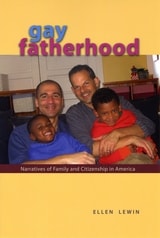
Gay Fatherhood
Narratives of Family and Citizenship in AmericaEllen Lewin
University of Chicago Press, 2009
Men are often thought to have less interest in parenting than women, and gay men are generally assumed to prefer pleasure over responsibility. The toxic combination of these two stereotypical views has led to a lack of serious attention being paid to the experiences of gay fathers. But the truth is that more and more gay men are setting out to become parents and succeeding—and Gay Fatherhood aims to tell their stories.
Ellen Lewin takes as her focus people who undertake the difficult process of becoming fathers as gay men, rather than having become fathers while married to women. These men face unique challenges in their quest for fatherhood, negotiating specific bureaucratic and financial conditions as they pursue adoption or surrogacy and juggling questions about their future child’s race, age, sex, and health. Gay Fatherhood chronicles the lives of these men, exploring how they cope with political attacks from both the "family values" right and the "radical queer" left—while also shedding light on the evolving meanings of family in twenty-first-century America.

Gay Latino Studies
A Critical ReaderMichael Hames-García and Ernesto Javier Martínez, eds.
Duke University Press, 2011
Contributors. Tomás Almaguer, Luz Calvo, Lionel Cantú,, Daniel Contreras, Catriona Rueda Esquibel, Ramón García, Ramón A. Gutiérrez, Michael Hames-García, Lawrence La Fountain-Stokes, María Lugones, Ernesto J. Martínez, Paula M. L. Moya, José Esteban Muñoz, Frances Negrón-Muntaner, Ricardo L. Ortiz, Daniel Enrique Pérez, Ramón H. Rivera-Servera, Richard T. Rodríguez, David Román, Horacio N. Roque Ramírez, Antonio Viego

Gay Liberation after May '68
Guy Hocquenghem
Duke University Press, 2022

Gay Lives
Homosexual Autobiography from John Addington Symonds to Paul MonettePaul Robinson
University of Chicago Press, 1999
Paul Robinson reads the memoirs of French, British, and American gay authors—André Gide, Quentin Crisp, and Martin Duberman, among others—through the prism of sexual identity, asking fascinating questions about homosexuality and its relation to literary form. How did these authors discover their sexual identity? Did they embrace it or reject it? How did they express often conflicted desires in their words, which ranged from defiant and brutally frank to ambiguous and abstract? Robinson considers the choices each made—as a man and an author—to accommodate himself to society's homophobia or live in protest against his oppression.
Despite the threads that connect these stories, Gay Lives refutes the notion that there is a typical homosexual "career" by showing that gay men have led wildly dissimilar lives—from the exuberant to the miserable—and that they have found no less dissimilar meanings in those lives.

Gay Men at the Movies
Cinema, Memory and the History of a Gay Male CommunityScott McKinnon
Intellect Books, 2016

Gay Men's Friendships
Invincible CommunitiesPeter M. Nardi
University of Chicago Press, 1999
Nardi explores the meaning of friends to some gay men, how friends often become a surrogate family, how sexual behavior and attraction affects these friendships, and how, for many, friends mean more and last longer than romantic relationships. While looking at the psychological joys and sorrows of friendship, he also considers the cultural constraints limiting gay men in contemporary urban America—especially those that deal with dominant images of masculinity and heterosexuality—and how they relate to friendship.
By listening to gay men talk about their interactions, Nardi offers a rare glimpse into the mechanisms of gay life. We learn how gay men meet their friends, what they typically do and talk about, and how these strong relationships contain the roots of larger cultural forces such as social movements and gay identities and neighborhoods. Nardi also points out the political and social consequences when friendships fail to provide support against oppression.
An intimate and informative look at gay life in urban America, Gay Men's Friendships ultimately shows how these relationships challenge the gender order of our society by questioning how masculinity is constructed and by offering a model for a more creative blending of gay and heterosexual masculinity.

Gay Print Culture
A Transnational History of North AmericaJuan Carlos Mezo González
Duke University Press, 2026

Gay Priori
A Queer Critical Legal Studies Approach to Law ReformLibby Adler
Duke University Press, 2018

Gay Rights at the Ballot Box
Amy L. Stone
University of Minnesota Press, 2012
The passage of the anti-gay marriage Proposition 8 in California in 2008 stunned gay rights activists across the country. Although facing a well-funded campaign in support of the ballot measure, LGBT activists had good reasons for optimism, including the size and strength of their campaign. Since 1974, the LGBT movement has fought 146 anti-gay ballot initiatives sponsored by the religious right and has developed innovative strategies to oppose these measures. In Gay Rights at the Ballot Box, Amy L. Stone examines how the tactics of LGBT activists have evolved and unravels the complex relationship between ballot measure campaigns and the broader goals of the LGBT movement.
The first comprehensive history of anti-gay ballot measures, both those merely attempted and those successfully put before voters, this book draws on archival research and interviews with more than one hundred LGBT activists to provide a detailed account of the campaigns to stop such ballot measures from passing into law. As Stone shows through in-depth case studies, although LGBT activists lost the vast majority of these fights, they also won significant statewide victories in Oregon in 1992 and Arizona in 2006, and local successes, including ones in Ypsilanti, Michigan, in 1998 and 2002.
Stone analyzes how LGBT activists constantly refined their campaign tactics in response to both victories and defeats. She also stresses that such campaigns have played both a complementary and contradictory role within the LGBT movement. Specific anti-ballot campaigns and the broader movement do often strengthen each other. However, ballot measure campaigns sometimes distract activists from the movement’s more general goals, and activists at the movement level can pressure local campaigns to take on more than they can handle. With gay rights coming under increasing assault from the religious right, this book is a vital resource for LGBT activists and others working to block their efforts.

Gay Shame
Edited by David M. Halperin and Valerie Traub
University of Chicago Press, 2009
Gay Shame seeks to lift this unofficial ban on the investigation of homosexuality and shame by presenting critical work from the most vibrant frontier in contemporary queer studies. An esteemed list of contributors tackles a range of issues—questions of emotion, disreputable sexual histories, dissident gender identities, and embarrassing figures and moments in gay history—as they explore the possibility of reclaiming shame as a new, even productive, way to examine lesbian and gay culture.

Gay TV and Straight America
Becker, Ron
Rutgers University Press, 2006
After decades of silence on the subject of homosexuality, television in the 1990s saw a striking increase in programming that incorporated and, in many cases, centered on gay material. In shows including Friends, Seinfeld, Party of Five, Homicide, Suddenly Susan, The Commish, Ellen, Will & Grace, and others, gay characters were introduced, references to homosexuality became commonplace, and issues of gay and lesbian relationships were explored, often in explicit detail.
In Gay TV and Straight America, Ron Becker draws on a wide range of political and cultural indicators to explain this sudden upsurge of gay material on prime-time network television. Bringing together analysis of relevant Supreme Court rulings, media coverage of gay rights battles, debates about multiculturalism, concerns over political correctness, and much more, Becker's assessment helps us understand how and why televised gayness was constructed by a specific culture of tastemakers during the decade.
On one hand the evidence points to network business strategies that embraced gay material as a valuable tool for targeting a quality audience of well-educated, upscale adults looking for something "edgy" to watch. But, Becker also argues that the increase of gay material in the public eye creates growing mainstream anxiety in reaction to the seemingly civil public conversation about equal rights.
In today's cultural climate where controversies rage over issues of gay marriage yet millions of viewers tune in weekly to programs like Queer Eye for the Straight Guy, this book offers valuable insight to the complex condition of America's sexual politics.
Gay, Inc.
The Nonprofitization of Queer PoliticsMyrl Beam
University of Minnesota Press, 2018
A bold and provocative look at how the nonprofit sphere’s expansion has helped—and hindered—the LGBT cause
What if the very structure on which social movements rely, the nonprofit system, is reinforcing the inequalities activists seek to eliminate? That is the question at the heart of this bold reassessment of the system’s massive expansion since the mid-1960s. Focusing on the LGBT movement, Myrl Beam argues that the conservative turn in queer movement politics, as exemplified by the shift toward marriage and legal equality, is due mostly to the movement’s embrace of the nonprofit structure.
Based on oral histories as well as archival research, and drawing on the author’s own extensive activist work, Gay, Inc. presents four compelling case studies. Beam looks at how people at LGBT nonprofits in Minneapolis and Chicago grapple with the contradictions between radical queer social movements and their institutionalized iterations. Through interview subjects’ incisive, funny, and heartbreaking commentaries, Beam exposes a complex world of committed people doing the best they can to effect change, and the flawed structures in which they participate, rail against, ignore, and make do.
Providing a critical look at a social formation whose sanctified place in the national imagination has for too long gone unquestioned, Gay, Inc. marks a significant contribution to scholarship on sexuality, neoliberalism, and social movements.
Gaza on Screen
Nadia Yaqub, editor
Duke University Press, 2023
Contributors. Nayrouz Abu Hatoum, Shahd Abusalama, Samirah Alkassim, Basma Alsharif, Hadeel Assali, Azza El-Hassan, Hatim El-Hibri, Mohamed Jabaly, Ahmed Mansour, Arab Nasser, Tarzan Nasser, Kamran Rastegar, Viviane Saglier, Abdelsalam Shehada, Yaron Shemer, Rebecca L. Stein, Helga Tawil-Souri, Shaira Vadasaria, Nadia Yaqub

Gaze and Voice as Love Objects
SIC 1Renata Salecl and Slavoj Žižek, eds.
Duke University Press, 1996
The first detailed Lacanian elaboration of this topic, Gaze and Voice as Love Objects examines the status of gaze, voice, and love in philosophy from Plato to Kant, in ideology from early Christianity to contemporary cynicism, in music from Hildegard of Bingen to Richard Wagner, in literature from Edith Wharton's Age of Innocence to Kazuo Ishiguro's The Remains of the Day, and in cinema from Michael Powell's Peeping Tom to Kieslowski's A Short Film on Love. Throughout, the contributors seek to show that the conflict between the sexes is the site of a larger battle over the destiny of modernity. With insights into the underlying target of racist and sexist violence, this book offers surprising revelations into the nature of an ancient enigma—love.
Contributors. Elisabeth Bronfen, Mladen Dolar, Fredric Jameson, Renata Salecl, Slavoj Žižek, Alenka Zupancic

Gen Z, Explained
The Art of Living in a Digital AgeRoberta Katz, Sarah Ogilvie, Jane Shaw, and Linda Woodhead
University of Chicago Press, 2021
Born since the mid-1990s, members of Generation Z comprise the first generation never to know the world without the internet, and the most diverse generation yet. As Gen Z starts to emerge into adulthood and enter the workforce, what do we really know about them? And what can we learn from them? Gen Z, Explained is the authoritative portrait of this significant generation. It draws on extensive interviews that display this generation’s candor, surveys that explore their views and attitudes, and a vast database of their astonishingly inventive lexicon to build a comprehensive picture of their values, daily lives, and outlook. Gen Z emerges here as an extraordinarily thoughtful, promising, and perceptive generation that is sounding a warning to their elders about the world around them—a warning of a complexity and depth the “OK Boomer” phenomenon can only suggest.
Much of the existing literature about Gen Z has been highly judgmental. In contrast, this book provides a deep and nuanced understanding of a generation facing a future of enormous challenges, from climate change to civil unrest. What’s more, they are facing this future head-on, relying on themselves and their peers to work collaboratively to solve these problems. As Gen Z, Explained shows, this group of young people is as compassionate and imaginative as any that has come before, and understanding the way they tackle problems may enable us to envision new kinds of solutions. This portrait of Gen Z is ultimately an optimistic one, suggesting they have something to teach all of us about how to live and thrive in this digital world.

GenXegesis
Essays on Alternative Youth (Sub)CultureJohn M. Ulrich
University of Wisconsin Press, 2003
Resituating the term in its neglected (sub)cultural context, the contributors offer a critical assessment of the "Generation X" phenomenon and its relation to the fashioning of differing identities within and against the mainstream. The essays explore a variety of topics, including punk subculture, alternative music, reality television, postmodernism, and the Internet. Together, the contributors share a refreshingly self-conscious approach to Generation X’s precarious, often paradoxical position as an alternative to the mainstream. This collection will be enjoyed by scholars, graduate and undergraduate students, and anyone interested in popular culture, including Gen-Xers themselves.
Gender Differences in Public Opinion
Values and Political ConsequencesMary-Kate Lizotte
Temple University Press, 2020
In this era in which more women are running for public office—and when there is increased activism among women—understanding gender differences on political issues has become critical. In her cogent study, Mary-Kate Lizotte argues that assessing the gender gap in public support for policies through a values lens provides insight into American politics today. There is ample evidence that men and women differ in their value endorsements—even when taking into account factors such as education, class, race, income, and party identification.
In Gender Differences in Public Opinion, Lizotte utilizes nationally representative data, mainly from the American National Election Study, to study these gender gaps, the explanatory power of values, and the political consequences of these differences. She examines the gender differences in several policy areas such as equal rights, gun control, the death penalty, and the environment, as well as social welfare issues. The result is an insightful and revealing study of how men and women vary in their policy positions and political attitudes.
Gender Equity in Education
An Annotated BibliographyBeverly Stitt
Southern Illinois University Press, 1994
Recent studies show that, either consciously or unconsciously, teachers are not practicing gender equity in the classroom. Boys are called on more in class than girls and are encouraged to pursue careers from which girls are excluded because they are thought to be less capable.
Serious questions arise for educators and counselors in this time of increasing awareness of the implications of gender bias, such as what comprises a gender-fair education and how can gender equity become part of the classroom curriculum? Guidance counselors and teachers share an important responsibility in seeking answers to these questions in order to avoid limiting students’ potential because of gender.
To achieve this end, Beverly A. Stitt has compiled an annotated bibliography of hundreds of books, articles, videos, classroom activities, and curriculum and workshop guides to help provide the tools needed for educators to become more gender conscious and to develop a gender–fair educational system.
The bibliography is divided into twenty-three categories under the headings of Agriculture and Industry, Business, Career Guidance, Communications, Computers, Discrimination, Displaced Homemakers/Reentry Women, Elementary Education, Family and Work Issues, Gender Role Stereotyping, History, Home Economics, In-service Training, Legislation, Male Focus, Math and Science, Nontraditional Careers, Pregnant and Parenting Teens, Recruitment, Special Needs, Teaching, Vocational Education, and Women’s Studies.
Each entry’s annotation provides a short description of the content, the age group to which the resource applies, and ordering information. The book concludes with an index in which entries are cross-referenced under various categories to further aid the reader’s research.
Gender Flashpoints
The Power of DialogueAbigail C. Saguy
Russell Sage Foundation, 2026
Americans are deeply divided about gender. Like other issues in the U.S., debates about gender are extremely polarized and can spark intense anger and conflict. These “gender flashpoints” include gender identity, gender and parenting, gender-neutral restrooms, the use of identifying pronouns, and participation in women’s sports. Even the term gender itself has become contested. In this divisive social context, advocates on both sides have reduced complex issues to all-or-nothing propositions. Many people are confused about these topics, embarrassed about what they do not know, or afraid that they will be called a bigot if they say the “wrong thing.” In Gender Flashpoints, sociologist Abigail C. Saguy gets to the root of these major disagreements about gender.
Saguy interviews activists across the full political spectrum about a wide range of contemporary debates over gender to better understand points of contention as well as surprising areas of agreement. She finds that at the crux of many of these debates are disputes about the goals of gender-related advocacy, the strategies to achieve these goals, and whose rights are being advocated for. For example, when discussing pregnancy-related policy issues, there is disagreement as to whether the term “pregnant person” or “pregnant woman” should be used. While some believe “pregnant person” affirms the existence of nonbinary people and trans men, others believe it erases women. These differences often appear to be simply about language, but they are, in fact, disagreements on worldviews, identities, and legitimacy.
One of the conflicts Saguy dives into is the issue of gender-neutral restrooms. She finds when interviewing different activists about what they thought of the topic, they initially repeated the familiar, mainstream polarized discourse. LGBTQ+ activists and mainstream feminists emphasized the importance of restroom access, especially for transgender and gender-nonconforming people. Conservatives and gender-critical feminists emphasized women’s and girls’ vulnerability and need for privacy and safety in public restrooms. Across the political spectrum, activists spoke about how those on the “other side” were unwilling to engage in productive dialogue. However, Saguy also finds that activists on both sides recognized the complexity of the issue and agreed on the need for public bathrooms that provided everyone with greater safety and privacy. Activists across the spectrum showed enthusiasm for desegregated public restrooms that include an open space for sinks and mirrors—along with toilets with European style, fully enclosed floor-to-ceiling doors. Saguy advocates for engaging in dialogue about charged issues, such as gender-neutral bathrooms, in order to help identify workable solutions to seemingly intractable social problems.
Gender Flashpoints is a fascinating and comprehensive view of the deeply personal and divisive topic of gender that offers hope for finding common ground and a path forward.
Gender Influences
Reading Student TextsDonnalee Rubin. Foreword by Nan Johnson
Southern Illinois University Press, 1993
Donnalee Rubin examines the responses of thirty-one freshman composition teachers to student writing and shows the negative effects of gender bias on assessment to prove that gender perceptions and expectations can influence assessment decisions that seem neutral on the surface. Arguing that certain pedagogies are more likely to minimize gender bias than others, Rubin believes that teachers are more likely to overcome the influence of gender bias on their teaching if they adopt a process-based method and work intimately with their students through nondirective, supportive conferences.
Rubin characterizes the conference/process-centered class as the type of environment in which maternal teaching can be cultivated. She stresses that maternal can describe any teacher, male or female, who exhibits the nurturing and supportive qualities that the conference/process approach embodies. With a primary focus on the student’s well-being and development as a person and a writer, the maternal teacher is in a better position to overcome gender bias that could distort the interpretation of student texts. In order for writing instructors to increase their sensitivity to gender issues in assessment, Rubin recommends that they self-consciously engage in what she calls "responsive reading." Responsive reading occurs when the teacher reads with an eye toward providing the sorts of supportive feedback and dialectic exchange that will encourage student writers to think for themselves and to revise effectively. Rubin argues that when teachers commit to a responsive-reading pedagogy, they are more likely to question their reactions to student writing along the lines of gender influence and to strive for self-conscious awareness of how their own inner male-female voices may distort their reading of student texts. She challenges all writing teachers to become more aware of the inevitable challenge gender influence presents.

Gender Is a Weapon
Liberalism, Difference, and US CounterinsurgencyElizabeth Mesok
University of Michigan Press, 2026
Following the end of the draft in 1973, the US military increasingly offered women the opportunity to transform their lives—to obtain an education, receive healthcare, provide for their families, and prove their worth to the nation. By the time the US invaded Iraq and Afghanistan at the turn of the twenty-first century, the labor of women—and Black women in particular—was critical to the military’s ability to simultaneously wage two wars. Within the context of counterinsurgencies fought amid civilian populations, the US military discovered the value of women’s gender difference as a weapon of war.
Through ethnographic and archival research with women soldiers and Marines, as well as military and government officials, Gender Is a Weapon contextualizes women’s service in Iraq and Afghanistan against the promises of liberal inclusion unfolding throughout the late twentieth and early twenty-first century. Centered on narratives of Black and Indigenous women, women of color, immigrant women, and queer women, the book analyzes the transformations of martial citizenship; the racialized language of cultural difference in the US’s revitalized counterinsurgency doctrine; the gendered performances of women in combat and civilian engagement missions; and ultimately, the irreparable injuries of body and mind with which these women returned home. The epilogue discusses the recent dismantling of DEI in the military and US government more broadly, reflecting on what we can learn from the violent history of military liberal inclusion to help us better understand our contemporary moment. By carefully attending to both the discursive construction and performative enactment of gender in militarized and securitized contexts, the book advances theoretical frames for studying gender in state militaries, militarism, and late liberalism.

Gender Justice
David Kirp, Mark Yudof, and Marlene Franks Strong
University of Chicago Press, 1985

Gender Knot Revised Ed
Unraveling Our Patriarchal LegacyAllan Johnson
Temple University Press, 2005
* the core characteristics of patriarchy and its power as a social system
* the relationship between individuals and social systems
* "men's movement" assessments of patriarchy and gender inequality
* key—and controversial—terms such as sexism, privilege, and political correctness
Gender Matters
Rereading Michelle Z. RosaldoAlejandro Lugo and Bill Maurer, Editors
University of Michigan Press, 2000
With the publication of Woman, Culture, and Society in 1974, Michelle Rosaldo initiated nothing less than a reconstruction of anthropology that placed feminist analysis at the center of the discipline. Through a rereading of Rosaldo's ideas and arguments, this collection provides in-depth analysis of Rosaldo's many contributions to anthropology and feminism. Each of the essays derives theoretically and politically useful insights from Rosaldo's work and sets them in motion for new intellectual and political practices. The authors do not always share Rosaldo's perspectives, nor do they necessarily agree with each other. But, together, they point to exciting syntheses of old and new feminist theory and practice.
Alejandro Lugo is Assistant Professor of Anthropology and Latina/o Studies, University of Illinois at Urbana-Champaign. Bill Maurer is Assistant Professor of Anthropology, University of California at Irvine.
Gender Meets Genre in Postwar Cinemas
Edited by Christine Gledhill
University of Illinois Press, 2012
This remarkable collection uses genre as a fresh way to analyze the issues of gender representation in film theory, film production, spectatorship, and the contexts of reception. With a uniquely global perspective, these essays examine the intersection of gender and genre in not only Hollywood films but also in independent, European, Indian, and Hong Kong cinemas. Working in the area of postcolonial cinema, contributors raise issues dealing with indigenous and global cinemas and argue that contemporary genres have shifted considerably as both notions of gender and forms of genre have changed. The volume addresses topics such as the history of feminist approaches to the study of genre in film, issues of female agency in postmodernity, changes taking place in supposedly male-dominated genres, concepts of genre and its use of gender in global cinema, and the relationship between gender and sexuality in film.
Gender Nonconformity, Race, and Sexuality
Charting the ConnectionsToni Lester
University of Wisconsin Press, 2002
How are culturally constructed stereotypes about appropriate sex-based behavior formed? If a person who is biologically female behaves in a stereotypically masculine manner, what are the social, political, and cultural forces that may police her behavior? And how will she manage her gendered image in response to that policing? Finally, how do race, ethnicity, or sexuality inform the way that sex-based roles are constructed, policed, or managed?
The chapters in this book address such questions from social science perspectives and then examine personal stories of reinvention and transformation, including discussions of the lives of dancers Isadora Duncan and Bill T. Jones, playwright Lorraine Hansberry, and surrealist artist Claude Cahun.Writers from fields as diverse as history, art, psychology, law, literature, sociology, and the activist community look at gender nonconformity from conceptual, theoretical, and empirical perspectives. They emphasize that gender nonconformists can be gay, lesbian, bisexual, transgender, or anyone else who does not fit a model of Caucasian heterosexual behavior characterized by binary masculine and feminine roles.
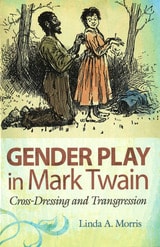
Gender Play in Mark Twain
Cross-Dressing and TransgressionLinda A. Morris
University of Missouri Press, 2007
Huckleberry Finn dressing as a girl is a famously comic scene in Mark Twain’s novel but hardly out of character—for the author, that is. Twain “troubled gender” in much of his otherwise traditional fiction, depicting children whose sexual identities are switched at birth, tomboys, same-sex married couples, and even a male French painter who impersonates his own fictive sister and becomes engaged to another man.
This book explores Mark Twain’s extensive use of cross-dressing across his career by exposing the substantial cast of characters who masqueraded as members of the opposite sex or who otherwise defied gender expectations. Linda Morris grounds her study in an understanding of the era’s theatrical cross-dressing and changing mores and even events in the Clemens household. She examines and interprets Twain’s exploration of characters who transgress gendered conventions while tracing the degree to which themes of gender disruption interact with other themes, such as his critique of race, his concern with death in his classic “boys’ books,” and his career-long preoccupation with twins and twinning.
Approaching familiar texts in surprising new ways, Morris reexamines the relationship between Huck and Jim; discusses racial and gender crossing in Pudd’nhead Wilson; and sheds new light on Twain’s difficulty in depicting the most famous cross-dresser in history, Joan of Arc. She also considers a number of his later “transvestite tales” that feature transgressive figures such as Hellfire Hotchkiss, who is hampered by her “misplaced sex.”
Morris challenges views of Twain that see his work as reinforcing traditional notions of gender along sharply divided lines. She shows that Twain depicts cross-dressing sometimes as comic or absurd, other times as darkly tragic—but that even at his most playful, he contests traditional Victorian notions about the fixity of gender roles.
Analyzing such characteristics of Twain’s fiction as his fascination with details of clothing and the ever-present element of play, Morris shows us his understanding that gender, like race, is a social construction—and above all a performance. Gender Play in Mark Twain: Cross-Dressing and Transgression broadens our understanding of the writer as it lends rich insight into his works.
Gender Play
Girls and Boys in SchoolThorne, Barrie
Rutgers University Press, 1993
Thorne observes children in schools in working-class communities, emphasizing the experiences of fourth and fifth graders. Most of the children she observed were white, but a sizable minority were Latino, Chicano, or African American. Thorne argues that the organization and meaning of gender are influenced by age, ethnicity, race, sexuality, and social class, and that they shift with social context. She sees gender identity not through the lens of individual socialization or difference, but rather as a social process involving groups of children. Thorne takes us on a fascinating journey of discovery, provides new insights about children, and offers teachers practical suggestions for increasing cooperative mixed-gender interaction.
Gender Play
Girls and Boys in SchoolBarrie Thorne
Rutgers University Press, 2024
A detailed and perceptive ethnography told with compassion and humor, Gender Play immerses readers in the everyday lives of a group of working-class children to examine the social interactions that shape their gender identities. This new Rutgers Classic edition of Gender Play contains an introduction from leading sociologists of gender Michael A. Messner and Raewyn Connell that places Thorne’s innovative research in historical context. It also includes a new afterword by one of Thorne’s own students, acclaimed sociologist C.J. Pascoe, reflecting on both the lasting influence of Thorne’s work and the ways that American children’s understandings of gender have shifted in the past thirty years.

Gender Politics And MTV
Voicing the DifferenceLisa Lewis
Temple University Press, 1991

Gender Politics
Citizenship, Activism and Sexual DiversitySurya Monro
Pluto Press, 2005
Gender Power, Leadership, and Governance
Georgia Duerst-Lahti and Rita Mae Kelly, Editors
University of Michigan Press, 1995
Gender Quotas and Democratic Participation
Recruiting Candidates for Elective Offices in GermanyLouise K. Davidson-Schmich
University of Michigan Press, 2016
Gender Relations in German History
Power, Agency, and Experience from the Sixteenth to the Twentieth CenturyLynn Abrams and Elizabeth Harvey, eds.
Duke University Press, 1997
Topics include childbirth, abortion, and the female body in early modern Germany; the roots of German feminism; gender, class, and medicine during World War I and during the Weimar republic; female homosexuality during the Nazi period; East and West German reconstruction following World War II and the formation of a gendered consumer culture.
This book will stimulate readers to think more deeply about the importance of gender in German history, and prove to be an invaluable resource for those interested in women’s studies and in German and European history.
Contributors. Lynn Abrams, Elizabeth Harvey, Dagmar Herzog, Kate Lacey, Katherine Pence, Ulinka Rublack, Claudia Schoppman, Regina Schulte, Cornelie Usborne, Heide Wunder
Gender Roles and Faculty Lives in Rhetoric and Composition
Theresa Enos
Southern Illinois University Press, 1997
Combining anecdotal evidence (the personal stories of rhetoric and composition teachers) with hard data, Theresa Enos offers documentation for what many have long suspected to be true: lower-division writing courses in colleges and universities are staffed primarily by women who receive minimal pay, little prestige, and lessened job security in comparison to their male counterparts. Male writing faculty, however, also are affected by factors such as low salaries because of the undervaluation of a field considered feminized. As Enos notes in her preface: "The rhetoric of our institutional lives is connected especially to the negotiations of gender roles in rhetoric and composition."
Enos describes and classifies narratives gathered from surveys, interviews, and campus visits and interweaves these narratives with statistical data gathered from national surveys that show gendered experiences in the profession. Enos discusses the ways in which these experiences affect the working conditions of writing teachers and administrators in various programs at different types of institutions.
Enos points out that fields in which women excel—and are acknowledged—receive less prestige than other fields. On the university level, those genres in which women have demonstrated competence are not taken as seriously as those dominated by men. In practical terms, academia affords more glory for teaching literature than for teaching rhetoric and composition.
Within the field of rhetoric and composition, however, Enos finds it difficult to determine why the accomplishments of women receive less credit than those of men. She speculates as to whether it is part of the larger pattern in society—and in academia—to value men more than women or something in the field itself that keeps women from real power, even though women make up the majority of composition and rhetoric teachers.
Enos provides fascinating personal histories of composition and rhetoric teachers whose work has been largely disregarded. She also provides information about writing programs, teaching, administrative responsibilities, ranks among teachers, ages, salary, tenure status, distribution of research, service responsibilities, records of publication, and promotion and tenure guidelines.

Gender Studies
New Directions in Feminist CriticismJudith A. Spector
University of Wisconsin Press, 1986

Gender Thinking
Steven G. Smith
Temple University Press, 1992
How can we accept the gender system in view of its ills? Yet, are we really at liberty to abolish gender differences, "when the gender system gives us benchmarks of personal identity and worth along with primary channels in which to pursue the rewards of love?" With this double question, Steven G. Smith introduces his inquiry into the idea of gender and how it is implicated in love, respect, equality, and personal character. Gender Thinking is the first comprehensive philosophical exploration of the concept of gender Asking the question, what is gender?—that is, what sort of thing do we take femininity and masculinity to be?—Smith considers how gender thinking is interwoven with ideas about human nature. He suggests ways in which ideas about race, class, culture age, temperament, and sexual orientation can be understood from clues found in gender thinking. And he calls for a renegotiated procreative partnership between women and men as the key to the redemption of gender.

Gender Violence and the Press
The St. Kizito StoryH. Leslie Steeves
Ohio University Press, 1997

Gender Violence and the Transnational Politics of the Honor Crime
Dana M. Olwan
The Ohio State University Press, 2021
More specifically, Olwan traces the term’s appearance in public and popular works that allow for its continued mass acceptance and circulation—from media depictions in Canada and beyond, to how it is taken up in national registers about migration and belonging in the US, to activism in Palestine that reveal the fault lines between activist and academic critiques of the honor crime, and finally to feminist efforts in Jordan and the wider Middle East to confront legal codes used to sanction gender-related violence. Through these cases, Olwan demonstrates how the honor crime functions as a signifier that governs and manages populations and how its meanings travel and circulate across and between separate and interconnected circuits of power and knowledge.

Gender Violence at the U.S.–Mexico Border
Media Representation and Public ResponseEdited by Héctor Domínguez-Ruvalcaba and Ignacio Corona
University of Arizona Press, 2012
Gender Violence in Peace and War
States of ComplicitySanford, Victoria
Rutgers University Press, 2016

Gender and Agricultural Development
Surveying the FieldEdited by Helen K. Henderson
University of Arizona Press, 1995
This book is both a resource guide and a review of major issues in gender and agriculture which demonstrates that recognizing the contribution of women to agricultural production is a necessary step in development planning. It presents relevant information and research literature regarding women's roles in agriculture in a consolidated and accessible format, offering insights into how the inclusion or exclusion of appropriate information at the planning stage can have an impact during implementation. It also provides guidelines for locating information on gender-related agricultural issues and incorporating it into development planning, research, and training. The literature reviewed not only calls attention to the work women do in order to improve their access to technology and training but also challenges existing development paradigms. The issues discussed present women's experiences and local knowledge and allude to gender and class inequities that farming women face. Each chapter is intended to help the reader address major gender issues in a specific subject in order to access relevant information and thereby better design and implement appropriate agricultural planning and policies.
By synthesizing twenty years of international research, Gender and Agricultural Development provides an effective tool for development practitioners to use in training programs or surveys in order to ensure the appropriate collection of gender disaggregated data and for educators to integrate gender issues into courses dealing with social aspects of agricultural systems. Its findings are presented in such a way as to allow them to be easily incorporated into innovative planning for more sustainable and equitable agricultural policies.
Gender and American Jews
Patterns in Work, Education, and Family in Contemporary LifeHarriet Hartman and Moshe Hartman
Brandeis University Press, 2009
Gender and Difference in the Middle Ages
Sharon Farmer
University of Minnesota Press, 2002
Exposes complex intersections between genders and other identities in medieval cultures.
Nothing less than a rethinking of what we mean when we talk about "men" and "women" of the medieval period, this volume demonstrates how the idea of gender-in the Middle Ages no less than now-intersected in subtle and complex ways with other categories of difference. Responding to the insights of postcolonial and feminist theory, the authors show that medieval identities emerged through shifting paradigms-that fluidity, conflict, and contingency characterized not only gender, but also sexuality, social status, and religion. This view emerges through essays that delve into a wide variety of cultures and draw on a broad range of disciplinary and theoretical approaches. Scholars in the fields of history as well as literary and religious studies consider gendered hierarchies in western Christian, Jewish, Byzantine, and Islamic areas of the medieval world.
Contributors: Daniel Boyarin, U of California, Berkeley; Ruth Mazo Karras, U of Minnesota; Mathew Kuefler, San Diego State U; Martha Newman, U of Texas; Kathryn M. Ringrose, U of California, San Diego; Elizabeth Robertson, U of Colorado; Everett Rowson, U of Pennsylvania; Michael Uebel, U of Kentucky; Ulrike Wiethaus, Wake Forest U.
Gender and Family Issues in the Workplace
Francine D. Blau
Russell Sage Foundation, 1997
Gender and International Migration
KATHARINE M. DONATO is professor and chair of sociology at Vanderbilt University. DONNA GABACCIA is professor of history in the Department of Historical and Cultural Studies at the University of Toronto-Scarborough.
Russell Sage Foundation, 2015
Gender and International Relations
An IntroductionSteans, Jill
Rutgers University Press, 1998
Until relatively recently, little had been written about gender issues in international relations despite the increased importance of the study of gender in other areas of the social sciences. Gender and International Relations fills that gap, providing a clear and accessible guide to the study of gender issues, feminist theories, and international relations. Steans illustrates how gender is central to nationalisms and political identity, the state, citizenship and conceptions of political community, security, and global political economy and development. Drawing on feminist scholarship from across the social sciences, she demonstrates the uses of feminism as critique. She also introduces readers to contemporary theoretical debates in international relations using concrete concerns and easily understandable issues to ground the discussion.
The book does not construct a single feminist theory of international relations nor does it advance a particular perspective of how gender can best be understood in an international or global context. Rather, the book argues that feminist theories have collectively produced insights crucial to the study of international relations and that these insights can be used to challenge conventional approaches to the discipline.

Gender and International Relations
An IntroductionSteans, Jill
Rutgers University Press, 1998
Until relatively recently, little had been written about gender issues in international relations despite the increased importance of the study of gender in other areas of the social sciences. Gender and International Relations fills that gap, providing a clear and accessible guide to the study of gender issues, feminist theories, and international relations. Steans illustrates how gender is central to nationalisms and political identity, the state, citizenship and conceptions of political community, security, and global political economy and development. Drawing on feminist scholarship from across the social sciences, she demonstrates the uses of feminism as critique. She also introduces readers to contemporary theoretical debates in international relations using concrete concerns and easily understandable issues to ground the discussion.
The book does not construct a single feminist theory of international relations nor does it advance a particular perspective of how gender can best be understood in an international or global context. Rather, the book argues that feminist theories have collectively produced insights crucial to the study of international relations and that these insights can be used to challenge conventional approaches to the discipline.
Gender and Modernity in Andean Bolivia
By Marcia Stephenson
University of Texas Press, 1999
In Andean Bolivia, racial and cultural differences are most visibly marked on women, who often still wear native dress and speak an indigenous language rather than Spanish. In this study of modernity in Bolivia, Marcia Stephenson explores how the state's desire for a racially and culturally homogenous society has been deployed through images of womanhood that promote the notion of an idealized, acculturated female body.
Stephenson engages a variety of texts—critical essays, novels, indigenous testimonials, education manuals, self-help pamphlets, and position papers of diverse women's organizations—to analyze how the interlocking tropes of fashion, motherhood, domestication, hygiene, and hunger are used as tools for the production of dominant, racialized ideologies of womanhood. At the same time, she also uncovers long-standing patterns of resistance to the modernizing impulse, especially in the large-scale mobilization of indigenous peoples who have made it clear that they will negotiate the terms of modernity, but always "as Indians."