Results by title
4038 books match the query 'Social aspects' and 118 start with g
Gestures of Concern
Chris Ingraham
Duke University Press, 2020
Get Shown the Light
Improvisation and Transcendence in the Music of the Grateful DeadMichael Kaler
Duke University Press, 2023

Getting Loose
Lifestyle Consumption in the 1970sSam Binkley
Duke University Press, 2007
Through a sociological analysis of the countercultural print culture of the 1970s, Sam Binkley investigates the dissemination of these self-loosening narratives and their widespread appeal to America’s middle class. He describes the rise of a genre of lifestyle publishing that emerged from a network of small offbeat presses, mostly located on the West Coast. Amateurish and rough in production quality, these popular books and magazines blended Eastern mysticism, Freudian psychology, environmental ecology, and romantic American pastoralism as they offered “expert” advice—about how to be more in touch with the natural world, how to release oneself into trusting relationships with others, and how to delve deeper into the body’s rhythms and natural sensuality. Binkley examines dozens of these publications, including the Whole Earth Catalog, Rainbook, the Catalog of Sexual Consciousness, Celery Wine, Domebook, and Getting Clear.
Drawing on the thought of Pierre Bourdieu, Zygmunt Bauman, and others, Binkley explains how self-loosening narratives helped the middle class confront the modernity of the 1970s. As rapid social change and political upheaval eroded middle-class cultural authority, the looser life provided opportunities for self-reinvention through everyday lifestyle choice. He traces this ethos of self-realization through the “yuppie” 1980s to the 1990s and today, demonstrating that what originated as an emancipatory call to loosen up soon evolved into a culture of highly commercialized consumption and lifestyle branding.

Getting There
The Epic Struggle between Road and Rail in the American CenturyStephen B. Goddard
University of Chicago Press, 1996
"This is a riveting story: of mighty railroads hamstrung almost overnight by government bureaucrats; of road interests led by General Motors Corp. conspiring in city after city to destroy efficient trolley systems . . . and of freeways that are far from free."—Bill Laitner, Detroit Free Press
"The combination of forces and fates that turned America into a giant parking lot from sea to shining sea is the subject of Stephen B. Goddard's lively pop history. . . . As Mr. Goddard ably points out, road-building and the creation of car-dependent suburbs have become ends in themselves."—James Howard Kunstler, Wall Street Journal
"The strength of Goddard's book is that he understands the complexities of manipulating public opinion to influence legislatures."—David Young, Chicago Tribune
"[Goddard's] book is a deft and easily read history of how transportation has shaped the nation and its economy, and ultimately, how a federation of truck and car interests drastically tilted national policies. . . . For many reasons this is an exceptionally important work."—Jim Dwyer, New York Newsday

Ghostly Matters
Haunting and the Sociological ImaginationAvery F. Gordon
University of Minnesota Press, 1996

Ghostly Matters
Haunting and the Sociological ImaginationAvery F. Gordon
University of Minnesota Press, 2008
“Avery Gordon’s stunningly original and provocatively imaginative book explores the connections linking horror, history, and haunting. ” —George Lipsitz
“The text is of great value to anyone working on issues pertaining to the fantastic and the uncanny.” —American Studies International
“Ghostly Matters immediately establishes Avery Gordon as a leader among her generation of social and cultural theorists in all fields. The sheer beauty of her language enhances an intellectual brilliance so daunting that some readers will mark the day they first read this book. One must go back many more years than most of us can remember to find a more important book.” —Charles Lemert
Drawing on a range of sources, including the fiction of Toni Morrison and Luisa Valenzuela (He Who Searches), Avery Gordon demonstrates that past or haunting social forces control present life in different and more complicated ways than most social analysts presume. Written with a power to match its subject, Ghostly Matters has advanced the way we look at the complex intersections of race, gender, and class as they traverse our lives in sharp relief and shadowy manifestations.
Avery F. Gordon is professor of sociology at the University of California, Santa Barbara.
Janice Radway is professor of literature at Duke University.

Ghosts and The Japanese
Cultural Experience in Japanese Death LegendsMichiko Iwasaka & Barre Toelken
Utah State University Press, 1994
The Japanese have ambivalent attitudes toward death, deeply rooted in pre-Buddhist traditions. In this scholarly but accessible work, authors Iwasaka and Toelken show that everyday beliefs and customs--particularly death traditions--offer special insight into the living culture of Japan.

Ghosts of Passion
Martyrdom, Gender, and the Origins of the Spanish Civil WarBrian D. Bunk
Duke University Press, 2007
In commemorating the uprising, revolutionaries and conservatives used the same methods to promote radically different political agendas: they deployed religious imagery to characterize the political situation as a battle between good and evil, with the fate of the nation hanging in the balance, and exploited traditional gender stereotypes to portray themselves as the defenders of social order against chaos. The resulting atmosphere of polarization combined with increasing political violence to plunge the country into civil war.
Giants Among Us
First-Generation College Graduates Who Lead Activist LivesSandria Rodriguez
Vanderbilt University Press, 2001
The daughter of parents who didn't finish elementary school, Rodriguez uses many examples from her own life in the course of examining the participants' experiences before, during, and after college that directed them toward social or educational activism. Together, the seventeen represent a wide range of diversity in terms of race, ethnicity, age, geographical area of childhood, and profession. Twelve of the seventeen hold advanced degrees, all are working professionals, and all come from families who were poor. Jerry, the son of German immigrants, owns an engineering company in Chicago; Chang, a native of China, is the first from his village to go to college; Grant, a sharecropper's son, is a lawyer with a nationally prominent law firm in Washington, D.C., and patron of fine arts; Arlene, a Mohawk Indian, is a storyteller and social activist; Alex, from Spanish Harlem, is an elementary school principal.
The book is divided into four parts. In the first two chapters, we meet the participants. In the three chapters that follow, Rodriguez examines how the participants as children perceived themselves within their families, schools, and communities. Chapters four and five focus on the campus life and the participants' activist experiences. Finally, chapter six offers recommendations for mentoring disadvantaged children, so that they can successfully "switch the track" and aim for something better.
Giants Among Us is an essential resource for college administrators, faculty, counselors, and student support-services staff--as well as K-12 educators--concerned with preparing, retaining and mentoring first-generation students.
Giving Back
Research and Reciprocity in Indigenous SettingsR. D. K. Herman
Oregon State University Press, 2018
Over the past several decades—and especially since the evolution of feminist methodologies, participatory research, and the post-colonial turn in the 1990s—there have been calls for research to be less exploitative, but also for researchers and for the research itself to give something back. Giving Back: Research and Reciprocity in Indigenous Settings addresses the need for reciprocity in the research process, especially (though not exclusively) in regard to Indigenous Communities.
The twelve case studies in this volume demonstrate that giving back can happen through the research itself – through the careful framing of questions, co-production of knowledge, and dissemination of results – but also through the day-to-day actions and attitudes of researchers that inevitably occur in the field. It can range from everyday give and take, to the sharing of research materials, to larger and longer-term engagements.
As practitioners of community-based research gain greater awareness of these issues, scholars and institutions need guidance and strategies for ensuring reciprocity in the research process. This volume presents a variety of situations from a wide range of research contexts, discussing what has and hasn’t worked, and exploring what issues remain.
Global Debates in the Digital Humanities
Domenico Fiormonte
University of Minnesota Press, 2022
A necessary volume of essays working to decolonize the digital humanities
Often conceived of as an all-inclusive “big tent,” digital humanities has in fact been troubled by a lack of perspectives beyond Westernized and Anglophone contexts and assumptions. This latest collection in the Debates in the Digital Humanities series seeks to address this deficit in the field. Focused on thought and work that has been underappreciated for linguistic, cultural, or geopolitical reasons, contributors showcase alternative histories and perspectives that detail the rise of the digital humanities in the Global South and other “invisible” contexts and explore the implications of a globally diverse digital humanities.
Advancing a vision of the digital humanities as a space where we can reimagine basic questions about our cultural and historical development, this volume challenges the field to undertake innovation and reform.
Contributors: Maria José Afanador-Llach, U de los Andes, Bogotá; Maira E. Álvarez, U of Houston; Purbasha Auddy, Jadavpur U; Diana Barreto Ávila, U of British Columbia; Deepti Bharthur, IT for Change; Sayan Bhattacharyya, Singapore U of Technology and Design; Anastasia Bonch-Osmolovskaya, National Research U Higher School of Economics; Jing Chen, Nanjing U; Carlton Clark, Kazimieras Simonavičius U, Vilnius; Carolina Dalla Chiesa, Erasmus U, Rotterdam; Gimena del Rio Riande, Institute of Bibliographic Research and Textual Criticism; Leonardo Foletto, U of São Paulo; Rahul K. Gairola, Murdoch U; Sofia Gavrilova, Leibniz Institute for Regional Geography; Andre Goodrich, North-West U; Anita Gurumurthy, IT for Change; Aliz Horvath, Eötvös Loránd U; Igor Kim, Russian Academy of Sciences; Inna Kizhner, Siberian Federal U; Cédric Leterme, Tricontinental Center; Andres Lombana-Bermudez, Pontificia, U Javeriana, Bogotá; Lev Manovich, City U of New York; Itay Marienberg-Milikowsky, Ben-Gurion U of the Negev; Maciej Maryl, Polish Academy of Sciences; Nirmala Menon, Indian Institute of Technology, Indore; Boris Orekhov, National Research U Higher School of Economics; Ernesto Priego, U of London; Sylvia Fernández Quintanilla, U of Kansas; Nuria Rodríguez-Ortega, U of Málaga; Steffen Roth, U of Turku; Dibyadyuti Roy, Indian Institute of Technology, Jodhpur; Maxim Rumyantsev, Siberian Federal U; Puthiya Purayil Sneha, Centre for Internet and Society, Bengaluru; Juan Steyn, South African Centre for Digital Language Resources; Melissa Terras, U of Edinburgh; Ernesto Miranda Trigueros, U of the Cloister of Sor Juana; Lik Hang Tsui, City U of Hong Kong; Tim Unwin, U of London; Lei Zhang, U of Wisconsin–La Crosse.
Global Digital Cultures
Perspectives from South AsiaAswin Punathambekar and Sriram Mohan, Editors
University of Michigan Press, 2019

Global Games
Maarten Van Bottenburg
University of Illinois Press, 2001
Maarten Van Bottenburg asserts that a hidden competition of social and international relations, rather than the particular qualities of a given sport, explains who plays what sport and why. Looking at Britain, Germany, the United States, and Japan, Van Bottenburg discusses how individual sports developed, what institutions and groups spread them to other nations, and why certain sports and not others found an international audience. As he shows, the nature of the relationship between the country of origin and the adopting country help determine how successfully a sport takes hold and to what degree new practitioners modify it. Other key factors include which groups dominated and promoted the various sports in their countries of origin, which groups appropriated them elsewhere, and the latter's positions within their society's class structure.
Global Health
Why Cultural Perceptions, Social Representations, and Biopolitics MatterMark Nichter
University of Arizona Press, 2008
The book examines the perceptions of three groups whose points of view on illness, health care, and the politics of responsibility often differ and frequently conflict: local populations living in developing countries, public health practitioners working in international health, and health planners/policy makers. The book is written for both health social scientists working in the fields of international health and development and public health practitioners interested in learning practical lessons they can put to good use when engaging communities in participatory problem solving.
Global Health critically examines representations that frame international health discourse. It also addresses the politics of what is possible in a world compelled to work together to face emerging and re-emerging diseases, the control of health threats associated with political ecology and defective modernization, and the rise of new assemblages of people who share a sense of biosociality. The book proposes research priorities for a new program of health social science research. Nichter calls for greater involvement by social scientists in studies of global health and emphasizes how medical anthropologists in particular can better involve themselves as scholar activists.
Global Memoryscapes
Contesting Remembrance in a Transnational AgeEdited by Kendall R. Phillips and G. Mitchell Reyes
University of Alabama Press, 2011
The essays contained within the volume--by scholars from a wide range of disciplines including American studies, art history, political science, psychology, and sociology--each engage a particular instance of the practices of memory as they are complicated by globalization.
Subjects include the place of nostalgia in post-Yugoslavia Serbian national memory, Russian identity after the collapse of the Soviet Union, political remembrance in South Africa’s Truth and Reconciliation Commissions, the role of Chilean mass media in forging national identity following the arrest of Augusto Pinochet, American debates over memorializing Japanese internment camps, and how the debate over the Iraq war is framed by memories of opposition to the Vietnam War.
Global Storytelling, vol. 1, no. 1
Journal of Digital and Moving ImagesYing Zhu
Michigan Publishing Services, 2021
In this issue
Letter from the Editor Ying Zhu Hong Kong and Social MovementsHong Kong Unraveled: Social Media and the 2019 Protest Movement
Anonymous
Unleashing the Sounds of Silence: Hong Kong’s Story in Troubled Times
Andrea Riemenschnitter
Tragedy of Errors at Warp Speed
Sam Ho
Imagining a City-Based Democracy: Review of The Appearing Demos: Hong Kong During and After the Umbrella Movement by Laikwan Pang, University of Michigan Press, 2020
Enoch Tam
China and the Film Festival
Richard Peña
Nationalism from Below: State Failures, Nollywood, and Nigerian Pidgin Jonathan Haynes Collective Memory and the Rhetorical Power of the Historical Fiction Film
Carl Plantinga
From Nations to Worlds: Chris Marker’s Si j’avais quatre dromadaires
Michael Walsh
American Factory and the Difficulties of Documenting Neoliberalism
Peter Hitchcock
R.I.P. Soft Power: China’s Story Meets the Reset Button: Review of Soft Power with Chinese Characteristics: China’s Campaign for Hearts and Minds edited by Kingsley Edney, Stanley Rosen, and Ying Zhu, Routledge, 2019
Robert A. Kapp
Review: On Epidemics, Epidemiology, and Global Storytelling
Carlos Rojas

Global Technological Change
From Hard Technology to Soft Technology - Second EditionZhouying Jin
Intellect Books, 2011
This updated second edition of Global Technological Change reconsiders how we make and use technology in the twenty-first century. With human-centered "soft technology" driving machine-based "hard technology" in ever more complex ways, Zhouying Jin provides an understanding of the human dimension of technological advancement. Through a theoretical framework that incorporates elements of both Eastern and Western philosophy, she offers insight into the dynamic between the two as it relates to a variety of technological innovation. More relevant than ever, Global Technological Change continues to challenge assumptions about technology and the gap between the developed and developing countries in the twenty-first century.
Global Television
Co-Producing CultureBarbara J. Selznick
Temple University Press, 2008
The face of U.S. television broadcasting is changing in ways that are both profound and subtle. Global Television uncovers the particular processes by which the international circulation of culture takes place, while addressing larger cultural issues such as identity formation.
Focusing on how the process of internationally made programming such as Highlander: The Series and The Odyssey—amusingly dubbed “Europudding” and “commercial white bread”—are changing television into a transnational commodity, Barbara Selznick considers how this mode of production—as a means by which transnational television is created—has both economic rewards and cultural benefits as well as drawbacks.
Global Television explores the ways these international co-productions create a “global” culture as well as help form a national identity. From British “brand” programming (e.g, Cracker) that airs on A&E in the U.S. to children’s television programs such as Plaza Sesamo, and documentaries, Selznick indicates that while the style, narrative, themes and ideologies may be interesting, corporate capitalism ultimately affects and impacts these programs in significant ways.

Global Village
Dead Or Alive?Edited by Ray B. Browne and Marshall W. Fishwick
University of Wisconsin Press, 1999
The Global Village offers fifteen essays by leading scholars and thinkers who weigh the pros and cons and come up with individual conclusions as well as a consensus. Included are “Turning McLuhan on His Head” by James E. Grunig, “The Vanishing Global Village” by Ray B. Browne, and “Global Village—Writ Small” by Marshall Fishwick. This book speaks to concerns in journalism, media, popular culture, and communications.

Global White Supremacy
Anti-Blackness and the University as ColonizerChristopher S. Collins
Rutgers University Press, 2023
Globalization in Historical Perspective
Edited by Michael D. Bordo, Alan M. Taylor, and Jeffrey G. Williamson
University of Chicago Press, 2003
This volume collects eleven papers doing exactly that and more. The first group of essays explores how the process of globalization can be measured in terms of the long-term integration of different markets-from the markets for goods and commodities to those for labor and capital, and from the sixteenth century to the present. The second set of contributions places this knowledge in a wider context, examining some of the trends and questions that have emerged as markets converge and diverge: the roles of technology and geography are both considered, along with the controversial issues of globalization's effects on inequality and social justice and the roles of political institutions in responding to them. The final group of essays addresses the international financial systems that play such a large part in guiding the process of globalization, considering the influence of exchange rate regimes, financial development, financial crises, and the architecture of the international financial system itself.
This volume reveals a much larger picture of the process of globalization, one that stretches from the establishment of a global economic system during the nineteenth century through the disruptions of two world wars and the Great Depression into the present day. The keen analysis, insight, and wisdom in this volume will have something to offer a wide range of readers interested in this important issue.

Globalizing Aids
Cindy Patton
University of Minnesota Press, 2002
A long-awaited look at responses to the AIDS epidemic in relation to globalization
As AIDS began to appear around the "global village" in the early 1980s, the closeness brought by new technologies no longer promised wondrous cultural exchange; instead it made possible the transmission of a frightening new kind of disease. International scientific institutions and news organizations quickly constructed a "place" for AIDS in the global imaginary: from the heart of Africa and gay bathhouses in San Francisco to the back streets of Southeast Asia and poverty-stricken neighborhoods in the United States. Such simplistic accounts helped recycle racist ideas about Africans and Asians, intensified homophobic visions of irresponsible gay sexuality, and ignored the scientific and human reality of local experiences of the epidemic.
In Globalizing AIDS, pioneering cultural critic Cindy Patton looks at the complex interaction between modern science, media coverage, and local activism during the first decade of the epidemic. Patton's critique of both the production of scientific credibility and the implementation of public health policy at the local level offers a bold reevaluation of how we think about AIDS and an innovative approach to the reality of the disease.
Go-Go Live
The Musical Life and Death of a Chocolate CityNatalie Hopkinson
Duke University Press, 2012
Go-Go Live is a social history of black Washington told through its go-go music and culture. Encompassing dance moves, nightclubs, and fashion, as well as the voices of artists, fans, business owners, and politicians, Natalie Hopkinson's Washington-based narrative reflects the broader history of race in urban America in the second half of the twentieth century and the early twenty-first. In the 1990s, the middle class that had left the city for the suburbs in the postwar years began to return. Gentrification drove up property values and pushed go-go into D.C.'s suburbs. The Chocolate City is in decline, but its heart, D.C.'s distinctive go-go musical culture, continues to beat. On any given night, there's live go-go in the D.C. metro area.

Goal!
Christian Koller
Catholic University of America Press, 2015

Gogo Breeze
Zambia’s Radio Elder and the Voices of Free SpeechHarri Englund
University of Chicago Press, 2018
Harri Englund provides a masterfully detailed study of this popular radio personality that addresses broad questions of free speech in Zambia and beyond. By drawing on ethnographic insights into political communication, Englund presents multivocal morality as an alternative to dominant Euro-American perspectives, displacing the simplistic notion of voice as individual personal property—an idea common in both policy and activist rhetoric. Instead, Englund focuses on the creativity and polyphony of Zambian radio while raising important questions about hierarchy, elderhood, and ethics in the public sphere.
A lively, engaging portrait of an extraordinary personality, Gogo Breeze will interest Africanists, scholars of radio and mass media, and anyone interested in the history and future of free speech.
Going All City
Struggle and Survival in LA's Graffiti SubcultureStefano Bloch
University of Chicago Press, 2019
In the age of commissioned wall murals and trendy street art, it’s easy to forget graffiti’s complicated and often violent past in the United States. Though graffiti has become one of the most influential art forms of the twenty-first century, cities across the United States waged a war against it from the late 1970s to the early 2000s, complete with brutal police task forces. Who were the vilified taggers they targeted? Teenagers, usually, from low-income neighborhoods with little to their names except a few spray cans and a desperate need to be seen—to mark their presence on city walls and buildings even as their cities turned a blind eye to them.
Going All City is the mesmerizing and painful story of these young graffiti writers, told by one of their own. Prolific LA writer Stefano Bloch came of age in the late 1990s amid constant violence, poverty, and vulnerability. He recounts vicious interactions with police; debating whether to take friends with gunshot wounds to the hospital; coping with his mother’s heroin addiction; instability and homelessness; and his dread that his stepfather would get out of jail and tip his unstable life into full-blown chaos. But he also recalls moments of peace and exhilaration: marking a fresh tag; the thrill of running with his crew at night; exploring the secret landscape of LA; the dream and success of going all city.
Bloch holds nothing back in this fierce, poignant memoir. Going All City is an unflinching portrait of a deeply maligned subculture and an unforgettable account of what writing on city walls means to the most vulnerable people living within them.
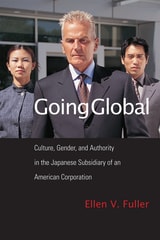
Going Global
Culture, Gender, and Authority in the Japanese Subsidiary of an American CorporationEllen V. Fuller
Temple University Press, 2009
In this intriguing ethnography, Ellen Fuller investigates how issues of gender and identity as they relate to authority are addressed in a globalizing corporate culture. Going Global goes behind the office politics, turf wars and day-to-day workings of a transnational American company in Japan in the late 1990s as employees try to establish a comfortable place within the company.
Fuller looks at how relationships among Asians and between Asians and Americans are tested as individuals are promoted to positions of power and authority. Is there pressure for the Japanese to be more “American” to get ahead in business? Do female employees have to subscribe to certain stereotypes to be promoted or respected? How these American and Japanese workers assess one another raises important questions about international business management and human resources.
Going North Thinking West
The Intersections of Social Class, Critical Thinking, and Politicized Writing InstructionIrvin Peckham
Utah State University Press, 2010
Going Public
Civic and Community EngagementHiram E. Fitzgerald
Michigan State University Press, 2013
The terms “civic engagement” and “community engagement” have various definitions, but they are united by the sense that individuals who are civically engaged not only are concerned about the quality of life in their communities but also take action to improve conditions for the common good. In the United States, to be civically engaged means to actively participate in a civil democratic society. Going Public examines programs related to civic engagement and the ways in which faculty and students participate in communities in order to improve them. Engagement scholarship is a scholarship of action, a scholarship of practice that takes place both in and with the community. Within the framework of this new scholarship, the mission of the academy does not begin and end with intellectual discovery and fact-finding. Rather, the academy joins forces with the community, and together they use their knowledge and resources to address pressing social, civic, economic, and moral problems. Each chapter in this book tells a unique story of community engagement and the scholarship of practice in a diverse range of settings, documenting successes and failures, the unintended consequences, and the questions yet to be answered.

Going Stealth
Transgender Politics and U.S. Surveillance PracticesToby Beauchamp
Duke University Press, 2018

Going Viral
Zombies, Viruses, and the End of the WorldSchweitzer, Dahlia
Rutgers University Press, 2018
In Going Viral, Dahlia Schweitzer probes outbreak narratives in film, television, and a variety of other media, putting them in conversation with rhetoric from government authorities and news organizations that have capitalized on public fears about our changing world. She identifies three distinct types of outbreak narrative, each corresponding to a specific contemporary anxiety: globalization, terrorism, and the end of civilization. Schweitzer considers how these fears, stoked by both fictional outbreak narratives and official sources, have influenced the ways Americans relate to their neighbors, perceive foreigners, and regard social institutions.
Looking at everything from I Am Legend to The X Files to World War Z, this book examines how outbreak narratives both excite and horrify us, conjuring our nightmares while letting us indulge in fantasies about fighting infected Others. Going Viral thus raises provocative questions about the cost of public paranoia and the power brokers who profit from it.
Supplemental Study Materials for "Going Viral": https://www.rutgersuniversitypress.org/going-viral-dahlia-schweitzer
Dahlia Schweitzer- Going Viral: https://www.youtube.com/watch?v=5xF0V7WL9ow

Going for Jazz
Musical Practices and American IdeologyNicholas Gebhardt
University of Chicago Press, 2001
Weaving together a range of seemingly disparate topics, from Frederick Jackson Turner's frontier thesis to the invention of bebop, from Jean Baudrillard's Seduction to the Cold War atomic regime, Gebhardt addresses the meaning and value of jazz in the political economy of American society. In Going for Jazz, jazz musicians assume dynamic and dramatic social positions that demand a more conspicuous place for music in our understanding of the social world.

Going to Court to Change Japan
Social Movements and the Law in Contemporary JapanPatricia G. Steinhoff, Editor
University of Michigan Press, 2014

Gold Dust on the Air
Television Anthology Drama and Midcentury American CultureMolly A. Schneider
University of Texas Press, 2024
2025 Broadcast Historian Award, Library of American Broadcasting Foundation
How mid-century television anthologies reflected and shaped US values and identities.
From the late 1940s to the early 1960s, anthology dramas presented “quality” television programming in weekly stand-alone television plays meant to entertain and provide cultural uplift to American society. Programs such as Playhouse 90, Studio One, and The Twilight Zone became important emblems of American creative potential on television. But their propensity for addressing matters of major social concern also meant that they often courted controversy. Although the anthology’s tenure would be brief, its importance in the television landscape would be great, and the ways the format negotiated ideas about “Americanness” at midcentury would be a crucial facet of its significance.
In Gold Dust on the Air, Molly Schneider traces a cultural history of the “Golden Age” anthology, addressing topics such as the format’s association with Method acting and debates about “authentic” American experience, its engagement with ideas about “conformity” in the context of Cold War pressures, and its depictions of war in a medium sponsored by defense contractors. Drawing on archival research, deep textual examination, and scholarship on both television history and broader American culture, Schneider posits the anthology series as a site of struggle over national meaning.

Golden and Blue Like My Heart
Masculinity, Youth, and Power Among Soccer Fans in Mexico CityRoger Magazine
University of Arizona Press, 2007
Roger Magazine takes readers inside Mexico’s soccer stadiums to explore young men’s participation in struggles over the future of that country’s urban society. His firsthand observations of the fan clubs—las porras—yield a unique inside look at confrontations in the stands over group organization, particularly at the emergence of rebel segments within the clubs. His study offers a close-up look at ground-level struggles over social organization in contemporary urban Mexico, showing how young male fans both blindly reproduce and consciously manipulate images of violence and disorder derived from national myths about typical urban Mexican men.
Golden and Blue Like My Heart offers a new way of understanding the dynamics of fandom while shedding new light on larger social processes and youth culture in Mexico. And with its insight into soccer culture, politico-economic transition, and masculinity, it has important and wide-reaching implications for all of Latin America.

Golf and the American Country Club
Richard J. Moss
University of Illinois Press, 2001
Often seen as anti-egalitarian and elitist, the country club has provoked strong responses since its initial appearance in the late 1800s. Golf, another elitist identifier, was commonly dismissed as a pseudo-sport or even unmanly. Where and how had the country club and the game of golf taken root in the United States? How had the manicured order of the golf course become a cultural site that elicited both strong loyalties and harsh criticism?
Richard J. Moss's cultural history explores the establishment of the country club as an American social institution and its inextricable connection to the ancient, imported game of golf. Moss traces the evolution of country clubs from informal groups of golf-playing friends to “country estates” in the suburbs and, eventually, into public and private daily fee courses, corporate country clubs, and gated golfing communities. As he shows, the development of these institutions reveals profound shifts in social dynamics, core American values, and attitudes toward health and sport.

Gone Goose
The Remaking of an American Town in the Age of Climate ChangeBraden T. Leap
Temple University Press, 2019
Sumner, MO, pop. 102, near the Swan Lake National Wildlife Refuge, proclaims itself “The Wild Goose Capital of the World.” It even displays Maxie, the World’s largest goose: a 40-foot tall fiberglass statue with a wingspan stretching more than 60 feet. But while the 200,000 Canada geese that spent their falls and winters at Swan Lake helped generate millions of dollars for the local economy—with hunting and the annual Goose Festival—climate change, as well as environmental and land use issues, have caused the birds to disappear. The economic loss of the geese and the activities they inspired served as key building blocks in the rural identities residents had developed and treasured.
In his timely and topical book, Gone Goose, Braden Leap observes how members of this rural town adapted, reorganized, and reinvented themselves in the wake of climate change—and how they continued to cultivate respect and belonging in their community. Leap conducted interviews with residents and participated in various community events to explore how they reimagine their relationships with each other as well as their community’s relationship with the environment, even as they wish the geese would return.

Good God but You Smart!
Language Prejudice and Upwardly Mobile CajunsNichole E. Stanford
Utah State University Press, 2016
The study investigates the complicated motivations and cultural concessions of upwardly mobile Cajuns who “choose” to self-censor—to speak Standardized English over the Cajun English that carries their cultural identity. Drawing on surveys of English teachers in four Louisiana colleges, previously unpublished archival data, and Pierre Bourdieu’s theory of the legitimate language, author Nichole Stanford explores how socioeconomic and political pressures rooted in language prejudice make code switching, or self-censoring in public, seem a responsible decision. Yet teaching students to skirt others’ prejudice toward certain dialects only puts off actually dealing with the prejudice. Focusing on what goes on outside classrooms, Stanford critiques code switching and cautions users of code meshing that pedagogical responses within the educational system are limited by the reproductive function of schools. Each theory section includes parallel memoir sections in the Cajun tradition of storytelling to open an experiential window to the study without technical language.
Through its explication of language legitimacy and its grounding in lived experience, Good God but You Smart! is an essential addition to the pedagogical canon of language minority studies like those of Villanueva, Gilyard, Smitherman, and Rose.
Good Maya Women
Migration and Revitalization of Clothing and Language in Highland Guatemalaby Joyce N. Bennett
University of Alabama Press, 2022
Good Maya Women: Migration and Revitalization of Clothing and Language in Highland Guatemala analyzes how Indigenous women’s migration contributes to women’s empowerment in their home communities in Guatemala. This decolonial ethnographic analysis of Kaqchikel Maya women’s linguistic and cultural activism demonstrates that marginalized people can and do experience empowerment and hope for the future of their communities, even while living under oppressive neoliberal regimes. Joyce N. Bennett contests dominant frameworks of affect theory holding that marginalized peoples never truly experience unrestricted hope or empowerment, and she contributes new understandings of the intimate connections between Indigenous women, migration, and language and clothing revitalization.
Based on more than twenty months of fieldwork, the study begins with an ethnographic investigation of how economic policies force Indigenous women into migration for wage work. To survive, many, like the three young women profiled in this ethnography, are forced to leave their schooling, families, and highland homes to work in cities or other countries. They might work, for example, as vendors, selling crafts to tourists, or as housekeepers or waitresses. Their work exposes them to structural violence, including anti-Indigenous slurs, sexual harassment and violence, and robbery.
Furthermore, the women are pressured to wear Western clothing and to speak Spanish, which endangers Indigenous culture and language in Guatemala. Yet the Indigenous migrant women profiled do not abandon their Indigenous clothing and language, in this case Kaqchikel Maya. Instead, they find inspiration and pride in revitalizing Kaqchikel traditions in their hometowns post-migration. As women attempt to revitalize Kaqchikel Maya language and clothing, they seek to earn the title of “good” women in their home communities.
Unpacking women’s daily activisms reveals that women attempt to retain their language and clothing and also collectively seek to make space for Indigenous people in the modern world. Bennett reveals that women find their attempts at revitalization to be personally empowering, even when their communities do not support them.

Good Vibes Only
Phenomenology and the Biopolitics of Algorithmic LegitimationRobin James
Duke University Press, 2026

Goodbye iSlave
A Manifesto for Digital AbolitionJack Linchuan Qiu
University of Illinois Press, 2016
Focusing on the alliance between Apple and the notorious Taiwanese manufacturer Foxconn, Jack Linchuan Qiu examines how corporations and governments everywhere collude to build systems of domination, exploitation, and alienation. His interviews, news analysis, and first-hand observation show the circumstances faced by Foxconn workers--circumstances with vivid parallels in the Atlantic slave trade. Ironically, the fanatic consumption of digital media also creates compulsive free labor that constitutes a form of bondage for the user. Arguing as a digital abolitionist, Qiu draws inspiration from transborder activist groups and incidents of grassroots resistance to make a passionate plea aimed at uniting--and liberating--the forgotten workers who make our twenty-first-century lives possible.
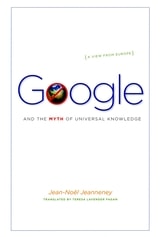
Google and the Myth of Universal Knowledge
A View from EuropeJean-Noël Jeanneney
University of Chicago Press, 2006
The recent announcement that Google will digitize the holdings of several major libraries sent shock waves through the book industry and academe. Google presented this digital repository as a first step towards a long-dreamed-of universal library, but skeptics were quick to raise a number of concerns about the potential for copyright infringement and unanticipated effects on the business of research and publishing.
Jean-Noël Jeanneney, president of France’s Bibliothèque Nationale, here takes aim at what he sees as a far more troubling aspect of Google’s Library Project: its potential to misrepresent—and even damage—the world’s cultural heritage. In this impassioned work, Jeanneney argues that Google’s unsystematic digitization of books from a few partner libraries and its reliance on works written mostly in English constitute acts of selection that can only extend the dominance of American culture abroad. This danger is made evident by a Google book search the author discusses here—one run on Hugo, Cervantes, Dante, and Goethe that resulted in just one non-English edition, and a German translation of Hugo at that. An archive that can so easily slight the masters of European literature—and whose development is driven by commercial interests—cannot provide the foundation for a universal library.
As a leading librarian, Jeanneney remains enthusiastic about the archival potential of the Web. But he argues that the short-term thinking characterized by Google’s digital repository must be countered by long-term planning on the part of cultural and governmental institutions worldwide—a serious effort to create a truly comprehensive library, one based on the politics of inclusion and multiculturalism.

Gossip, Markets, and Gender
How Dialogue Constructs Moral Value in Post-Socialist KilimanjaroTuulikki Pietilä
University of Wisconsin Press, 2007
"All traders are thieves, especially women traders," people often assured social anthropologist Tuulikki Pietilä during her field work in Kilimanjaro, Tanzania, in the mid-1990s. Equally common were stories about businessmen who had "bought a spirit" for their enrichment. Pietilä places these and similar comments in the context of the liberalization of the Tanzanian economy that began in the 1980s, when many men and women found themselves newly enmeshed in the burgeoning market economy. Even as emerging private markets strengthened the position of enterprising people, economic resources did not automatically lead to heightened social position. Instead, social recognition remained tied to a complex cultural negotiation through stories and gossip in markets, bars, and neighborhoods.
With its rich ethnographic detail, Gossip, Markets, and Gender shows how gossip and the responses to it form an ongoing dialogue through which the moral reputations of trading women and businessmen, and cultural ideas about moral value and gender, are constructed and rethought. By combining a sociolinguistic study of talk, storytelling, and conversation with analysis of gender, the political economy of trading, and the moral economy of personhood, Pietilä reveals a new perspective on the globalization of the market economy and its meaning and impact on the local level.
Winner, Aidoo-Snyder Prize, African Studies Association Women’s Caucus
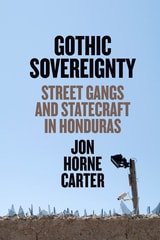
Gothic Sovereignty
Street Gangs and Statecraft in HondurasJon Horne Carter
University of Texas Press, 2022
Gang-related violence has forced thousands of Hondurans to flee their country, leaving behind everything as refugees and undocumented migrants abroad. To uncover how this happened, Jon Carter looks back to the mid-2000s, when neighborhood gangs were scrambling to survive state violence and mass incarceration, locating there a critique of neoliberal globalization and state corruption that foreshadows Honduras’s current crises.
Carter begins with the story of a thirteen-year-old gang member accused in the murder of an undercover DEA agent, asking how the nation’s seductive criminal underworld has transformed the lives of young people. He then widens the lens to describe a history of imperialism and corruption that shaped this underworld—from Cold War counterinsurgency to the “War on Drugs” to the near-impunity of white-collar crime—as he follows local gangs who embrace new trades in the illicit economy. Carter describes the gangs’ transformation from neighborhood groups to sprawling criminal societies, even in the National Penitentiary, where they have become political as much as criminal communities. Gothic Sovereignty reveals not only how the revolutionary potential of gangs was lost when they merged with powerful cartels but also how close analysis of criminal communities enables profound reflection on the economic, legal, and existential discontents of globalization in late liberal nation-states.

Governing Fortune
Casino Gambling in AmericaEdward A. Morse and Ernest P. Goss
University of Michigan Press, 2009
"Goss and Morse provide an outstandingly sound economic understanding of the function and place of casinos in American society, including essential heretofore unavailable grounding in the legal issues that the book accomplishes remarkably effectively. Moreover, this wealth of economic and legal information is transmitted in an engaging and readable manner. Scholarly, thoughtfully collected and authoritative, the book is of interest to any learner of the gambling industry, including students, civic activists, legislators, and scholars."
— Earl Grinols, Baylor University
"In this book, Morse and Goss make important contributions to our understanding of the negative outcomes of the expansion of gambling in America."
— Jon Bruning, Nebraska Attorney General
Edward A. Morse is Professor of Law and holder of the McGrath North Mullin & Kratz Endowed Chair in Business Law at Creighton University School of Law. Ernest P. Goss is Professor of Economics and MacAllister Chair at Creighton University and was a 2004 scholar-in-residence with the Congressional Budget Office.
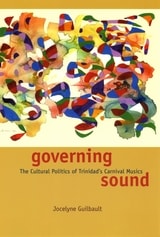
Governing Sound
The Cultural Politics of Trinidad's Carnival MusicsJocelyne Guilbault
University of Chicago Press, 2007
Calypso music is an integral part of Trinidad’s national identity. When, for instance, Franklin D. Roosevelt asked the great Trinidadian musician Roaring Lion where he was from, Lion famously replied “the land of calypso.” But in a nation as diverse as Trinidad, why is it that calypso has emerged as the emblematic music?
In Governing Sound, Jocelyne Guilbault examines the conditions that have enabled calypso to be valorized, contested, and targeted as a field of cultural politics in Trinidad. The prominence of calypso, Guilbault argues, is uniquely enmeshed in projects of governing and in competing imaginations of nation, race, and diaspora. During the colonial regime, the period of national independence, and recent decades of neoliberal transformation, calypso and its musical offshoots have enabled new cultural formations while simultaneously excluding specific social expressions, political articulations, and artistic traditions. Drawing on over a decade of ethnographic work, Guilbault maps the musical journeys of Trinidad’s most prominent musicians and arrangers and explains the distinct ways their musical sensibilities became audibly entangled with modes of governing, audience demands, and market incentives.
Generously illustrated and complete with an accompanying CD, Governing Sound constitutes the most comprehensive study to date of Trinidad’s carnival musics.
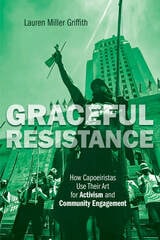
Graceful Resistance
How Capoeiristas Use Their Art for Activism and Community EngagementLauren Miller Griffith
University of Illinois Press, 2023
Capoeira began as a martial art developed by enslaved Afro-Brazilians. Today, the practice incorporates song, dance, acrobatics, and theatrical improvisation—and leads many participants into activism.
Lauren Miller Griffith’s extensive participant observation with multiple capoeira groups informs her ethnography of capoeiristas--both individuals and groups--in the United States. Griffith follows practitioners beyond their physical training into social justice activities that illuminate capoeira’s strong connection to resistance and subversion. As both individuals and communities of capoeiristas, participants march against racial discrimination, celebrate Martin Luther King Jr. Day and Juneteenth, organize professional clothing drives for job seekers, and pursue economic and environmental justice in their neighborhoods. For these people, capoeira becomes a type of serious leisure that contributes to personal growth, a sense of belonging, and an overall sense of self, while also imposing duties and obligations.
An innovative look at capoeira in America, Graceful Resistance reveals how the practicing of an art can catalyze action and transform communities.
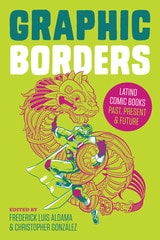
Graphic Borders
Latino Comic Books Past, Present, and FutureEdited by Frederick Luis Aldama and Christopher González
University of Texas Press, 2016
From the influential work of Los Bros Hernandez in Love & Rockets, to comic strips and political cartoons, to traditional superheroes made nontraditional by means of racial and sexual identity (e.g., Miles Morales/Spider-Man), comics have become a vibrant medium to express Latino identity and culture. Indeed, Latino fiction and nonfiction narratives are rapidly proliferating in graphic media as diverse and varied in form and content as is the whole of Latino culture today.
Graphic Borders presents the most thorough exploration of comics by and about Latinos currently available. Thirteen essays and one interview by eminent and rising scholars of comics bring to life this exciting graphic genre that conveys the distinctive and wide-ranging experiences of Latinos in the United States. The contributors’ exhilarating excavations delve into the following areas: comics created by Latinos that push the boundaries of generic conventions; Latino comic book author-artists who complicate issues of race and gender through their careful reconfigurations of the body; comic strips; Latino superheroes in mainstream comics; and the complex ways that Latino superheroes are created and consumed within larger popular cultural trends. Taken as a whole, the book unveils the resplendent riches of comics by and about Latinos and proves that there are no limits to the ways in which Latinos can be represented and imagined in the world of comics.

Grassroots Activisms
Public Rhetorics in Localized ContextsEdited by Lisa L. Phillips, Sarah Warren-Riley, and Julie Collins Bates
The Ohio State University Press, 2024
What is the nature of grassroots activism? How and why do individuals get involved or attempt to make change for themselves, others, or their own communities? What motivates activists to maintain momentum when their efforts to redress injustices or paths toward change seem difficult or personally risky to navigate? These questions and more are addressed in Grassroots Activisms: Public Rhetorics in Localized Contexts. Featuring a diverse array of both local activist profiles and original scholarly essays, the collection amplifies and analyzes the tactics of grassroots activists working locally to intervene in a variety of social injustices—from copwatching and policy reform to Indigenous resistance against land colonization to #RageAgainstRape.
Attuned to the demanding—and often underappreciated—work of grassroots activism, this book interrogates how such efforts unfold within and against existing historical, cultural, social, and political realities of local communities; are informed by the potentials and constraints of coalition-building; and ultimately shape different facets of society at the local level. This collection acknowledges and celebrates the complexity of grassroots activist work, showing how these less-recognized efforts often effect change where institutions have failed.
Grassroots Engagement and Social Justice through Cooperative Extension
Nia Imani Fields
Michigan State University Press, 2022