244 books match the query 'Arkansas' and 7 start with h

cover of Hangin' Times in Fort Smith: A History of Executions in Judge Parker’s Court

Hangin' Times in Fort Smith

A History of Executions in Judge Parker’s Court

Jerry Akins

Butler Center for Arkansas Studies, 2012
For twenty-one years, Judge Isaac C. Parker ruled in the federal court at Fort Smith, Arkansas, the gateway to the wild and lawless Western frontier. Parker, however, was not the "hangin' judge" that casual legend portrays. In most cases, the guilt or innocence of those tried in his court really was not in question once their stories were told. These horrible crimes would have screamed out for justice in any circumstance. Author Jerry Akins has finally arrived at the real story about Parker and his court by comparing newspaper accounts of the trials and executions to what has been written and popularized in other books.
[more]
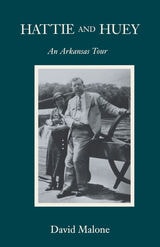
cover of Hattie and Huey: An Arkansas Tour

Hattie and Huey

An Arkansas Tour

David Malone

University of Arkansas Press, 1990
During the first eight scorching days of August in 1932, U.S. Senator Huey P. Long of Louisiana campaigned in Arkansas for the election of Hattie Caraway to the U.S. Senate. Caraway easily defeated six well-known opponents in a race she was not expected to win and became the first woman to be elected to the U.S. Senate. This volume is a textbook of politics and a sweeping picture of the Great Depression, as if those perilous times had been compressed into a week and a day. It is a fascinating look at two extremely different people caught briefly in a common purpose.
[more]
cover of Hipbillies: Deep Revolution in the Arkansas Ozarks

Hipbillies

Deep Revolution in the Arkansas Ozarks

Jared M. Phillips

University of Arkansas Press, 2019

Counterculture flourished nationwide in the 1960s and 1970s, and while the hippies of Haight–Ashbury occupied the public eye, a faction of back to the landers were quietly creating their own haven off the beaten path in the Arkansas Ozarks. In Hipbillies, Jared Phillips combines oral histories and archival resources to weave the story of the Ozarks and its population of country beatniks into the national narrative, showing how the back to the landers engaged in “deep revolution” by sharing their ideas on rural development, small farm economy, and education with the locals—and how they became a fascinating part of a traditional region’s coming to terms with the modern world in the process.
[more]
cover of Homefront Arkansas: Arkansans Face Wartime Past and Present

Homefront Arkansas

Arkansans Face Wartime Past and Present

Velma B. Branscum Woody

Butler Center for Arkansas Studies, 2009
For almost two hundred years, Arkansans have been part of America’s struggle to maintain democracy and keep the peace at home and around the globe. Homefront Arkansas: Arkansans Face Wartime Past and Present shows how war has affected those at home as well as those who served as soldiers. The chapters include: * A wounded Civil War soldier stumbles onto a homestead after a battle at Poison Springs, Arkansas, forever changing the family there * In 1875, Arkansans take sides in the Brooks-Baxter War, involving two men each claiming to be the governor of Arkansas * Arkansas volunteers follow Teddy Roosevelt into the Spanish-American War, and find troops crowded into a filthy camp as they wait to be shipped out * An African American girl leaves her native state to escape persecution, only to find that a world war is threatening to envelop her new home in England Woody’s stories provide a factual and compelling backdrop for Arkansas’s history as seen through its conflicts. Fascinated readers will follow the chronology of Arkansans who met the nation’s call both at home and abroad.
[more]
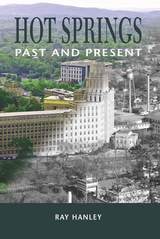
cover of Hot Springs: Past and Present

Hot Springs

Past and Present

Ray Hanley

University of Arkansas Press, 2014
A century ago Hot Springs, Arkansas, was a world-renown resort city. Today, the town remains the most unique city in Arkansas but with much of its Victorian-to-1950s views nearly unrecognizable. Hot Springs: Past and Present shows vividly the before and after of hundreds of sites, answering questions such as “What used to be on this corner?” and “What was here before it was a parking lot?” The answer to those questions is often an opulent hotel, a theater, a bathhouse, a gambling house, or a mansion. Fire destroyed many buildings, even more were demolished, and some sites remain not so unlike they used to be. Hot Springs: Past and Present makes a perfect walking companion for anyone visiting the town and wishing to learn more about this one-of-a-kind place through not only the photographs but also the informative text that provides a good overview of the town’s history.
[more]
cover of House of Mourning: A Biocultural History of the Mountain Meadows Massacre

House of Mourning

A Biocultural History of the Mountain Meadows Massacre

Shannon A Novak

University of Utah Press, 2008

On September 11, 1857, some 120 men, women, and children from the Arkansas hills were murdered in the remote desert valley of Mountain Meadows, Utah. This notorious massacre was, in fact, a mass execution: having surrendered their weapons, the victims were bludgeoned to death or shot at point-blank range. The perpetrators were local Mormon militiamen whose motives have been fiercely debated for 150 years.

In House of Mourning, Shannon A. Novak goes beyond the question of motive to the question of loss. Who were the victims at Mountain Meadows? How had they settled and raised their families in the American South, and why were they moving west once again? What were they hoping to find or make for themselves at the end of the trail? By integrating archival records and oral histories with the first analysis of skeletal remains from the massacre site, Novak offers a detailed and sensitive portrait of the victims as individuals, family members, cultural beings, and living bodies.

The history of the massacre has often been treated as a morality tale whose chief purpose was to vilify (or to glorify) some collective body. Resisting this tendency to oversimplify the past, Novak explores Mountain Meadows as a busy and dangerous intersection of cultural and material forces in antebellum America. House of Mourning is a bold experiment in a new kind of history, the biocultural analysis of complex events.

Winner of the Society for Historical Archaeology James Deetz Book Award. 

 

[more]
cover of Hunting Arkansas: The Sportsman's Guide to Natural State Game

Hunting Arkansas

The Sportsman's Guide to Natural State Game

Keith B. Sutton

University of Arkansas Press, 2002

Reading Hunting Arkansas is like walking alongside acclaimed Arkansas outdoorsman and writer Keith Sutton as he searches for the elusive woodcock in bottomland timber near the L'Anguille River, stalks deer across farmland, or treks through woodlands hunting black bears. Sutton weaves hunting know-how with personal stories and histories of various regions to produce this book telling you when, where, why and how to hunt in the Natural State.
[more]