Results by title
167 books match the query 'Artists, Architects, Photographers' and 5 start with h
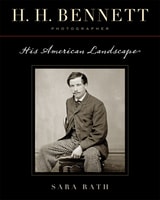
H. H. Bennett, Photographer
His American LandscapeSara Rath
University of Wisconsin Press, 2010
"My energies for near a lifetime have been used almost entirely to win such prominence as I could in outdoor photography."—H. H. Bennett
Henry Hamilton Bennett (1843–1908) became a celebrated photographer in the half-century following the American Civil War. Bennett is admired for his superb depictions of dramatic landscapes of the Dells of the Wisconsin River and also for his many technical innovations in photography, including a stop-action shutter and a revolving solar printing house that is now housed at the Smithsonian Institution. With his instantaneous shutter, he gained recognition for his striking images of moving subjects, such as lumber raftsmen shooting the river rapids and his son Ashley leaping in midair from a bluff to the craggy pillar of Stand Rock. Less well-known are Bennett’s splendid urban photographs of nineteenth-century Chicago, Milwaukee, and St. Paul.
This engaging biography of H. H. Bennett tells his life story, illustrated throughout with his remarkable photographs, some of them rarely viewed before. It draws on the photographer’s own letters and journals, along with other family documents, to portray the sweep of his career and personal life. An important figure in the history of photography, he also contributed to the growth of American tourism: his nationally distributed stereoscopic views of Dells rock formations and his portraits of local Ho-Chunk Indians played a significant role in creating the Wisconsin Dells as the popular tourist destination it is today. Despite personal challenges—a crippling Civil War injury, the death of his first wife, and continual financial worries—Bennett produced an extensive portfolio that captures the midwestern culture of his time. He accepted commissions in the 1890s to document Chicago’s modern skyscrapers, grand residences of Milwaukee’s entrepreneurs and sailing ships in its harbor, enormous scenic panoramas along the routes of Wisconsin railroads, and sparkling ice palaces lit by fireworks at the St. Paul Winter Carnival.
Finalist, Midwest Regional Interest, Midwest Book Awards
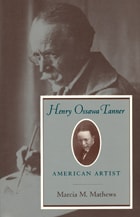
Henry Ossawa Tanner
American ArtistMarcia M. Mathews
University of Chicago Press, 1995
"[Tanner] ranks not only as the first truly distinguished Negro American artist but as one of America's first outstanding successes in the salons of Europe. In this work [Mathews] has significantly added to our knowledge of the history of American art."—John Hope Franklin, from the Foreword
"The book gives the main facts of Tanner's life and successfully places his artistic work in its historic context....It is a welcome and useful volume."—August Meier, Journal of American History
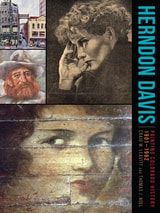
Herndon Davis
Painting Colorado History, 1901–1962Craig Leavitt
University Press of Colorado, 2016
Herndon Davis, an artist and journalist, dedicated his life to depicting the major landmarks and personalities of Colorado in watercolor, oil, and pen and pencil. Best known for the Face on the Barroom Floor, the portrait of an alluring woman on the floor of the Teller House Hotel barroom in Central City, Colorado, Davis was a prolific artist whose murals, sketches, and portraits can be found all over the state, from the Sage Room of the Oxford Hotel on Seventeenth Street to the Denver Press Club poker room. Despite his numerous contributions, his work was never showcased or exhibited in the traditional manner.
In this biography and first-ever collection featuring most of his life’s work, authors Craig Leavitt and Thomas J. Noel provide a detailed look into Davis’s life and career and include a catalog of almost 200 of his paintings and drawings from Colorado and around the country. They also put his work into the broader context of the time through comparison with such contemporary Colorado artists as Muriel Sibell Wolle, Allen Tupper True, Charles Waldo Love, and Juan Menchaca.
Published to coincide with the Denver Public Library’s 2016 exhibition—the only public display of Davis’s work to date—and bringing deserved attention to this overlooked figure, Herndon Davis: Painting Colorado History, 1901-1962 is an important contribution to Colorado’s cultural history.
This book and the accompanying exhibit are sponsored by the Western History/Genealogy Department at the Denver Public Library.
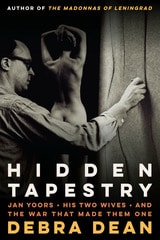
Hidden Tapestry
Jan Yoors, His Two Wives, and the War That Made Them OneDebra Dean
Northwestern University Press, 2018
Hidden Tapestry reveals the unforgettable story of Flemish American artist Jan Yoors—childhood vagabond, wartime Resistance fighter, and polyamorous New York bohemian. At the peak of his fame in the 1970s, Yoors’s photographs and vast tapestries inspired a dedicated following in his adopted Manhattan and earned him international acclaim. Though his intimate friends guessed the rough outline of his colorful life, Hidden Tapestry is first to detail his astonishing secrets.
At twelve, Jan’s life took an extraordinary and unexpected turn when, lured by stories of Gypsies, he wandered off with a group of Roma and continued to live on-and-off with them and with his own family for several years. As an adult in German-occupied France, Yoors joined the Resistance and persuaded his adoptive Roma family to fight alongside him. Defying repeated arrests and torture by the Gestapo, he worked first as a saboteur and later escorted Allied soldiers trapped behind German lines across the Pyrenees to freedom.
After the war, he married childhood friend Annabert van Wettum and embarked on his career as an artist. When a friend of Annabert’s, Marianne Citroen, modeled for Yoors, the two began an affair, which led the three to form a polyamorous family that would last for the rest of their lives. Moving to New York, the trio became part of the bohemian life of Greenwich Village in the 1950s.
Told in arresting detail by Debra Dean, best-selling author of The Madonnas of Leningrad, Yoors’s story is a luminous and inspiring account of resilience, resourcefulness, and love.
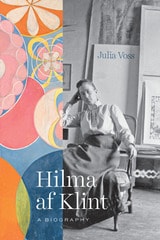
Hilma af Klint
A BiographyJulia Voss
University of Chicago Press, 2022
The Swedish painter Hilma af Klint (1862–1944) was forty-four years old when she broke with the academic tradition in which she had been trained to produce a body of radical, abstract works the likes of which had never been seen before. Today, it is widely accepted that af Klint was one of the earliest abstract academic painters in Europe.
But this is only part of her story. Not only was she a working female artist, she was also an avowed clairvoyant and mystic. Like many of the artists at the turn of the twentieth century who developed some version of abstract painting, af Klint studied Theosophy, which holds that science, art, and religion are all reflections of an underlying life-form that can be harnessed through meditation, study, and experimentation. Well before Kandinsky, Mondrian, and Malevich declared themselves the inventors of abstraction, af Klint was working in a nonrepresentational mode, producing a powerful visual language that continues to speak to audiences today. The exhibition of her work in 2018 at the Guggenheim Museum in New York City attracted more than 600,000 visitors, making it the most-attended show in the history of the institution.
Despite her enormous popularity, there has not yet been a biography of af Klint—until now. Inspired by her first encounter with the artist’s work in 2008, Julia Voss set out to learn Swedish and research af Klint’s life—not only who the artist was but what drove and inspired her. The result is a fascinating biography of an artist who is as great as she is enigmatic.